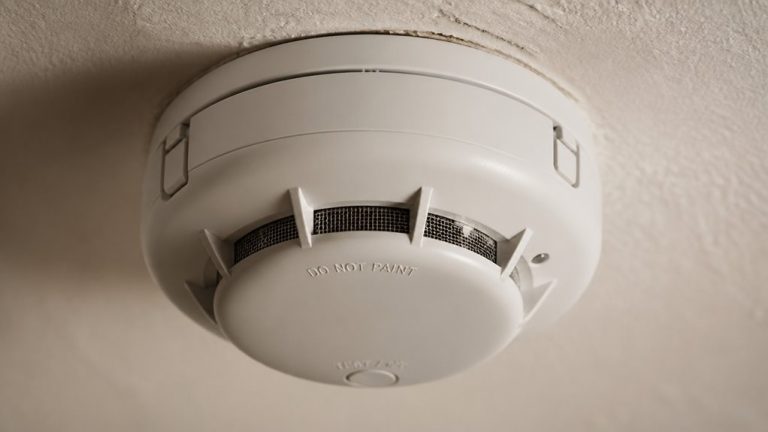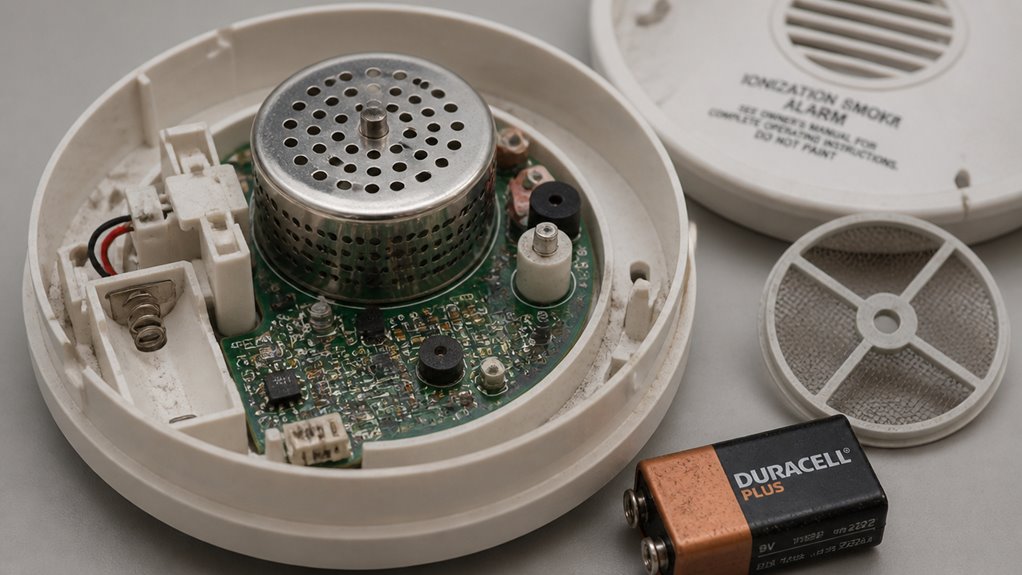

Inside your smoke detector, you’ll find a fire-resistant PVC casing housing a printed circuit board with capacitors and resistors for electrical control.
It contains precise sensors, either ionization chambers with tiny amounts of americium-241 that detect fast flaming fires via ion flow disruption or photoelectric sensors that use angled light scattering to spot smoldering smoke.
A 9-volt battery or house current powers the system, which triggers a piercing 90-decibel alarm.
Understanding these components reveals how it reliably protects you.
Key Takeaways
- Inside a smoke detector is a printed circuit board with capacitors, resistors, and diodes for electrical regulation and signal processing.
- Ionization models contain an ionization chamber with americium-241 foil emitting alpha particles to detect smoke via disrupted ion flow.
- Photoelectric detectors have an optical chamber where a light source and sensor detect smoke by scattered light at a 90-degree angle.
- A fire-resistant PVC casing encloses internal components, providing heat resistance, structural integrity, and electrical insulation.
- The alarm siren produces a loud 90-decibel sound triggered by sensor signals when smoke is detected.
Core Components of Smoke Detectors
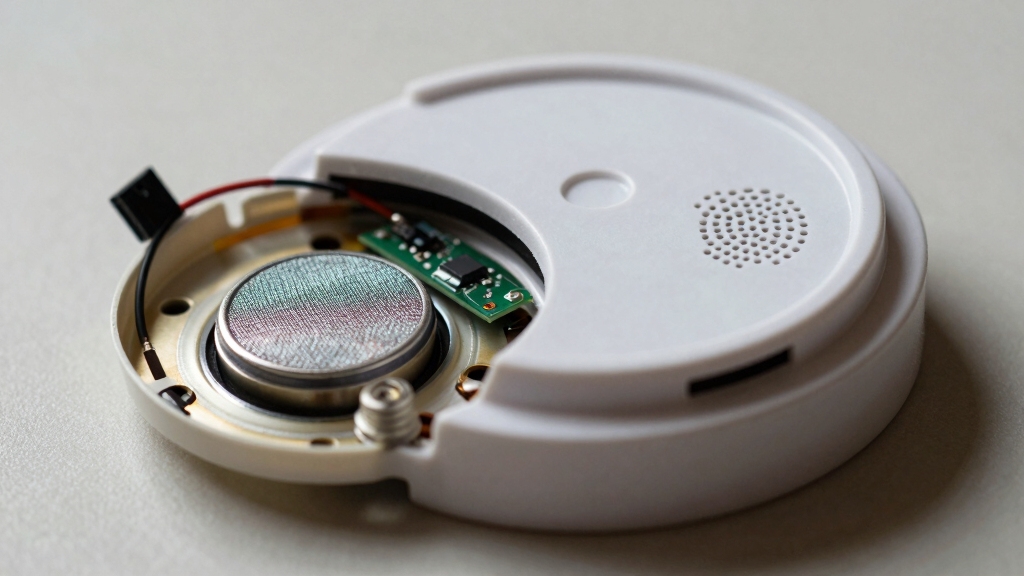
A smoke detector’s core components work together to guarantee reliable fire detection and alarm activation.
Inside, you’ll find a printed circuit board housing capacitors, diodes, and resistors that regulate electrical flow and signal processing.
The power source, often a 9-volt battery or direct 120-volt house current, guarantees continuous operation.
You’ll notice the alarm siren, capable of producing approximately 90 decibels, designed to alert occupants effectively.
The entire assembly is encased within a fire-resistant polyvinyl chloride (PVC) shell, providing durability and safety.
Strategically positioned within are either an ionization chamber or photoelectric sensor, placed at precise 90-degree angles for peak smoke detection.
Each element integrates seamlessly, balancing electrical stability, sensor accuracy, and acoustic output to maintain dependable performance under diverse conditions.
Many models also include a battery backup system to ensure continuous functionality during power outages.
Detection Mechanisms: Ionization and Photoelectric Sensors
Inside a smoke detector, there are two main types of detection mechanisms: ionization and photoelectric sensors.
So, here’s how they work: ionization sensors keep an eye on changes in an ionized air current when smoke particles enter the mix.
On the other hand, photoelectric sensors are all about light—they detect the scattering of light caused by smoke.
Knowing the differences between these two can really help you understand how each sensor works to target specific types of fires.
This way, you can be better prepared for timely alerts.
Photoelectric sensors are especially effective at providing early warnings for smoldering fires due to their sensitivity to larger smoke particles.
Ionization Sensor Functionality
Detecting smoke efficiently hinges on two primary sensor types: ionization and photoelectric.
With ionization sensors, you rely on a tiny americium-241 foil that emits alpha particles, ionizing air between two charged silver plates. This ionized air creates a steady current.
When smoke enters, it absorbs ions, reducing the current. Your detector senses this drop and triggers the alarm.
| Component | Function |
|---|---|
| Americium-241 foil | Emits alpha particles to ionize air |
| Silver plates (±) | Create an ionization chamber |
| Ionized air current | Maintains steady current between plates |
| Current drop detection | Activates alarm when smoke disrupts ions |
This mechanism guarantees rapid response to flaming fires by detecting changes in ion flow. The radioactive source is securely sealed inside the detector to prevent any radiation exposure during normal use.
Photoelectric Sensor Operation
While ionization sensors excel at identifying flaming fires by monitoring ion flow disruptions, photoelectric sensors target a different smoke detection principle. They use a light source aimed at a sensor positioned at a 90-degree angle inside the detector.
When smoke particles enter the chamber, they scatter the light beam onto the optical sensor, triggering the alarm. This design allows the sensor to detect smoldering fires, which produce larger smoke particles that effectively scatter light.
Unlike ionization detectors, photoelectric sensors don’t rely on radioactive materials, enhancing safety and regulatory acceptance. The precise positioning of the light source and sensor guarantees peak light scattering detection, enabling early warning.
This mechanism is especially sensitive to slow, smoldering combustion typical in household fires, providing critical time to react. Additionally, many hardwired smoke detectors incorporate battery backups to ensure continuous operation even during power outages.
Smoke Detection Differences
Although both ionization and photoelectric sensors serve the purpose of smoke detection, they operate on fundamentally different principles that affect their sensitivity to various fire types.
Ionization sensors detect changes in ionized air current caused by smoke particles. They respond quickly to flaming fires.
Photoelectric sensors rely on light scattering to detect smoke, excelling in identifying smoldering fires. Understanding these differences helps you select the right detector for specific environments.
Photoelectric technology offers detection speed more than 25% faster than average alarms, providing earlier warnings in smoldering fire scenarios.
| Feature | Ionization Sensor | Photoelectric Sensor |
|---|---|---|
| Detection Principle | Ionized air current disruption | Light scattering by smoke particles |
| Fire Type Sensitivity | Fast response to flaming fires | Effective for smoldering fires |
| Radioactive Material | Contains Americium-241 | None |
Electrical Wiring and Power Sources in Smoke Detectors
Within a smoke detector, electrical wiring guarantees reliable power delivery and seamless communication between components.
You’ll find a brown wire carrying live current to the first connector block, while a gray wire serves as the neutral connection, ensuring consistent circuit completion.
The earth wire, shielded by green and yellow sleeving, maintains grounding for safety. For inter-device communication, a black wire links with a white wire, enabling synchronized alarm activation across multiple units.
The detector typically draws power from a 120-volt house current, routed through a miniature circuit breaker (MCB) or residual current circuit breaker with overload protection (RCBO) for fault safety.
Additionally, most models include a 9-volt battery backup to maintain functionality during power outages. This ensures continuous monitoring and timely alerts regardless of mains supply status.
To ensure reliable operation, it is important to regularly test the unit using the Test or Hush button to confirm both battery and circuitry functionality.
Materials and Safety Features of Smoke Detectors
You know, the casing of a smoke detector is actually made from fire-resistant polyvinyl chloride (PVC). This stuff is designed to last, even when temperatures get really high. Pretty cool, right?
Now, if we talk about ionization models for a minute, they use a small amount of radioactive material called americium-241. But don’t worry—it’s only in microgram quantities and is securely layered to keep exposure risks super low. So, while these materials are chosen to ensure effective smoke detection, they also meet some pretty strict safety standards. Safety first!
Most smoke detectors require a consistent power source to operate, which can be provided by batteries or hardwired connections.
Fire-Resistant Casing
Durability plays a vital role in the effectiveness of smoke detectors, especially when it comes to their fire-resistant casing.
The casing is typically made from polyvinyl chloride (PVC), chosen for its high resistance to heat and flame. This material protects internal components from external fires, guaranteeing the detector remains functional during critical early fire stages.
The PVC casing also provides structural integrity, preventing deformation or melting that could expose sensitive electronics. Its insulating properties minimize electrical hazards, maintaining safe operation even under elevated temperatures.
By using fire-resistant materials, manufacturers guarantee the detector’s electronic circuitry, including the printed circuit board and sensors, stays intact and operational.
This design consideration markedly enhances the reliability and longevity of the smoke detector in real-world fire scenarios. Additionally, the casing design supports the device’s low standby current by protecting critical power management components from damage.
Radioactive Material Safety
While the fire-resistant PVC casing safeguards the detector’s electronics from external hazards, the internal use of radioactive material demands careful safety considerations.
You’ll find less than one microgram of americium-241 oxide inside, emitting alpha particles that ionize air without penetrating the casing. This quantity poses minimal risk, as alpha particles can’t pass through the plastic or skin.
| Material | Quantity | Safety Feature |
|---|---|---|
| Americium-241 | < 1 microgram | Alpha particles blocked by casing |
| Gold foil | Thin layer | Chemical stability |
| Silver plates | Charged electrodes | Electron movement control |
| PVC casing | Durable | Fire-resistant, blocks radiation |
The use of hardwired detectors like these is preferred in home automation systems for their continuous monitoring and reliable emergency alerts.
You must handle detectors carefully. The design guarantees safe operation in homes.
Smoke Detector Response to Flaming and Smoldering Fires
Smoke detectors typically respond differently depending on the fire type. Ionization detectors activate more rapidly during flaming fires due to their sensitivity to the rapid decrease in ionized air current.
When flames produce small combustion particles, these particles disrupt the ion flow between charged silver plates. This disruption causes the detector’s electronic circuit to trigger the alarm swiftly.
Conversely, photoelectric detectors excel in identifying smoldering fires by detecting light scattered by larger smoke particles inside their optical chamber. This scattering causes a significant change in sensor readings, prompting alarm activation.
Understanding this distinction helps you select detectors based on fire risk profiles. Use ionization for fast, flaming fires and photoelectric for slow, smoldering fires.
Both systems maintain precise thresholds calibrated to balance early warning with minimizing false alarms.
However, standard detectors are generally less sensitive to cigarette smoke due to the smaller particle size and lower concentration compared to fire smoke, which limits their reliability in detecting cigarette smoke.
How Smoke Detectors Alert You: Alarm Systems and Sound Levels?
Typically, smoke detectors alert you through a powerful alarm siren designed to produce around 90 decibels of sound. This guarantees it can rouse individuals even from deep slumber.
Smoke detectors use a loud 90-decibel alarm to wake even the deepest sleepers.
This sound level is carefully calibrated to penetrate ambient noise and trigger a rapid response. The alarm system engages when either the ionization or photoelectric sensor detects smoke, disrupting electrical current or light scattering patterns.
Here’s how the alert mechanism works:
- Smoke particles alter ion flow or scatter light, signaling smoke presence.
- The detector’s circuitry senses this change and activates the electronic horn.
- The alarm emits a loud, piercing sound at approximately 90 decibels.
- This volume level guarantees wakefulness, even in heavy sleepers and noisy environments.
You rely on this precise, consistent alert to protect lives effectively.
Frequently Asked Questions
How Often Should Smoke Detector Batteries Be Replaced?
You should replace smoke detector batteries at least once every 12 months to guarantee reliable operation.
Some models use sealed lithium batteries lasting up to 10 years, but for standard 9-volt or AA batteries, annual replacement is critical.
Additionally, test your smoke detector monthly to verify battery functionality. If the detector emits a low-battery warning chirp, replace the battery immediately to maintain peak safety and early fire detection.
Can Smoke Detectors Be Interconnected Wirelessly?
Yes, you can interconnect smoke detectors wirelessly, so you don’t need complex wiring throughout your home.
Wireless units communicate via radio frequency signals, instantly triggering alarms simultaneously when one detects smoke.
This setup simplifies installation, especially in older buildings without pre-existing wiring.
However, you must make certain all detectors operate on compatible frequencies and have reliable battery power to maintain seamless communication and prompt alerts during emergencies.
What Is the Average Lifespan of a Smoke Detector?
You can expect your smoke detector to last about 8 to 10 years on average.
Over time, the sensors degrade, and the device becomes less reliable at detecting smoke particles or ionization changes.
Manufacturers recommend replacing the entire unit once it reaches this age to maintain peak performance and safety.
Regular testing and battery changes don’t extend its lifespan, so timely replacement is essential to guarantee continuous protection.
Are Smoke Detectors Affected by Humidity or Dust?
Think of humidity and dust as tiny saboteurs that can cloud your smoke detector’s senses.
Yes, they can interfere with its delicate ionization or photoelectric mechanisms by causing false alarms or reducing sensitivity.
Moisture can corrode electrical contacts, while dust can block sensors or mimic smoke particles.
To keep your detector performing at its best, regularly clean it and make certain it’s installed in low-humidity, dust-free areas to avoid these invisible disruptors.
How Do Smoke Detectors Perform During Power Outages?
During power outages, your smoke detector relies on its backup battery, usually a 9-volt battery, to maintain functionality.
This guarantees continuous operation even when mains power fails.
You should regularly test and replace the battery to avoid detector failure.
Modern detectors switch seamlessly to battery power, preserving their alarm capabilities and assuring early fire warning regardless of external power conditions.
Neglecting battery maintenance compromises your safety during outages.
What the Inside of a Smoke Detector Teaches About Safety
Inside a smoke detector, you find a compact world of precision. Tiny sensors and circuits work silently, contrasting sharply with the loud alarm meant to jolt you awake.
While the ionization and photoelectric components quietly analyze airborne particles, the power source guarantees constant vigilance.
This blend of delicate technology and robust alert systems highlights how intricate engineering quietly stands guard.
It is ready to transform subtle smoke signals into urgent warnings, safeguarding you from unseen dangers.