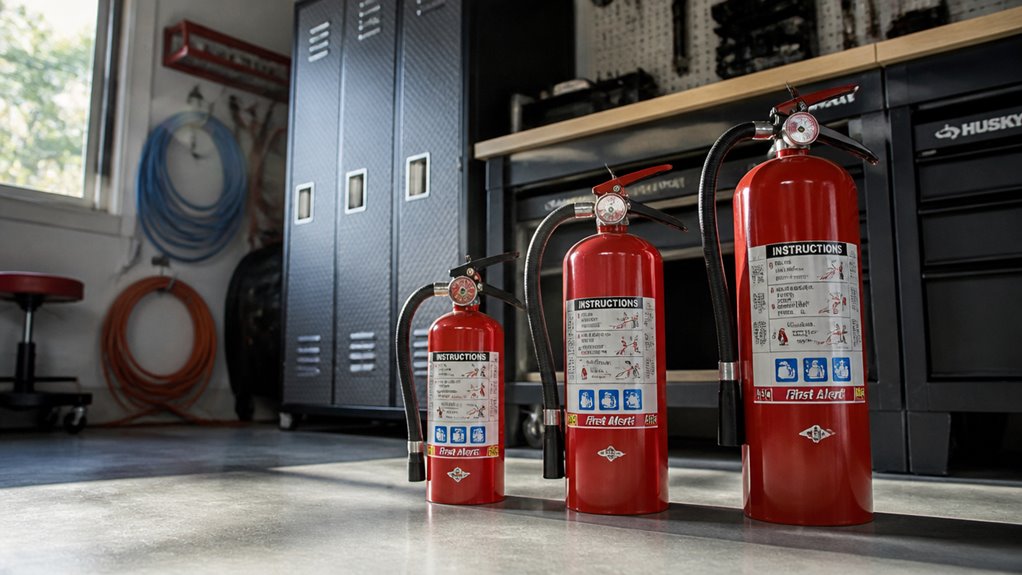

You need enough fire extinguishers to cover your building’s specific fire hazard class and layout, ensuring every area lies within the maximum travel distance, like 75 feet for Class A or 30 feet for Class K.
Start by identifying hazards, then place units near exits and along common routes, avoiding obstructions. For larger or complex spaces, add more extinguishers to maintain accessibility and meet code requirements.
Keep your setup tailored and compliant to protect your space effectively; more details explain how.
Key Takeaways
- Determine the fire hazard class of each area to select appropriate extinguisher types and ratings.
- Calculate extinguisher quantity using maximum travel distances, not just floor area measurements.
- For Class A hazards, typically provide one 2-A extinguisher per 3,000 square feet with additional units for complex layouts.
- Position extinguishers near exits, corridors, and along normal travel paths to ensure accessibility within allowed travel distances.
- Regularly inspect and maintain extinguishers to comply with safety codes and ensure readiness.
How to Determine Your Fire Hazard Class?
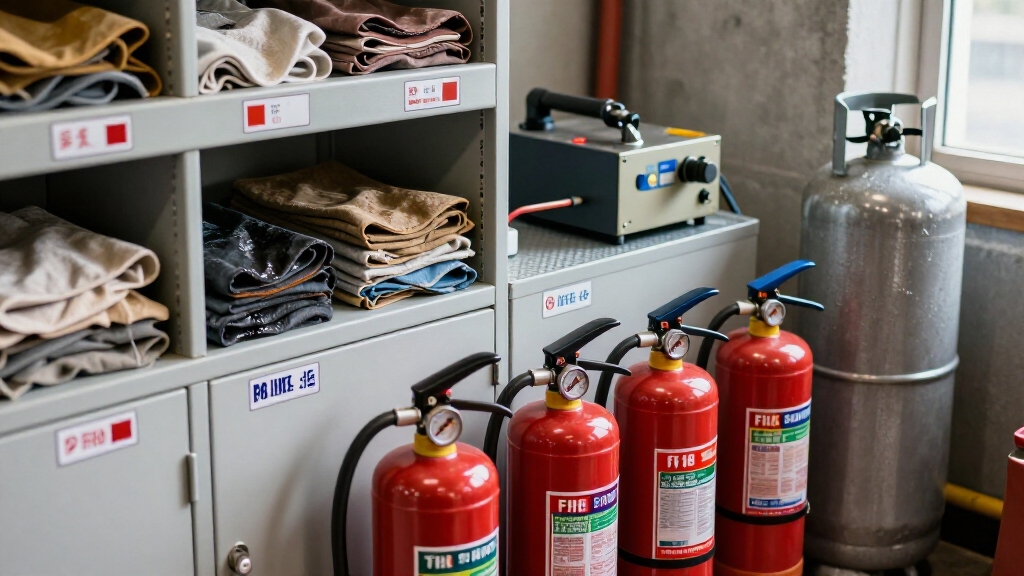
Before you can figure out how many fire extinguishers you need, you must determine the fire hazard class for each area in your building.
Fire hazards fall into classes A, B, C, D, and K, based on the type of combustible material present. Class A covers ordinary combustibles like wood or paper.
Class B involves flammable liquids and gases. Class C represents energized electrical equipment. Class D applies to combustible metals, and Class K targets cooking oils and fats.
You’ll need to evaluate each space individually, identifying the predominant fire risk. This classification dictates the extinguisher type and placement.
Accurately assigning hazard classes is essential since it directly affects extinguisher quantity, spacing, and compliance with safety standards.
Don’t guess; use clear criteria to classify hazards before moving forward.
For effective fire safety, ensure that fire extinguishers are regularly inspected and maintained by certified technicians to guarantee proper functionality.
How Building Types Affect Fire Extinguisher Needs?
When evaluating your fire extinguisher needs, consider how your building type directly influences the hazard classification and extinguisher requirements.
For example, offices and classrooms typically fall under light hazard Class A, needing fewer extinguishers spaced by 75-foot travel distances.
In contrast, workshops, garages, or warehouses often present Class B or higher hazards, requiring extinguishers with shorter spacing and sometimes different types.
Commercial kitchens demand Class K extinguishers placed closer together due to cooking fire risks.
Combustible metal storage calls for specialized Class D units.
Mixed-use buildings, with varied hazards, require multiple extinguisher types and more strategic placement per floor.
Understanding your building’s function helps you select the correct extinguisher class and quantity, ensuring full coverage and compliance with safety codes.
It is also important to conduct a thorough fire risk assessment to determine the appropriate extinguisher quantity and placement for your specific premises.
Understanding Travel Distance Limits for Fire Extinguisher Placement
When it comes to placing fire extinguishers, it’s really important to keep some maximum travel distances in mind.
For example, if you’re dealing with Class A hazards, the limit is typically 75 feet. But for Class B and K hazards, those distances are usually shorter.
You also want to ensure that the extinguishers are positioned along normal paths of travel. That means placing them near exits and corridors so that they’re easy to grab in case of an emergency.
Following these specific distance requirements isn’t just a good idea—it’s essential for effective fire protection and staying compliant with safety codes.
Travel distance must be measured along the shortest navigable walking path, accounting for any obstructions and clear access routes.
Maximum Travel Distance Rules
Although fire extinguisher quantity often hinges on square footage, the maximum travel distance to reach an extinguisher plays a more critical role in determining placement.
You need to make certain every point in your space is within the allowed travel distance, which varies by hazard class. Ignoring these limits risks delayed response and increased fire damage.
| Hazard Class | Max Travel Distance |
|---|---|
| Class A Light | 75 feet |
| Class A Extra | 50 feet |
| Class B | 30-50 feet |
| Class K | 30 feet |
| Class D | 75 feet |
It is also essential to select the appropriate extinguisher type for the fire hazards present, such as a BC fire extinguisher for flammable liquid and electrical fires.
Hazard-Specific Distance Requirements
Because each fire hazard class poses unique risks, the travel distance to a fire extinguisher must be tailored accordingly to guarantee rapid access during emergencies.
For Class A hazards, you’ll typically allow a maximum travel distance of 75 feet, suitable for ordinary combustibles in offices or classrooms.
Class B hazards demand closer proximity, with travel distances ranging from 30 to 50 feet depending on the fire rating and hazard level.
Class K extinguishers, designed for cooking fires, require a maximum travel distance of 30 feet to guarantee swift intervention.
Class D hazards, involving combustible metals, also use a 75-foot limit but require specialized extinguishers.
It is essential to measure travel distance along the shortest navigable walking path to ensure practical and accurate placement for quick access.
Path of Travel Placement
Knowing the maximum travel distances for each fire hazard class sets the foundation.
Effective extinguisher placement depends on following the actual paths people take within a building.
You need to make certain extinguishers are accessible along normal walking routes, not just theoretically within range.
Placement should consider corridors, doorways, and exits where people naturally move during emergencies.
To optimize extinguisher placement:
Position units near exits to allow safe egress if the fire grows.
Avoid hidden or obstructed locations; visibility and accessibility are critical.
Follow travel distance limits along hallways and through connected spaces.
Account for separated rooms or complex layouts that may require additional units.
Additionally, ensuring extinguishers are Coast Guard-approved and properly rated enhances safety and compliance.
How Many Fire Extinguishers You Need by Floor Area?
When figuring out how many fire extinguishers you need, it’s important to consider the floor area. But here’s the catch: the distance you have to travel to get to an extinguisher can often be more important than just the square footage.
You also have to think about hazard classification. Areas with higher risks will need extinguishers spaced closer together.
By keeping these factors in mind, you can ensure that your extinguishers are positioned to cover all points effectively and comply with safety codes. Generally, extinguishers should be reachable within 20 meters walking distance to guarantee quick access in an emergency.
Area-Based Extinguisher Requirements
Calculate your fire extinguisher needs by first evaluating the floor area and the specific hazard classification of each space. The number of extinguishers depends on the hazard type and the area they must cover. For Class A hazards, one 2-A extinguisher per 3,000 square feet is typical. Layout complexities may increase that number. You must make certain every point in the space falls within required coverage limits.
Key considerations include:
- Hazard classification dictates extinguisher type and density.
- Floor area coverage follows established limits per hazard class.
- Complex floor plans with corridors and rooms require more units.
- Extinguishers must be accessible and placed strategically near exits.
It is also important to ensure proper placement and accessibility to enable quick and safe use in an emergency.
Travel Distance Impact
Travel distance often plays a vital role in determining how many fire extinguishers you need on a floor.
Instead of relying solely on floor area, focus on maximum travel distances, typically 75 feet for Class A hazards.
You must make certain every point in the space lies within this range from an extinguisher.
If your floor plan has long corridors, separated rooms, or complex layouts, you’ll need more units to maintain proper coverage.
Measure along walking paths rather than straight lines to identify gaps exceeding the allowed distance.
Position extinguishers near exits and along normal travel routes for quick accessibility.
By prioritizing travel distance in your calculations, you’ll provide effective fire protection and comply with safety codes.
Make certain extinguishers are where you need them most.
Routine fire extinguisher maintenance ensures these units remain reliable and fully operational when needed.
Hazard Classification Effects
Understanding how hazard classifications influence the number of fire extinguishers required per floor area helps guarantee your building is adequately protected.
Different hazard levels dictate extinguisher placement and quantity. For example, light hazard Class A areas allow up to 75 feet travel distance, while extra hazard areas reduce that to 50 feet.
You must tailor your extinguisher count according to these classifications to assure effective coverage.
Consider these factors when determining extinguisher needs:
- Class A light hazard: one 2-A extinguisher per 3,000 square feet with 75-foot travel distance.
- Extra hazard Class A: closer spacing with maximum 50-foot travel distance.
- Class B hazards: require 30 to 50 feet maximum travel distance depending on rating.
- Class K cooking areas: tighter spacing, max 30 feet travel distance.
Adjust extinguisher placement based on these rules to meet safety standards precisely. Fire extinguishers used during hot work must have a minimum rating of 2-A:20-B:C to ensure effectiveness against common fire classes.
Where to Place Fire Extinguishers for Maximum Accessibility and Visibility?
When you place fire extinguishers, make sure they’re positioned for quick access and clear visibility to anyone in the area.
Install them near exits, stairwells, hallways, and doorways, ensuring they’re along normal travel paths rather than hidden spots.
Keep extinguishers unobstructed, with labels facing outward for immediate identification.
Follow travel-distance limits, typically no more than 75 feet for Class A hazards, to guarantee every point in the area is within reach.
Avoid placing units where furniture, equipment, or storage blocks access.
In long corridors or complex floor plans, add more units to maintain coverage.
Always check that extinguishers are easy to grab without detours and that placement aligns with local codes.
Prioritize visibility and accessibility to maximize safety during emergencies.
Choosing Fire Extinguisher Types for Different Hazards
Proper placement of fire extinguishers guarantees quick access, but selecting the right extinguisher type for each hazard is just as important for effective fire control. You need to match extinguisher classes to the specific fire risks present in each area to guarantee safety and compliance.
Consider these key points:
Class A extinguishers handle ordinary combustibles like wood and paper. They’re ideal for offices and classrooms.
Class B units cover flammable liquids and gases and are suited for workshops and storage.
Class K extinguishers are necessary in commercial kitchens for grease fires.
Class D extinguishers target combustible metals and are used in specialized industrial settings.
Calculating Fire Extinguisher Needs in Complex Layouts
Although calculating fire extinguisher needs in straightforward spaces can be simple, complex layouts demand a more detailed approach.
Determining fire extinguisher requirements is easy in simple areas but requires precision in complex layouts.
You must first identify hazard classes in each area, then apply maximum travel-distance limits rather than relying solely on square footage.
Long corridors, separated rooms, and irregular floor plans often increase the number of extinguishers needed to guarantee no point exceeds the allowed travel distance, typically 75 feet for Class A hazards.
Place extinguishers near exits and along common travel paths to maximize accessibility.
Measure distances carefully, accounting for obstacles and walls that can extend travel distance.
Finally, add units wherever coverage gaps appear, especially in mixed-use or high-hazard zones.
This method guarantees all-encompassing protection tailored to your building’s unique layout, enhancing safety and compliance.
Verifying Your Fire Extinguisher Setup Meets Local Code Requirements
Making certain your fire extinguisher setup complies with local code requirements demands a thorough understanding of both national standards and jurisdiction-specific regulations.
You need to verify extinguisher types, quantities, placement, and accessibility against these rules to guarantee safety and legal compliance.
Focus on these key areas:
Confirm extinguisher classifications match the hazards present in each space.
Measure travel distances to guarantee no point exceeds maximum allowed limits.
Position extinguishers near exits and along normal travel paths for quick access.
Check local amendments or additional rules that may affect placement or extinguisher ratings.
Frequently Asked Questions
How Often Should Fire Extinguishers Be Inspected and Maintained?
You should inspect fire extinguishers monthly to ensure they’re fully charged, accessible, and undamaged.
A thorough maintenance check by a professional is required annually, including checking pressure, mechanical parts, and recharging if necessary.
After any use, even partial, you must service the extinguisher immediately.
Keep detailed records of inspections and maintenance to comply with safety codes and ensure your extinguishers are always ready for use in an emergency.
Can I Use a Single Extinguisher for Multiple Hazard Classes?
You can use a single extinguisher for multiple hazard classes if it’s rated for those specific classes, like an ABC extinguisher covering Class A, B, and C fires.
However, you must guarantee the extinguisher’s rating matches the hazards present. For specialized hazards like Class K or D, you’ll need dedicated extinguishers.
Always verify extinguisher compatibility with the fire risks in your space and follow local codes to guarantee proper protection.
What Is the Lifespan of a Typical Fire Extinguisher?
You might be surprised, but a typical fire extinguisher lasts about 5 to 15 years.
It depends on the type and maintenance.
You should check the pressure gauge monthly and get professional inspections annually.
If you spot corrosion, damage, or a failed pressure test, replace it immediately.
Keeping your extinguisher in top shape guarantees it works when you need it most.
Don’t wait until it’s too late to find out it’s expired.
Are There Specific Mounting Height Requirements for Extinguishers?
Yes, you need to follow specific mounting height requirements for fire extinguishers.
Generally, if the extinguisher weighs 40 pounds or less, mount its carrying handle 3.5 to 5 feet above the floor.
For units over 40 pounds, mount the handle 3 to 3.5 feet high.
Make certain the bottom of the extinguisher is at least 4 inches above the floor.
These heights keep extinguishers accessible and visible for quick use.
How Do I Train Employees to Properly Use Fire Extinguishers?
Imagine confidently grabbing a fire extinguisher, feeling its weight as you approach a small blaze.
To train your employees, start with clear demonstrations of the PASS technique: Pull the pin, Aim low, Squeeze the handle, Sweep side to side.
Follow up with hands-on practice in a safe environment. Reinforce training regularly, including recognizing fire types and when to evacuate.
Ensure they act swiftly and safely under pressure.
Protect Your Building With Proper Extinguisher Placement
Just like a seasoned captain charts safe waters, you must navigate fire safety with precision.
Knowing your fire hazard class, building type, and travel distances guarantees you don’t just guess but strategically place the right number and type of extinguishers.
By doing so, you’re not only meeting codes but also safeguarding lives and property.
Take control, plan thoroughly, act decisively, and keep your space protected from unexpected flames.