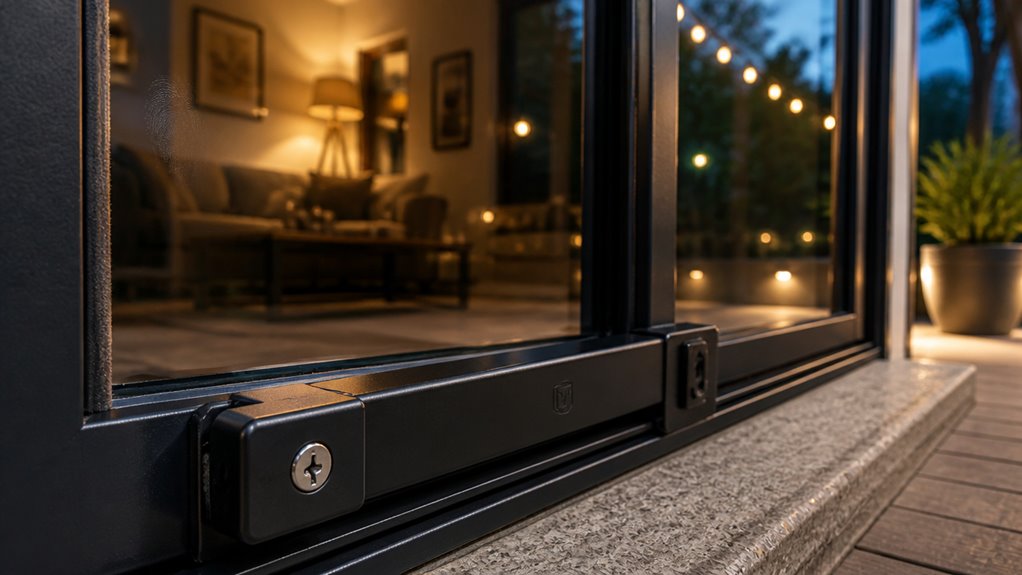

To secure your sliding door, regularly inspect and maintain its frame, rollers, and hardware for any looseness or damage.
Use a snugly fitting track blocker to prevent forced sliding, and install anti-lift pins to stop vertical panel movement.
Upgrade to heavy-duty locks, adding secondary locking mechanisms for dual-point security.
Integrate monitored contact and glass-break sensors for real-time alerts.
Consistent maintenance and combining mechanical with electronic measures will significantly strengthen your door’s defense.
These methods form the foundation for all-encompassing sliding door security.
Key Takeaways
- Regularly inspect and maintain door hardware, tightening screws and lubricating moving parts to prevent mechanical vulnerabilities.
- Use a sturdy track blocker, like a metal rod or wooden dowel, firmly inserted in the bottom track to prevent forced sliding.
- Install anti-lift devices and reinforce the upper track with sheet metal screws to block vertical panel movement.
- Upgrade to heavy-duty locks and add secondary locks for multi-point locking to resist forced entry and enhance security.
- Consistently lock the door when not in use and close curtains or blinds to reduce interior visibility and intrusion risk.
Check Your Sliding Door for Weak Points
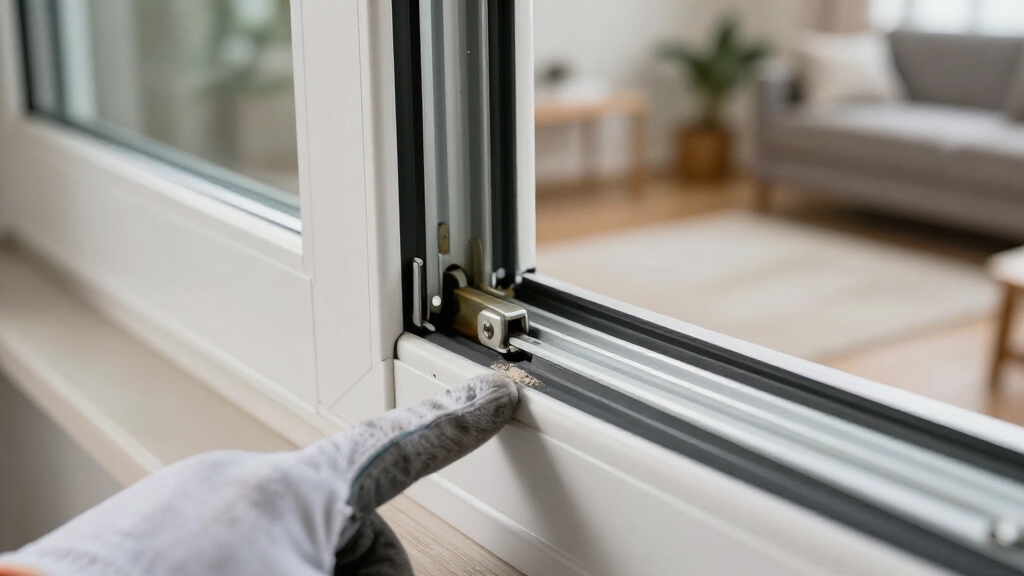
Before adding any additional security measures, you should thoroughly inspect your sliding door for vulnerabilities.
Test the panel’s movement; if it lifts, rattles, or slides with excessive ease, you’ve identified a security gap.
Examine the latch for looseness, misalignment, or wear; a compromised latch undermines your door’s integrity.
Check rollers for damage and confirm they’re properly adjusted to prevent easy lifting.
Evaluate the frame and hardware, confirming they resist prying and twisting forces effectively.
Replace any damaged tracks, latches, or rollers immediately, as these weaken the door’s defense.
This technical assessment forms the foundation of your security upgrade, assuring subsequent reinforcements perform at their best and close all exploitable points.
Also, be sure to check the frame for level, plumb, and squareness to detect any misalignment that could compromise the door’s security.
Block Your Sliding Door Track to Prevent Forced Opening
When it comes to securing your sliding door, picking the right blocking device is key. You’ll want something that fits snugly in the track to stop any forced movement. Make sure to insert it firmly at the bottom track; this way, it won’t be easy to remove or bypass.
Also, it’s a good idea to keep that blocker in place whenever the door isn’t in use. This simple step can really help maintain consistent security for your home. Just a little effort can go a long way in keeping your space safe! Using additional measures like installing a high-security deadbolt can further enhance your sliding door’s protection against forced entry.
Choosing The Right Blocker
A properly fitting blocker is essential to prevent forced entry through a sliding door track.
You need to select a device that fits snugly within the bottom track, eliminating any gap that an intruder could exploit.
Common options include wooden dowels, metal rods, or purpose-built charley bars.
Prioritize materials that resist bending or breaking under pressure.
Measure your track width accurately to ensure a secure fit without damaging the door or frame.
Avoid loose or adjustable blockers that can shift during an attack.
Consistently placing the blocker whenever the door is unused maximizes its protective effect.
Remember, an effective blocker complements other security measures by physically obstructing the panel’s lateral movement.
This creates a reliable, low-cost barrier against forced sliding door entry.
For comprehensive protection, combining blockers with reinforced strike plates strengthens the door frame against prying attacks.
Proper Track Insertion
Ensuring your blocker fits securely within the sliding door track requires precise insertion technique.
Begin by selecting a blocking device that matches the track’s width and depth exactly to prevent any movement.
Insert the blocker firmly at the bottom track, pushing it fully into the channel without gaps.
Angle the dowel, rod, or bar slightly if needed to achieve a tight wedge that resists sliding.
Confirm the blocker remains flush against the track walls and can’t be lifted or shifted easily.
Avoid loose placement, as any play creates vulnerable points for forced entry.
Regularly inspect the insertion point for wear or deformation, replacing the blocker if it no longer fits snugly.
Proper track insertion creates a robust mechanical barrier that markedly hinders unauthorized sliding door access.
For enhanced security, consider installing a security camera nearby to monitor the sliding door area and deter tampering.
Consistent Usage Importance
Regularly blocking your sliding door track is essential to maintain effective security against forced entry. You should insert a sturdy wooden dowel, metal rod, or a purpose-built charley bar snugly into the bottom track each time the door is closed.
This physical barrier prevents the panel from sliding open, markedly reducing the risk of forced entry. Make sure to use a device that fits tightly to eliminate any movement.
Consistent use is vital; neglecting to block the track even once creates a vulnerability that intruders can exploit. Treat this step as a low-cost, high-impact security layer that complements your locks and anti-lift devices.
For enhanced security, consider installing interior anti-slide barriers that physically block the sliding motion and resist forced entry attempts.
Reinforce the Door Frame and Hardware
First off, take a good look at the door frame. Check for any signs of weakness—think cracks or loose fittings. These little issues can really compromise your security, so it’s best to address them early on.
Next, consider upgrading your door hardware. Opt for heavy-duty components that are specifically designed to withstand prying and twisting forces. By doing this, you’ll not only enhance the stability of the frame but also bolster the overall security of your door.
When you combine a sturdy frame with robust hardware, you’re creating a solid barrier against forced entry. It’s a smart move for keeping your space safe!
For the best protection, make sure your door frame is a steel frame anchored into masonry, which eliminates weak points and improves rigidity.
Inspect Frame Stability
Although many focus on locks and sensors, the door frame and hardware provide the foundation for sliding door security.
You must inspect the frame stability thoroughly to prevent forced entry. Check for any looseness or damage in the frame that could compromise its integrity.
Test the panel for excessive rattling or easy sliding, which signals weak support. Examine the latch and rollers for wear or misalignment, ensuring the lock engages properly and the door moves smoothly without lifting gaps.
Replace damaged tracks, worn rollers, or loose fasteners promptly to maintain rigidity. A sturdy, well-maintained frame resists prying and twisting attempts, reinforcing your overall security.
Regular inspections and timely repairs are essential to keep the sliding door’s structural defenses uncompromised.
Additionally, upgrading to high-quality locks can significantly improve the door’s resistance to forced opening attempts.
Upgrade Door Hardware
Strengthen your sliding door’s defense by upgrading its hardware to resist prying, twisting, and forced entry.
Begin by inspecting and reinforcing the door frame and existing components.
Replace worn rollers and damaged tracks to guarantee smooth, secure panel movement and prevent lifting.
Install anti-lift pins or through-the-door pins to block the panel from being removed.
Reinforce the upper track with sheet metal screws positioned at critical points to inhibit upward sliding.
Upgrade the locking system by adding a secondary lock, such as a deadlock or foot lock, that firmly immobilizes the door even if the primary latch is compromised.
Make certain all hardware fits tightly and operates without play under pressure.
Regularly maintain and test the system to maintain peak security and prevent vulnerabilities.
Additionally, consider installing a security camera at the sliding door to monitor this critical entry point and deter unauthorized access.
Install Anti-Lift Devices to Keep Your Door in Place
When securing a sliding door, installing anti-lift devices is essential in preventing the panel from being forced upward and removed from its track.
Installing anti-lift devices is crucial to stop sliding doors from being lifted out of their tracks.
You should install anti-lift pins or through-the-door pins that physically block vertical movement, securing the sliding panel firmly in place.
Additionally, place sheet metal screws in the upper track, ensuring the door barely clears them during normal operation.
Position screws strategically near track ends and the middle, targeting points vulnerable to lifting.
Drill pilot holes accurately before installing hardware to avoid misalignment.
Remember, anti-lift devices work best when combined with a reliable latch system, as relying on one security measure alone leaves weaknesses.
Proper installation of these devices greatly improves your door’s resistance to forced entry by eliminating the common tactic of lifting the panel out of its frame.
For enhanced security, also consider inspecting and maintaining related components regularly to prevent mechanical issues that could compromise door stability.
Upgrade Your Sliding Door Locks for Better Security
Enhance your sliding door’s security by upgrading its locking system to include secondary and more robust locks.
Start by installing a heavy-duty sliding door lock or deadlock that resists forced entry better than basic latches.
Add a secondary lock, such as a foot lock or auxiliary key lock, to create a dual-point locking mechanism that prevents panel movement even if the primary latch fails.
Make sure the new locks engage tightly and remain stable under pressure, eliminating any shifting or looseness.
If keys are missing or locks show wear, re-key or replace them promptly to maintain reliability.
By integrating these advanced locking components, you greatly reduce vulnerability to forced sliding or prying.
This reinforces your door’s defense with precision-engineered hardware designed for maximum security.
For optimal protection, combine these mechanical locks with multi-point lock integration to enhance overall security and sensor compatibility.
Strengthen Glass and Add Entry Sensors
Upgrading your sliding door’s locks markedly improves physical security, but addressing vulnerabilities in the glass and integrating entry sensors adds another critical layer of defense.
Start by applying shatter-resistant film to the glass to delay breakage and deter quick entry. Reinforce this with a glass-break sensor that triggers an alert the moment the pane is shattered, providing immediate notification of forced entry attempts.
Complement these with monitored contact sensors installed on the door frame to detect unauthorized openings. Make certain these sensors are connected to a reliable security system with auto-arm capabilities to minimize human error.
Set Up Sliding Door Alarms to Catch Break-Ins Early
You know, it’s a good idea to install glass-break sensors. They’ll alert you right away if someone shatters the glass on your sliding door. It’s a smart move to catch break-ins early!
Also, consider integrating contact sensors with your security system. These will keep an eye on door openings in real time.
When you combine these alarms, you get those early warnings that can really help prevent unauthorized entry before things get out of hand. It’s all about staying one step ahead!
Glass-Break Sensor Benefits
Frequently overlooked, glass-break sensors provide a critical layer of security by detecting the distinct sound frequency of shattering glass.
When integrated with your sliding door alarm system, these sensors immediately alert you to attempted break-ins, enabling a swift response before intruders gain entry.
Unlike contact sensors, glass-break detectors monitor the integrity of the glass itself, essential since many intrusions begin with pane breakage.
You’ll reduce false alarms by choosing sensors calibrated to differentiate between window breakage and everyday noises.
Proper placement near vulnerable glass panels maximizes sensitivity and coverage.
Contact Sensor Integration
Setting up contact sensors on your sliding door provides an essential early warning system that detects unauthorized opening before intruders gain full entry.
You’ll install two components: a magnet on the door panel and a sensor on the frame, aligned precisely so the circuit closes when the door is shut.
When the door opens, the circuit breaks and triggers an alert.
To maximize effectiveness, integrate these sensors with your home security system or alarm panel, ensuring instant notifications.
Position sensors to avoid false alarms caused by vibrations or minor movements.
Regularly test the sensors to verify proper function and replace batteries promptly.
Combining contact sensors with other security measures, like glass-break sensors and reinforced locks, creates a thorough defense against sliding door intrusions.
Maintain Security Hardware Regularly
Regularly inspecting and maintaining your sliding door’s security hardware guarantees it performs reliably and resists forced entry.
You need to check for any looseness or misalignment in latches and locks, ensuring they engage firmly without shifting under pressure.
Examine rollers and tracks for wear or damage, replacing components that compromise smooth operation or allow panel lifting.
Tighten screws and fasteners on frames and hardware to prevent twisting or prying vulnerabilities.
Lubricate moving parts with appropriate agents to maintain smooth sliding and reduce mechanical strain.
Don’t overlook anti-lift devices; verify pins and track screws are securely installed and correctly positioned.
By routinely servicing these elements, you eliminate weak points and sustain the door’s structural integrity.
This reinforces your overall security system effectively and consistently.
Adopt Daily Habits to Enhance Sliding Door Security
Maintaining your sliding door’s hardware is only part of effective security. How you use the door daily plays a significant role in preventing vulnerabilities.
You need to adopt habits that reinforce security beyond physical upgrades. Consistently locking the door whenever it’s not in use prevents accidental exposure.
Ensuring the door fully closes before engaging the lock eliminates gaps that could be exploited. Closing curtains or blinds limits visibility, reducing targeted intrusion risk.
Regularly inspecting the door’s hardware allows you to identify wear or misalignment before they compromise security.
Always lock the door immediately after use. Confirm the door panel is completely shut before locking.
Keep window treatments closed to obscure interior view. Conduct routine hardware inspections for early issue detection.
Integrate Mechanical and Electronic Security Measures for Maximum Protection
While mechanical reinforcements establish a solid physical barrier, integrating electronic security systems markedly enhances your sliding door’s overall protection.
Start by combining robust mechanical elements like anti-lift pins, sturdy locks, and track blockers with electronic sensors such as monitored contact sensors and glass-break detectors.
These devices promptly alert you to unauthorized access or glass breakage, enabling rapid response.
Verify your electronic components are compatible and properly installed to avoid blind spots or false alarms.
Regularly test both mechanical and electronic systems to maintain reliability.
By synchronizing physical barriers with real-time electronic monitoring, you create a thorough security network that deters intruders and provides immediate alerts.
This integrated approach markedly elevates your home’s security posture.
Frequently Asked Questions
Can Sliding Door Security Be Improved Without Professional Installation?
Yes, you can improve sliding door security without professional installation by reinforcing the existing door, such as tightening latches and adjusting rollers.
Insert a wooden dowel or a charley bar in the track to block forced opening.
Add anti-lift pins or screws in the top track yourself.
Upgrade locks with secondary or deadlock options that you can install.
Regularly inspect hardware and use shatter-resistant films for added glass protection.
What Materials Are Best for DIY Sliding Door Reinforcement?
Steel and hardwood are your best bets for DIY sliding door reinforcement because they offer unmatched strength and durability.
Think of these materials as your door’s armor, resisting prying and twisting attacks.
Use steel rods or sturdy wooden dowels to block the track securely.
Combine them with quality metal anti-lift pins and heavy-duty locks to make sure your door stays firmly in place.
Avoid flimsy plastics or soft metals that compromise security.
How Do Weather Conditions Affect Sliding Door Security Devices?
Weather conditions can degrade sliding door security devices by causing rust, warping, or misalignment.
You’ll want to choose corrosion-resistant materials like stainless steel for locks and hardware to maintain integrity.
Moisture can cause wooden blockers to swell, reducing fit and effectiveness, so use treated or synthetic materials instead.
Extreme temperatures may affect latch tension and roller function, so adjust and inspect hardware regularly to ensure consistent security performance throughout seasonal changes.
Are Pet Doors a Security Risk for Sliding Doors?
Imagine a small pet door nestled within your sliding door, a convenient portal for your furry friend.
However, it does create a security risk, as it can provide intruders with a potential entry point or allow tools to manipulate the main lock.
To counter this, reinforce the door with anti-lift pins and sturdy locks.
Consider pet doors with secure locking mechanisms or sensors to maintain your home’s safety without sacrificing convenience.
Can Smart Home Systems Integrate With Sliding Door Locks?
Yes, you can integrate smart home systems with sliding door locks. Many smart locks are compatible with platforms like Alexa, Google Home, or Apple HomeKit, letting you control and monitor your sliding door remotely.
You’ll benefit from features such as remote locking, real-time alerts, and automation schedules. Make sure your smart lock supports your door’s specifications and pairs securely with your home network to maintain robust security.
Protect Your Home With Better Sliding Door Security
Securing your sliding door isn’t just about locking it; it’s about fortifying every link in the chain. By identifying weak points and reinforcing frames, you build an unbreakable fortress.
Think of your door as a guarded gatekeeper. With regular maintenance and smart habits, it won’t just keep intruders out; it’ll stand as your home’s vigilant sentinel, ready to protect what matters most.
Don’t leave security to chance; lock it down every time.