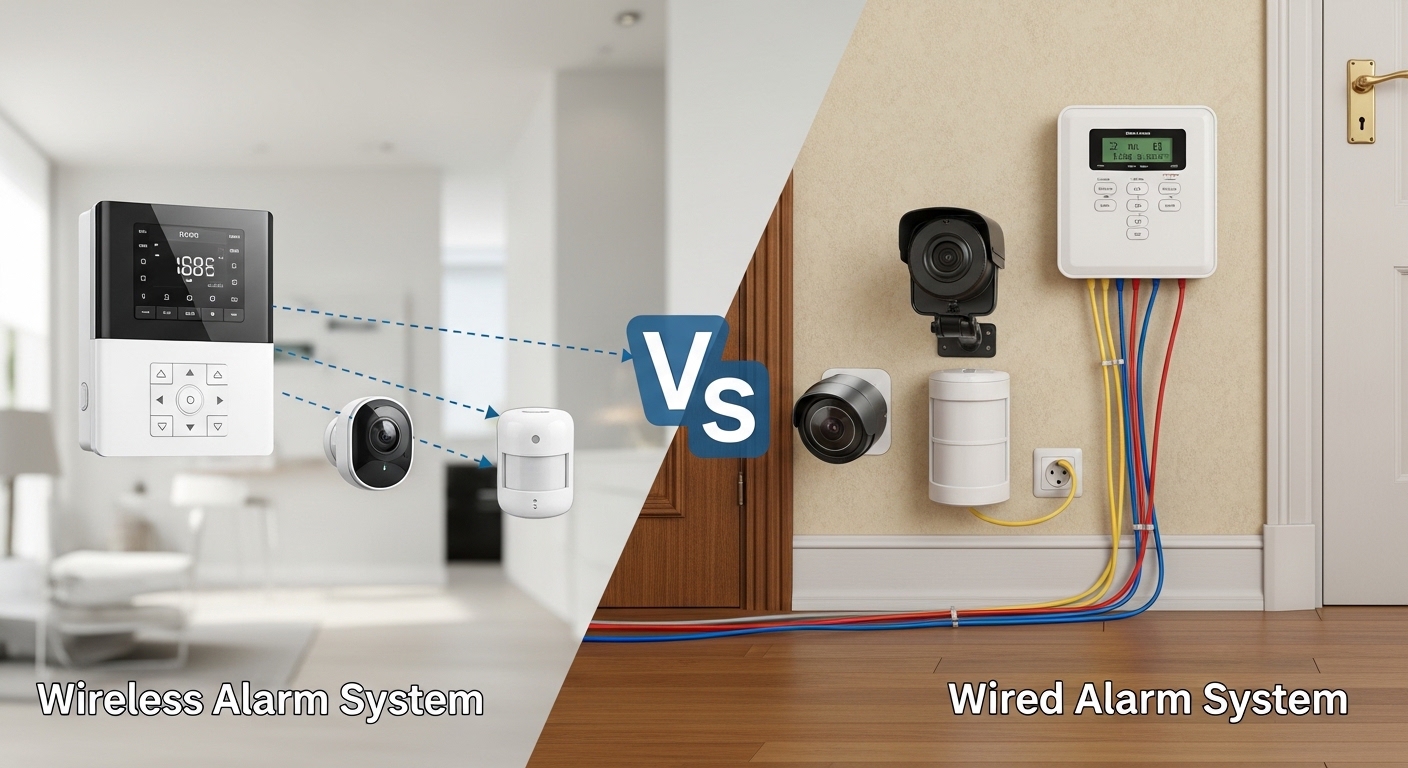

You’ll find wireless alarm systems let you install quickly with minimal disruption. They easily adapt sensor placement without rewiring, making them ideal for finished homes or rentals.
Wired systems require professional setup and wiring but deliver superior power stability and consistent communication without signal loss. They also offer enhanced tamper resistance via physical circuits.
While wireless offers flexibility, wired guarantees long-term reliability and lower maintenance. Exploring both options reveals key trade-offs in installation, coverage, and system resilience for your security needs.
Key Takeaways
- Wired alarm systems offer stable, uninterrupted communication with no RF interference, ideal for large properties and long-term reliability.
- Wireless alarm systems allow easy installation and flexible sensor placement without structural modifications or wiring.
- Wired systems draw continuous power from the electrical grid, reducing maintenance and battery replacement needs.
- Wireless systems rely on batteries, requiring regular replacements and monitoring, increasing ongoing maintenance costs.
- Wireless signals are vulnerable to interference and range limits, while wired systems provide consistent coverage without signal loss.
Wireless or Wired Alarm System: Comparison
| Feature | Wired Alarm System | Wireless Alarm System |
|---|---|---|
| Installation Process | Requires professional installation and internal wiring through walls | Quick DIY or professional setup with minimal disruption |
| Best For | New constructions or pre-wired homes | Finished homes, rentals, and flexible layouts |
| Power Source | Continuous electrical power with panel battery backup | Battery-powered devices (each sensor requires batteries) |
| Maintenance Level | Low maintenance; occasional panel battery check | Regular battery replacements and monitoring required |
| Signal Reliability | Direct copper connection; no signal loss or RF interference | Uses encrypted RF signals; vulnerable to interference and range limits |
| Tamper Resistance | High — physical circuits trigger instant alerts if cut | Moderate — relies on signal supervision |
| Remote Hacking Risk | None (no RF communication) | Higher risk, though encrypted |
| Coverage Area | Unlimited distance between sensors and panel | Limited by signal range (walls and devices affect performance) |
| Expansion Flexibility | Difficult; requires additional wiring | Easy to add or relocate sensors |
| False Alarm Risk | Lower due to stable communication | Higher if signal interference occurs |
| Long-Term Costs | Lower ongoing costs; minimal battery replacements | Higher ongoing costs due to batteries and maintenance |
| Internet Dependency | Not required for core operation | Not required for local operation, but needed for app features |
| Video Surveillance Integration | Highly stable wired camera integration | Possible, but dependent on signal stability |
| Overall Strength | Maximum reliability and physical security | Maximum flexibility and ease of installation |
Installation Differences: Wired vs Wireless Alarm Systems
Although both wired and wireless alarm systems serve the same security purpose, their installation processes differ markedly.
Wired and wireless alarm systems offer similar security but differ significantly in installation methods.
When you install a wired system, you’ll need professional assistance to run cables through walls and conduits. This demands significant time and can disrupt your living space.
This invasive process suits new constructions or homes pre-wired for security, reducing costs.
In contrast, wireless systems streamline deployment with minimal intrusion. They are ideal for finished homes or rentals where modifying walls isn’t an option.
You can place wireless devices without electrical access or existing cable infrastructure, enhancing flexibility.
This rapid setup reduces installation complexity and downtime.
Understanding these differences helps you choose the system aligning with your property’s structural constraints and your tolerance for installation disruption.
Additionally, wireless alarm systems often use IP-based connectivity, which allows for easier integration and remote monitoring.
Power and Maintenance: Wired vs Wireless Systems
Once your alarm system is installed, its power source and maintenance requirements become key factors in long-term reliability.
Wired systems draw continuous power from your home’s electrical grid with backup batteries, minimizing maintenance. Wireless systems rely on batteries for each device, requiring periodic replacements and monitoring to avoid failures.
Battery alerts help you stay ahead of power loss in wireless setups, but wired systems maintain uninterrupted operation without such concerns.
It is important to note that hardwired detectors still require battery backups to ensure functionality during electrical outages.
| Feature | Wired Systems |
|---|---|
| Power Source | Continuous home electrical power |
| Battery Backup | Yes, for panel only |
| Maintenance Frequency | Minimal; panel battery check |
| Wireless Dependence | None |
Choosing wired reduces your maintenance burden and enhances system uptime.
Signal Reliability: Wired vs Wireless Security
When it comes to alarm systems, wired options really stand out for their signal stability. Thanks to direct copper connections, they eliminate the risk of interference, which is a huge plus. You don’t have to worry about anything messing with the signal.
On the other hand, wireless systems operate using encrypted RF signals, but they can face some challenges. Things like walls, electronic devices, and even competing frequencies can disrupt the signal.
So, it’s important to keep these factors in mind when you’re assessing which system might work best for your specific environment. Additionally, wireless systems offer more flexible placement options due to their wireless connectivity.
Signal Stability Comparison
When evaluating signal stability, wired alarm systems offer a clear advantage by maintaining uninterrupted communication through direct physical copper connections.
This guarantees consistent data transmission free from external disruptions, providing a highly reliable security backbone.
You won’t encounter signal drops or latency since the electrical pathway is fixed and shielded, guaranteeing stable operation even under adverse conditions.
In contrast, wireless systems depend on radio frequency signals, which inherently fluctuate due to environmental factors.
Although modern encryption enhances security, wireless signals remain vulnerable to attenuation and range limitations.
You must consider the potential for intermittent connectivity when relying solely on wireless setups, as these can compromise alarm responsiveness.
Ultimately, wired systems deliver superior signal stability, making them the preferred choice if uninterrupted alarm communication is critical.
Additionally, passive alarm systems can operate locally and record events internally even without internet or cellular connectivity, ensuring continuous protection despite wireless signal issues and highlighting the value of local sensor operation.
Interference and Disruption
Building on the reliability advantages of wired systems, it’s important to examine how interference and disruption affect signal integrity in both wired and wireless alarm setups.
Wired systems use direct copper connections, ensuring uninterrupted communication without susceptibility to radio frequency interference. In contrast, wireless systems transmit encrypted RF signals vulnerable to environmental factors and competing frequencies.
Consider these key points:
- Wired systems resist interference from household electronics and weather conditions.
- Wireless signals can be disrupted by microwaves, baby monitors, and dense walls.
- Wired systems feature diagnostics to detect tampering or open circuits instantly.
- Wireless systems risk false alarms and signal loss due to external interference.
Additionally, wiring problems such as loose connections or damaged insulation can critically impair the performance of wired alarm systems, requiring professional inspection for resolution.
You’ll find wired systems deliver superior signal reliability with minimal disruption risk compared to wireless alternatives.
Physical Security Advantages of Wired Systems
Physical security stands as a core strength of wired alarm systems, offering robust protection against tampering and unauthorized access.
You benefit from closed physical circuits that are hardwired directly to the control panel, with end-of-line resistors triggering alerts if wires are cut. Concealed wiring within walls or conduits further deters unauthorized interference.
Unlike wireless systems, wired setups can’t be hacked remotely since they lack RF communication vulnerabilities. This guarantees higher integrity and reliability in securing your premises.
Additionally, wired systems often incorporate multi-point locking mechanisms that enhance the overall security framework by distributing locking force and resisting forced entry attempts.
| Security Feature | Wired Systems | Wireless Systems |
|---|---|---|
| Tamper Detection | Immediate alerts via resistor cuts | Limited, relies on RF signal checks |
| Physical Access | Wires concealed in walls/conduits | Devices exposed, easier to access |
| Remote Hacking Risk | None | Higher, despite encryption |
| Circuit Integrity Monitoring | Built-in diagnostics | Not available |
Coverage and Flexibility: Wired vs Wireless Alarms
When it comes to coverage and flexibility, wired alarm systems really shine. They offer almost unlimited coverage areas since the sensors connect directly to the control panel, and there aren’t any distance constraints to worry about. This means you can spread them out as far as you need.
On the other hand, wireless systems have their own set of strengths. While they do require the sensors to stay within a specific range, making their coverage a bit more limited, they’re much easier to expand and relocate. So, if you need to adjust your setup down the line, wireless can be a breeze.
It’s all about understanding these trade-offs. When you’re planning your security network, think about how scalable and adaptable you want it to be. That way, you can make the right choice for your needs! Central systems’ ability to provide automated emergency dispatch can significantly enhance safety beyond basic coverage and flexibility.
Coverage Area Limitations
Although wireless alarm systems offer impressive flexibility, their coverage area is inherently limited by the range between sensors and the central control panel.
You must position wireless sensors within a specific distance to maintain reliable communication, or risk signal loss and system failure.
In contrast, wired systems impose no such distance constraints, allowing extensive coverage with multiple protection zones.
Keep these key points in mind:
- Wireless sensor range typically maxes out at a few hundred feet, affected by walls and interference.
- Wired systems use direct copper connections, eliminating signal drop regardless of distance.
- Wireless range extenders can partially mitigate limitations but add complexity and cost.
- Wired installations support larger properties without coverage gaps or additional hardware.
Additionally, wired systems can support constant monitoring with higher sensitivity compared to battery-powered wireless units.
Understanding these limits will help you choose the right system for your coverage needs.
Expansion And Mobility
When expanding or relocating your security system, wireless alarms offer unmatched mobility by allowing you to add or move sensors without rewiring or structural modifications.
This flexibility enables rapid adaptation to changing security needs or property layouts. In contrast, wired systems require significant labor to install new cables or reroute existing wiring, limiting expansion and complicating relocation.
While wired systems support unlimited distances between sensors and control panels, their fixed infrastructure restricts flexibility once installed. Wireless systems, although constrained by signal range, allow you to extend coverage easily with range extenders and reposition devices as needed.
Consequently, if you prioritize adaptability and minimal disruption during expansion or relocation, wireless alarms provide a superior solution. Wired systems deliver stability but lack the agility needed for dynamic security environments. It is important to remember that sensor maintenance is critical to ensure reliable operation regardless of system type.
Long-Term Costs: Wired vs Wireless Security
Since security systems represent a long-term investment, understanding their ongoing costs is critical for making an informed choice.
Wired systems generally have lower maintenance costs because they draw continuous power from your home’s electrical system, eliminating frequent battery replacements.
Conversely, wireless systems require regular battery changes for each device, increasing expenses over time. Additionally, false alarms, more common in wireless setups, can lead to costly municipal fines.
Wireless systems need frequent battery replacements and may incur fines from false alarms, raising long-term costs.
Consider these key cost factors:
- Initial installation expenses vary; wired may cost more unless existing wiring is present.
- Wired systems have minimal ongoing maintenance due to stable power supply.
- Wireless systems incur recurrent battery replacement costs.
- Wireless false alarms can result in financial penalties.
Understanding these elements helps you select a system aligned with your budget and operational expectations. It is also important to factor in the potential savings and enhanced security benefits of integrating smart lock systems with wireless alarms for a comprehensive solution.
Frequently Asked Questions
Can Wireless Alarms Integrate With Smart Home Devices?
Yes, you can integrate wireless alarms with smart home devices effectively.
Wireless systems use encrypted RF signals compatible with many smart home hubs and platforms like Alexa, Google Home, or Apple HomeKit. This allows you to control alarms remotely and automate security routines.
You can also receive real-time alerts on your smartphone. Their flexibility supports seamless expansion and connection with other IoT devices, enhancing home automation and security management.
Are Wired Systems Compatible With Modern Mobile App Controls?
About 80% of modern wired alarm systems now support mobile app controls. You can monitor and control these systems remotely via your smartphone, enabling real-time alerts, arming, disarming, and system status checks.
This integration typically requires a compatible control panel with network connectivity or an added module. While wired systems prioritize reliability and security, app compatibility guarantees you don’t sacrifice convenience or modern remote management capabilities.
How Do Weather Extremes Affect Wired Alarm Hardware Longevity?
You’ll find that wired alarm hardware generally withstands weather extremes well because its components are typically installed indoors or within protective conduits.
Exposure to moisture, temperature fluctuations, or UV radiation is minimized, preserving longevity.
However, if outdoor sensors or wiring aren’t properly sealed or insulated, you risk corrosion, signal degradation, or physical damage.
Proper installation with weatherproof enclosures and routine inspections guarantees durable, reliable wired system performance in harsh climates.
Can Wireless Alarms Operate During Internet Outages?
You expect your wireless alarm to keep protecting your home, even when the internet drops.
Yes, wireless alarms can operate during internet outages because they rely on encrypted RF signals between sensors and the control panel, not on internet connectivity.
However, remote monitoring or app notifications might pause until the connection restores. Your system maintains local security functions autonomously, ensuring uninterrupted detection and alarm triggering despite internet disruptions.
Do Wired Systems Support Video Surveillance Integration?
Yes, wired systems fully support video surveillance integration. You can connect IP or analog cameras directly to the control panel or network via dedicated cabling, ensuring stable, uninterrupted video feeds.
Wired connections provide consistent bandwidth and power delivery, minimizing latency and signal loss. This setup enhances overall security by synchronizing video footage with alarm events.
It enables precise monitoring and recording without relying on wireless signals prone to interference or outages.
Reliability vs. Flexibility: The Choice That Defines Your Protection
When choosing between wired and wireless alarm systems, you’re not just picking a security method. You’re deciding the fate of your entire property’s safety.
Wired systems offer rock-solid reliability and unbeatable physical security. Wireless setups give you unparalleled flexibility and ease of installation.
Ignoring these differences could leave you vulnerable to constant false alarms or total signal loss. Make your choice wisely; your security depends on it more than you think.