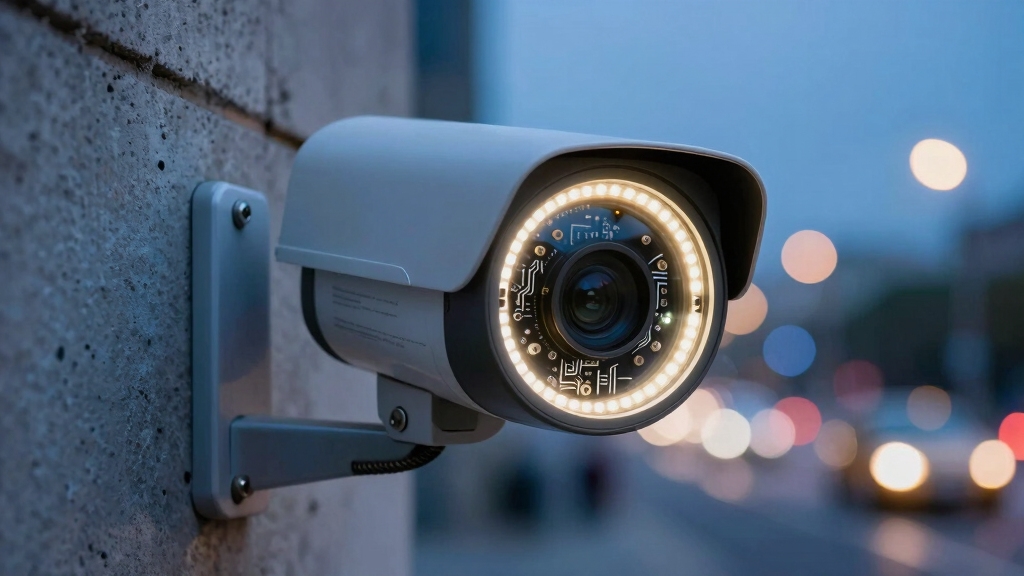

Security cameras work by using lenses to focus light onto image sensors that convert it into electrical signals for processing.
These signals undergo analog-to-digital conversion, compression, and enhancement to produce clear video, even in low light or at night.
The processed footage is then transmitted via wired or wireless networks to storage devices or remote access points.
Variations in camera types, resolution, and features like motion detection impact performance and reliability.
Understanding these components reveals how cameras protect your property effectively.
Key Takeaways
- Security cameras capture light through lenses and convert it into electrical signals via image sensors like CCD or CMOS.
- Processors perform analog-to-digital conversion, apply image enhancements, and encode video using compression codecs such as H.265.
- Cameras transmit video data over wired or wireless networks, enabling remote access, storage, and real-time monitoring.
- Night vision uses infrared LEDs and large-aperture lenses to capture clear images in low or no light conditions.
- Protective housings and components ensure durability against weather, vandalism, and temperature fluctuations for reliable operation.
How Different Types of Security Cameras Are Used?
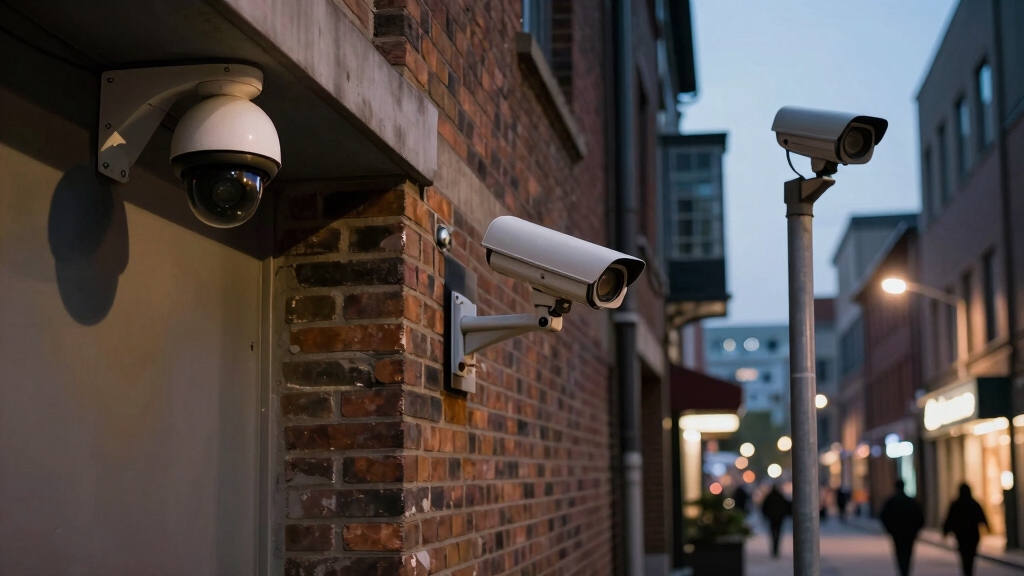
Choosing the right security camera type depends on your specific monitoring needs and environment.
Bullet cameras, with their robust housings, excel outdoors, deterring intruders through visible presence and weather resistance.
Dome cameras suit indoor or discreet outdoor use, thanks to their tinted glass that conceals lens direction, complicating tampering attempts.
C-mount cameras provide versatility with detachable lenses, ideal for customized long-range surveillance in rugged conditions.
PTZ cameras offer dynamic control by enabling you to pan, tilt, and zoom, focusing precisely on moving or distant subjects, perfect for active monitoring scenarios.
IP cameras integrate easily into digital networks, facilitating remote access and high-resolution streaming, essential for modern security systems.
Selecting among these types requires matching camera capabilities to environmental challenges and surveillance objectives for peak performance.
Additionally, IP cameras support advanced features like motion detection and AI analytics, enhancing security beyond simple video capture.
What’s Inside a Security Camera? Key Components Explained
Delving into the internal structure of a security camera reveals a sophisticated assembly of components designed to capture, process, and transmit high-quality video.
You’ll find the lens, which focuses light onto the image sensor. The sensor, either CCD or CMOS, converts light into electrical signals.
A processor then handles compression, noise reduction, and color correction, ensuring clear video output. Finally, the network module enables wired or wireless data transmission to your monitoring system.
Analog High Definition (AHD) cameras, for example, transmit high-definition video over coaxial cables with minimal latency, providing near-real-time video quality without network bandwidth issues.
| Component | Function | Key Detail |
|---|---|---|
| Lens | Focuses light | Fixed-focus or zoom options |
| Image Sensor | Converts light to signals | CCD or CMOS type |
| Processor | Processes video signals | Compression, noise reduction |
| Housing | Protects internal parts | Waterproof, vandal-resistant |
| Network Module | Transmits video data | Wired or wireless connectivity |
How Security Cameras Capture and Process Images Step-by-Step?
Sure! Let’s break it down in a more conversational way.
First, think about how the lens works. It captures light and focuses it right onto the image sensor. This sensor is pretty amazing because it takes that light and turns it into electrical signals.
Once that’s done, the processor jumps in. It’s like the brain of the camera, handling important tasks like noise reduction, color correction, and compression. These steps are crucial—they transform all that raw data into clear, usable images.
And just like that, you have images that are ready to be stored or sent out! Pretty cool, right? Wired cameras often ensure this process happens with minimal video latency, providing consistent and real-time monitoring.
Lens And Sensor
The lens plays a critical role by capturing incoming light and focusing it precisely onto the image sensor. The sensor then converts this light into electrical signals.
You’ll find lenses designed with fixed-focus or zoom capabilities to adapt to different surveillance needs. The image sensor, typically CCD or CMOS, uses photodiodes to detect light intensity and color, transforming photons into analog electrical charges.
These charges are then converted into voltage signals, representing the captured image. The sensor’s size and quality directly impact resolution and low-light performance. Larger sensors gather more light and produce clearer images.
Understanding this interaction between lens and sensor helps you grasp how raw visual data is initially captured before any digital processing takes place. This knowledge lays the foundation for accurate and reliable surveillance footage.
In modern systems like NVRs, the camera itself handles video encoding before transmission, improving image clarity and reducing recorder workload.
Signal Processing Steps
Once the image sensor converts light into electrical signals, the processor takes over to transform these raw signals into usable digital images.
It first applies analog-to-digital conversion, translating continuous signals into discrete pixel data.
Next, the processor performs noise reduction algorithms to minimize grain and artifacts, enhancing clarity.
Color correction follows, adjusting white balance and saturation to guarantee accurate reproduction.
The system then compresses the images using efficient codecs like H.265, balancing quality with storage constraints.
Advanced features such as wide dynamic range (WDR) and backlight compensation (BLC) are integrated here, optimizing visibility in challenging lighting.
Finally, the processed video stream is formatted for real-time transmission or storage.
This entire sequence guarantees you receive sharp, clear, and reliable footage from your security camera.
Similar to how photoelectric smoke alarms use signal processing circuitry to analyze photodetector output and trigger alarms based on detected changes, security cameras rely on sophisticated processing to interpret and enhance visual data.
How Security Cameras Store and Share Your Footage?
Although security cameras continuously capture video, efficient storage and sharing methods guarantee you can access footage when needed without overwhelming your system.
Your camera compresses video using H.265 or H.265+ codecs, substantially reducing file size without degrading quality. This compression enables longer retention on local storage devices like DVRs or NVRs, which manage analog and IP camera feeds respectively.
Many systems employ cyclic overwriting, making certain continuous recording by replacing the oldest footage. For sharing, cameras transmit compressed data via wired or wireless connections to monitoring stations or cloud servers.
Cloud storage offers remote access and redundancy but depends on bandwidth and subscription models. Encryption protocols safeguard footage during transmission and storage, maintaining data integrity and privacy.
To ensure reliable communication between devices, security systems often operate within specific frequency ranges similar to those used by garage door remotes, minimizing interference and optimizing signal performance.
How Network Connectivity Affects Security Camera Operation?
Securing reliable network connectivity plays a critical role in how effectively your security cameras operate, especially for IP-based systems that rely on real-time data transmission.
Reliable network connectivity is essential for optimal performance of IP-based security cameras and real-time data transmission.
Network stability directly impacts video streaming quality, latency, and the ability to access live feeds remotely. Wired connections like Ethernet provide consistent bandwidth and lower interference, optimizing data flow from the camera’s network module to monitoring stations or NVRs.
Wireless setups offer flexibility but can suffer from signal degradation, congestion, and security vulnerabilities. Network throughput must accommodate high-resolution video and compression rates like H.265 without bottlenecks.
Additionally, network protocols and IP addressing secure seamless device communication and remote accessibility. Prioritizing robust connectivity minimizes frame loss, delays, and interruptions, ultimately enhancing the reliability and responsiveness of your security camera system.
Implementing strong network security measures such as unique passwords and regular firmware updates further protects your camera system from unauthorized access and hacking attempts.
How Resolution and Frame Rate Affect Security Camera Performance?
Network connectivity determines how smoothly your security camera delivers video data. The quality of that video hinges largely on resolution and frame rate.
Resolution, measured in megapixels, directly impacts the level of detail you capture. For identification purposes, 8MP or higher is ideal. Higher resolution demands more processing power and bandwidth.
Frame rate, expressed in frames per second (fps), affects motion clarity. 25fps or above minimizes motion blur, essential for tracking moving subjects.
Balancing these factors is indispensable. Increasing resolution improves image clarity but may reduce frame rate if bandwidth or processing capacity is limited.
Conversely, prioritizing frame rate ensures smoother video but can lower image sharpness. Understanding this trade-off enables you to optimize your camera’s performance for precise monitoring and effective incident analysis.
Additionally, ensuring an unobstructed field of view is crucial to maximize the effectiveness of your camera’s resolution and frame rate capabilities.
How Night Vision, Motion Detection, and Other Features Enhance Security Cameras?
Security cameras frequently rely on advanced features like night vision and motion detection to substantially improve monitoring effectiveness in diverse conditions.
Night vision utilizes infrared LEDs and sensors with large apertures (F1.6 or lower) to capture clear images in near-total darkness. It does this by converting infrared light into visible video.
Night vision uses infrared LEDs and wide-aperture sensors to produce clear images even in near-total darkness.
Motion detection algorithms analyze pixel changes frame-by-frame, triggering alerts and recording only when movement occurs. This optimizes storage and response efficiency.
Additional enhancements such as 3D digital noise reduction (3D DNR) reduce graininess in low-light.
Wide dynamic range (WDR) compensates for contrasting brightness within scenes. Brightness and headlight glare controls (BLC, HLC) further refine image clarity in challenging lighting.
These integrated technologies collectively enable you to maintain vigilant, high-quality surveillance around the clock, regardless of environmental variables.
Continuous monitoring and motion detection technologies enhance security without overwhelming users with false alerts.
How Outdoor Security Cameras Stay Protected and Reliable?
Because outdoor cameras face harsh environmental conditions, their design incorporates robust protective measures to maintain functionality and durability.
You’ll find housings made from weather-resistant materials like polycarbonate or metal, sealed to meet IP66 or higher standards, preventing water and dust ingress.
Anti-corrosion coatings and UV-resistant finishes extend lifespan under sun exposure.
Internally, temperature regulation components, such as heat sinks or small fans, stabilize electronics amid temperature fluctuations.
Impact-resistant casings protect against vandalism and physical shocks.
Additionally, you’ll rely on secure mounting systems to guarantee stability during wind or tampering attempts.
Power solutions often include surge protectors and PoE to maintain continuous operation.
These technical safeguards collectively guarantee your outdoor cameras deliver reliable performance regardless of environmental challenges.
In some cases, integrating reinforced steel frames in camera housings enhances protection against forced physical attacks.
Frequently Asked Questions
How Do Security Cameras Integrate With Smart Home Systems?
You integrate security cameras with smart home systems by connecting IP cameras via your home network, enabling real-time video streaming and control through apps or voice assistants.
The cameras’ network modules support Wi-Fi or Ethernet, letting you access feeds remotely.
Advanced features like motion detection trigger automated responses in your smart ecosystem, such as lighting or alarms.
This seamless integration enhances surveillance efficiency and centralized management within your smart home platform.
Can Security Cameras Detect and Alert on Specific Sounds?
Yes, you can equip security cameras with sound detection capabilities. Advanced models integrate microphones and signal processors that analyze audio patterns in real time.
They detect specific sounds like glass breaking or alarms by filtering noise and triggering alerts. This integration uses algorithms to differentiate important sounds from background noise.
This enables you to receive precise notifications alongside video feeds for thorough security monitoring.
What Are the Privacy Concerns Related to Security Camera Use?
You need to be aware that security cameras raise privacy concerns, especially regarding unauthorized surveillance and data misuse.
They can capture sensitive personal information or activities without consent, infringing on individuals’ rights.
Improper storage or sharing of footage increases risks of breaches.
You should guarantee compliance with legal regulations, limit camera placement to public or agreed areas, and implement strict access controls and encryption to protect privacy effectively.
How Long Can Security Cameras Operate During a Power Outage?
You can expect security cameras to operate anywhere from a few minutes to several hours during a power outage, depending on their backup power systems.
If your setup includes uninterruptible power supplies (UPS) or battery backups, cameras can keep running for extended periods, often 1–4 hours or more.
Without backup power, cameras relying solely on mains electricity will stop immediately.
For longer operation, consider integrating PoE switches with battery backup or solar-powered solutions.
Are There Legal Restrictions on Where Security Cameras Can Be Installed?
Yes, you must consider legal restrictions when installing security cameras.
Generally, you can’t place them where they capture private areas like neighbors’ yards or inside private spaces without consent.
Public spaces often have fewer restrictions, but laws vary by jurisdiction, focusing on privacy rights and consent.
You should research local regulations and possibly consult legal counsel to guarantee compliance, especially regarding audio recording or surveillance in sensitive zones.
Final Thoughts on How Security Cameras Work Efficiently
When you glance at a security camera, you’re seeing more than a lens. You’re witnessing a complex blend of optics, sensors, processors, and connectivity working in harmony.
Just as gears in a clock synchronize to tell precise time, these components capture, analyze, and transmit images seamlessly. Understanding how resolution, night vision, and motion detection interplay helps you appreciate the technical intricacies that keep your surroundings monitored, reliable, and secure.
This is true day or night, rain or shine.
[…] is also important to ensure that any video footage is securely stored and transmitted using encryption protocols to protect student […]