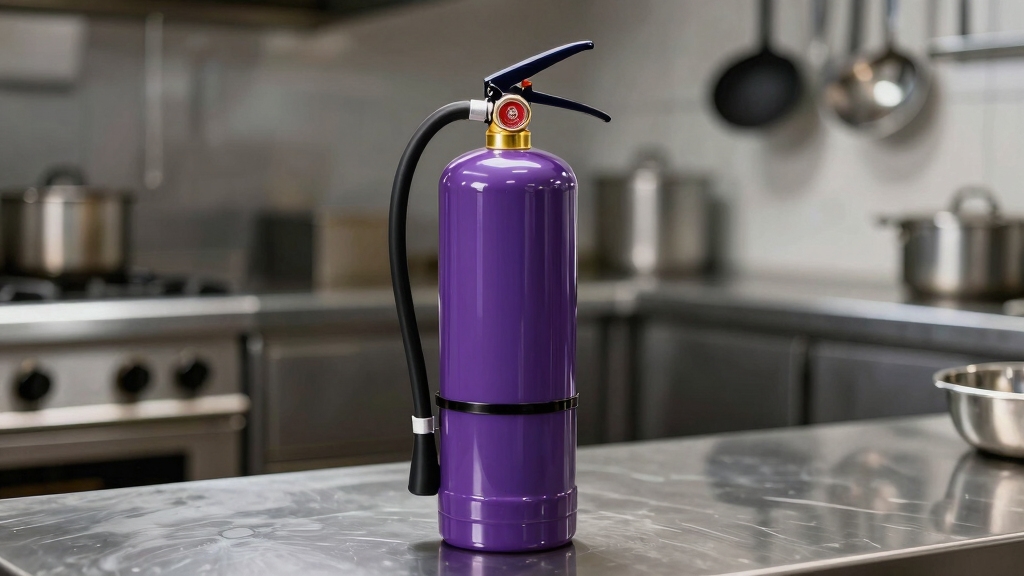

A Purple K fire extinguisher uses fluidized, siliconized potassium bicarbonate to rapidly suppress flammable liquid (Class B) and energized electrical (Class C) fires.
Its non-conductive, non-corrosive dry chemical interrupts the fire’s chemical chain reaction. It coats surfaces to prevent reignition without relying on cooling.
You’ll find it in industrial and electrical settings where fast, efficient suppression is critical. Keep going to explore its advantages, proper use, and why it’s trusted in high-risk environments.
Key Takeaways
- Purple K fire extinguishers use siliconized potassium bicarbonate powder with a distinctive lavender tint for rapid suppression of Class B and C fires.
- They interrupt the chemical chain reaction of fires, effectively stopping combustion without relying on cooling.
- Designed for flammable liquid and energized electrical fires, Purple K is non-conductive and safe around electrical equipment.
- These extinguishers perform faster and more efficiently than ABC, sodium bicarbonate, and CO₂ agents on hydrocarbon fires.
- Commonly used in industrial, commercial, and high-risk areas like oil refineries, airports, and power plants for superior fire control.
What Is Purple K and How Does It Extinguish Fires?
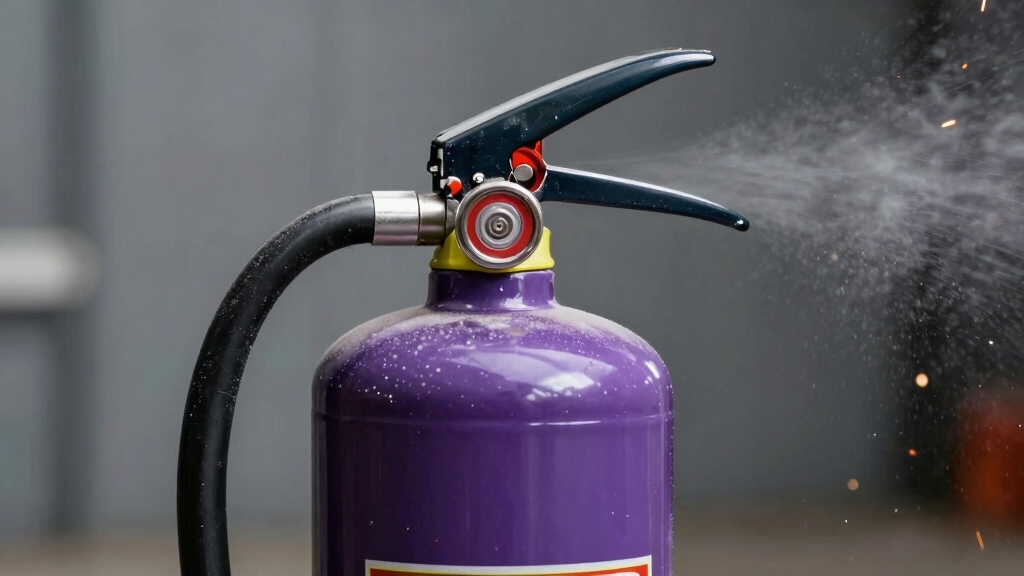
Purple K, often called PKP, acts as a highly effective dry-chemical agent designed specifically to suppress Class B and C fires involving flammable liquids and energized electrical equipment.
You’ll find that PKP consists of fluidized, siliconized potassium bicarbonate, giving it a distinctive lavender tint when discharged.
When you apply Purple K, it disrupts the fire tetrahedron’s chemical chain reaction, halting combustion rapidly.
Besides interrupting the reaction, it provides a smothering effect by partially excluding oxygen and cools flames and hot surfaces through endothermic reactions.
Unlike some agents, Purple K remains in powder form on heated surfaces, coating them to reduce the chance of reignition.
Its electrically non-conductive and non-corrosive properties make it ideal for electrical fire scenarios, ensuring safety and efficiency during suppression.
Purple K’s use of potassium bicarbonate classifies it as a BC-type powder, which is effective against flammable liquids and energized electrical fires but lacks Class A fire suppression capability.
Which Fires Can a Purple K Extinguisher Put Out?
Understanding the types of fires an extinguisher can handle helps you select the right tool for safety.
A Purple K extinguisher is specifically rated for Class B and Class C fires. It effectively suppresses flammable liquid fires involving gasoline, oil, grease, acetone, and flammable gases.
Additionally, it’s suitable for energized electrical fires, which fall under Class C, due to its electrically non-conductive properties.
Purple K excels in interrupting the chemical chain reaction of these fires, providing rapid suppression.
However, it isn’t designed for Class A fires involving ordinary combustibles like wood or paper, nor for Class D metal fires.
Using Purple K correctly guarantees efficient fire control in industrial and commercial environments where flammable liquids or energized electrical equipment are present.
For fires involving combustible metals, a specialized Class D extinguisher is essential because standard agents like Purple K can be ineffective or dangerous.
Comparing Purple K to ABC and Other Agents
When you look at Purple K in comparison to ABC agents, it’s clear that Purple K really shines when it comes to tackling Class B fires, especially those involving flammable liquids. Plus, it does a better job on energized electrical fires too.
Now, ABC extinguishers are versatile since they cover Class A solids along with B and C fires. But here’s the kicker: Purple K specifically targets Class B and C fires with much better penetration and a quicker knockdown.
However, unlike Purple K, ABC extinguishers use monoammonium phosphate powder that also effectively insulates and cools Class A fires by melting at approximately 350°F.
Purple K Versus ABC
Purple-K, primarily potassium bicarbonate, excels at penetrating and covering flammable liquid and energized electrical fires (Class B and C). It delivers a stronger extinguishing effect by disrupting the flame’s chemical chain reaction.
In contrast, ABC agents contain ammonium phosphate, effectively handling Class A fires involving ordinary combustibles like wood and paper, in addition to Class B and C.
While ABC powders offer good fluidity, extended storage life, and insulation, Purple-K prioritizes superior performance on high-hazard Class B and C fires.
If you focus on flammable liquids and electrical hazards, Purple-K’s efficiency and non-conductive, environmentally friendly properties make it the most favorable agent over ABC in those scenarios.
Proper storage within recommended temperature ranges preserves propellant and agent functionality, ensuring Purple-K maintains its effectiveness over time.
Effectiveness On Class B
Beyond their general fire class capabilities, Purple-K and ABC agents show distinct performance differences specifically against Class B fires involving flammable liquids.
Purple-K, formulated with potassium bicarbonate, outperforms ABC’s ammonium phosphate by more than twice the extinguishing efficiency on these fires.
It inhibits the chemical chain reaction more effectively and provides superior flame penetration and coverage on hydrocarbon surfaces.
While ABC offers versatility across Class A, B, and C fires, Purple-K’s specialized formulation targets Class B scenarios with higher suppression speed and reduced re-ignition risk.
Compared to other agents like sodium bicarbonate and carbon dioxide, Purple-K delivers 4–5 times the effectiveness of CO₂ and over double that of sodium bicarbonate.
This makes it the preferred choice for industrial and high-hazard flammable liquid environments where rapid, reliable suppression is critical.
Its performance is enhanced by the use of specific additives that improve foam stability and longevity, contributing to sustained fire suppression effectiveness.
Electrical Fire Performance
Although both Purple-K and ABC agents target Class C fires involving energized electrical equipment, Purple-K offers distinct advantages in extinguishing performance due to its potassium bicarbonate composition. Its chemical structure interrupts the combustion chain reaction more effectively, rapidly suppressing electrical fires while minimizing re-ignition risk.
Unlike ABC’s ammonium phosphate, Purple-K remains non-conductive and produces minimal residue. This ensures safer application around sensitive electrical components and reduces cleanup time. While ABC handles Class A solids too, its effectiveness on energized electrical fires is comparatively lower.
Other agents like carbon dioxide provide cooling but lack Purple-K’s superior chemical inhibition. When you choose Purple-K, you benefit from its enhanced flame penetration, swift extinguishment, and compatibility with high-voltage environments, making it the preferred agent for electrical fire suppression in industrial and commercial settings.
Proper use and recharge of Purple-K extinguishers require certified technician servicing to maintain optimal performance and safety.
Purple K’s Role in Industrial and Electrical Fires
When dealing with industrial and electrical fires, Purple K stands out as a highly effective extinguishing agent.
Its ability to rapidly interrupt the chemical chain reaction sustaining flames in flammable liquids and energized equipment makes it exceptional.
Purple K excels in suppressing Class B fires involving hydrocarbons like gasoline, oil, and solvents.
It is also effective against Class C fires from energized electrical sources.
Its potassium bicarbonate composition inhibits flame propagation by chemically interfering with combustion reactions.
Additionally, its powder form coats surfaces to reduce reignition risk.
Because it’s electrically non-conductive, Purple K is safe for use on energized equipment without causing short circuits.
Industries such as oil refining, power generation, and chemical processing rely on Purple K extinguishers for efficient, rapid response to high-hazard fire scenarios.
This includes situations involving flammable liquids and energized electrical systems.
Unlike water mist extinguishers, Purple K does not provide cooling but focuses on chemical chain interruption to suppress fires rapidly.
Why Purple K Is Safe and Environmentally Friendly?
Purple K extinguishers provide a safe and environmentally responsible option for fire suppression in industrial and electrical settings.
You’ll appreciate that Purple K is electrically non-conductive, minimizing risks when tackling energized electrical fires. Its dry chemical composition is non-corrosive and easy to clean, preventing damage to sensitive equipment and surfaces.
Unlike some agents, Purple K doesn’t release harmful residues or toxic byproducts, making it safer for both operators and the environment. Its high density and efficiency mean you need less agent to extinguish fires, reducing material use and waste.
Additionally, Purple K operates effectively across a wide temperature range, ensuring reliability without environmental degradation. When you choose Purple K, you get a fire suppressant that balances performance with environmental stewardship and operational safety.
Moreover, Purple K’s mechanism of interrupting the chemical chain reaction allows it to extinguish flames quickly and efficiently without relying on thermal suppression methods.
Where to Find Purple K Fire Extinguishers?
In industrial and commercial environments, you’ll typically find Purple K fire extinguishers strategically placed near high-risk areas such as fuel storage, electrical panels, and chemical processing zones.
These locations demand rapid response to Class B and C fires involving flammable liquids and energized electrical equipment.
You can also spot them in oil refineries, airport ramps, military facilities, and power plants where flammable liquids and electrical hazards coexist.
Purple K extinguishers come in handheld, mobile, and fixed-nozzle configurations, often integrated into fixed piping systems for total flooding applications.
They’re commonly installed alongside foam units in twin-agent systems at airports and high-hazard sites.
When inspecting or planning fire safety, seek Purple K units in areas with significant flammable liquid or electrical fire risk, ensuring compliance with industry safety standards.
For optimal effectiveness, choosing the correct extinguisher size that balances capacity and ease of use is crucial in these high-risk environments.
Choosing and Using Purple K Fire Extinguishers
Select a fire extinguisher based on the specific hazards present, focusing on Class B and C fire risks involving flammable liquids and energized electrical equipment.
When choosing a Purple K extinguisher, make certain it matches the fire classification and environment.
Industrial sites or areas with fuel spills benefit most.
You’ll appreciate Purple K’s superior chemical chain reaction inhibition, which rapidly suppresses flames and reduces re-ignition risk.
Use it by aiming at the fire’s base and sweeping side to side to maximize coverage.
Maintain a safe distance while discharging, as its powder can obscure visibility temporarily.
Regularly inspect the extinguisher for pressure, physical damage, and expiration.
Training is essential—know how to operate the extinguisher correctly to leverage its high-density, electrically non-conductive properties efficiently during emergencies.
For optimal effectiveness, follow the PASS method to ensure proper operation and maximize fire suppression.
Frequently Asked Questions
How Long Does a Purple K Extinguisher Last Once Discharged?
Once you discharge a Purple K extinguisher, its effective suppressant action typically lasts only seconds, usually around 8 to 20 seconds depending on the unit size and nozzle design.
The powder rapidly interrupts the fire’s chemical chain reaction, but the physical application is brief. You need to act quickly and aim accurately.
After discharge, the powder residue can continue to inhibit fire re-ignition by coating surfaces, but active suppression is momentary.
Can Purple K Extinguishers Be Refilled or Reused?
Yes, you can refill and reuse Purple K extinguishers, but only through certified professionals following strict procedures.
After discharge, the extinguisher must be thoroughly inspected, cleaned, and repressurized with the correct potassium bicarbonate powder.
You shouldn’t attempt refilling yourself, as improper handling risks malfunction.
Regular maintenance guarantees reliability and compliance with safety standards.
Always follow manufacturer guidelines and local regulations to keep your Purple K extinguisher ready for effective fire suppression.
Are There Any Health Risks From Inhaling Purple K Powder?
Inhaling Purple K powder is like breathing in fine dust; it’s generally irritating but not highly toxic.
You might experience coughing, sneezing, or mild respiratory discomfort if exposed to significant amounts.
Purple K’s potassium bicarbonate base is non-corrosive and non-toxic.
However, prolonged or heavy inhalation can cause temporary respiratory irritation.
Always use proper respiratory protection during discharge or cleanup to minimize health risks and avoid unnecessary exposure to airborne powder.
How Should Purple K Extinguishers Be Maintained and Inspected?
You should inspect Purple K extinguishers monthly, checking pressure gauges, seals, and for physical damage.
Annually, perform a thorough maintenance that includes verifying the powder’s condition and weight, making sure the hose and nozzle are clear, and testing the mechanical parts.
Follow manufacturer guidelines and NFPA standards.
After any use, recharge or replace the extinguisher promptly.
Proper maintenance guarantees reliable performance during Class B and C fire emergencies.
What Is the Typical Discharge Range and Duration of Purple K?
You might assume Purple K extinguishers have a uniform discharge, but typical ranges vary.
Usually, you’ll get about 10 to 15 feet of effective discharge distance, allowing you to stay safely back from flames.
The discharge duration generally lasts between 10 to 20 seconds, depending on extinguisher size and pressure.
This balance guarantees you deliver enough agent to interrupt the fire’s chemical chain reaction effectively, maximizing suppression while minimizing agent waste.
Purple K: Precision Protection for Critical Fire Emergencies
When you face a grease or electrical fire, a Purple K extinguisher acts like a swift, purple shield, cutting off flames efficiently. Its specialized formula targets Class B and C fires, outperforming ABC agents in many industrial settings.
You’ll appreciate its safety and environmental benefits, making it a smart choice for your fire response toolkit. Knowing when and how to use Purple K guarantees you’re always ready to protect life and property with precision.