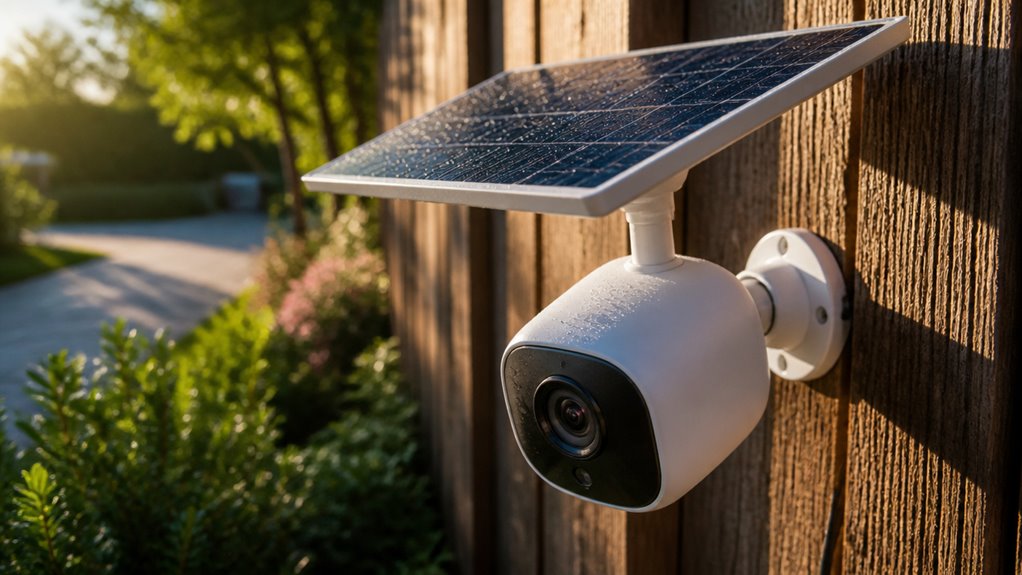

Your outdoor solar security camera generally needs 2 to 6 hours of direct sunlight daily for reliable operation.
However, high-efficiency panels can reduce that to as little as 30 minutes to 1 hour.
Battery size influences how much sunlight you’ll need to keep power steady, with larger batteries requiring longer charging.
Weather, shadows, and proper positioning affect sunlight absorption.
Maintaining a clean, unshaded, well-angled panel is essential.
Exploring these factors helps optimize your camera’s solar performance.
Key Takeaways
- Outdoor solar security cameras typically need 2 to 6 hours of direct sunlight daily for reliable battery charging and operation.
- High-efficiency solar panels can reduce sunlight requirements to as little as 30 minutes to 1 hour under ideal conditions.
- Clear, unobstructed sunlight exposure and proper panel positioning maximize charging effectiveness and minimize shading impacts.
- Cloudy or overcast weather significantly reduces effective sunlight, requiring larger battery capacity or longer charging times.
- Regular cleaning and maintenance of the solar panel ensure optimal sunlight absorption and sustained charging performance.
How Much Sunlight Does Your Solar Camera Need?
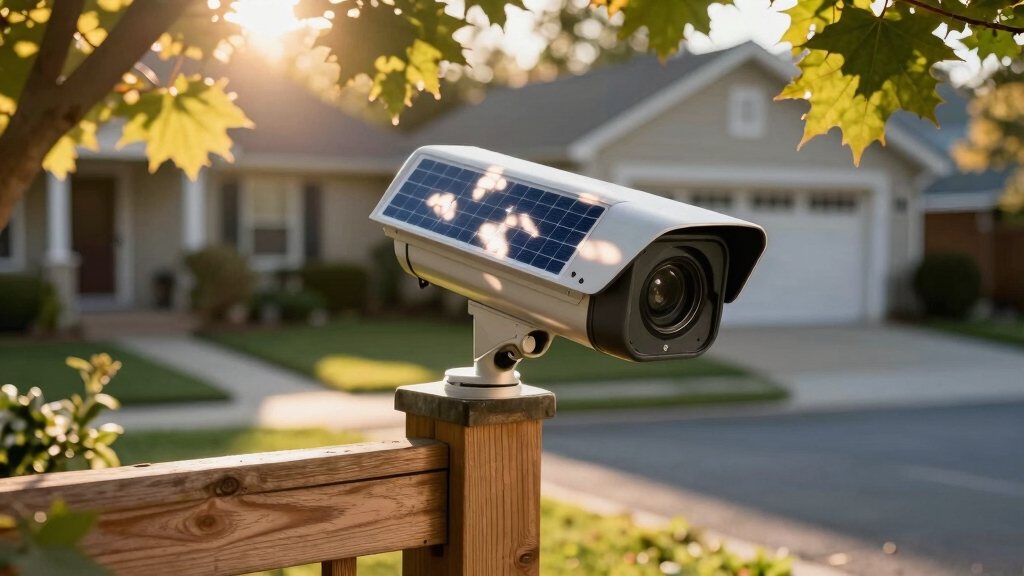
To keep your outdoor solar camera running smoothly, you’ll need to provide it with a consistent amount of sunlight daily. Generally, 2 to 4 hours of direct sunlight maintains the battery charge, while 4 to 6 hours guarantee reliable operation.
Consistent daily sunlight, typically 2 to 4 hours, keeps your outdoor solar camera charged and running smoothly.
Well-engineered models often require 2 to 3 hours, but high-efficiency panels like Wyze need only about 1 hour. Under ideal conditions, Tapo panels operate with 30 minutes to 1 hour of sun.
Factors such as battery capacity, panel size, and camera power consumption influence these requirements. Keep in mind that indirect sunlight and shade drastically reduce charging efficiency, so direct exposure is essential.
Position your solar panel where it receives unobstructed sun for several hours daily to maintain peak camera performance and battery health. Charging through windows is possible but less efficient because glass filters UV and reduces light intensity, so outdoor exposure is preferred for optimal performance and charging efficiency.
Why Solar Panel Efficiency Changes How Much Sunlight You Need?
Although solar panels convert sunlight into electricity, their efficiency directly determines how much sun your outdoor camera needs to operate reliably. Higher efficiency panels generate more power from the same sunlight, reducing required exposure time. Conversely, less efficient panels demand longer sun exposure to maintain adequate charge levels.
Consider these factors influencing sunlight requirements due to panel efficiency:
- Conversion Rate: Efficient panels convert a larger percentage of solar energy, shortening charging duration.
- Panel Size: Smaller, high-efficiency panels can deliver equal power output as larger, low-efficiency ones.
- Environmental Impact: Efficiency dictates performance under indirect sunlight or partial shading.
- Power Stability: Higher efficiency guarantees steady energy supply during variable weather conditions.
Optimizing panel efficiency decreases sunlight dependency and improves your camera’s reliability. Additionally, ensuring a stable power source is crucial to maintain reliable and uninterrupted outdoor camera operation.
How Battery Capacity Affects Solar Camera Charging?
Understanding how battery capacity impacts your solar camera’s charging process builds on recognizing the role of panel efficiency in sunlight requirements.
A larger battery capacity provides a greater power buffer, allowing the camera to operate longer during periods of low sunlight.
However, it also requires more energy and therefore longer charging times to reach full capacity.
Conversely, a smaller battery charges faster but offers less reserve during cloudy or shaded conditions.
You must balance battery size with expected sunlight exposure to guarantee reliable operation.
For example, if your location receives only 2-4 hours of direct sun daily, a moderate capacity battery paired with an efficient panel optimizes charging cycles and prevents power loss.
Ultimately, battery capacity directly influences how much sunlight your camera needs to maintain continuous function.
Regular maintenance and testing of the battery, similar to the practices recommended for lithium battery replacement, ensure dependable performance and longevity.
How Weather Affects Your Solar Camera’s Power?
Since solar cameras rely heavily on sunlight for power, weather conditions directly influence their charging efficiency and operational continuity.
You need to understand how varying weather impacts your solar camera’s performance to guarantee reliable surveillance.
- Clear sunny days provide 6+ hours of optimal charging, maximizing battery capacity.
- Partly cloudy skies reduce charging to 3-5 hours, still sufficient for maintenance but less efficient.
- Overcast or rainy conditions limit effective sunlight to 0-2 hours, forcing greater battery reliance and possible power-saving modes.
- Seasonal shifts, like clear winter days, offer 2-4 hours of sunlight, requiring careful energy management to maintain camera operation.
Regularly cleaning the solar panel and positioning it for maximum sunlight exposure helps maintain charging efficiency and ensures year-round performance.
How Shadows and Location Reduce Solar Charging?
Shadows can substantially cut down the amount of sunlight your solar camera receives, directly impacting its charging efficiency. When your panel is shaded by trees, buildings, or nearby structures, the effective solar irradiance drops sharply, reducing power output and extending charging time.
Even partial shading during peak sunlight hours can cause significant voltage drops, impairing battery recharge cycles. Location plays a critical role; areas with frequent shadows or narrow sun exposure windows limit daily solar gain, often below the 2-4 hour threshold needed for reliable operation.
Deep shade or indirect light won’t suffice, as these conditions generate insufficient energy for continuous camera function. To maintain peak performance, you must evaluate the installation site carefully, ensuring minimal shadow interference throughout the day while considering the sun’s path and local obstructions.
Additionally, optimizing settings such as recording modes can help manage power consumption effectively when solar charging is limited.
How to Position Your Solar Panel for Maximum Sunlight?
To capture the maximum sunlight, position your solar panel facing true south if you’re in the Northern Hemisphere. This ensures it receives the most direct sun throughout the day.
Tilt the panel between 30 and 45 degrees to align with the sun’s elevation, maximizing energy absorption. Avoid shading from trees, buildings, or chimneys that can drastically reduce charging efficiency.
Keep the panel within 10 feet of your camera to maintain prime cable performance.
Follow these essential positioning tips:
- Align the panel true south for peak solar exposure.
- Set tilt angle based on latitude for direct sunlight capture.
- Eliminate all shadows during peak sun hours.
- Mount on rooftops or open areas with uninterrupted sunlight.
Proper positioning directly impacts your camera’s reliability and battery longevity. Regular visual inspections help ensure shading or dirt does not reduce panel efficiency over time.
Why Regular Maintenance Boosts Solar Panel Sunlight Capture?
To really get the most out of your solar panels, regular maintenance is key. Think about it—when you clean them, you’re removing dust and debris that can block sunlight and lower absorption. It’s like giving your panels a fresh start!
And don’t forget about airflow! Keeping your panels well-ventilated prevents overheating, ensuring that they run at their best.
Plus, if there are any shadows or obstructions around, removing those will help maintain that all-important direct sunlight exposure. After all, reliable charging depends on it!
Additionally, combining regular upkeep with proper preparation of components can significantly improve overall efficiency and sustainability.
Cleaning For Maximum Absorption
When dust, dirt, and debris accumulate on your solar panel, they markedly reduce its ability to absorb sunlight efficiently.
You need to clean your panel regularly to maintain optimal energy capture and guarantee reliable camera operation.
Neglecting this leads to reduced charging rates and shorter battery life.
Follow these steps for effective cleaning:
- Use a soft cloth or sponge with mild soapy water to remove surface grime.
- Avoid abrasive materials that can scratch the panel’s surface, lowering efficiency.
- Rinse thoroughly with clean water to eliminate soap residue.
- Schedule cleaning at least once a month or more frequently in dusty environments.
Regular cleaning maximizes sunlight absorption, maintaining peak solar panel performance and extending system longevity. Additionally, maintaining proper temperature levels around your solar panel helps prevent premature component degradation and ensures consistent performance.
Preventing Overheating Issues
Although solar panels are designed to withstand high temperatures, excessive heat can markedly reduce their efficiency and lifespan.
You should ensure proper airflow around the panel to dissipate heat and prevent thermal buildup, which directly impacts energy conversion rates.
Avoid mounting panels near flammable materials or in enclosed spaces that trap heat.
Regularly inspect for dust or debris that not only blocks sunlight but also insulates the panel, causing temperature rise.
Using high-efficiency ETFE panels helps, but maintenance remains vital for peak performance.
Overheated panels degrade faster, lowering charge capacity and risking premature failure.
Maintaining good air circulation around solar panels is essential to reduce heat buildup and enhance their operational efficiency.
Removing Shadows And Obstructions
Proper airflow and temperature control aren’t the only factors that influence solar panel efficiency; shadows and physical obstructions also play a significant role in reducing sunlight absorption.
To maintain ideal power generation for your outdoor solar security camera, you must regularly inspect and clear any shading elements.
Here’s what you should focus on:
- Trim nearby tree branches that cast shadows during peak sunlight hours.
- Remove debris or dirt buildup on the solar panel surface to prevent partial shading.
- Reposition or adjust the panel to avoid obstructions like antennas, chimneys, or walls.
- Monitor seasonal changes in sun angle that may introduce new shadows over time.
Consistent removal of shadows and obstructions guarantees maximum direct sunlight exposure.
This sustains reliable camera operation and battery health.
Additionally, using devices with integrated 10-year sealed batteries ensures long-lasting power even when sunlight conditions vary.
How High-Efficiency Panels Lower Sunlight Needs?
High-efficiency solar panels are pretty amazing! They actually cut down the amount of sunlight needed for effective charging, sometimes requiring just about an hour of sunlight a day. Isn’t that cool?
Reduced Sunlight Requirements
When you choose high-efficiency solar panels, such as those using ETFE materials or advanced photovoltaic cells, you markedly reduce the amount of direct sunlight your outdoor camera requires to maintain reliable operation.
These panels convert sunlight to electricity more effectively, allowing your camera to function with less exposure.
Key factors worth noting include:
- Lower Minimum Sunlight: High-efficiency panels can operate with as little as 30 minutes to 1 hour of direct sunlight daily.
- Improved Charging Under Diffuse Light: They capture more energy from indirect or cloudy conditions.
- Smaller Panel Size: You can use compact panels without sacrificing performance.
- Extended Battery Life: Consistent charging reduces deep discharge cycles, preserving battery health.
Enhanced Charging Efficiency
Building on how high-efficiency solar panels reduce sunlight requirements, their enhanced charging efficiency directly impacts the camera’s energy intake by maximizing power conversion even under limited light.
These panels utilize advanced photovoltaic cells that convert a greater percentage of solar energy into electrical power, allowing your camera to charge effectively with as little as one hour of direct sunlight daily.
This efficiency compensates for suboptimal conditions like partial shading or overcast skies, maintaining a steady charge rate.
By optimizing energy capture, high-efficiency panels minimize reliance on extended sun exposure, ensuring your camera operates reliably with shorter sunlight durations.
To fully benefit, position the panel to maximize incident light and keep its surface clean. Even minor obstructions can reduce the panel’s ability to convert available sunlight into usable power.
Extended Battery Life
Harnessing high-efficiency solar panels directly contributes to extending your camera’s battery life by reducing the frequency and duration of sunlight exposure required for charging.
These advanced panels convert sunlight more effectively, allowing your camera to operate longer with less direct sun.
By optimizing energy capture, they lower the strain on the battery, enhancing its longevity.
Key factors include:
- Increased conversion efficiency reduces daily sunlight needed to maintain charge.
- Lower power consumption results from stable, consistent energy input.
- Smaller charge cycles decrease battery degradation over time.
- Enhanced panel materials, like ETFE coatings, improve durability and energy retention.
Frequently Asked Questions
Can Solar Security Cameras Work Indoors With Artificial Lighting?
No, solar security cameras generally won’t work indoors with artificial lighting because the energy output from typical indoor lights is far too low to effectively charge the solar panels.
These panels rely on direct or strong indirect sunlight to generate sufficient power.
You’d need specialized, high-intensity grow lights positioned very close, but even then, performance will be limited and unreliable for continuous operation indoors.
How Do Different Solar Panel Materials Compare in Durability?
Different solar panel materials vary in durability.
Monocrystalline panels offer high efficiency and last 25-30 years with proper care.
Polycrystalline panels are less efficient but still durable.
They may degrade faster under harsh conditions.
Thin-film panels are lightweight but less durable and have shorter lifespans.
ETFE-coated panels enhance durability by resisting dirt and weathering.
This reduces maintenance needs.
Choose materials based on your environment and maintenance willingness for maximum longevity.
Are There Smartphone Apps to Monitor Solar Camera Charging Status?
Yes, many outdoor solar security cameras come with smartphone apps that let you monitor charging status in real time.
These apps provide detailed battery levels, solar panel efficiency, and power consumption metrics.
You can receive alerts for low battery or charging issues, enabling proactive maintenance.
Popular brands like Wyze and Tapo integrate this functionality, giving you precise control and insight into your camera’s solar charging performance from anywhere.
What Is the Average Lifespan of a Solar Security Camera Battery?
You can expect the average lifespan of a solar security camera battery to range between 3 to 5 years, depending on usage and battery type.
Lithium-ion batteries, common in these cameras, degrade gradually with charge cycles and temperature fluctuations.
To maximize battery life, ensure proper sunlight exposure, avoid deep discharges, and maintain moderate temperatures.
Replacing the battery after this period keeps your camera reliable and maintains peak performance.
Can Solar Cameras Store Excess Energy for Nighttime Use?
Absolutely, your solar camera can tuck away extra energy for the night. It stores surplus power in its built-in rechargeable battery, ensuring continuous operation when sunlight fades.
The battery capacity and panel efficiency dictate how much reserve you get. Proper installation and maintenance maximize this energy bank, letting your camera function reliably through darkness, cloudy days, or extended low-light spells without interruption.
This energy buffer is essential for seamless security coverage.
Make Your Outdoor Solar Camera More Reliable
You don’t need a medieval sundial to understand that your solar security camera’s sunlight needs hinge on panel efficiency, battery capacity, and location.
By positioning your panel to avoid shadows and performing regular maintenance, you maximize sunlight capture.
Weather variations and high-efficiency panels also play vital roles. Keep these factors in check, and your camera will stay powered reliably, ensuring continuous security without interruption.