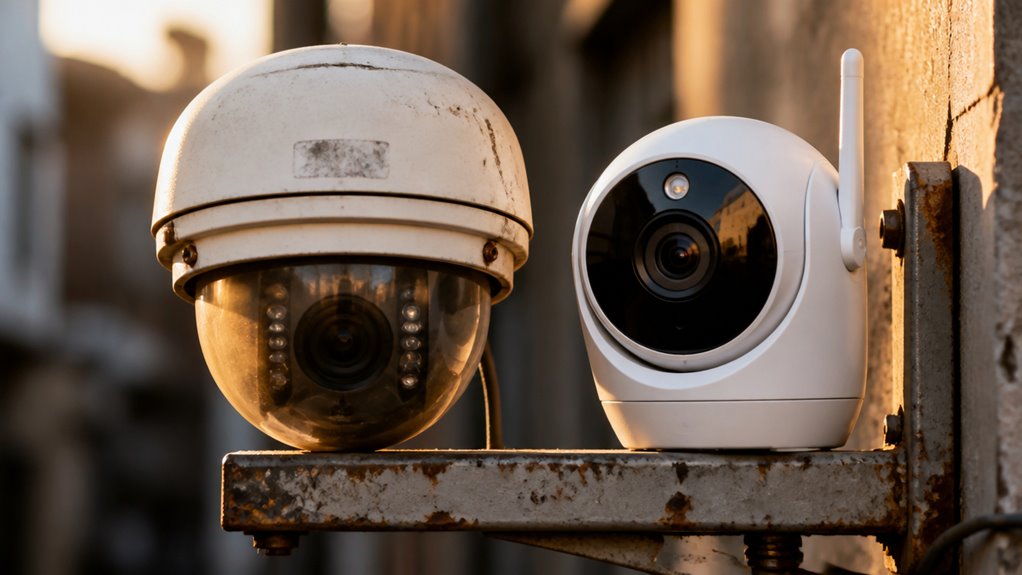

When choosing between analog and IP security cameras, consider your priorities.
Analog cameras are cost-effective with simpler coaxial wiring but max out at 1080p resolution and need separate power lines.
IP cameras deliver superior image quality up to 8K with PoE simplifying installation, plus advanced AI and scalable network integration.
IP systems also offer better low-light capture, compression, and remote access, though they require networking knowledge.
Understanding these trade-offs helps you select the best fit for your surveillance needs.
Key Takeaways
- IP cameras offer higher resolution (up to 8K) and better low-light performance than analog cameras, which max out around 1080p.
- Analog cameras use coaxial cables (RG59) with longer single-run distances (~800 ft), while IP cameras use Ethernet cables limited to ~328 ft per segment.
- IP systems support Power-over-Ethernet (PoE), enabling single-cable power and data delivery, whereas analog cameras require separate power lines.
- IP cameras provide remote access, cloud storage, and advanced AI analytics, unlike analog systems that rely on local DVRs with limited remote functionality.
- Analog cameras have lower upfront costs but are less scalable and require costly rewiring for expansion compared to the flexible, network-based IP systems.
Analog vs IP Security Cameras: Key Features Compared
| Comparison Factor | Analog Security Cameras | IP Security Cameras |
|---|---|---|
| Video quality | Commonly supports 720p to 1080p, depending on the system | Supports high-resolution video, including 4K and selected 8K models |
| Video transmission | Sends an analog signal through coaxial cabling to a DVR | Sends digital video data through Ethernet, Wi-Fi, or a network |
| Recorder type | Usually connects to a DVR, which processes and stores footage | Commonly connects to an NVR, server, cloud platform, or network storage |
| Cabling | Uses RG59 coaxial cable and often requires separate power wiring | Uses Cat5e or Cat6 Ethernet, often carrying power and data together |
| Power delivery | Usually needs a separate power connection for each camera | Often supports Power over Ethernet, reducing cable requirements |
| Installation | Generally offers a simpler hardware setup, especially with existing coaxial wiring | Requires network configuration, device addressing, and cybersecurity planning |
| Remote access | Remote viewing may depend on the DVR and additional configuration | Provides more flexible mobile, desktop, and cloud-based access |
| Smart features | Usually limited to basic motion detection and recorder-based functions | May include object detection, facial recognition, motion tracking, and intelligent alerts |
| Scalability | Expansion may require additional DVR channels and new cable runs | Easier to expand through network switches and existing infrastructure |
| Low-light performance | Performance varies, but lower-resolution models may produce grainier night footage | Larger sensors and digital processing can provide clearer low-light images |
| Maintenance focus | Requires cable checks, connector inspections, and DVR hardware maintenance | Requires firmware updates, network monitoring, password management, and cybersecurity maintenance |
| Best suited for | Smaller installations, basic monitoring, or properties with existing coaxial infrastructure | Larger, expanding, or feature-rich surveillance systems requiring high detail and remote management |
How To Choose Between Analog And IP Cameras?
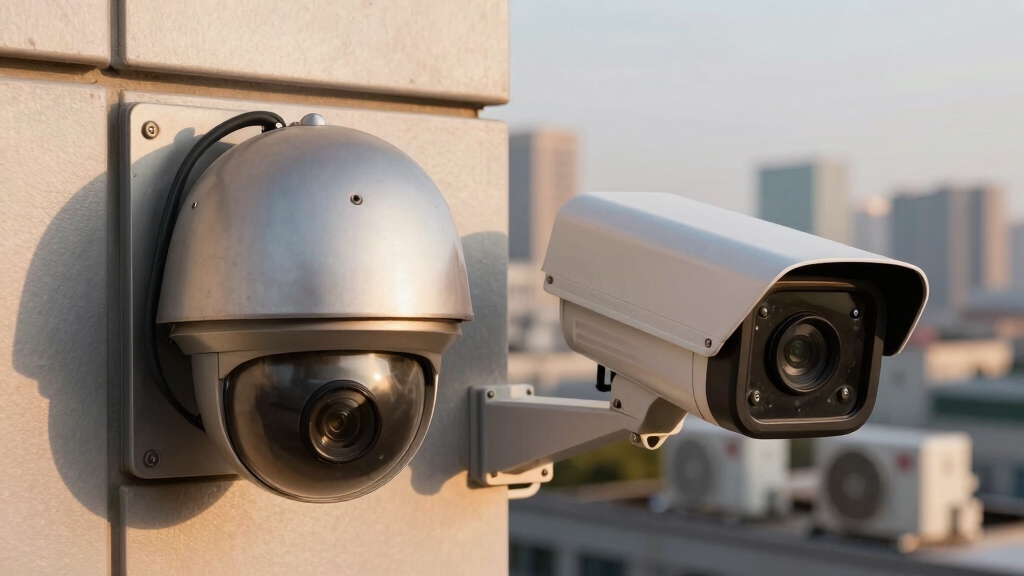
When deciding between analog and IP cameras, what factors should you prioritize to match your security needs?
First, consider your existing infrastructure and installation complexity. Analog cameras require coaxial cabling and direct connection to DVRs, which simplifies setup but limits flexibility.
IP cameras rely on Ethernet or Wi-Fi networks, demanding more advanced configuration but offering PoE for streamlined power and data delivery.
Next, evaluate scalability. IP systems integrate easily with network expansions, whereas analog setups often need costly rewiring for added units.
Also, assess your storage approach. IP cameras encode video locally before transmission, supporting cloud and remote access, while analog cameras depend on DVR encoding with limited remote functionality.
Finally, factor in maintenance. IP cameras require ongoing software updates and network security, whereas analog systems focus on hardware upkeep and cable integrity.
Additionally, IP cameras transmit encrypted digital video, enhancing security but requiring proper network configuration to prevent cyber threats.
Image Quality And Performance Differences In Analog vs IP Cameras
IP cameras really stand out when it comes to resolution and clarity. They can deliver stunning images, even reaching up to 8K with impressive chroma accuracy. In comparison, analog cameras are pretty limited, usually maxing out at 1080p or 720p.
Another area where IP cameras shine is low-light performance. Their larger sensors allow them to capture more detail in dimly lit environments, which is something analog cameras often struggle with.
And let’s not forget about motion capture! IP systems handle fast-moving scenes much better, thanks to their quicker frame rates and efficient digital compression. This means less pixelation and blur when things get a bit hectic. Overall, it’s clear that IP cameras have a significant edge over their analog counterparts in these aspects.
Additionally, IP cameras encode video digitally at the camera itself, reducing the processing load on the recorder and enabling higher resolutions and clearer images.
Resolution And Clarity
Experience a marked difference in resolution and image clarity when comparing IP and analog security cameras.
IP cameras support resolutions up to 4K and 8K with advanced Alpha chroma clarity, delivering crisp, detailed footage.
In contrast, analog cameras typically max out at 1080p HD-TVI or CVI, with 720p being more common.
This limits sharpness and fine detail.
You’ll notice IP’s superior digital compression and higher frame rates reduce pixelation and motion blur, especially during fast movements.
Analog’s smaller 1/3 inch sensors contribute to grainier images and less clarity.
When you require precise identification or forensic analysis, IP’s enhanced resolution and image fidelity provide a distinct advantage.
This ensures you capture accurate, reliable visual data critical for security applications.
Additionally, IP cameras utilize H.265 compression to efficiently balance video quality and storage requirements.
Low-Light Performance
Low-light conditions frequently challenge security camera performance. IP cameras handle these scenarios with greater effectiveness than analog models.
You’ll notice this primarily because IP cameras use larger sensors—typically 1/1.8 or 1/2 inch—versus the smaller 1/3 inch sensors in analog cameras. This sensor size difference translates to better light capture and less noise in dark environments.
Consider these factors when evaluating low-light performance:
- IP cameras’ larger sensors increase sensitivity, improving image brightness and detail.
- Analog cameras often produce grainy or pixelated images under minimal lighting.
- IP systems leverage advanced digital noise reduction algorithms for clearer visuals.
- Higher resolution on IP cameras guarantees low-light footage retains critical details, unlike analog’s limited 720p or 1080p max.
Ultimately, IP cameras deliver superior clarity and reliability in low-light scenarios. Many turret cameras support improved low-light image quality through reduced IR glare, further enhancing nighttime surveillance.
Motion Capture Quality
Motion capture quality hinges on how well a camera maintains clarity and detail during movement. IP cameras outperform analog systems in this regard.
IP cameras leverage higher frame rates and advanced digital compression (H.265), preserving sharpness even when subjects move rapidly. Their larger sensors (1/1.8 or 1/2 inch) capture more light, reducing motion blur and grain that often plague analog’s smaller 1/3 inch sensors.
Analog cameras, limited to 720p or 1080p resolutions, frequently exhibit pixelation and loss of detail when tracking fast motion due to lower frame rates and analog signal degradation.
When you need precise, clear motion capture, such as identifying faces or license plates during movement, IP cameras deliver superior performance. They ensure critical details remain intact without compromising video fluidity or introducing artifacts common in analog systems.
Additionally, IP cameras benefit from higher video quality due to stable digital data transmission and minimal interference, unlike analog systems which can degrade over coaxial cables.
Connectivity And Cable Requirements For Analog And IP Cameras
When it comes to connectivity for your security cameras, it’s important to know what type of cables each camera uses. So, let’s break it down a bit.
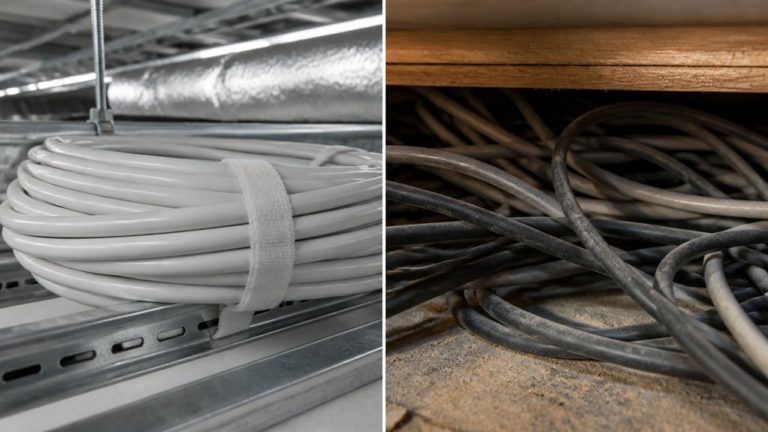
Analog cameras typically rely on coaxial cables, like RG59. These cables can transmit signals up to about 800 feet, but keep in mind that you might experience some signal degradation over that distance.
On the other hand, if you’re considering IP cameras, they use Ethernet cables—usually Cat5 or Cat6. These cables work well for up to 328 feet per hop, but the great thing about them is that you can extend the range indefinitely using network infrastructure. That’s a pretty big advantage if you’re planning a larger setup.
Now, let’s talk about power delivery. With analog cameras, you’ll need to provide separate power sources, which can complicate your installation a bit. However, IP cameras often come with Power-over-Ethernet (PoE) capabilities. This means you can send both data and power through a single cable, simplifying your setup significantly.
For the best results, it is also crucial to route and protect cables properly to avoid interference and ensure system reliability.
Cable Types Used
When setting up security cameras, understanding the cable types used is essential for ensuring reliable connectivity and peak performance.
Analog cameras rely on coaxial cables, specifically RG59, which carry both video signals and power over short distances to Digital Video Recorders (DVRs).
IP cameras, meanwhile, use Ethernet cables such as Cat5 or Cat6, enabling data transmission and Power-over-Ethernet (PoE) through a single cable.
Here’s what you need to take into account:
- RG59 coaxial cables transmit analog signals with limited bandwidth and are prone to interference over long runs.
- Cat5/Cat6 Ethernet cables support higher data rates essential for IP camera resolutions up to 8K.
- PoE simplifies IP setup by delivering power and data simultaneously, reducing cable clutter.
- Proper cable shielding and quality impact signal integrity for both analog and IP systems.
Additionally, AHD cameras use coaxial cables to transmit high-definition analog video over long distances with minimal signal degradation, bridging the gap between traditional analog and IP systems.
Transmission Distance Limits
Although both analog and IP cameras require cables for data transmission, their maximum effective distances differ markedly due to signal type and cable technology.
Analog cameras transmit uncompressed video over coaxial cables (RG59), supporting distances up to 800 feet (244 meters) before signal degradation occurs.
IP cameras send digital data through Ethernet cables (Cat5/Cat6), limited to 328 feet (100 meters) per hop, though network switches can extend this range.
Understanding these limits helps you design an efficient surveillance layout without signal loss.
| Camera Type | Maximum Cable Distance |
|---|---|
| Analog | Up to 800 feet (244 meters) |
| IP | 328 feet (100 meters) per hop |
| Analog | Requires signal boosters beyond 800 feet |
| IP | Distance extended via network switches |
Careful camera placement and adherence to privacy guidelines are essential to minimize legal and ethical risks.
Power Delivery Methods
Power delivery methods distinguish analog and IP security cameras markedly, shaping their connectivity and cable requirements. When you install analog cameras, you’ll rely on separate power cables alongside coaxial video cables, increasing wiring complexity. IP cameras simplify this by using Power-over-Ethernet (PoE), where a single Ethernet cable transmits both power and data.
- Analog cameras require RG59 coaxial cables plus additional power lines, complicating installation.
- IP cameras use Cat5 or Cat6 Ethernet cables, supporting PoE to deliver power and data simultaneously.
- PoE limits cable runs to 328 feet without repeaters, while analog power lines may require boosters for longer distances.
- IP systems reduce cable bulk and installation costs, benefiting from network infrastructure and centralized power management.
Proper wiring management and protection are essential to maintain system reliability and prevent connectivity issues.
Understanding these differences helps you choose the right infrastructure for your surveillance setup.
Storage And Remote Access Options For Analog And IP Cameras
Because storage and remote access are critical to effective surveillance, understanding the differences between analog and IP camera systems in these areas is essential.
Analog cameras transmit raw video signals to DVRs, which handle encoding and compression locally. This setup limits remote access, typically requiring dedicated apps or hardware configurations.
In contrast, IP cameras perform H.265 compression onboard before sending data to NVRs, local servers, or cloud platforms. This networked approach enables seamless remote viewing via mobile or desktop apps, providing real-time access from anywhere with Internet connectivity.
Additionally, IP systems support scalable storage options and cloud integration, allowing flexible retention policies and easier management. You’ll find analog systems more constrained by physical DVR hardware, while IP setups offer advanced, network-based storage and remote access capabilities essential for modern surveillance demands.
NVRs also offer event-triggered recording features that enhance storage efficiency and security monitoring effectiveness.
Costs And Scalability Of Analog vs IP Camera Systems
Evaluating the costs and scalability of analog versus IP camera systems reveals distinct financial and logistical considerations that directly impact your surveillance strategy.
Analog cameras generally cost less upfront, ranging from $30 to $180, making initial deployment more affordable. However, expanding analog systems demands additional coaxial cabling and DVR channel capacity, increasing complexity and costs.
IP cameras, priced between $60 and $400+, offer easier scalability by integrating into existing network infrastructure without extensive rewiring.
Consider these factors:
- Analog setup has lower initial costs but higher incremental expansion expenses.
- IP systems require higher upfront investment but scale efficiently with network growth.
- IP storage and bandwidth costs tend to be higher due to digital data transfer.
- Analog expansion necessitates physical infrastructure upgrades for each new camera.
Understanding these trade-offs helps optimize your budget and future-proof your surveillance network.
Installation Differences Between Analog And IP Cameras
After considering costs and scalability, installation differences substantially influence your choice between analog and IP camera systems.
Analog cameras require straightforward coaxial cable runs directly to a DVR, with basic electrical skills sufficing for setup.
Conversely, IP cameras demand network configuration expertise, including managing switches and device IPs.
PoE simplifies power and data delivery for IP, reducing wiring clutter, but you must guarantee network stability and security.
| Aspect | Analog Cameras | IP Cameras |
|---|---|---|
| Cabling | Coaxial (RG59), limited to ~800 ft | Ethernet (Cat5/Cat6), PoE up to 328 ft |
| Installation Skill | Basic electrical wiring | Networking and device configuration |
| Maintenance | Cable and DVR hardware checks | Software updates, network security |
These distinctions impact your installation time, costs, and long-term management complexity.
Smart Features And AI In IP Cameras vs Analog Cameras
You know, when you look at IP cameras, they come packed with some pretty advanced AI features. Think about things like facial recognition and behavior analysis. These capabilities really go beyond what you get with the basic motion detection in analog systems. It’s like having a personal security assistant!
And here’s the cool part: these smart features allow for precise object classification and motion tracking right on the device itself. This means you’ll see a big drop in false alarms, which is a huge win.
Now, let’s talk about access. With IP cameras, you can easily connect to cloud platforms for seamless remote access. On the flip side, if you’re using an analog setup, you’re pretty much stuck with local DVR connections. That means no real-time AI integration, which is a bummer. So, it’s clear that IP cameras really take the lead in today’s security tech!
Advanced AI Capabilities
When you explore the advanced AI capabilities of security cameras, IP systems clearly stand out by integrating sophisticated analytics such as facial recognition, license plate reading, and object classification directly on the device.
These AI-driven functions process data locally, reducing latency and bandwidth usage. You benefit from:
- Real-time facial recognition that enhances security access control.
- Automatic license plate reading for efficient vehicle monitoring.
- Object classification distinguishing people, animals, or vehicles accurately.
- Behavior analysis detecting unusual activities for proactive alerts.
In contrast, analog cameras rely on DVRs that offer only basic motion detection without on-device AI.
IP cameras also support scalable firmware updates, enabling continuous AI improvements. This makes IP systems highly adaptive and intelligent.
Analog hardware remains static after installation, limiting its analytical potential.
Motion Detection Differences
Building on the advanced AI capabilities in IP cameras, motion detection technology sets these systems apart from analog counterparts. IP cameras leverage onboard AI algorithms to analyze pixel changes, distinguishing between relevant motion like humans or vehicles and irrelevant disturbances such as shadows or foliage movement.
This reduces false alarms and bolsters event accuracy. Meanwhile, analog cameras rely on basic pixel-change detection processed by DVRs, lacking contextual understanding, which often triggers unnecessary alerts.
Additionally, IP cameras support motion tracking, enabling the system to follow moving objects across multiple frames, improving situational awareness.
Their higher frame rates and digital encoding guarantee motion clarity, while analog systems suffer from pixelation during movement. Consequently, IP cameras offer superior, intelligent motion detection that heightens security response efficiency and reduces storage clutter from false positives.
Remote Access Features
Among the most transformative advantages of IP cameras is their seamless remote access capability. This leverages cloud storage and internet connectivity to provide real-time video monitoring from virtually anywhere.
Unlike analog systems that rely on direct DVR connections with limited remote functionality, IP cameras offer dynamic smart features and AI-driven analytics accessible remotely. You can:
- View live and recorded footage instantly through mobile apps or web portals.
- Receive AI-triggered alerts for facial recognition, motion tracking, and behavior analysis.
- Update firmware remotely to enhance AI capabilities without hardware changes.
- Store encrypted video on cloud platforms, ensuring secure off-site backups.
This integration of remote access and AI enhances situational awareness and system scalability. It makes IP cameras vastly superior for modern security needs.
Low-Light And Motion Performance: Analog vs IP Cameras
Although both analog and IP cameras serve surveillance purposes, their performance in low-light and motion scenarios differs markedly due to sensor size and processing capabilities.
IP cameras use larger sensors, typically 1/1.8 inch or 1/2 inch, allowing better light capture than analog’s smaller 1/3 inch sensors. This translates to clearer night footage with less noise.
When it comes to motion, IP cameras deliver higher frame rates and advanced digital compression, reducing pixelation and motion blur.
Analog cameras, constrained by lower frame rates and older encoding methods, often produce grainy images with motion artifacts.
If you need crisp details in dim environments or fast-moving subjects, IP cameras offer a significant advantage over analog in both image fidelity and motion clarity.
Maintenance Needs For Analog And IP Camera Systems
Regular maintenance plays a vital role in ensuring the reliability and longevity of both analog and IP camera systems, but the nature and complexity of these tasks differ markedly.
When managing your analog system, you’ll focus on physical inspections and hardware upkeep. IP cameras demand more technical attention, involving software and network upkeep.
Here’s what you should consider:
- Analog systems require regular cable integrity checks and DVR hardware diagnostics to prevent signal loss.
- IP systems need frequent firmware updates to patch vulnerabilities and enhance features.
- Network performance monitoring is crucial for IP cameras to avoid connectivity disruptions.
- Analog maintenance is generally less complex, while IP systems often involve troubleshooting network configurations and cybersecurity protocols.
Understanding these maintenance distinctions helps you optimize system performance and reduce downtime effectively.
Which Camera System Fits Your Use Case Best?
How do you determine which camera system best suits your specific security needs? Start by evaluating your priorities: resolution, scalability, budget, and installation complexity.
IP cameras excel in high-resolution imaging, smart features, and flexible network expansion. They are ideal for large or evolving setups. Analog cameras offer simpler installation and lower upfront costs, fitting smaller or budget-constrained projects.
| Factor | IP Cameras | Analog Cameras |
|---|---|---|
| Resolution | Up to 8K, superior motion clarity | Max 1080p, lower motion detail |
| Installation | Complex network setup | Simple cabling |
| Scalability | Easily expandable via network | Limited by coaxial wiring |
| Cost | Higher initial and storage cost | Lower upfront cost |
Choose based on your technical capacity, future growth, and feature requirements.
Frequently Asked Questions
Can Analog Cameras Be Upgraded With AI Features Later?
You can’t upgrade analog cameras with AI features directly, since they lack onboard processing power and digital architecture.
AI analytics require smart IP devices capable of running algorithms locally or on connected networks. While you could theoretically add external AI-capable hardware, it complicates the system and negates analog’s simplicity.
For true AI functionality like facial recognition or behavior analysis, replacing analog cameras with IP models is necessary.
What Is the Typical Lifespan of Analog vs. IP Cameras?
You know what they say: “A stitch in time saves nine.”
Typically, analog cameras last around 5 to 7 years before image quality degrades or hardware fails. IP cameras often have a similar physical lifespan but benefit from software updates that extend usability.
However, their complexity means you’ll need regular maintenance. Considering tech advances, you might replace IP cameras sooner to keep up with resolution and AI improvements, while analog units become obsolete faster.
Are There Privacy Concerns Unique to IP Camera Systems?
Yes, you’ll face unique privacy concerns with IP cameras because they connect to networks and the internet. This exposes your video streams to potential hacking, unauthorized access, or interception if encryption and network security aren’t robust.
You must implement strong passwords, firewall protections, and regularly update firmware to mitigate risks. Additionally, cloud storage can raise data sovereignty issues, so you need to verify where and how your video data is stored and managed.
How Do Weather Conditions Affect Analog and IP Camera Performance?
When weather throws a wrench in the works, both analog and IP cameras face challenges.
You’ll find analog cameras more vulnerable to signal degradation in heavy rain or snow due to coaxial cable interference.
IP cameras handle adverse conditions better with sealed housings and digital error correction.
However, extreme cold or heat can still impact sensor performance.
Proper weatherproofing and temperature regulation are key to keeping your surveillance sharp in any storm.
Can Analog and IP Cameras Be Integrated Into a Single System?
Yes, you can integrate analog and IP cameras into a single system using hybrid DVR/NVR units that support both signal types.
This allows you to leverage existing analog infrastructure while expanding with IP cameras for higher resolution and smart features.
You’ll need compatible hardware and proper network configuration to guarantee seamless video management.
Keep in mind, integration complexity rises with system size, requiring thorough planning for bandwidth, storage, and device compatibility.
Take the Next Step Toward Better Video Security
When choosing between analog and IP cameras, consider that IP cameras offer up to 4K resolution, delivering four times the detail of analog systems.
This enhanced image quality, combined with advanced AI features and scalable storage, makes IP cameras ideal for future-proof security.
However, analog cameras still provide reliable, cost-effective solutions for basic monitoring.
Your decision should balance technical needs, budget, and long-term scalability to guarantee you invest in a system that truly fits your security goals.