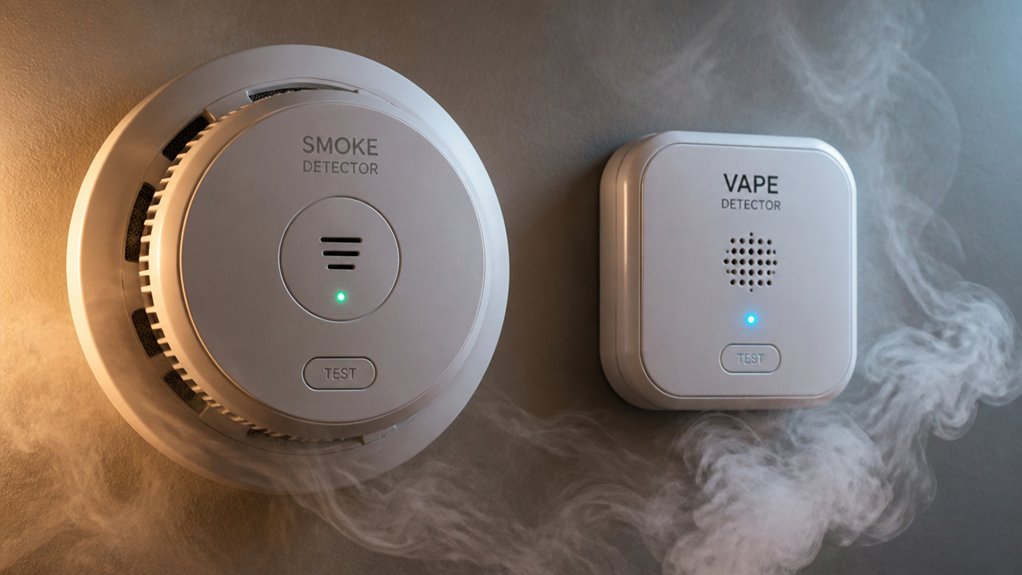

You need vape detectors to catch tiny vaping aerosols under 0.5 microns. Smoke detectors miss these since they target larger combustion particles like soot.
Smoke detectors excel at fire safety by triggering loud alarms for evacuation. Vape detectors provide discreet alerts to enforce vaping policies in schools or offices.
Both require proper calibration and placement to minimize false alarms. Understanding their distinct technologies and ideal applications guarantees you choose the right device for your environment’s safety and monitoring needs.
Key Takeaways
- Smoke detectors detect larger combustion particles and trigger loud alarms for fire evacuation, prioritizing life safety.
- Vape detectors sense smaller aerosol particles and chemical markers like nicotine, providing discreet alerts for vaping monitoring.
- Smoke detectors suit residential and industrial fire safety, while vape detectors fit schools and offices enforcing no-vape policies.
- Vape detectors use multi-sensor fusion and AI filtering to reduce false positives, unlike smoke detectors calibrated for larger particles.
- Alerts from smoke detectors prompt immediate evacuation, whereas vape detectors notify administrators discreetly to enforce policies.
Vape Detector vs Smoke Detector: Key Differences at a Glance
| Comparison Point | Vape Detector | Smoke Detector |
|---|---|---|
| Primary purpose | Identifies vaping activity and supports no-vaping policy enforcement | Detects possible fire and combustion smoke to provide an early warning |
| What it detects | Fine vape aerosols, airborne particles, and sometimes chemical or environmental changes | Smoke particles created by smoldering or flaming fires |
| Sensor technology | May use particle sensors, chemical sensors, air-quality monitoring, and detection algorithms | Commonly uses photoelectric, ionization, or combined sensing technology |
| Alert method | Usually sends discreet notifications to administrators, security teams, or facility managers | Activates a loud audible alarm to warn occupants and support evacuation |
| Common locations | Frequently installed in schools, offices, hotels, restrooms, and restricted indoor areas | Required or recommended in homes, workplaces, commercial buildings, and industrial facilities |
| False-alarm factors | Steam, aerosols, cleaning products, humidity, and changing air conditions may affect readings | Cooking fumes, dust, steam, insects, or poor placement may trigger unwanted alarms |
| Main safety role | Supports vaping monitoring, compliance, and indoor-environment management | Provides essential life-safety protection against fire hazards |
| Can it replace the other? | No. A vape detector should be treated as a supplementary monitoring device | No. Smoke detectors remain essential even when vape detectors are installed |
Vape vs Smoke Detectors: Which One Do You Need?
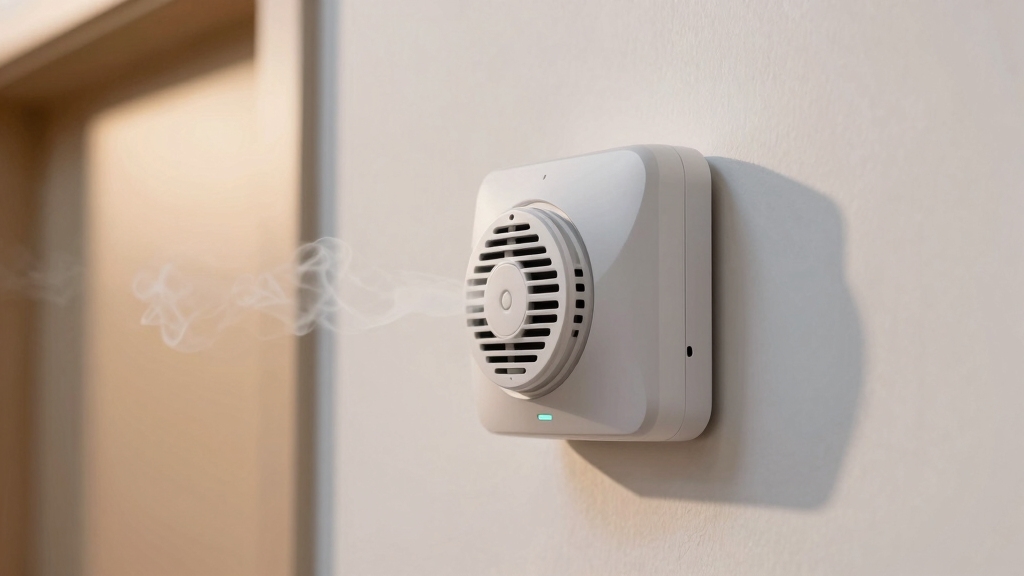
Although both vape and smoke detectors serve to monitor air quality, you need to choose one based on your specific detection requirements.
If your priority is fire safety, a smoke detector equipped with photoelectric or ionization sensors is essential. It identifies combustion particles and triggers evacuation alarms.
Conversely, if you need to monitor vaping activity or enforce no-vape policies in environments like schools or offices, a vape detector is more appropriate.
It uses laser-scattering sensors and chemical detection algorithms to identify aerosolized vapor particles and specific compounds such as nicotine.
Your choice depends on whether you require early fire hazard warnings or discreet vaping detection. Each device’s detection technology and alert mechanisms are optimized for distinct applications.
Selecting the correct detector enhances safety and compliance effectively. Proper placement and ventilation of smoke detectors is important to reduce false alarms caused by steam or humidity.
Particles Detected By Vape And Smoke Detectors
Understanding the specific particles that vape and smoke detectors identify helps clarify their distinct functionalities.
Smoke detectors primarily sense combustion particles produced by traditional fires, including larger soot and ash particles generated from burning wood, cigarettes, or other materials. They rely on photoelectric or ionization sensors to detect smoke density changes caused by these broader combustion particles.
Smoke detectors detect larger combustion particles like soot and ash using photoelectric or ionization sensors.
In contrast, vape detectors focus on much smaller aerosolized particles, typically under 0.5 microns, emitted by e-cigarettes and vape pens. They utilize laser-scattering particle sensors and chemical sensors to identify vapor components like propylene glycol and glycerin.
This specificity enables vape detectors to measure aerosol concentration accurately, differentiating vapor from ambient particulates and smoke. Recognizing these distinct particle profiles is essential for targeted detection and minimizing false alarms in diverse environments.
However, standard smoke detectors cannot distinguish vape aerosol from smoke due to their reliance on physical disruptions rather than chemical composition.
Why Vape Detectors Spot Vaping Aerosols Better Than Smoke Detectors?
You know, vape detectors really have the upper hand compared to smoke detectors. Why? Well, they use specialized sensors that are specifically designed to catch vaping aerosols, even at those tiny submicron particle sizes.
These detectors rely on advanced technology, like laser-scattering and chemical sensors, which help them pinpoint specific compounds such as propylene glycol. This means they can really focus in on the vapor itself.
Because of this targeted approach, vape detectors can distinguish between vapor and regular combustion smoke much more accurately. So, if you’re in the market for something reliable, vape detectors definitely have the edge!
Additionally, many modern vape detectors offer wireless interconnectivity for enhanced monitoring and alert capabilities.
Specialized Sensing Technology
Because vaping aerosols consist of much smaller and chemically distinct particles than traditional smoke, vape detectors employ specialized sensing technologies that smoke detectors lack.
Unlike smoke detectors, which primarily use photoelectric or ionization sensors, vape detectors integrate laser-scattering particle sensors and chemical sensors targeting compounds like nicotine and propylene glycol.
This multi-sensor fusion allows vape detectors to differentiate vaping aerosols from ambient particulates accurately.
You’ll appreciate how these advanced technologies:
- Detect submicron aerosol particles invisible to standard smoke sensors.
- Analyze chemical signatures unique to vaping liquids, reducing false alarms.
- Filter environmental noise using algorithms tailored for vaping detection.
These innovations guarantee vape detectors respond precisely to vaping activity rather than general combustion.
This enhances monitoring in sensitive environments like schools and offices.
Additionally, implementing specialized sensors helps ensure accurate detection and reduces false alarms in complex environments.
Enhanced Particle Detection
Vape detectors excel at identifying vaping aerosols due to their ability to sense much smaller and lighter particles than smoke detectors can detect.
While smoke detectors primarily target larger combustion particles from smoldering or flaming fires, vape detectors use laser-scattering sensors to measure aerosol particles under 0.5 microns.
These detectors analyze particle size, concentration, and chemical composition, distinguishing vapor from ambient particulates.
By incorporating multi-sensor fusion and chemical detection of compounds like propylene glycol and nicotine, vape detectors accurately identify vaping aerosols without triggering false alarms.
You’ll find smoke detectors often miss or misinterpret these smaller particles, reducing their effectiveness in vaping detection.
This enhanced particle detection capability allows vape detectors to offer precise, reliable monitoring tailored specifically to vaping aerosols rather than general smoke.
Their effectiveness is further improved by advanced processing techniques such as noise reduction to minimize false positives in varying environmental conditions.
Why Smoke Detectors Miss Vaping And Some Fires?
You know, smoke detectors are pretty essential for safety, but they’ve their limitations. They’re designed to pick up on larger combustion particles, which means that when it comes to the smaller aerosols from vaping, they often don’t register anything.
It’s interesting, right? The ionization and photoelectric sensors in these devices really struggle with low-density vapor clouds. And it’s not just vaping; they can also miss certain organic fires that don’t produce much smoke. So, when you think about it, it makes sense why some fires and vaping events might slip under the radar of traditional smoke alarms. Photoelectric smoke alarms, in particular, rely on light scattering by larger smoke particles, which explains their reduced sensitivity to the smaller particles found in vape aerosols.
Sensor Limitations Explained
Although smoke detectors excel at identifying combustion particles from fires, they often fail to detect the finer aerosol particles produced by vaping.
You should know that smoke sensors rely on photoelectric or ionization technologies calibrated for larger, denser smoke particles typical of combustion. Vape aerosols are much smaller and lighter, often escaping detection.
This limitation means you might miss early vaping activity or certain fires that emit less detectable particles.
Consider these sensor constraints:
Smoke detectors can overlook smoldering fires with low particle density.
Vape aerosols’ submicron size often falls below smoke sensors’ sensitivity thresholds.
Ionization sensors may not respond to organic fires producing minimal ionizing particles.
Understanding these limits helps you choose proper detection systems tailored to your environment’s risks.
Specialized detectors using laser scattering sensors and chemical analysis provide improved detection of vape aerosols compared to standard smoke alarms.
Particle Detection Challenges
Building on the sensor limitations previously outlined, it’s clear that particle detection poses specific challenges for smoke detectors when monitoring vaping activities and certain fire types.
Smoke detectors rely primarily on photoelectric or ionization sensors calibrated to detect larger combustion particles typically produced by fires.
However, vaping aerosols consist of much smaller particles—often under 0.5 microns—that scatter light differently and fail to trigger conventional smoke alarms reliably.
Additionally, fires that produce low-smoke or smoldering combustion generate particles with varying optical and electrical properties, further complicating detection.
As a result, smoke detectors may miss vaping events entirely and fail to identify certain fire hazards promptly.
To overcome these challenges, vape detectors employ laser-scattering sensors and chemical markers, enabling precise differentiation between vapor aerosols and genuine smoke particles.
Regular maintenance and calibration of detection sensors are essential to ensure reliable performance and reduce false negatives in challenging environments such as those with particle size variations.
Alert Systems: How Vape And Smoke Detectors Respond?
When vape and smoke detectors sense their respective targets, they trigger distinct alert mechanisms tailored to their specific purposes.
Smoke detectors activate loud alarms and interconnected systems to prompt immediate evacuation, prioritizing life safety during fire events.
Smoke detectors trigger loud alarms and linked systems to ensure swift evacuation and prioritize safety during fires.
Vape detectors, however, send discreet notifications to administrators, allowing for policy enforcement without causing public panic.
You’ll notice these differences in how alerts are managed:
Smoke alarms demand urgent action, triggering audible warnings to protect lives.
Vape detectors quietly inform staff, maintaining a controlled environment.
Both systems use thresholds and algorithms to minimize false alarms and ensure reliability.
Advanced alert systems often incorporate multi-layered AI filtering to reduce false positives and improve response accuracy.
Use Cases: When To Choose Vape Or Smoke Detectors?
Deciding between vape and smoke detectors depends primarily on the environment’s specific safety and monitoring needs.
You should choose smoke detectors in settings where fire safety is paramount, such as residential buildings, industrial sites, and commercial kitchens.
Vape detectors suit areas requiring vaping regulation and air quality monitoring, like schools, offices, and hotels. Understanding their detection capabilities guarantees ideal implementation.
Proper installation, such as placing smoke detectors near bedrooms and key living areas, maximizes early warnings and overall safety through proper placement.
| Environment Type | Recommended Detector | Primary Focus | Key Benefit |
|---|---|---|---|
| Residential | Smoke Detector | Fire hazard detection | Early fire warning |
| Educational Facilities | Vape Detector | Vaping activity monitoring | Policy enforcement |
| Commercial Offices | Vape Detector | Air quality and compliance | Discreet alerts |
| Industrial Sites | Smoke Detector | Combustion detection | Immediate evacuation alert |
Avoiding False Alarms In Vape And Smoke Detectors
Selecting the appropriate detector for your environment involves more than just matching device type to location. It also requires managing false alarms effectively.
False alarms disrupt safety protocols and erode trust in detection systems. To minimize these incidents, you must calibrate sensors accurately and apply advanced filtering algorithms tailored to the specific particle types detected.
Vape detectors use chemical markers to distinguish vaping aerosols from benign particles. Smoke detectors rely on particle size and density thresholds.
Focus on these practices to reduce false alarms:
Regularly test and calibrate sensors to maintain sensitivity accuracy.
Employ multi-sensor fusion to differentiate smoke from vapor and environmental particulates.
Adjust detection thresholds based on localized air quality and occupancy patterns.
Implementing these measures guarantees reliability and preserves safety integrity.
Frequently Asked Questions
Can Vape Detectors Monitor Air Quality Beyond Vaping Particles?
Yes, vape detectors can monitor air quality beyond vaping particles.
They utilize chemical sensors that identify compounds like propylene glycol and glycerin, which are common in e-cigarette aerosols but also present in various environments.
By applying advanced algorithms and multi-sensor fusion, these detectors differentiate vaping-related chemicals from other particulates.
This enables you to track specific changes in air quality while minimizing false alarms caused by unrelated substances or humidity variations.
How Do Chemical Sensors Identify Nicotine or Propylene Glycol?
Chemical sensors identify nicotine or propylene glycol by detecting their unique molecular signatures through selective adsorption and electrochemical reactions.
These sensors measure changes in electrical conductivity or generate specific voltammetric responses when these compounds interact with sensor surfaces.
Advanced sensors use functionalized materials that bind selectively to nicotine or propylene glycol, enabling precise quantification even at low concentrations.
They filter out interference from other airborne chemicals.
What Are the Limitations of Ionization Sensors in Fire Detection?
Ionization sensors can miss up to 30% of smoldering fires because they’re less sensitive to larger combustion particles.
They primarily detect smaller, charged particles from flaming fires, so they struggle with slow, low-smoke fires.
Additionally, ionization sensors can be prone to false alarms from non-fire aerosols.
To maximize fire detection, you’ll want to pair them with photoelectric sensors, which better handle smoldering conditions and reduce missed detections.
Do Vape Detectors Send Private Notifications to Administrators?
Yes, vape detectors do send private notifications to administrators.
They’re designed to discreetly alert staff or building managers about detected vaping activity without causing public alarm.
This targeted notification supports policy enforcement and monitoring by providing timely, confidential information.
You can rely on these alerts to manage compliance effectively while maintaining normal operations.
They avoid triggering broad evacuation or public warning systems typical of fire alarms.
How Do Multi-Sensor Fusion Systems Reduce False Alarms?
Picture smoke swirling thickly while vapor drifts lightly nearby.
Multi-sensor fusion systems reduce false alarms by combining data from laser-scattering, photoelectric, and chemical sensors. They analyze particle size, density, and composition simultaneously.
You’ll see they distinguish combustion smoke’s larger, denser particles from the smaller, lighter aerosol particles of vapor.
This layered detection approach filters out environmental noise, enabling you to accurately identify true threats and avoid unnecessary alerts.
It optimizes system reliability.
Build a More Effective Detection Strategy
You need vape detectors to catch the fine aerosols smoke detectors often miss.
Smoke detectors excel at identifying larger combustion particles and real fires.
Vape detectors offer precision against discreet vaping, but smoke detectors remain essential for broader fire safety.
Choosing between them depends on your specific risks: vaping or fire.
Understanding their distinct particle detection and alert systems guarantees you avoid false alarms while maximizing protection in your environment.