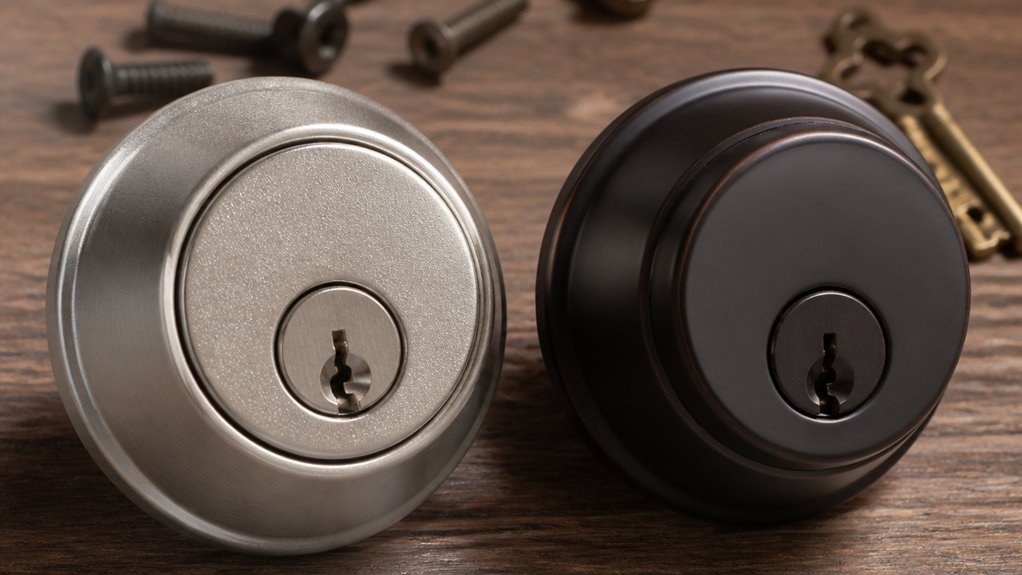

If you want a lock with superior forced-entry resistance, tighter manufacturing tolerances, and advanced anti-pick features, Schlage is the stronger choice.
It uses Grade 1 hardware, thicker bolts, and reinforced strike plates, ensuring better durability and security.
Kwikset, while more budget-friendly and easier to install with convenient rekeying options, offers moderate protection suited for basic residential needs.
To understand the trade-offs in smart features, installation, and specific use cases, keep exploring further.
Key Takeaways
- Schlage offers superior forced-entry resistance with Grade 1 hardware and reinforced, heavier metal construction compared to Kwikset’s lighter build.
- Schlage bolts are longer, thicker, and made of hardened steel, providing tighter strike plate engagement than Kwikset’s shorter, thinner bolts.
- Schlage locks use four security pins and tighter manufacturing tolerances, enhancing pick and bump resistance over Kwikset’s two-pin design.
- Schlage smart locks support Apple Home and Matter with AES-256 encryption, while Kwikset offers fingerprint access but less advanced encryption.
- Kwikset is more budget-friendly with easier DIY installation and convenient SmartKey rekeying, ideal for residential use and tenant turnover.
Schlage Locks vs Kwikset Comparison: Security, Value, and Smart Features
| Comparison Point | Schlage Locks | Kwikset Locks | Best Choice |
|---|---|---|---|
| Security Strength | Offers stronger forced-entry resistance with heavier construction | Provides moderate residential protection | Schlage for higher security |
| Hardware Grade | Often uses Grade 1 hardware in stronger models | Commonly focused on standard residential grades | Schlage for premium protection |
| Bolt Design | Uses longer, thicker bolts for tighter strike engagement | Uses lighter bolts suitable for basic home use | Schlage for door reinforcement |
| Pick and Bump Resistance | Has more security pins and tighter tolerances | Easier to use but generally less resistant | Schlage for lock manipulation resistance |
| Smart Lock Features | Strong smart compatibility, encryption, and access code support | Offers smart locks with fingerprint and SmartKey features | Depends on smart home needs |
| Rekeying Convenience | More secure but less convenient for quick rekeying | SmartKey rekeying makes key changes faster | Kwikset for tenant turnover |
| Installation Ease | May need more precise alignment and setup | Usually easier for DIY installation | Kwikset for quick setup |
| Cost and Value | Higher cost but stronger long-term security value | More budget-friendly for basic protection | Kwikset for lower upfront cost |
| Best Use Case | Best for commercial, high-risk, or security-focused doors | Best for homes, rentals, and standard residential use | Match to your security priority |
Schlage vs Kwikset: Which Lock Is More Secure?
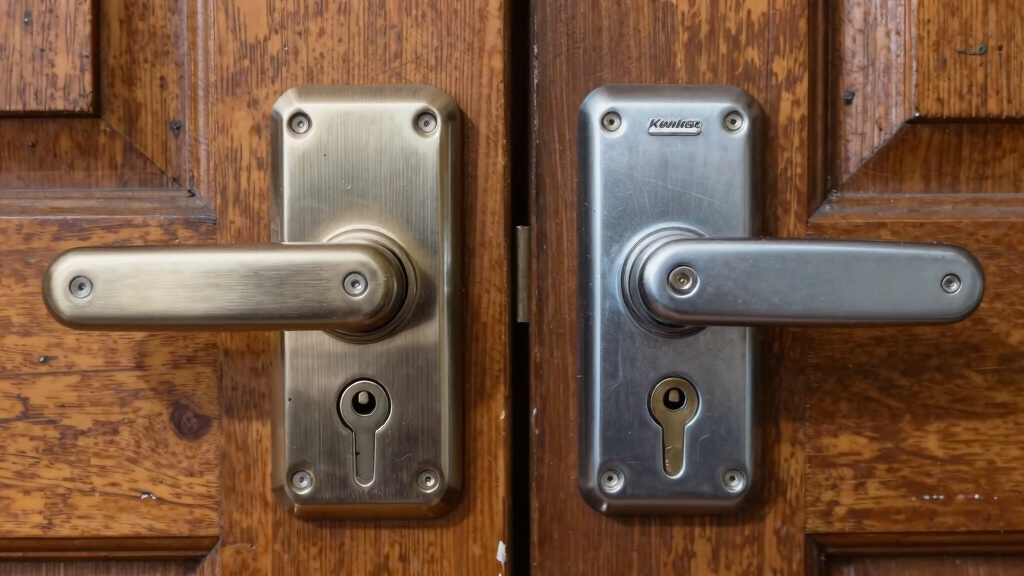
While both Schlage and Kwikset offer reliable security options, Schlage clearly outperforms Kwikset in resisting forced and non-forced entry attempts.
Schlage surpasses Kwikset in strength and security against both forced and subtle break-ins.
You’ll find Schlage deadbolts equipped with Grade 1 hardware, heavier internal components, and drill-resistant plates, all contributing to superior durability.
The locks also feature longer, thicker bolts that engage more securely with strike plates, minimizing door jiggling.
Schlage’s use of four security pins compared to Kwikset’s two markedly increases resistance to picking and bumping.
Although Kwikset’s SmartKey technology allows for convenient rekeying, it introduces vulnerabilities absent in Schlage’s tighter manufacturing tolerances and robust construction.
If your priority is maximizing lock security through proven mechanical strength and pick resistance, Schlage provides a more resilient option than Kwikset without sacrificing reliability or efficiency.
Additionally, Schlage’s integration of security driver pins helps disrupt bumping dynamics, further enhancing protection against lock bumping attacks.
Forced Entry Resistance: Schlage vs Kwikset
When you’re looking at forced entry resistance, it’s pretty clear that Schlage has an edge. Their bolts aren’t only thicker but also longer, which means they engage with the strike plate more securely than what you’d typically find with Kwikset.
Plus, let’s talk about durability. Schlage’s housing and their drill-resistant plates are designed to withstand physical attacks much better. This means that in a real-world scenario, you’re likely to find Schlage holding up stronger against forced entry attempts. So, overall, if security is your top priority, Schlage definitely stands out compared to Kwikset.
Additionally, Schlage’s locks often incorporate multi-point locking systems, which distribute locking force across the door height to resist bending and prying more effectively.
Bolt Strength Comparison
Examine the bolt strength closely, and you’ll find Schlage deadbolts outperform Kwikset in resisting forced entry. Schlage’s bolts are longer, thicker, and made from heavier-duty materials, allowing tighter engagement with the strike plate.
Kwikset bolts, while adequate for residential use, lack the robust dimensions and reinforced components that Schlage offers.
| Feature | Schlage Bolt | Kwikset Bolt |
|---|---|---|
| Bolt Length | Longer (1 inch+) | Shorter (approx. 0.75 inch) |
| Bolt Thickness | Thicker (solid metal core) | Thinner |
| Material Strength | Hardened steel | Standard steel |
| Engagement with Strike | Tighter, reduces door movement | Looser, allows slight jiggle |
This structural superiority enhances Schlage’s forced entry resistance markedly. The effectiveness of a deadbolt’s resistance also depends on the bolt’s ability to extend deeply and securely into the strike plate, a feature critical for single-point locking security mechanisms.
Housing and Plate Durability
Beyond bolt strength, the durability of the lock housing and strike plate plays a pivotal role in preventing forced entry.
When you evaluate Schlage locks, you’ll notice their housings are thicker and constructed with drill-resistant materials, eliminating hollow spaces that intruders could exploit.
The strike plates are also reinforced and designed for deeper bolt engagement, reducing door movement under force.
In contrast, Kwikset’s housings tend to be lighter, lacking drill-resistant plates, which lowers their resilience to physical attacks.
Their strike plates offer less robust reinforcement, increasing vulnerability to forced entry attempts that rely on prying or impact.
If you prioritize structural integrity around the lock mechanism, Schlage’s approach provides a clear advantage by integrating heavier, more robust components that enhance overall housing and plate durability.
Additionally, locksmiths use precision tools to manipulate these reinforced components during non-destructive entry, preserving the lock’s integrity while maintaining security.
Resistance to Forced Entry
Schlage deadbolts deliver superior resistance against forced entry by incorporating larger, thicker bolts and reinforced lock housings that withstand common attack methods.
You’ll find that Schlage’s bolts engage more tightly with the strike plate, reducing door movement and making it harder to pry open.
Their lock housings eliminate hollow spaces, enhancing structural integrity against physical attacks.
In contrast, Kwikset lacks drill-resistant plates and features lighter housing, which provides less challenge to forced entry attempts.
While Kwikset offers adequate security for typical residential use, it doesn’t match Schlage’s robustness in resisting brute force.
If your priority is resisting forced entry, Schlage’s design choices give you a significant advantage.
These components are engineered to withstand aggressive manipulation and physical attacks.
Additionally, Schlage incorporates hardened steel anti-drill plates to further fortify against drilling and tampering attempts.
Picking and Bumping Resistance Compared
When you look at picking and bumping resistance, you’ll see that Schlage really stands out with its four security pins. In contrast, Kwikset only has two. That difference makes it a lot harder to manipulate the Schlage locks.
Plus, Schlage’s manufacturing process is super precise, which means tighter tolerances. This really cuts down on the chances of someone pulling off a successful non-destructive attack.
Security Pins Advantage
Although both Schlage and Kwikset aim to secure your home, the number and quality of security pins play a critical role in resisting picking and bumping attempts.
Schlage incorporates four security pins in its lock cylinders, compared to Kwikset’s two. This difference markedly increases Schlage’s resistance to manipulation techniques by creating more complex shear lines that pickers must navigate.
Additionally, Schlage’s security pins are crafted with precision to counteract bump keys and lock picks effectively.
Kwikset’s simpler pin configuration and lighter internal construction make it more vulnerable to these non-destructive entry methods.
When evaluating locks for enhanced protection against picking and bumping, the superior pin design in Schlage locks offers a more reliable safeguard. This directly impacts your home’s overall security resilience.
For enhanced long-term protection, incorporating tamper-resistant fasteners can further improve the lock’s resistance to tampering and physical attacks.
Manufacturing Precision Impact
The quality of security pins is only part of what determines a lock’s resistance to picking and bumping. Manufacturing precision plays an equally significant role.
When you choose Schlage, you benefit from tighter tolerances and heavier internal components that reduce manipulation opportunities. Schlage’s precise machining guarantees minimal internal spacing, making it harder for lock picks or bump keys to align pins incorrectly.
In contrast, Kwikset’s lighter metal construction and looser internal clearances create vulnerabilities, allowing easier bypass via bumping or picking. This precision in Schlage locks directly translates to improved non-destructive entry resistance, enhancing overall security.
For optimal security, just as with concealed cameras, balancing precision and effectiveness ensures the highest level of protection against unauthorized access.
Smart Lock Features and Compatibility
How well a smart lock integrates with your existing home system can greatly impact your convenience and security.
Schlage smart locks offer superior compatibility, supporting Apple Home and Matter ecosystems, which enhances seamless control across multiple platforms.
Schlage Encode models allow up to 100 unique access codes, while Kwikset’s Halo series extends functionality with fingerprint access via Halo Touch.
Schlage Encode Pro 2025 secures communication using AES-256 encryption, providing bank-level security that surpasses Kwikset’s standard protocols.
Both brands feature built-in Wi-Fi, eliminating the need for additional hubs.
However, Schlage provides a broader range of models with enhanced encryption and smart features.
If you prioritize robust integration and advanced security, Schlage’s smart locks present a more all-encompassing solution compared to Kwikset’s more basic compatibility and features.
For optimal security, it is also important to ensure regular firmware updates to protect against emerging vulnerabilities and maintain network security.
Price and Value: What You Get for Your Money
When evaluating locks, you’ll find that price often reflects the balance between security features and material quality.
Schlage locks generally cost between $200 and $250, reflecting their use of Grade 1 hardware, heavier internal components, longer bolts, and additional security pins.
This investment translates into enhanced forced entry resistance and superior durability.
Kwikset, priced around $150 to $230, offers a more budget-friendly option with solid materials and diverse designs but lacks the same level of robust security features.
While Kwikset’s SmartKey technology adds convenience, it compromises some protection compared to Schlage’s reinforced construction.
Consequently, if your priority is maximum security and long-term reliability, Schlage provides better value.
If you want to save upfront and accept moderate protection, Kwikset meets basic residential needs effectively.
Choosing materials with reinforced mounting hardware can further enhance the security and longevity of your locks.
Lock Installation and Ease of Use
Getting locks installed efficiently can save you time and reduce hassle, especially when managing multiple properties. Kwikset generally offers quicker, more straightforward DIY installation, making it ideal if you want to minimize professional involvement.
Schlage locks, while also user-friendly, may require more precise door preparation and occasional professional installation, especially for models with reinforced strikes.
Kwikset supports fast, tool-light installation processes. Schlage’s deeper bolt engagement demands accurate door alignment.
Kwikset excels in SmartKey rekeying for frequent tenant turnover. Schlage’s robust construction sometimes complicates DIY setups.
Both brands provide clear instructions, but Kwikset is more beginner-friendly. Ultimately, your choice depends on balancing ease of use with the level of security and durability you require.
For enhanced security on doors, consider integrating reinforced strike plates during installation to resist pry attacks and strengthen the door frame.
Choosing Locks for Commercial vs Residential Use
Although both Schlage and Kwikset offer reliable locking solutions, your choice should depend heavily on whether you’re securing a commercial property or a residential space.
For commercial settings, Schlage’s Grade 1 hardware and reinforced designs provide superior durability and resistance to forced entry. They meet higher security demands typical in high-traffic environments.
Their longer, thicker bolts and drill-resistant plates enhance safety and longevity under heavy use. Conversely, for residential use, Kwikset delivers adequate protection with a more budget-friendly price and simpler installation.
Kwikset’s SmartKey technology also facilitates quick rekeying, ideal for homes with changing occupants. While Schlage excels in high-security and commercial compatibility, Kwikset suits residential applications where cost efficiency and ease of use take priority without compromising basic security needs.
When to Choose Schlage or Kwikset Locks?
Deciding between Schlage and Kwikset locks hinges on your specific security needs and budget constraints.
Choosing Schlage or Kwikset depends largely on balancing your security priorities with budget considerations.
You should opt for Schlage when maximum security, durability, and advanced smart features are priorities.
Choose Kwikset if affordability, ease of installation, and convenient rekeying are more important.
Consider these factors:
Select Schlage for high-traffic or commercial settings requiring Grade 1 security.
Choose Kwikset for residential use or rental properties needing quick tenant turnover.
Prefer Schlage smart locks for superior encryption and broader smart home compatibility.
Opt for Kwikset when budget constraints limit upfront costs.
Favor Schlage if resistance to forced or non-forced entry is critical.
This approach guarantees your lock choice aligns precisely with your functional and financial requirements.
Frequently Asked Questions
How Do Schlage and Kwikset Locks Perform in Extreme Weather Conditions?
You’ll find that Schlage locks generally handle extreme weather better due to their robust materials and tighter manufacturing tolerances. This reduces rust and freezing risks.
Kwikset locks perform adequately but may be more prone to corrosion and mechanical wear in harsh conditions because of lighter materials.
If you live in an area with severe temperature shifts or heavy moisture, Schlage’s durable construction offers more reliable long-term performance and less maintenance.
Are There Specific Warranties Offered by Schlage and Kwikset?
Think of warranties as safety nets beneath a tightrope; Schlage offers a limited lifetime mechanical and finish warranty, giving you long-term peace of mind against defects.
Kwikset matches this with a limited lifetime warranty on mechanical parts and a one-year finish warranty.
Both cover defects but exclude misuse or normal wear.
You’ll want to read the fine print closely to understand coverage scope and claim procedures for each brand.
What Are the Differences in Key Duplication Policies Between the Brands?
You’ll find that key duplication policies differ in control and convenience.
Schlage keys are patented, so you must provide proof of ownership to authorized dealers for duplication, enhancing security.
Kwikset keys, however, are more widely duplicated without stringent controls, offering easier access but less restriction.
If you prioritize controlled duplication to prevent unauthorized copies, Schlage’s policy better protects your property.
Kwikset offers simpler, more flexible key copying options.
Can Schlage and Kwikset Locks Be Integrated With Third-Party Security Systems?
Think of Schlage and Kwikset locks as puzzle pieces fitting into your home security picture.
You can integrate both with third-party systems, but Schlage shines with smoother compatibility, especially with Apple Home and commercial platforms. This is thanks to broader smart ecosystem support.
Kwikset works well too but may offer fewer seamless connections.
Both have built-in Wi-Fi, so you won’t need extra hubs. Yet Schlage’s stronger encryption and compatibility give you a more reliable integration experience.
How Do Schlage and Kwikset Locks Affect Home Insurance Premiums?
Your choice of lock can influence home insurance premiums by enhancing your property’s security.
Installing Schlage locks, known for their superior durability and resistance to forced entry, often leads to better premium discounts compared to Kwikset.
While Kwikset offers solid security, Schlage’s advanced features and higher security ratings provide insurers with greater confidence, potentially lowering your costs.
Always check with your insurer for specific discount qualifications tied to lock brands and security levels.
Choose the Lock That Matches Your Security Needs
Choosing between Schlage and Kwikset locks is like picking the right shield for your home’s security.
Schlage offers robust forced entry resistance and advanced smart features, making it ideal for high-security needs.
Kwikset, while reliable and budget-friendly, suits everyday residential use.
Consider your specific security demands, installation ease, and budget.
By weighing these factors objectively, you’ll confidently select the lock that best guards your home’s safety and value.