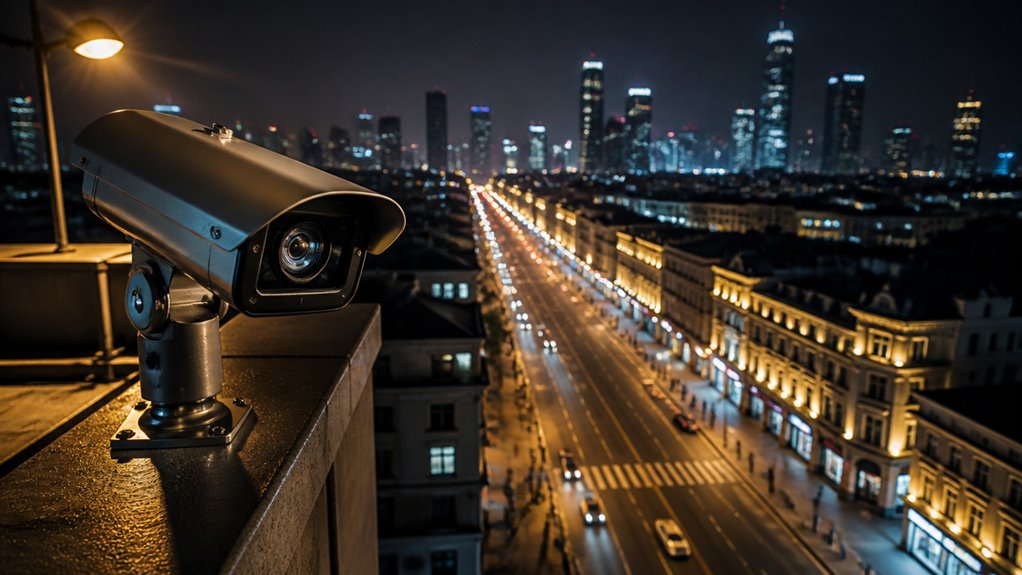

You can expect a standard security camera to detect activity clearly between 30 and 100 feet, depending on lens type, resolution, and environmental factors.
Night vision often limits you to around 50–60 feet, while advanced PTZ models with optical zoom and IR can extend visibility beyond 200 feet.
Wireless range typically maxes out near 150 to 300 feet outdoors, but obstructions reduce this.
Understanding these variables helps optimize your camera’s effective coverage and image clarity over distance.
Key Takeaways
- Standard security cameras typically detect objects clearly within 30 to 100 feet, depending on lens and sensor quality.
- Longer focal length lenses and higher resolution sensors extend effective visibility beyond 150 feet for detailed identification.
- Night vision range is generally limited to 50–60 feet, with advanced IR and PTZ cameras reaching up to 200 feet or more.
- Wireless camera range varies from 150 feet indoors to 300 feet outdoors with clear line of sight, influenced by obstructions.
- DORI framework defines detection up to 200+ feet, observation up to 100 feet, and identification within about 30 feet on standard cameras.
How Far Can Standard Security Cameras See?
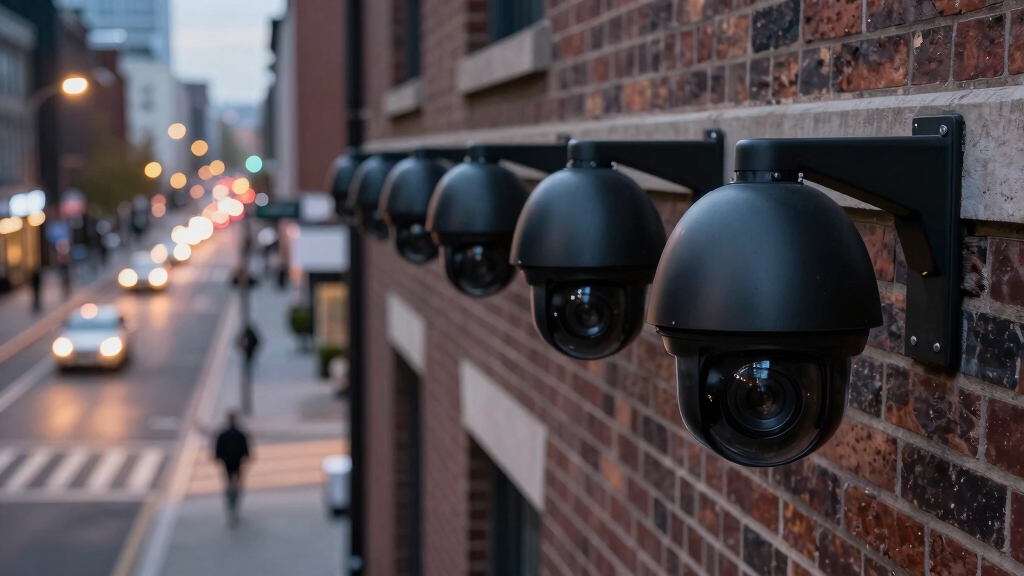
When evaluating how far standard security cameras can see, you should consider their typical detection range, which generally spans from 30 to 100 feet (9 to 30 meters).
Fixed-lens bullet and turret cameras maintain clear imaging up to approximately 70 to 80 feet. These cameras rely on lens focal length and sensor resolution to define this range precisely.
Environmental factors like lighting and obstructions also influence effective distance. You’ll find that typical home or business systems fall within this detection scope, providing adequate coverage for general surveillance needs.
While some advanced models extend beyond this, standard cameras focus on reliable clarity within this range. Understanding these parameters helps you select equipment suited to your monitoring requirements without overestimating capabilities.
For optimal performance, it is recommended to mount outdoor cameras at an 8 to 10 feet height with a slight downward angle to maximize field of view and reduce blind spots.
Understanding DORI: Detection and Identification Distances
Although different cameras vary widely in capability, understanding the DORI framework helps you clearly define the level of detail you can expect at various distances.
DORI stands for Detection, Observation, Recognition, and Identification, each representing a progressively closer and more detailed view of a subject.
DORI defines key stages of visual clarity, from spotting shapes to confirming identities at closer distances.
You can expect the following:
- Detection: Spotting a human shape or object, typically up to 200+ feet.
- Observation: Understanding what a person is doing, effective up to 100 feet.
- Recognition and Identification: Recognizing a known individual or proving identity requires distances within 50 and 30 feet respectively on standard lenses.
The actual effective range also depends on factors such as the camera’s lens type and sensor quality, which influence image clarity and light sensitivity.
How Lens and Resolution Affect Security Camera Range?
When it comes to security cameras, the lens focal length plays a crucial role in how far you can capture clear images. Basically, the longer the focal length, the further away you can see. It’s like using binoculars – the longer the lens, the better you can spot details from a distance.
Now, let’s talk about resolution. This is all about how much detail you can make out when you’re looking at those far-off images. Higher resolution means you can identify and recognize things more clearly, which is super important for security purposes. NVR cameras handle encoding, enabling higher resolutions and clearer images through digital video processing.
Lens Focal Length
Understanding lens focal length is essential to optimizing your security camera’s effective range and image clarity. The focal length determines the camera’s field of view and magnification, directly influencing how far and how clearly you can see objects.
A shorter focal length provides a wider view but less detail at distance. In contrast, a longer focal length narrows the field but enhances distant object clarity.
Keep in mind:
- Short focal lengths (2.8mm–4mm) cover broad areas up to 30–70 feet but with limited zoom.
- Medium focal lengths (6mm–12mm) balance range and detail, ideal for 70–150 feet.
- Long focal lengths (12mm and above) focus tightly, extending visibility beyond 150 feet, vital for identifying subjects.
Selecting the right focal length aligns your camera’s capabilities with surveillance goals. Additionally, mounting cameras at an optimal height enhances their ability to capture clear images within their effective range.
Resolution Impact on Detail
Resolution plays a critical role in determining the level of detail a security camera can capture at various distances. Higher resolution sensors provide more pixels per frame, enabling you to discern finer details such as facial features or license plates at greater ranges.
When paired with an appropriate lens focal length, increased resolution extends the effective identification distance beyond the typical 15–25 feet for standard HD cameras. However, resolution alone doesn’t guarantee clarity; sensor quality and lens sharpness also influence image fidelity.
For example, a 4K camera with a fixed 4mm lens can resolve subjects clearly up to 50 feet, while lower resolution cameras struggle past 30 feet. To maximize range and detail, select a camera that balances resolution, lens focal length, and sensor performance according to your surveillance requirements. Models featuring 4K resolution at 3840 × 2160 pixels provide crisp daytime images suitable for identifying faces and objects.
How Night Vision and IR Affect Security Camera Visibility?
When it comes to night vision, one thing you’ll notice is that it tends to limit your camera’s effective range. For standard models, you’re usually looking at a visibility of around 50 to 60 feet. That’s not too far, right?
Now, let’s talk about IR illumination. This can really help extend your range, but there’s a catch. If it’s not calibrated properly, you might end up with image wash-out beyond 30 to 40 feet. That can be pretty frustrating!
Fog droplets scatter infrared and visible light, which drastically reduces the effective range and clarity of night vision cameras, especially in adverse weather conditions like fog and humidity.
Night Vision Range Limits
Although night vision and infrared (IR) technology extend a security camera’s functionality in low-light conditions, they impose distinct range limitations that affect image clarity and detail.
You’ll notice that IR illumination intensity and sensor sensitivity dictate the effective night vision distance, which usually falls short of daylight ranges. For example, fixed-lens cameras typically achieve 50–60 feet of night vision, while advanced PTZ cameras with IR can reach up to 200 feet or more.
However, IR overexposure can cause image washout at close distances, reducing clarity.
Key points to take into account:
- Night vision range varies with camera type and IR strength.
- Effective clarity often decreases beyond half the rated IR distance.
- Environmental factors further limit night vision performance.
Understanding these limits helps you select the right camera for nighttime surveillance needs. Additionally, turret-style IP cameras can reduce IR glare to further enhance nighttime surveillance, improving overall image quality in low-light conditions through advanced sensor technology.
IR Illumination Impact
When infrared (IR) illumination activates, it directly influences how well your security camera captures images in low-light conditions. It enhances visibility without relying on external light sources.
IR LEDs emit light invisible to the human eye but detectable by the camera sensor, extending effective night vision range. Standard fixed-lens cameras typically achieve clear IR coverage up to 50–60 feet.
PTZ cameras with advanced IR can reach 200 feet or more. However, IR illumination intensity must balance range and image clarity. Excessive IR can cause wash-out, reducing detail beyond 30–40 feet despite rated distances.
Environmental factors and sensor quality also affect IR performance. Understanding these limits helps you optimize placement and select cameras with appropriate IR capabilities to maintain reliable visibility during nighttime conditions.
For optimal night vision through glass, it is recommended to position cameras and IR illuminators outside the glass to prevent internal reflections that degrade image quality.
Wireless Security Camera Signal Range Limits
Since wireless security cameras depend on Wi-Fi signals to transmit data, their effective range relies heavily on environmental factors and signal strength.
Typically, indoor wireless cameras operate up to 150 feet, while outdoor units may reach 300 feet with a clear line of sight.
However, walls, trees, and electronic interference reduce this range considerably. You should assess your installation site carefully to avoid dead zones or weak connections.
Key factors to bear in mind include:
- Physical obstructions that block or degrade signals
- Interference from other wireless devices or networks
- The need for range extenders or mesh Wi-Fi systems to maintain stable connections
Wireless cameras are also subject to signal interference, which can cause intermittent video degradation and connectivity issues.
Zoom and PTZ Cameras: Extending Viewing Range
Zoom and PTZ cameras dramatically extend your security system’s viewing range by combining optical zoom capabilities with motorized pan and tilt functions.
Zoom and PTZ cameras enhance security by merging powerful optical zoom with versatile motorized pan and tilt features.
These cameras can zoom optically up to 30x, allowing you to identify details like faces and license plates clearly at distances between 150 and 250 feet.
High-end PTZ models push this range further, capturing identifiable images from over 1,000 feet during daylight.
The pan and tilt mechanisms enable you to remotely adjust the field of view, covering wide areas without needing multiple fixed cameras.
Additionally, PTZ cameras often include long-range IR illumination, extending effective night vision up to 200 feet or more.
This integration of zoom, maneuverability, and enhanced lighting maximizes surveillance coverage and detail, making PTZ cameras ideal for extensive monitoring tasks.
For optimal performance, it is important to calibrate each camera’s field of view to capture details effectively across different lighting and shadowed conditions.
Frequently Asked Questions
What Are the Best Mounting Heights for Optimal Camera Range?
For ideal camera range, you should mount security cameras between 8 to 12 feet high. This height balances wide coverage and detail capture, minimizing blind spots and reducing tampering risks.
Mounting too low limits the field of view; too high sacrifices facial recognition detail. Position cameras to avoid obstructions and guarantee clear sightlines.
Adjust height depending on lens type and zoom capabilities to maximize detection and identification over desired distances.
How Do Weather Conditions Impact Camera Performance?
Like trying to see through a fogged window, weather conditions blur your camera’s view.
Rain, snow, and fog scatter infrared light, reducing night vision range and image clarity.
High winds can shake mounts, causing blurry footage.
Dirt or water droplets on lenses distort details, leading to reduced detection distances and muted contrast.
To maintain performance, you must regularly clean lenses and consider weatherproof housings with built-in heaters or wipers.
Can Security Cameras Work Effectively in Fog or Heavy Rain?
Security cameras can function in fog or heavy rain, but their effectiveness decreases markedly.
Fog scatters light, reducing image clarity and range, while rain creates visual noise and reflections that obscure details.
You’ll notice diminished detection and recognition distances. To improve performance, use cameras with higher resolution, advanced IR illumination, and protective housings.
Positioning cameras strategically to minimize direct exposure to weather also helps maintain clearer footage during adverse conditions.
What Maintenance Is Needed to Keep Cameras Viewing Clearly?
You need to clean the camera lens regularly with a microfiber cloth to remove dust, dirt, and smudges that impair clarity.
Check and clear obstructions like spider webs or foliage around the lens. Inspect housing seals to guarantee weatherproofing remains intact.
Verify proper alignment and focus periodically. Also, test night vision and IR LEDs for functionality.
Finally, update firmware to maintain peak performance and fix vulnerabilities.
How Do Different Camera Brands Compare in Range Reliability?
You’ll notice high-end Axis and Pelco Pro systems can reliably capture detailed images beyond 1,500 feet during daylight. They outperform many competitors in this regard.
Brand reliability varies mainly due to lens quality, sensor resolution, and IR capabilities. Some brands excel in long-range zoom and night vision, while others deliver consistent mid-range clarity.
When comparing, focus on these specs and real-world performance reviews. This will help ensure you choose a brand that meets your range and reliability needs precisely.
Choose the Right Camera Range for Your Property
Now that you know how lens type, resolution, night vision, and wireless signals shape your security camera’s range, imagine scanning a vast, shadowy perimeter with pinpoint clarity.
But don’t stop there; think about leveraging zoom and PTZ features to push those boundaries even further. Your camera’s true potential lies in mastering these elements, transforming distant shadows into clear, actionable images.
Are you ready to see beyond the obvious and secure every corner?