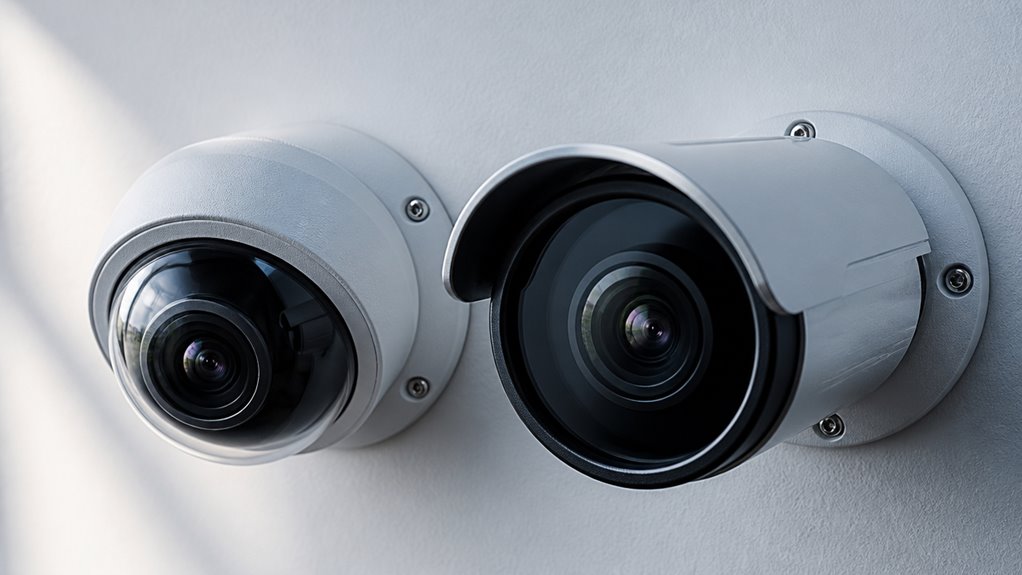

You’ll want a 2.8 mm lens if you need broad coverage and to monitor wider areas up to about 10 meters.
Though expect some edge distortion. A 3.6 mm lens suits you better when detail and identification at mid to longer distances matter.
It offers a narrower field of view but sharper images ideal for faces or license plates.
Balancing coverage, clarity, and environment will guide your choice. Exploring specifics can help you optimize your surveillance setup.
Key Takeaways
- A 2.8 mm lens offers a wider 100°–110° field of view for broad area monitoring with less detail at distance.
- A 3.6 mm lens provides a narrower 78°–94° view, enhancing distant object detail for better identification like faces or plates.
- The 2.8 mm lens suits close-range coverage up to 10 meters, ideal for expansive nearby surveillance zones.
- The 3.6 mm lens reduces distortion and fisheye effects, delivering clearer, more natural images at mid to long range.
- Choose 2.8 mm for wide coverage with some edge distortion; select 3.6 mm for focused, detailed surveillance in specific areas.
Security Camera 2.8 mm vs 3.6 mm Comparison: Field of View, Detail, and Placement
| Comparison Point | 2.8 Mm Lens | 3.6 Mm Lens | Best Choice |
|---|---|---|---|
| Main Strength | Provides wide area coverage with fewer blind spots | Provides sharper detail in a more focused view | Depends on surveillance goal |
| Field of View | Wider angle, around 100°–110° | Narrower angle, around 78°–94° | 2.8 Mm for wider view |
| Coverage Area | Better for open rooms, yards, entrances, and broad zones | Better for driveways, gates, corridors, and focused spots | 2.8 Mm for larger spaces |
| Detail at Distance | Distant subjects appear smaller with less fine detail | Better for faces, plates, and mid-range identification | 3.6 Mm for detail |
| Close-Range Use | Works well for nearby monitoring up to about 10 meters | Better when the target is slightly farther away | 2.8 Mm for close coverage |
| Image Distortion | More likely to show edge distortion or fisheye effect | More natural image with less distortion | 3.6 Mm for cleaner image |
| Blind Spot Control | Helps reduce blind spots by capturing more of the scene | May need more careful placement or extra cameras | 2.8 Mm for fewer blind spots |
| Night Vision Detail | Covers more space but may spread IR light wider | Can improve focused night detail at mid-range | 3.6 Mm for focused night views |
| Best Use Case | General monitoring and wider scene awareness | Identification-focused surveillance | Match to camera purpose |
| Overall Fit | Choose when coverage matters most | Choose when clarity and recognition matter most | 2.8 Mm for coverage, 3.6 Mm for detail |
Which Lens Is Best for Your Surveillance Needs?
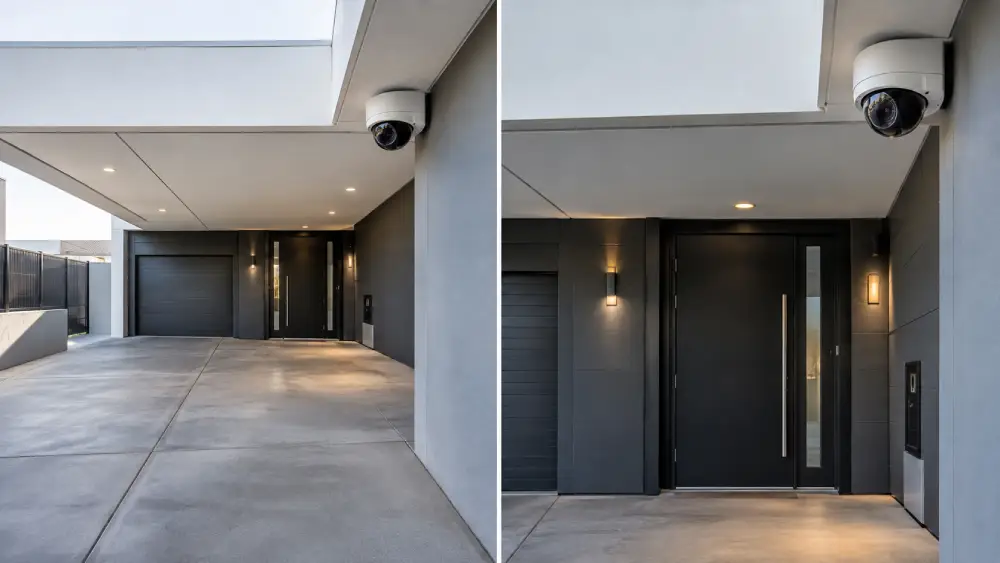
Determining which lens best suits your surveillance needs hinges on balancing coverage area and image detail.
If you prioritize monitoring broad zones with minimal blind spots, the 2.8 mm lens excels due to its wider field of view. It captures expansive scenes effectively.
Conversely, when detail recognition at a distance, such as face or license plate identification, is critical, the 3.6 mm lens offers superior subject clarity. It focuses on a narrower scene segment.
Your choice depends on the environment size, target distance, and surveillance goals. For large areas requiring general awareness, 2.8 mm is advantageous.
For focused observation where identification accuracy outweighs coverage, 3.6 mm is preferable.
Evaluating your surveillance context and priorities will guide you to the best lens. This balances field coverage with necessary image resolution.
Additionally, selecting a lens with a suitable aperture can improve performance in low-light conditions by allowing more light to reach the sensor, enhancing image clarity through large-aperture lenses.
Field of View Differences Between 2.8 mm and 3.6 mm Lenses
When you compare 2.8 mm and 3.6 mm security camera lenses, the most immediate distinction lies in their field of view. The 2.8 mm lens offers a wider angle, capturing approximately 100° to 110°. This makes it ideal for broad coverage with fewer blind spots.
Conversely, the 3.6 mm lens narrows the view to roughly 78° to 94%, focusing more on a central area. This difference impacts how much scene your camera can monitor at once, influencing placement and surveillance strategy.
| Feature | 2.8 mm Lens |
|---|---|
| Field of View | 100° – 110° |
| Coverage Area | Wide, open spaces |
| Blind Spots | Reduced |
| Scene Concentration | Lower central focus |
| Ideal Use | Large areas monitoring |
| Feature | 3.6 mm Lens |
| Field of View | 78° – 94° |
| Coverage Area | Narrower, focused |
| Blind Spots | Slightly increased |
| Scene Concentration | Higher central focus |
| Ideal Use | Focused surveillance |
When planning your camera placement, it’s important to design overlapping camera angles with intersecting fields of view to eliminate blind spots and ensure continuous coverage.
Detail and Identification: 2.8 mm vs 3.6 mm at Different Distances
Although both 2.8 mm and 3.6 mm lenses capture broad scenes, the 3.6 mm lens excels at rendering finer details at greater distances.
The longer focal length narrows the field of view, increasing the subject’s size in the frame and improving clarity for identification tasks like face or plate recognition.
The 2.8 mm lens maintains wider coverage but sacrifices detail on distant objects.
Consider these points:
- 3.6 mm lenses improve mid-to-long-range detail clarity, enhancing identification accuracy.
- 2.8 mm lenses display smaller distant subjects, limiting fine detail capture.
- 3.6 mm lenses reduce blind spots by focusing on a narrower, more detailed area.
- Image pixel density on distant subjects favors 3.6 mm for recognition reliability.
Choose based on whether detail or coverage is your priority.
Additionally, bullet cameras often use longer focal length lenses like 3.6 mm to provide superior long-range zoom and clarity, especially for outdoor identification tasks.
Close-Range Performance of 2.8 mm vs 3.6 mm Lenses
In close-range scenarios, 2.8 mm lenses excel by capturing wide scenes with clarity up to approximately 10 meters. This makes them ideal for monitoring broad areas nearby. They offer expansive coverage without sacrificing detail at short distances.
Conversely, 3.6 mm lenses provide a narrower field of view but bring improved mid-range detail. They often feature a longer close-focus distance. Your choice hinges on target proximity and scene width.
Choosing the right lens also depends on coverage area and lighting conditions to ensure optimal surveillance performance.
| Lens Focal Length | Effective Close-Range Focus | Field of View (Degrees) |
|---|---|---|
| 2.8 mm | Up to ~10 meters | 100° – 110° |
| 3.6 mm | Typically longer than 10 m | 78° – 94° |
| Use Case | Wide, near-area surveillance | Narrower, focused zones |
Image Quality and Distortion in 2.8 mm vs 3.6 mm Lenses
Since image quality directly impacts the effectiveness of surveillance, understanding distortion differences between 2.8 mm and 3.6 mm lenses is essential.
Image quality is crucial for surveillance, making it vital to understand distortion differences in lens choices.
The 2.8 mm lens provides a wider field of view but introduces more edge distortion, often producing a fisheye effect.
Conversely, the 3.6 mm lens yields a narrower, more natural image with less distortion, improving mid-range detail clarity.
Consider these key points to evaluate image quality and distortion:
- 2.8 mm lenses spread pixels over a broader area, reducing subject size and detail at distance.
- 3.6 mm lenses concentrate pixels, enhancing detail and reducing distortion.
- Edge warping is more prominent with 2.8 mm, affecting peripheral image accuracy.
- Sensor and lens design also influence distortion beyond focal length alone.
Choose based on your balance of coverage versus detail priorities.
Additionally, mounting cameras at the recommended 8–10 feet height with a slight downward angle can maximize image clarity and minimize distortion effects for both lens types.
Frequently Asked Questions
How Do 2.8 mm and 3.6 mm Lenses Affect Night Vision Performance?
Night vision performance differs mainly due to lens focal length impacting infrared light capture.
With a 2.8 mm lens, you get a wider field. This means IR illumination spreads thinner, potentially reducing brightness and detail at distance.
A 3.6 mm lens narrows the view, concentrating IR light and enhancing clarity on mid-range objects.
You’ll find 3.6 mm better for focused night detail, while 2.8 mm suits broader, less detailed night coverage.
Are There Significant Price Differences Between 2.8 mm and 3.6 mm Cameras?
You won’t find a massive treasure chest difference when comparing 2.8 mm and 3.6 mm camera prices.
The cost gap is typically minimal, usually just a few dollars, because both lenses share similar manufacturing processes and sensor compatibility.
Your budget impact comes more from brand, resolution, and features than focal length.
Can 2.8 mm or 3.6 mm Lenses Be Easily Swapped on the Same Camera Model?
You can often swap 2.8 mm and 3.6 mm lenses on the same camera model if it supports interchangeable lenses, typically via a C/CS mount.
However, not all cameras allow this; many have fixed lenses.
Before attempting a swap, verify compatibility and mounting type to avoid damage.
Also, recalibration might be necessary to maintain focus and image quality.
Check the manufacturer’s specs to guarantee a smooth lens change.
Which Lens Type Consumes More Power or Affects Camera Battery Life?
Power consumption between 2.8 mm and 3.6 mm lenses is like a whisper in a thunderstorm. It’s virtually negligible.
The lens focal length doesn’t markedly affect battery life. Instead, factors like image sensor, processing, and wireless transmission dominate power draw.
Do 2.8 mm or 3.6 mm Lenses Require Different Mounting Heights or Angles?
Yes, 2.8 mm and 3.6 mm lenses often require different mounting heights and angles.
With a 2.8 mm lens, you’ll mount higher or angle downward more to maximize its wider field of view and minimize distortion.
For a 3.6 mm lens, you can mount lower or focus more directly on a specific area since it captures a narrower, more concentrated scene with better detail at mid-range distances.
Adjust based on coverage needs.
Choose the Lens That Matches Your Security Goal
Choosing between a 2.8 mm and 3.6 mm security camera lens isn’t just about numbers. It’s about your specific surveillance goals.
You might expect wider coverage from the 2.8 mm. But what if that extra field of view compromises detail at critical distances?
Does the 3.6 mm’s narrower frame actually enhance identification where it counts? The decision hinges on balancing coverage, clarity, and distortion.
So which lens truly fits your security puzzle?