
You want a night vision camera that suits your environment and security needs.
If color detail matters, choose models like Eufy’s color night vision with floodlight, offering vivid footage even in near darkness.
For reliable infrared clarity and power efficiency, Google Nest Cam’s IR system delivers sharp black-and-white images up to 100 feet.
Larger sensors and higher resolution improve low-light performance, while thermal cameras suit specialized heat detection.
Understanding these factors helps optimize your choice.
Key Takeaways
- Color night vision cameras like the Eufy e340 offer vivid, full-color footage in low light, enhancing detail and situational awareness.
- Infrared night vision cameras, such as Google Nest Cam, provide reliable black-and-white images in near-total darkness with low power consumption.
- Thermal night vision cameras detect heat signatures, ideal for complete darkness, fog, or smoke conditions, with models like FLIR Scout III.
- Larger sensors combined with high resolution (e.g., 4K) improve low-light sensitivity and image clarity for night vision cameras.
- Camera placement at an 8–10 feet height with a 45-degree angle reduces glare and maximizes night vision effectiveness, especially through glass.
How to Choose the Best Night Vision Camera for Your Use Case and Budget?
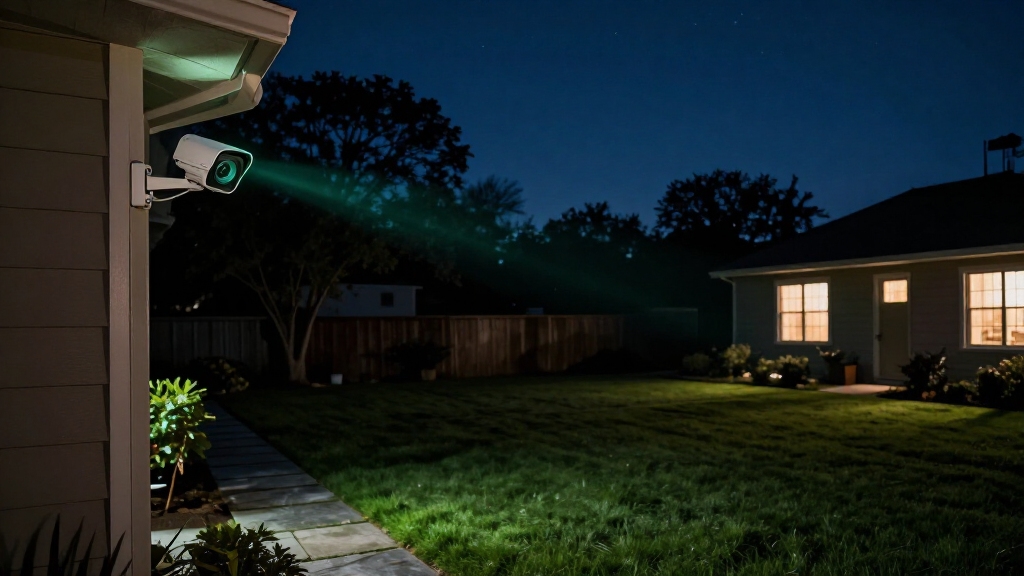
Start by evaluating your primary night vision needs and how much you’re willing to invest. Identify whether you prioritize color fidelity, infrared reliability, long-range coverage, or thermal detection.
This focus guides your choice toward cameras like the Reolink Argus 4 Pro for 4K color video or the Google Nest Cam for dependable infrared imaging. Factor in your environment—indoor or outdoor—and desired range, since outdoor models like EZVIZ C3W prioritize extended night vision distances.
Budget constraints influence sensor size and resolution options, impacting low-light clarity and detail. Additionally, consider storage solutions; some cameras offer local microSD storage, avoiding recurring fees. Also, ensure to consider lighting and environmental factors during installation to maintain clear footage in night conditions.
How Sensor Size and Resolution Affect Night Vision Quality?
When evaluating night vision cameras, you’ll find that sensor size and resolution are critical factors that directly influence image quality in low-light conditions.
A larger sensor, like the 1/1.2-inch sensor in the Annke NC800, captures more photons per frame, improving sensitivity and reducing noise. This results in clearer, more detailed images even in ultra-low light.
A larger sensor captures more light, enhancing sensitivity and clarity for sharper images in ultra-low light conditions.
Resolution also plays a key role: higher resolutions, such as 4K, provide sharper, more defined visuals, which help you identify finer details at night.
However, balancing resolution with sensor size is essential. A high-resolution sensor that’s too small may struggle to gather enough light.
Consequently, when choosing a night vision camera, prioritize models combining large sensors with high resolution for peak performance in darkness.
Additionally, cameras featuring True Color Night Vision technology can provide more natural and detailed images in low-light environments.
Color vs Infrared Night Vision Cameras: Which One Should You Pick?
If you’re trying to decide between a color night vision camera and an infrared one, think about what you need. A color night vision camera is your best bet if you want detailed, full-color footage in low light, especially when there’s some ambient light around. It really shines in those situations!
On the other hand, infrared cameras are fantastic for when it’s almost pitch black. They give you clear black-and-white images without any interference from visible light. So, if you’re dealing with total darkness, these cameras really come through.
In the end, it really comes down to your environment. Are you more focused on color accuracy, or do you need something that can penetrate total darkness? That’ll help guide your choice! Keep in mind that IR mode activates infrared LEDs for clear black-and-white footage by removing the IR cut filter at night, enabling effective surveillance in complete darkness.
Color Night Vision Benefits
Choosing between color and infrared night vision cameras hinges on the specific details you want to capture in low-light conditions.
Color night vision offers distinct advantages by leveraging advanced sensors and low-light amplification technologies to produce vivid, full-color footage even in near darkness.
This enables you to identify clothing colors, vehicle details, and environmental context that infrared models typically render in monochrome.
Cameras like the Annke NC800 use large 1/1.2-inch sensors to maximize light gathering, enhancing image clarity and color accuracy in ultra-low-light scenarios.
Additionally, color night vision facilitates better situational awareness and reduces false alarms by distinguishing objects more precisely.
If you prioritize detailed, colorful imagery for security or monitoring, color night vision cameras provide superior visual information compared to standard infrared alternatives.
For optimal performance when monitoring through glass at night, positioning cameras at a 45-degree angle can significantly reduce reflections and glare.
Infrared Night Vision Strengths
While color night vision excels in capturing vivid details under low light, infrared night vision remains a reliable solution for near-total darkness. Infrared cameras like Google Nest Cam provide consistent visibility when ambient light is insufficient for color sensors. They use IR LEDs to illuminate scenes invisibly, ensuring clear black-and-white images regardless of lighting.
Infrared night vision also extends effective range, often reaching up to 100 feet, making it ideal for perimeter security.
| Strength | Explanation |
|---|---|
| Low-light reliability | Works in total darkness using IR illumination |
| Longer range | IR LEDs enable visibility up to 100 feet |
| Energy efficiency | IR LEDs consume less power than full-color sensors |
| Cost-effective | Generally less expensive than color night vision |
| Reduced false alerts | Less affected by ambient light fluctuations |
Infrared remains your go-to for dependable, long-range night monitoring. Many security cameras combine infrared LEDs with Color Night Vision booster technology to provide enhanced visibility in varying lighting conditions.
Choosing Based On Environment
Because night vision cameras rely on different technologies, selecting between color and infrared models depends heavily on your specific environment and monitoring needs.
If your setting has some ambient light or street illumination, color night vision cameras like the Annke NC800 excel. They leverage large sensors to produce detailed, full-color images in ultra-low light.
However, in near-total darkness or indoor areas without ambient light, infrared cameras such as Google Nest Cam models provide reliable black-and-white footage with better clarity and range.
For outdoor environments requiring long-distance monitoring, infrared systems with extended reach, like the EZVIZ C3W Outdoor, perform best.
Ultimately, you should evaluate lighting conditions, desired image detail, range, and whether color information is essential to your security goals before choosing between color and infrared night vision cameras.
When installing outdoor night vision cameras, it is important to mount them at 8–10 feet high with a slight downward angle to maximize infrared effectiveness and reduce vandalism risk.
Top Cameras for Full-Color Night Vision in Low Light
Full-color night vision cameras offer a significant advantage when you need detailed, true-to-life footage in low-light environments.
Full-color night vision cameras provide detailed, true-to-life footage even in the darkest low-light conditions.
To achieve this, look for models with large sensors and advanced low-light imaging technology.
The Annke NC800 stands out with its 1/1.2-inch 8-megapixel sensor, delivering crisp, vibrant video even in ultra-low light.
The Reolink Argus 4 Pro combines ColorX technology with 4K resolution, ensuring sharp, full-color footage near total darkness.
These cameras outperform standard infrared systems by capturing more scene detail and accurate color representation.
When selecting, prioritize sensor size, resolution, and color night-vision capabilities to maximize image quality.
These technical features enable you to monitor environments effectively without sacrificing clarity or color fidelity in challenging lighting conditions.
Additionally, models like the Eufy e340 Floodlight Security Camera enhance night vision with a 2,000-lumen floodlight that provides intense illumination to improve image clarity and deter intruders.
Best Infrared Cameras for Reliable Nighttime Security
Rely on infrared cameras to deliver consistent, clear images when lighting conditions drop to near total darkness. These cameras use IR LEDs to illuminate the scene invisibly, providing dependable black-and-white footage regardless of ambient light.
For reliable nighttime security, the Google Nest Cam models stand out with sensitive IR sensors and optimized LED arrays. They ensure sharp contrast and minimal noise. Their efficient sensor design balances power consumption and image clarity, essential for continuous monitoring.
When choosing, focus on sensor sensitivity, IR wavelength, and lens quality to maximize detail in pitch-black environments. Additionally, consider models offering local storage to avoid reliance on cloud services.
Infrared cameras excel in scenarios where color imaging fails, maintaining vigilance with crisp monochrome images that highlight movement and intruder presence accurately. Some advanced security cameras combine traditional infrared with color night vision using motion-activated spotlights to improve identification and deterrence in darkness.
Cameras With the Longest Night Vision Range for Outdoors
When monitoring expansive outdoor areas at night, you’ll want cameras capable of delivering clear images over long distances. Models like the EZVIZ C3W Outdoor and Lorex 4K Dome excel by offering night vision ranges extending up to 100 feet or more.
These cameras combine powerful infrared LEDs with large sensors to maximize low-light sensitivity, ensuring reliable coverage in near-total darkness. Prioritize sensor size and LED strength for the best long-range clarity. Here’s a quick comparison to help you decide:
| Camera Model | Night Vision Range | Key Feature |
|---|---|---|
| EZVIZ C3W Outdoor | Up to 100 feet | Strong IR LEDs, weatherproof |
| Lorex 4K Dome | 100+ feet | 4K resolution, wide coverage |
| Reolink Argus 4 Pro | 80 feet | Color night vision, 4K sensor |
| Google Nest Cam | 50 feet | Infrared night vision, smart AI |
Choose based on range and image detail needs. Some Ring models offer color night vision in their Plus and Pro versions, enhancing low-light identification for outdoor surveillance.
Thermal Night Vision Cameras for Specialized Heat Detection
Thermal night vision cameras are pretty amazing because they detect heat signatures instead of depending on visible light. This makes them super useful in total darkness or when visibility is poor.
If you’re looking for high-quality options, models like the AGM Rattler V2 and TOPDON TC005 really stand out. They provide precise thermal imaging thanks to advanced sensors, which means they can quickly and accurately spot heat sources.
When you’re trying to choose the right camera, think about what you need it for—whether it’s security, search and rescue, or monitoring industrial environments. In situations where heat differentiation is crucial, having the right thermal camera can make all the difference.
For remote or off-grid monitoring, some cameras offer solar power and cellular connectivity options that extend deployment time without requiring Wi‑Fi.
Thermal Imaging Advantages
Although traditional night-vision cameras depend on visible or infrared light, thermal imaging cameras detect heat signatures emitted by objects. This provides clear visibility in complete darkness, fog, smoke, or other obscurants.
You’ll benefit from thermal cameras’ ability to visualize temperature differences, enabling the detection of living beings, machinery, or heat leaks regardless of lighting conditions. Unlike infrared cameras that rely on reflected light, thermal sensors capture emitted long-wave infrared radiation.
This makes them immune to camouflage or light-blocking obstacles. This precision allows you to conduct surveillance, search and rescue, or equipment inspection with higher reliability.
Thermal imaging also offers enhanced contrast in complex environments, improving target identification and reducing false alarms. This makes it invaluable for specialized heat detection where conventional night vision falls short.
Top Thermal Camera Models
Thermal cameras bring specialized capabilities to night vision by detecting heat signatures rather than relying on visible or infrared light.
You’ll find these devices excel in total darkness and obscured conditions like smoke or fog.
Two leading models stand out for precise thermal imaging: the AGM Rattler V2 and the TOPDON TC005.
They offer high-resolution thermal sensors, fast refresh rates, and robust temperature detection ranges.
These features make them ideal for security and inspection tasks where heat detection is critical.
| Model | Key Feature |
|---|---|
| AGM Rattler V2 | High-res sensor, 50Hz refresh |
| TOPDON TC005 | Wide temperature range |
| FLIR Scout III | Compact, rugged design |
| Pulsar Helion | Long detection distance |
| Seek Thermal | Mobile-compatible |
These cameras enhance night vision by visualizing thermal contrasts you can’t see otherwise.
Detection Capabilities Explained
When standard night vision struggles to reveal details in complete darkness or obscured environments, heat detection steps in to fill the gap.
Thermal night vision cameras don’t rely on visible or infrared light; instead, they detect the infrared radiation emitted by objects based on their temperature. This ability lets you identify living beings, vehicles, or heat sources even through smoke, fog, or total darkness.
Cameras like the AGM Rattler V2 and TOPDON TC005 use advanced thermal sensors with high thermal sensitivity to differentiate subtle temperature variations. Their detection range and resolution enable precise identification of heat signatures at distances where traditional night vision fails.
If your priority is detection rather than image detail, thermal cameras offer unmatched performance in challenging conditions. They’re ideal for security, search and rescue, or industrial monitoring.
Storage Options and Fees for Night Vision Cameras
Because storage capacity and recurring fees directly impact the long-term usability of night vision cameras, you need to carefully evaluate your options before purchasing.
Many cameras, like the Reolink Argus 4 Pro, offer local microSD storage, which eliminates monthly fees and secures footage onsite. However, you’ll want to verify maximum card capacity, commonly 128GB to 256GB.
Cloud storage is popular, especially with Google Nest Cam models, providing offsite backup and easy remote access. However, these often require subscription plans ranging from $5 to $30 monthly.
Consider data encryption, retention periods, and upload speeds when selecting cloud services. Hybrid systems combining local and cloud storage provide redundancy but increase complexity and cost.
Ultimately, balancing storage capacity, cost, and security features guarantees your night vision camera delivers reliable, accessible footage long-term.
Frequently Asked Questions
Can Night Vision Cameras Work Well in Rainy or Foggy Conditions?
Yes, night vision cameras can work in rainy or foggy conditions, but their effectiveness varies.
Rain and fog scatter infrared light, reducing range and clarity.
Cameras using thermal imaging perform better in these conditions, as they detect heat rather than visible light.
Regular infrared cameras may produce blurred or obscured images in heavy precipitation.
To maximize performance, choose models with strong infrared LEDs, weatherproofing, and advanced image processing designed for low-visibility environments.
How Do Night Vision Cameras Perform in Urban Areas With Light Pollution?
You’ll find that night vision cameras in urban areas with light pollution often face challenges with infrared glare and washed-out images.
To get clear footage, choose models with advanced low-light sensors like the Annke NC800 or Reolink Argus 4 Pro’s ColorX technology, which handle ambient light better.
Cameras relying solely on infrared may struggle, so prioritize full-color low-light systems that adapt well to mixed lighting conditions in cities.
Are There Any Health Concerns With Prolonged Exposure to Infrared Light?
You won’t face health risks from prolonged infrared exposure used in night vision cameras, as these devices emit IR light at safe, low power levels.
Studies show typical IR illumination in surveillance is far below the maximum permissible exposure set by safety standards like ICNIRP.
However, direct, intense IR exposure to your eyes should be avoided. Overall, everyday use around security cameras poses no measurable harm to your health.
Can Night Vision Cameras Be Integrated With Smart Home Systems?
Yes, you can integrate night vision cameras with smart home systems. Many models, like Arlo Pro 4 and Google Nest Cam, support platforms such as Alexa, Google Assistant, and Apple HomeKit.
This lets you control cameras via voice commands, receive motion alerts, and automate recordings. Make certain your chosen camera offers compatible APIs or native app integrations to smoothly connect with your existing smart home ecosystem for real-time monitoring and enhanced security management.
What Maintenance Is Required to Keep Night Vision Cameras Effective?
You need to regularly clean the camera lens and infrared LEDs to avoid dirt or smudges that reduce night vision clarity.
Check connections and power supply for stability, especially in outdoor setups.
Update firmware to guarantee peak performance and security patches.
Inspect mounts and housings for damage or misalignment, which can affect field of view.
Finally, test night vision functionality periodically in low-light conditions to confirm consistent image quality.
Which Camera Is Best for Night Vision in Your Setup?
When choosing a night vision camera, remember that sensor quality directly impacts clarity. Cameras with larger sensors can capture up to 40% more light, markedly enhancing image detail in darkness.
Whether you prioritize full-color or infrared imaging, understanding your environment and storage needs guarantees peak performance. By selecting a camera tailored to your specific use case and budget, you’ll achieve reliable, precise nighttime monitoring without compromise.