
Night vision won’t work in complete darkness on its own because it amplifies existing ambient light or relies on infrared (IR) illumination.
Without photons hitting the photocathode, image intensifiers can’t create a visible image. You’ll need at least minimal ambient light or an IR illuminator to see anything.
Digital and analog systems both require added IR in true zero-light conditions. Understanding how IR boosts night vision and how thermal imaging differs can clarify your best options in no-light environments.
Key Takeaways
- Standard night vision amplifies ambient light and fails without any light source, producing no visible image in complete darkness.
- Image intensifier tubes need photons to generate electrons; without ambient or IR light, the phosphor screen remains dark.
- Infrared (IR) illuminators emit near-IR light invisible to humans, enabling night vision devices to work in zero ambient light.
- Night vision devices combined with IR illumination maintain visibility in total darkness by supplying necessary photons actively.
- Both analog and digital night vision require minimal ambient light or IR illumination to function effectively in complete darkness.
Why Standard Night Vision Fails in Complete Darkness?
Although night vision devices amplify existing light, standard image-intensifier technology fails in complete darkness because it relies entirely on ambient photons to generate an image.
Night vision relies on ambient light, so without it, image-intensifier tech simply can’t produce a visible image.
Without any ambient photons, the photocathode in the image intensifier can’t emit electrons, so no image forms on the phosphor screen.
You’ll find that even a room appearing pitch black usually contains minimal photons from sources like moonlight or distant streetlights, enough for the device to operate.
However, in true zero-light conditions, where no photons exist within the device’s sensitive spectral range, the image intensifier goes dark.
Unlike thermal imagers, these devices don’t generate their own illumination and hence can’t function independently in absolute darkness.
This limitation makes their use conditional on existing environmental light levels.
To improve night vision performance, especially through glass barriers, using cameras with adjustable IR illuminators can help minimize reflections and enhance visibility.
How Night Vision Uses Ambient Light to Work?
How exactly does night vision harness ambient light to create a visible image? Night vision devices amplify the minimal photons already present in your environment, such as moonlight or distant streetlights.
These photons enter the device, striking a photocathode that converts them into electrons. The electrons multiply through a microchannel plate, increasing their number exponentially.
Finally, they hit a phosphor screen, converting electrons back into visible light you can see. This process depends entirely on ambient light photons; without them, the device has nothing to amplify.
Even in what feels like pitch black, tiny amounts of ambient light enable night vision to function. The efficiency of this amplification hinges on sensor sensitivity and the quantity of available ambient photons within the device’s spectral range.
Similar to how sensor technology in WDR cameras enhances image detail by optimizing brightness across varying light conditions, night vision relies on advanced sensor sensitivity to maximize the usable signal from minimal light.
How Infrared Illuminators Boost Night Vision in Zero Light?
When ambient light is completely absent, infrared (IR) illuminators supply the necessary photons that standard night vision devices can’t detect on their own.
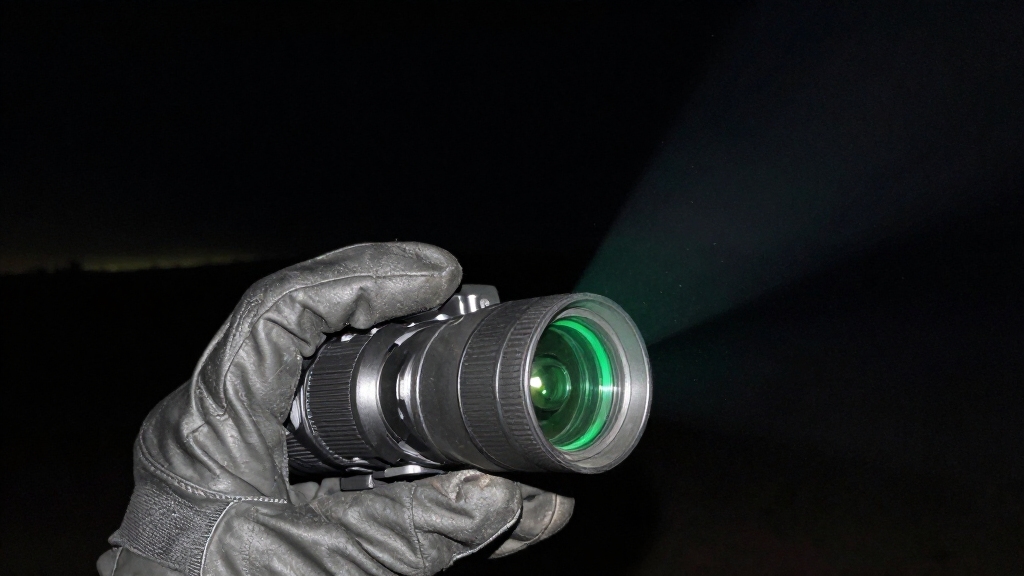
These illuminators emit near-infrared light invisible to the human eye but within the sensitivity range of night vision sensors.
By projecting IR light onto a scene, they create a source of photons that image intensifier or digital sensors amplify to form a visible image.
This active illumination compensates for the lack of ambient photons, enabling night vision functionality in zero-light conditions.
You’ll find IR illuminators integrated into many digital night vision units or available as external attachments, enhancing close-range visibility.
Their effectiveness depends on factors like IR output power, beam angle, and sensor sensitivity.
They fundamentally transform night vision devices from passive to active imaging systems in total darkness.
Night-vision goggles specifically detect reflected near-infrared light rather than emitted heat, which is why IR illuminators are essential for their operation in complete darkness.
How IR Illuminators Extend Night Vision Range and Clarity?
You know, infrared illuminators are pretty amazing tools when it comes to night vision. They emit near-infrared light that night vision sensors can pick up, even when there’s hardly any ambient light around. This means you can see in complete darkness!
Now, what really makes a difference is how these illuminators optimize beam intensity and focusing techniques. By doing this, they can significantly extend your effective viewing range. So, if you thought you were limited in the dark, think again!
Plus, there are other factors at play, like controlling the wavelength and diffusion of the light. These adjustments really enhance image clarity, helping to reduce noise and improve how well you can recognize details. It’s all about getting the best possible view, no matter how dark it is!
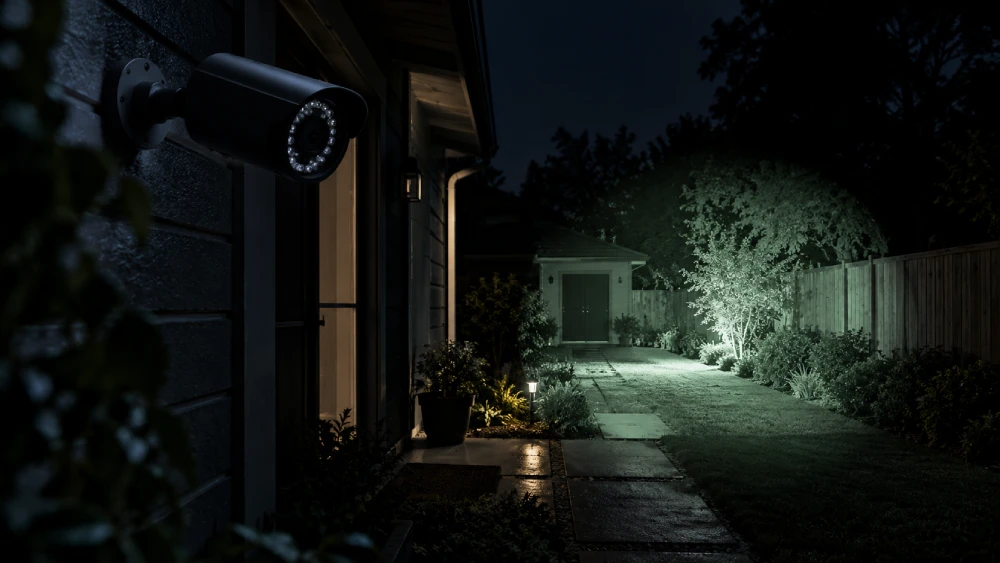
IR LEDs flood dark environments with invisible infrared light for detailed night footage, making them essential for reliable infrared night vision.
Infrared Light Basics
Infrared (IR) illuminators emit near-infrared light that night vision devices detect but remain invisible to the naked eye, effectively acting as concealed light sources.
This invisible illumination supplements ambient photons, enabling night vision sensors to capture clearer images in total darkness. The IR light’s wavelength typically ranges from 700 nm to 950 nm, optimized for sensitivity in image intensifier tubes and digital sensors.
By providing a controlled photon supply, IR illuminators mitigate the limitations of zero-light environments where ambient photons are insufficient.
You rely on this targeted near-IR emission to extend effective visibility, reduce image noise, and improve contrast.
However, IR intensity and beam pattern directly influence performance, requiring careful calibration to avoid signal oversaturation or insufficient illumination. This ensures peak night vision clarity within the device’s optical range.
Many modern long-range security cameras incorporate infrared LEDs combined with color night vision to enhance image clarity in low-light and no-light conditions.
Range Enhancement Techniques
Supplementing ambient light with near-IR illumination markedly boosts night vision performance, especially over extended distances. You rely on IR illuminators to supply photons where ambient light fails, extending effective range and improving image detectability.
The IR source’s power, beam angle, and wavelength directly influence how far and clearly you can see in complete darkness.
| Parameter | Effect on Range and Clarity |
|---|---|
| IR Power | Higher power increases illumination distance |
| Beam Angle | Narrow beams concentrate light, extending range |
| Wavelength | 850nm common; 940nm less visible but shorter range |
| Sensor Sensitivity | More sensitive sensors detect weaker IR signals |
| Obstructions | Reduce IR effectiveness, limiting range |
Optimizing these parameters guarantees you maximize night vision capability in no-light scenarios. Cameras with dual-zone motion detection can also improve alert accuracy by focusing on relevant movement within the IR illuminated area.
Clarity Improvement Factors
Although night vision devices rely on ambient photons, IR illuminators markedly enhance image clarity by providing a controlled, invisible light source.
This supplemental near-infrared illumination boosts photon availability, allowing image intensifiers or digital sensors to capture a clearer, more detailed scene in complete darkness.
By emitting a focused IR beam, the illuminator reduces noise and motion blur caused by insufficient light, improving contrast and edge definition.
You’ll notice how this targeted illumination extends effective viewing range, especially in low-reflectivity environments.
However, clarity gains depend on the illuminator’s power, beam angle, and wavelength compatibility with the night vision sensor.
Consequently, integrating a properly matched IR illuminator is essential for maximizing night vision clarity and operational effectiveness when ambient light is absent.
Gen 3 night vision devices, with their higher sensitivity and ability to perform passive viewing beyond 300 yards without active IR, significantly reduce reliance on active IR illumination.
Digital vs Analog Night Vision: Which Works Better in No Light?
When you compare digital and analog night vision in complete darkness, you’ll find that neither technology performs ideally without some form of illumination.
Neither digital nor analog night vision works well in total darkness without added illumination.
Analog night vision amplifies existing photons but fails in zero-light conditions. Digital night vision depends heavily on infrared (IR) illuminators to create a usable image. Both types lose effectiveness when no photons are available.
Key differences to take into account:
Analog devices excel in very low ambient light but go dark without it. Digital units often integrate built-in IR illuminators for zero-light use.
Image quality depends on sensor sensitivity and IR strength. Both struggle with range and detail in complete darkness without IR support.
Ultimately, your choice hinges on the availability of IR illumination and the operational environment.
Many advanced security cameras now combine IR with full-color night vision technology to enhance visibility in near-total darkness.
When Thermal Imaging Beats Night Vision in Total Darkness?
Night vision technologies, whether digital or analog, depend on detecting photons, either ambient or IR-illuminated, to form images. In total darkness without IR illumination, these devices fail because no photons reach their sensors.
Thermal imaging, however, detects emitted infrared radiation from objects’ heat signatures, independent of visible or IR light. This fundamental difference means thermal devices operate effectively in complete darkness, revealing heat contrasts invisible to night vision.
You’ll find thermal imaging particularly advantageous in zero-light environments, where detecting human or animal heat signatures is critical for navigation or threat identification.
While thermal imaging can be affected by environmental factors like ambient temperature or weather, it outperforms night vision when no photons exist for amplification.
This provides you with reliable visibility where night vision alone can’t function.
Additionally, thermal cameras often incorporate large-aperture lenses to enhance sensitivity to subtle heat differences, improving image clarity in complete darkness.
Common Visual Challenges of Night Vision in Complete Darkness
In complete darkness, you’re really up against limited photon availability. That means image-intensifier devices can struggle to work effectively. When there aren’t enough photons, the image quality takes a hit, leading to issues like noise, glare, and motion blur. These factors make it tough to see clearly.
And then there’s depth perception. It can get pretty tricky in low-light situations, which complicates how you judge space around you. Overall, navigating in total darkness is definitely a challenge! Thermal night vision cameras, which detect heat signatures instead of visible light, offer a reliable alternative for seeing in complete darkness.
Limited Photon Availability
Although night vision technology amplifies available photons to create images, its effectiveness sharply declines as photon availability vanishes in complete darkness. Without photons entering the device’s sensor, no image forms, rendering standard image-intensifier devices ineffective.
You’ll find that even environments perceived as pitch black often contain minimal photons from ambient sources, enabling limited functionality. However, in true zero-light conditions, the absence of usable photons halts image generation entirely.
Consider these limitations of photon scarcity:
- Image intensifiers require at least trace ambient photons to function.
- Complete darkness means zero photons, causing device blackout.
- Infrared illuminators can supply photons artificially, enabling vision.
- Digital night vision relies heavily on IR illumination under zero light.
Understanding photon availability is critical to evaluating night vision performance in total darkness.
Image Quality Degradation
When ambient light disappears and only artificial IR illumination remains, image quality commonly deteriorates due to factors such as increased noise, reduced contrast, and motion blur.
You’ll notice grainy visuals because the sensor amplifies weak IR signals, raising electronic noise. Contrast drops as IR reflectivity varies across surfaces, making object differentiation harder.
Fast movement worsens motion blur, as exposure times lengthen in low light. These issues limit the effective range and detail resolution.
| Challenge | Cause |
|---|---|
| Increased Noise | Amplification of weak IR signals |
| Reduced Contrast | Variable IR reflectivity |
| Motion Blur | Longer exposure on moving objects |
| Limited Range | Signal attenuation over distance |
Understanding these factors helps you optimize night vision use under complete darkness.
Depth Perception Difficulties
Because night vision relies on limited light sources or artificial IR illumination, your ability to accurately gauge depth diminishes markedly in complete darkness. Without sufficient ambient light or strong IR illumination, the visual cues your brain uses to interpret depth, like shadows, texture gradients, and binocular disparity, become unreliable. This affects spatial awareness and distance estimation, increasing navigation risks.
Key factors that impair depth perception include:
- Reduced contrast between objects and backgrounds
- Flattened image appearance due to uniform IR illumination
- Limited stereoscopic cues from monocular night vision devices
- Increased image noise obscuring fine spatial details
Understanding these limitations helps you anticipate challenges when using night vision in no-light scenarios. It emphasizes the need for supplemental illumination or alternative imaging methods like thermal vision for accurate depth assessment.
Practical Tips for Using Night Vision in Dark Environments
Optimize your night vision performance by understanding the limitations of your device in low-light or zero-light conditions.
Always verify ambient light levels before use; if photons are insufficient, activate your IR illuminator to supplement illumination.
Position the IR source strategically to avoid glare and reflections that degrade image quality.
Maintain a steady hold to minimize motion blur, which can impair detail resolution and depth perception.
Regularly clean lenses and sensors to reduce noise and artifacts.
When operating in complete darkness, rely on digital night vision units equipped with powerful IR emitters for peak range.
Adjust device gain settings cautiously to balance brightness against noise.
Monitor battery levels closely, as IR illumination consumes significant power.
Practicing these measures ensures reliable visibility and maximizes your device’s operational efficacy in dark environments.
Night Vision vs Thermal Imaging: Which Is Best for Your Needs?
How do you decide between night vision and thermal imaging for low-light operations?
You need to assess your environment and objectives carefully.
Night vision amplifies existing light, requiring at least minimal ambient photons or an IR illuminator to function effectively.
Thermal imaging detects heat signatures, allowing operation in complete darkness without any light source.
Consider these factors:
Ambient light conditions: Night vision struggles in zero-light without IR support. Thermal imaging excels in complete darkness.
Target identification: Night vision reveals finer details. Thermal highlights temperature differences.
Range and resolution: Night vision often offers better resolution at closer ranges. Thermal maintains detection over longer distances.
Environmental influences: Thermal imaging performance can degrade in extreme weather or against background heat.
Choose based on your specific operational needs and constraints.
Frequently Asked Questions
Can Night Vision Devices Be Damaged by Using IR Illuminators Continuously?
No, night vision devices generally won’t be damaged by continuous use of IR illuminators.
These illuminators emit low-power infrared light designed to be safe for the device’s sensors.
However, excessive heat buildup from prolonged use or poor ventilation could potentially degrade performance over time.
You should monitor your device’s operating temperature and follow manufacturer guidelines to avoid any risk of overheating or sensor strain when using IR illuminators extensively.
How Long Do the Batteries Typically Last in Night Vision Devices With IR?
You know what they say: “A chain is only as strong as its weakest link.”
For night vision devices with IR illuminators, battery life typically lasts between 4 to 10 hours, depending on factors like battery type, IR intensity, and device efficiency.
Using higher IR settings drains batteries faster, sometimes halving runtime.
You should always carry spare batteries or rechargeable packs to guarantee uninterrupted operation during extended use in low-light conditions.
Are There Legal Restrictions on Using IR Illuminators or Night Vision Devices?
Yes, you’ll find legal restrictions on using IR illuminators and night vision devices vary by country and region.
Some places limit their use to military, law enforcement, or licensed hunters.
Export controls and FCC regulations may apply, especially for devices emitting infrared light.
Before using, you should check local laws to avoid penalties.
Compliance guarantees you use night vision technology responsibly and legally in your area.
Can Animals Detect IR Illumination Emitted by Night Vision Equipment?
Yes, some animals can detect IR illumination emitted by night vision equipment, especially species sensitive to near-infrared wavelengths.
Dogs, for example, have limited IR sensitivity, so they might notice it, while many mammals and insects cannot.
You should consider the animal’s visual spectrum when using IR illuminators, as detection varies by species.
This can impact covert operations or wildlife observation, where IR visibility could alter animal behavior.
What Maintenance Is Required to Keep Night Vision Devices Functional in the Dark?
You need to maintain night vision devices like tuning a fine instrument.
Regularly clean lenses with microfiber cloths to avoid scratches. Check battery health to guarantee consistent IR illuminator power.
Store them in dry, dust-free cases to prevent moisture damage. Inspect connections and optics for wear or dirt.
Calibrate digital units as recommended. Proper upkeep guarantees the device performs optimally in darkness without signal loss or image degradation.
Does Night Vision Work in Complete Darkness? Final Answer
If you rely solely on standard night vision, you’ll find it falters in absolute darkness because it needs ambient light.
Imagine a security guard monitoring a pitch-black warehouse; without an IR illuminator or thermal imaging, their vision is nearly useless.
By integrating infrared or switching to thermal tech, you markedly enhance clarity and range in zero light.
Understanding these differences lets you choose the right tool for critical, no-light scenarios.