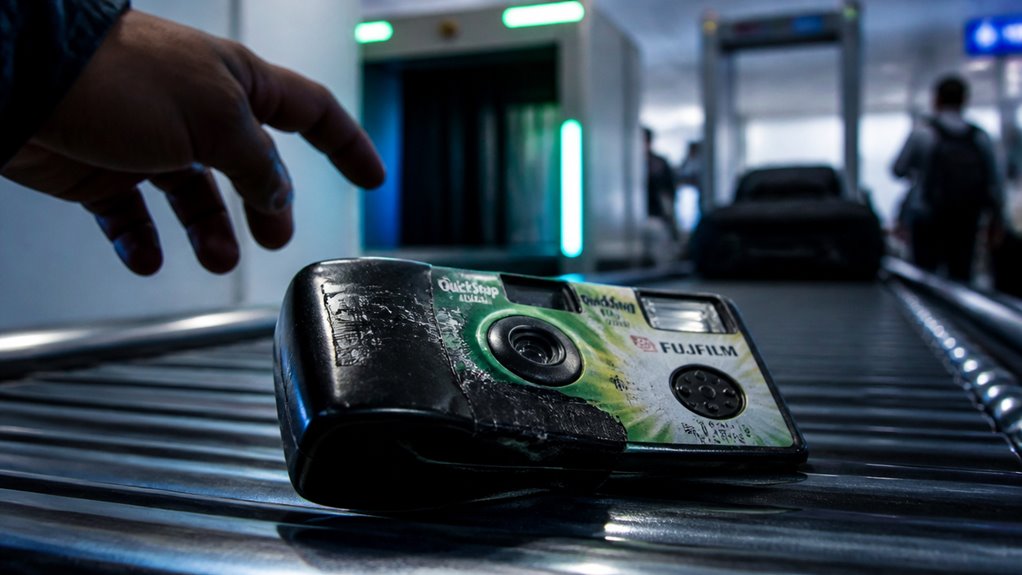

Yes, disposable cameras can get ruined by airport security scanners, especially if you put them in checked luggage where stronger X-ray or CT machines expose film to high-energy scans.
Carry your camera in your carry-on to reduce risk. Always ask for a hand inspection to avoid damage from repeated scans.
Higher-speed films and multiple screenings increase the chance of fogging or color shifts. To protect your shots and guarantee the best results, understanding scanner risks and precautions is essential.
Key Takeaways
- Disposable cameras with undeveloped film are vulnerable to damage from strong X-ray or CT scanners used in checked baggage screening.
- Carry-on scanners use lower-energy X-rays, reducing but not eliminating the risk of fogging or ruining film in disposable cameras.
- Multiple scans, especially at layovers, increase the risk of film fogging and permanent image degradation in disposable cameras.
- Requesting a manual hand inspection at security checkpoints can help protect disposable cameras from X-ray damage.
- Always keep disposable cameras and undeveloped film in carry-on luggage to minimize exposure to damaging scanners.
How to Protect Disposable Camera Film at Airport Security?
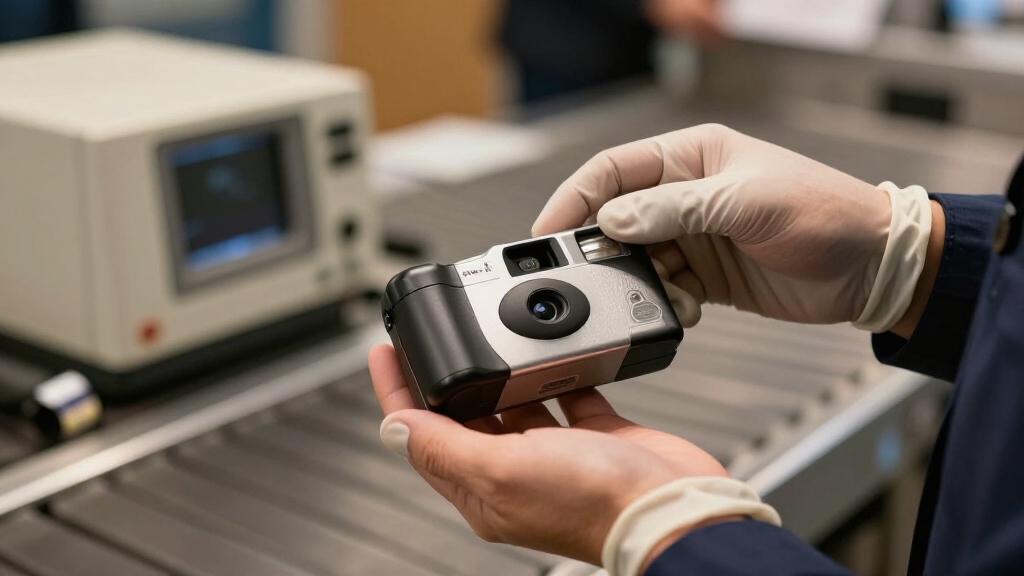
When you travel with a disposable camera, protecting the film from airport security scanners should be a top priority.
Always keep your camera in your carry-on luggage to reduce exposure to high-intensity scanners used for checked bags.
Keep your disposable camera in carry-on luggage to avoid damage from powerful checked baggage scanners.
Request a hand inspection at the security checkpoint to avoid X-ray or CT scanner damage.
Minimize the number of times your film passes through scanners, especially if it’s high-speed ISO 800 film, which is more vulnerable to fogging and color shifts.
Remember, older X-ray scanners tend to be less harmful than newer CT systems, so a single carry-on scan is often survivable.
Avoid checked baggage screening entirely, as it uses stronger technology that can ruin undeveloped film in one pass.
Taking these precautions helps preserve your images effectively.
For enhanced monitoring during your travels, consider cameras with color night vision to better capture details in low-light environments near airports.
Why Carry-On Bags Are Best for Disposable Cameras?
At airport security, carrying your disposable camera in your carry-on bag offers the best protection against film damage.
Carry-on scanners typically use lower-energy X-rays than checked baggage systems, reducing the risk of fogging or ruining undeveloped film.
You can also request a hand inspection more easily with carry-on items, avoiding scanner exposure altogether.
Keeping your camera with you minimizes multiple screenings, which increase film damage chances.
Checked luggage scanners often employ stronger X-ray or CT technology that can destroy film in one pass.
By storing disposable cameras in your carry-on, you retain control, reduce exposure to harsh scanning, and protect your images.
Always prioritize carry-on storage to safeguard your film’s integrity during airport security checks.
Ensure you keep your carry-on bag accessible and maintain steady footing when handling your camera through security checkpoints.
The Risks of Putting Disposable Cameras in Checked Luggage
You really shouldn’t put disposable cameras with undeveloped film in checked luggage. Why? Well, those high-energy scanners they use can ruin your film in just one pass!
It’s kind of a bummer because these powerful machines often lead to fogging or, worse, a complete loss of your images.
To keep your shots safe, it’s best to keep your camera in your carry-on. And if you can, go ahead and request a manual inspection when you go through security. It’s a simple step that can save your memories!
For enhanced reliability in complex environments, combining manual inspection with visual inspection techniques can help protect your film from damage.
Checked Luggage Film Damage
Although checked luggage offers convenience, it poses a significant threat to your disposable camera’s undeveloped film.
Checked-bag X-ray scanners use higher-energy technology that can fog or completely ruin your film in just one pass.
Unlike carry-on screening, which often involves lower-dose X-rays, checked luggage scanners don’t prioritize film safety, making damage almost inevitable.
Even a single scan through checked baggage screening can cause permanent image degradation, color shifts, or fogging.
For these reasons, you should never put undeveloped film or disposable cameras in checked luggage.
Instead, always keep them in your carry-on bag and request a manual inspection when possible.
This approach dramatically reduces the risk of damage and preserves your photos from irreversible harm during airport security checks.
Electrical interference and exposure to high-energy sources can degrade sensitive electronic components, similar to how strong X-rays affect film, highlighting the importance of avoiding high-energy exposure to preserve image quality.
High-Risk Screening Effects
Moving your disposable camera from carry-on to checked luggage dramatically raises the risk of film damage. Checked baggage scanners use stronger X-ray or CT technology that can ruin undeveloped film in just one pass. Unlike carry-on screening, where a hand inspection might protect your film, checked luggage undergoes automated, high-energy scans that fog or destroy images.
Here’s what you need to know about high-risk screening effects:
Checked baggage scanners expose film to intense radiation, increasing damage risk. One scan in checked luggage can permanently fog or degrade your film. Multiple scans compound damage, especially with high-ISO film. Manual inspection isn’t an option for checked bags, so damage prevention is limited.
To protect your shots, always keep disposable cameras in your carry-on. Proper procedures and precautions, such as verification before handling, are essential to avoid unnecessary damage or loss.
How X-Ray and CT Scanners Affect Film Quality?
When airport security scans your disposable camera, the type of scanner used plays a critical role in how the film inside fares.
Older X-ray scanners, typically used for carry-on luggage, emit low-dose radiation that usually won’t ruin your film with a single pass.
However, newer CT scanners, now common at many checkpoints, produce higher-energy scans that can fog or permanently damage undeveloped film in just one exposure.
Checked baggage systems use even stronger X-ray or CT technology, posing the greatest risk.
While a single carry-on X-ray scan often leaves your film intact, repeated scans or exposure to CT imaging increases fogging and image degradation.
Understanding these differences helps you protect your film by opting for carry-on luggage and requesting manual inspections whenever possible.
It is important to avoid repeated exposure to such scanners, as repeated/intense exposure can accelerate film damage.
What Film Speed Means for Disposable Camera Safety?
Hey there! Let’s chat about film speed and how it affects your disposable camera when you’re traveling.
So, film speed is pretty important when it comes to how well your camera’s film can handle those airport security scanners. If you’ve got a higher ISO rating, like ISO 800, your film is more prone to fogging and damage during screening. Not great, right?
On the other hand, if you stick with lower-speed films, like ISO 400, you’ll usually find they handle X-ray exposure much better. This means there’s less chance of your photos getting ruined. So, when you’re packing for your trip, it’s good to keep this in mind! Also, remember that some advanced screening methods can affect film differently, so understanding security scanner effects can help protect your camera’s film.
Film Speed Vulnerability
Although all disposable camera films face some risk at airport security, the film speed directly affects how vulnerable your photos are to damage.
Higher-speed films, like ISO 800, are more sensitive to X-rays and prone to fogging, color shifts, or degradation after screening.
Lower-speed films, such as ISO 400, generally withstand a single carry-on scan better.
However, no film speed is completely safe, especially against newer CT scanners.
Keep these points in mind:
Higher ISO films are more susceptible to visible damage. Lower ISO films have better resistance to single scans. Sensitivity increases the longer the film remains undeveloped. Multiple screenings amplify the risk regardless of film speed.
Understanding how environmental factors influence film sensitivity can help you better protect your images during travel.
ISO Ratings Impact
Disposable camera film with higher ISO ratings, like ISO 800, frequently faces greater risks of damage during airport security scans compared to lower ISO films such as ISO 400.
Higher ISO films are more sensitive, making them prone to fogging, color shifts, or degradation when exposed to airport X-ray or CT scanners.
While ISO 400 film tends to withstand a single carry-on scan better, you should still handle any undeveloped film with care.
The increased sensitivity of high-ISO film means even low-dose scans can cumulatively affect image quality if exposed multiple times.
To protect your film’s integrity, request hand inspections whenever possible and avoid placing disposable cameras with high-ISO film in checked luggage.
Stronger scanners pose a significant threat to film safety.
Additionally, regular maintenance and avoiding exposure to excessive light or reflections can help preserve film quality, similar to how glass cleanliness improves camera performance in sensitive environments.
High-Speed Film Risks
When carrying high-speed film like ISO 800 in your disposable camera, you face a greater risk of damage from airport security scanners. High-speed film is more sensitive to X-rays and can suffer fogging, color shifts, or loss of image quality after screening.
While one carry-on scan might be survivable, multiple scans increase the chance of visible damage. You should take extra precautions with ISO 800 film to preserve your shots.
Keep these points in mind:
High-speed film shows damage more easily than lower ISO film. CT scanners pose a risk to all film speeds, including ISO 800. Multiple security scans multiply the risk of fogging. Always request hand inspections to avoid scanner exposure.
Handling high-speed film carefully is essential for keeping your photos intact.
Why Multiple Security Scans Increase Film Damage?
Experiencing multiple security scans markedly raises the risk of film damage. Each exposure to X-rays or CT scanners compounds the effects on undeveloped film.
Every scan adds cumulative radiation that gradually fogs and degrades your disposable camera’s film, especially if it remains undeveloped.
While a single carry-on scan might be survivable, repeated screenings at layovers or multi-leg flights increase the chance of visible image loss or color shifts.
This risk escalates with newer CT scanners and higher-sensitivity film, but even lower-speed film suffers with repeated passes.
Avoiding multiple scans is vital since damage isn’t always immediate; it builds over time.
You should be aware that each additional exposure chips away at your film’s quality. Multiple screenings pose a significant threat to your photos’ integrity.
To better understand possible threats to your camera equipment, it is also important to recognize signs of hidden surveillance devices that may be disguised as everyday items.
How to Request a Hand Inspection for Your Disposable Camera Film?
Since multiple security scans increase the risk of film damage, minimizing exposure becomes a priority.
When you get to airport security, ask for a hand inspection to protect your disposable camera film from X-ray or CT scanner damage. Here’s how to do it effectively:
Politely inform the TSA officer that your disposable camera contains undeveloped film sensitive to X-rays.
Request a manual inspection instead of letting the camera pass through the scanner.
Keep your camera easily accessible, in a separate bin, to speed up the process.
Be prepared to open your camera or bag for the officer’s visual check if requested.
Tips to Avoid Film Damage During Airport Security Screening
To protect your disposable camera film during airport security, you’ll want to take proactive steps that minimize its exposure to damaging X-rays and CT scanners.
Always carry your camera and film in your carry-on luggage, never checked bags. Checked baggage scanners use stronger X-rays that can ruin undeveloped film in a single pass.
Keep your camera and film in carry-on bags only—checked baggage scanners can damage undeveloped film instantly.
Request a hand inspection whenever possible to avoid machine screening. Keep the number of scans low by controlling when and where your film is screened, especially during layovers or multiple checkpoints.
If you use high-speed film (ISO 800 or above), exercise extra caution, as it’s more vulnerable to fogging and color shifts.
Following these tips will help you preserve your film’s quality throughout your journey.
What to Do If Your Disposable Camera Is Exposed?
If your disposable camera has been exposed to airport security scanners, don’t panic right away. Exposure doesn’t always mean your film is ruined, especially after a single carry-on scan.
However, take these steps to protect your shots and minimize further damage:
Avoid additional screenings by keeping the camera in your carry-on and requesting hand inspections when possible.
Develop the film as soon as you can to prevent cumulative damage from prolonged exposure.
Inspect your photos carefully once developed; slight fogging or color shifts may appear but images could still be salvageable.
For future trips, consider using lower-ISO film and informing security staff about your film to reduce risks.
Frequently Asked Questions
Can Disposable Cameras Be Packed With Other Electronics Safely in Carry-On Bags?
Yes, you can pack disposable cameras with other electronics in your carry-on bag safely.
Just keep in mind that undeveloped film is sensitive to airport X-ray scanners, so request a hand inspection to avoid damage.
Avoid placing the camera in checked luggage and minimize repeated scans by keeping it easily accessible.
Treat higher-ISO film with extra care, as it’s more vulnerable to fogging and color shifts from scanner exposure.
Are There Specific Airport Security Lines Better for Film Screening?
Imagine you’re at a smaller regional airport where manual inspections are common.
Those security lines are better for your film because you can request a hand check, avoiding damaging scanners.
Larger international airports often use CT scanners, which are harsher on film.
How Does Climate or Temperature at Airports Affect Disposable Camera Film?
You should know that extreme climate or temperature changes at airports can harm your disposable camera film.
High heat or humidity can cause the film to degrade, lose contrast, or stick together.
Cold temperatures might make it brittle or affect chemical stability.
To protect your film, keep it insulated.
Avoid leaving it in hot cars or freezing environments, and store it in a stable temperature range during your travels.
Can Disposable Camera Film Be Insured Against Airport Security Damage?
You generally can’t insure disposable camera film specifically against airport security damage. Most travel or camera insurance policies don’t cover X-ray or CT scanner risks.
To protect your film, you should carry it on, request hand inspections, and minimize scans. If you’re worried about costly loss, consider buying separate travel insurance that covers photographic equipment.
Be sure to confirm it explicitly includes undeveloped film damage during security screening.
Do International Airports Have Different Rules for Disposable Camera Screening?
Just like each country’s cuisine varies, international airports have different screening rules for disposable cameras.
You’ll find that some airports offer hand inspections if you ask, while others rely heavily on advanced CT scanners that can damage your film.
To protect your shots, always carry your disposable camera in your carry-on, request manual checks, and be prepared for varying security protocols depending on where you fly.
Keep Your Disposable Camera Safe at Airport Security
Think of your disposable camera film as a delicate treasure map.
Airport security scanners are like mysterious guardians who can blur the path if you’re not careful.
By carrying your camera in your carry-on, requesting hand inspections, and avoiding multiple scans, you protect your film’s clarity.
Treat your film with care, and your captured memories will remain vivid, guiding you back to your best moments without losing a single detail.