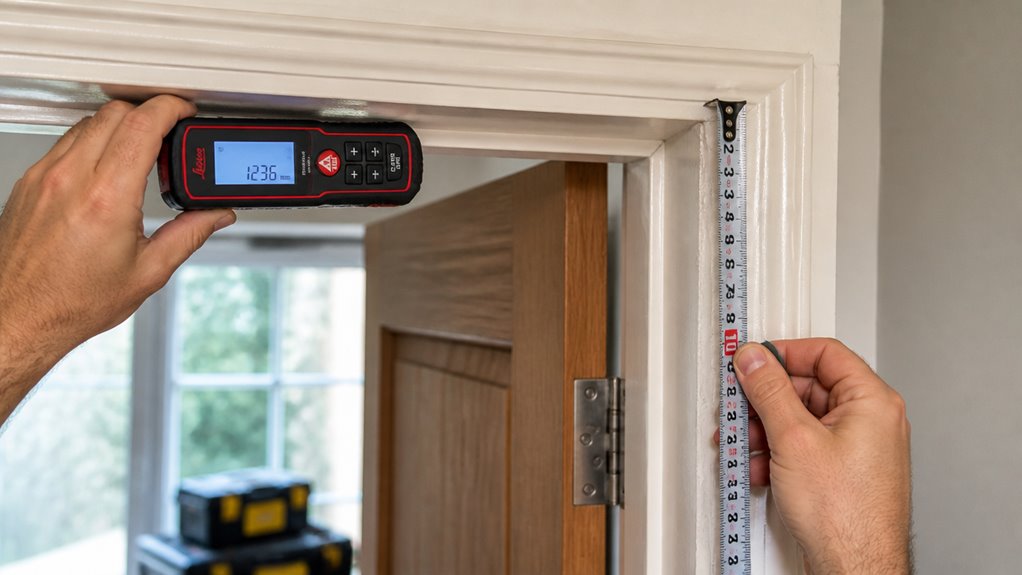

To measure for a security door, start by measuring the width at the top, middle, and bottom of your opening. Use the smallest width for sizing.
Next, measure the height at the left, center, and right from the threshold to the underside of the head trim. Select the smallest height unless otherwise specified.
Check that the frame is square and plumb by measuring diagonals and using a level. Don’t forget to note door swing, lock placement, and frame depth for a precise fit.
Understanding these basics sets the foundation for a secure installation.
Key Takeaways
- Measure the door width at the top, middle, and bottom, using the smallest width for accurate sizing.
- Record door height at left, center, and right from threshold to underside of head, using the smallest height unless specified.
- Check that jambs are plumb and the opening is square by measuring diagonal distances corner-to-corner.
- Measure frame depth, including rebates, trims, and threshold height, to ensure proper fit and clearance.
- Identify door swing direction and lock height, and record all measurements precisely to avoid errors.
Measure the Width and Height of Your Security Door Opening
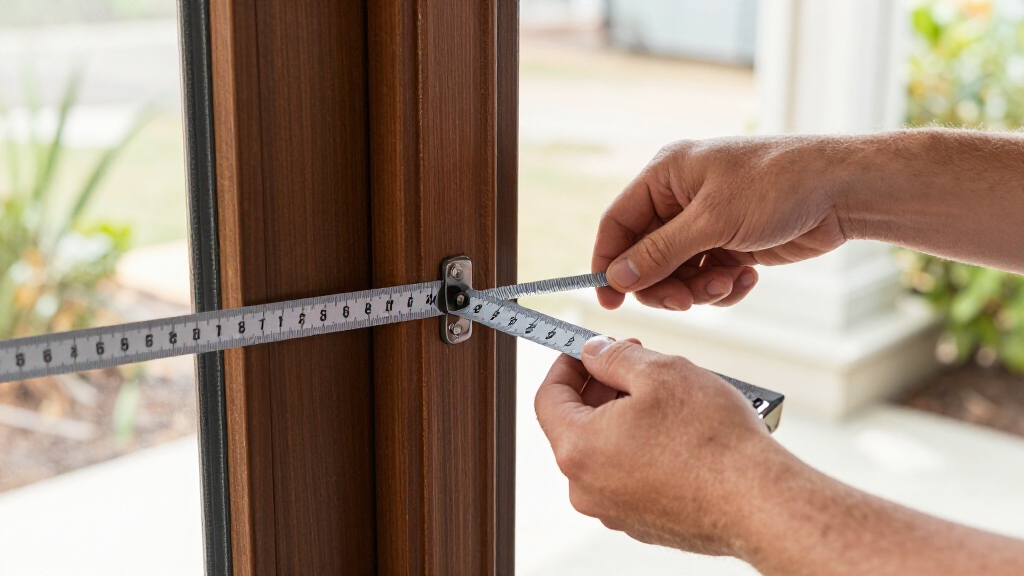
Begin by measuring the width of your security door opening at three distinct points: the top, middle, and bottom. Use a tape measure that stays straight and taut across the opening.
Measure the width of your security door opening at the top, middle, and bottom using a taut tape measure.
Record each width separately without averaging; the smallest width determines your door size. Next, measure the height on the left side, center, and right side of the opening. Start at the threshold or sill and extend to the underside of the head or trim.
Again, document all three height measurements and select the smallest height, unless your manufacturer specifies otherwise. Always include flooring, thresholds, or lips in your height reference points.
Recheck any visible bowing or irregularities to ensure accuracy before ordering. Precise measurements prevent fitment issues during installation. For enhanced security, consider mounting cameras at optimal heights and angles near your door to monitor access points effectively.
Select Accurate Reference Points for Measuring Your Door
After measuring the width and height at multiple points, focus on using the correct reference points for your measurements.
Stand outside the opening and measure from the inside face of the jamb or mounting surface if the product guide specifies this method.
Avoid measuring only the existing door slab unless instructed.
For certain door styles, measure brick-to-brick or frame-to-frame as required.
Make sure your tape measure is straight and taut to prevent inaccurate readings.
Also, consider any rebates, trims, or brickmoulds affecting fit.
Confirm threshold height and any sill lips that may interfere with installation.
Matching your measuring method precisely to the security door style you’re ordering guarantees a proper fit and prevents costly errors during installation.
For optimal accuracy, ensure the door frame is level and plumb before finalizing your measurements to avoid installation issues related to frame alignment.
Check for Square, Plumb, and Diagonal Consistency
When measuring your door opening, you’ll need to verify that it’s square, plumb, and consistent diagonally to guarantee a proper fit.
Begin by using a level to check that both jambs are perfectly vertical (plumb).
Next, measure the diagonal distances from corner to corner. If these measurements are equal, the opening is square; if not, it indicates racking or twisting.
Also, inspect for any bows in the jambs that may affect door alignment.
Record all readings carefully, noting any irregularities.
If the opening isn’t square or plumb, consider ordering a custom-sized door or allowing extra tolerance.
Photographs of your measurements can assist in confirming accuracy with the supplier and help prevent installation issues.
Additionally, when installing security features such as a peephole, proper placement and sightline measurements are crucial for optimal functionality.
Inspect Frame Depth and Threshold for Installation Fit
Confirming that your opening is square and plumb sets a solid foundation for accurate measurements.
However, you also need to inspect the frame depth and threshold closely. These elements directly affect the fit and function of your security door.
Start by measuring the frame depth or reveal where the door and screen will sit. Note any rebates or trims that could impact installation.
Next, assess the threshold height and any sill lips that might interfere with the door’s operation.
Finally, identify obstructions such as architraves or raised flooring that reduce clearance.
Pay special attention to:
- Frame depth and any rebates or brickmoulds
- Threshold height and sill lip dimensions
- Clearance around obstructions for smooth door movement
Accurate inspection guarantees your door fits securely and operates without issues.
Be sure to measure the jamb depth precisely at multiple points to ensure the frame fits flush and prevents gaps or misalignment.
Measure Door Swing, Lock Position, and Record Measurements
Although measuring the opening dimensions is vital, accurately determining the door swing direction and lock position guarantees proper hardware alignment and functionality. First, identify the door swing: left or right, inward or outward. This affects hinge placement and clearance.
Next, measure the lock height from the floor and note if the lock sits above or below the handle. This confirms compatibility with your security door model. Record all measurements immediately to prevent errors during ordering.
Ensuring proper measurement of the door frame and hinge type is essential to accommodate reinforced frames that provide enhanced security and structural integrity.
| Measurement Aspect | Description | Notes |
|---|---|---|
| Door Swing | Left/Right, Inward/Outward | Affects hinge and clearance |
| Lock Position | Height from floor | Check above/below handle |
| Measurement Records | Write down all values | Avoid transcription mistakes |
| Hardware Alignment | Correlate with specs | Confirm before final order |
Frequently Asked Questions
What Tools Do I Need to Measure for a Security Door?
You’ll need a reliable tape measure, preferably steel, to get precise width, height, and depth measurements.
A level or carpenter’s square helps verify plumb and squareness.
A pencil and notepad or digital device guarantee you record measurements accurately.
For tricky angles, use a digital angle finder or laser measure.
Don’t forget a camera or smartphone to document the opening and tape positions for reference during ordering.
How Do I Measure for a Security Door on a Curved or Arched Opening?
When you face a curved or arched opening, you’ll want to measure the width and height at multiple points along the curve: top, middle, and bottom, just like with straight openings.
Use a flexible tape to follow the contour accurately. Record the smallest width and height, but also note the arch’s radius or peak height.
Make sure to check the frame’s depth and reveal carefully, as these irregularities affect fit and installation precision.
Can I Measure Security Doors for Double Door Installations?
Yes, you can measure security doors for double door installations.
Measure the width of each door panel separately at three points: top, middle, and bottom. Use the smallest measurement for each.
Then, measure the height on both sides and the center, again using the smallest measurement.
Record the gap between the doors and check frame depth and clearance to guarantee proper fit and operation.
Always verify square and plumb conditions before ordering.
How Do Weather Conditions Affect Security Door Measurements?
Don’t let weather conditions throw your measurements into a chaotic storm!
Temperature and humidity cause materials to expand or contract, affecting door frame dimensions.
You should measure in stable, moderate conditions to ascertain accuracy.
Avoid measuring right after rain or extreme heat, as moisture can swell wood or metal.
If unavoidable, account for potential dimensional changes by consulting manufacturer guidelines.
This guarantees your security door fits perfectly under all weather conditions.
Should I Measure Security Doors Differently for Sliding Versus Hinged Doors?
Yes, you should measure sliding and hinged security doors differently.
For sliding doors, focus on the width and height of the entire opening, including track clearance and frame depth. This ensures smooth operation.
Hinged doors require precise measurements of width, height, jamb depth, and swing direction.
Always record smallest widths and heights at multiple points for accuracy. Consider hardware placement and frame reveal specifics unique to each door type.
Final Tips for Measuring a Security Door Correctly
By carefully measuring every aspect of your security door—from width and height to frame depth and door swing—you’ll guarantee a perfect fit that leaves no room for error.
Don’t cut corners; accurate measurements are the backbone of a secure installation.
Remember, getting these details right now will save you headaches down the road, making the whole process smooth sailing and your security door as reliable as it should be.