
Forced air heat means using a furnace or heat pump to warm air, then pushing it through ductwork with a blower fan to distribute heat quickly and evenly throughout your home.
Return ducts pull cooler air back for reheating, maintaining a consistent cycle controlled by your thermostat.
This system integrates with cooling and air filtration, offering fast temperature changes but requiring regular filter and duct maintenance.
Exploring its components and benefits will deepen your understanding of how it keeps your home comfortable year-round.
Key Takeaways
- Forced air heat uses a blower fan to push warmed air through ducts into rooms for heating.
- It describes the movement of heated air, not the type of fuel or heat source used.
- Return ducts pull cooler air back to the furnace or heat pump for reheating, creating a continuous cycle.
- This system provides faster temperature adjustments compared to radiant or baseboard heating methods.
- Forced air systems rely on filters and ducts, which affect indoor air quality and require regular maintenance.
Understanding Forced Air Heat
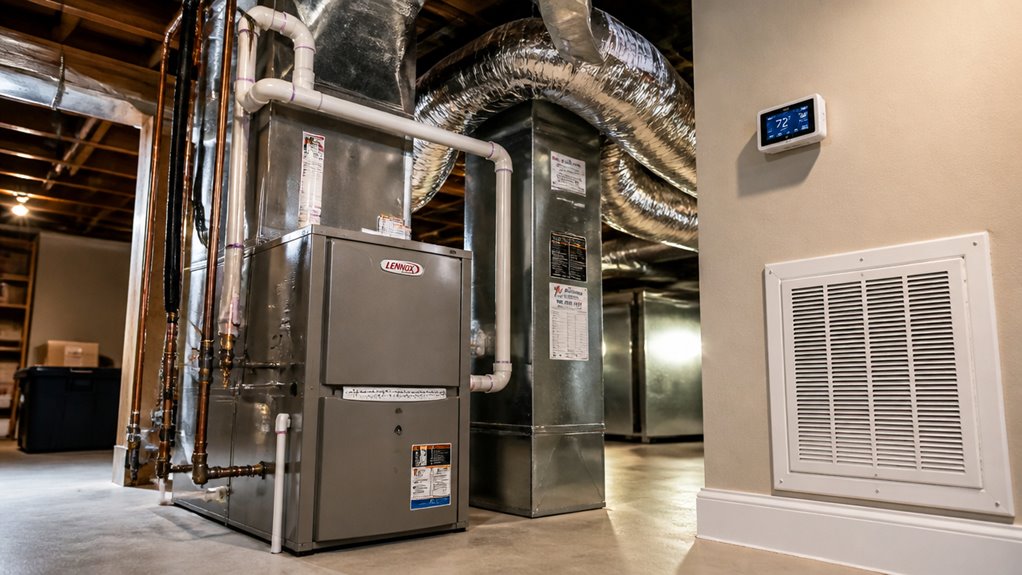
Forced air heat is a central heating method that warms air using a furnace, heat pump, or similar device. It then distributes this air throughout your home via ductwork and vents.
Forced air heat warms air centrally and distributes it through ducts and vents in your home.
Forced air refers specifically to how heated air moves, not the fuel source. A blower fan pushes the warmed air through a system of supply ducts into each room. Return ducts pull cooler air back for reheating.
This continuous cycle maintains an even temperature throughout your home. Unlike local heat sources like radiators, forced air heat relies on a centralized system to circulate air room to room.
It’s also a key part of many HVAC setups. The same duct network can handle cooling and filtration, ensuring efficient air distribution year-round. Many systems also integrate with smart home platforms to enable remote monitoring and control.
Main Parts of a Forced Air Heating System
A forced air heating system relies on several key components working together to efficiently warm your home.
At its core, the furnace or heat pump generates heat by warming air inside the system. The blower fan then forces this heated air into the supply plenum, directing it through the ductwork.
This network of ducts channels warm air to vents and registers in each room, releasing it to maintain consistent temperatures.
Simultaneously, return ducts collect cooler indoor air and transport it back to the furnace or heat pump for reheating.
Each part is essential: the heat source produces warmth, the blower guarantees air movement, ducts distribute air, vents deliver it to living spaces, and return ducts enable continuous recirculation and temperature regulation throughout your home.
Proper airflow management in the duct system is crucial to ensure accurate thermostat readings and efficient heating performance.
Fuel Sources for Forced Air Heat
Once the system’s components work together to circulate air effectively, the next consideration is the fuel source powering the heat generation.
Forced air heating systems can utilize various fuels, each influencing efficiency, installation cost, and maintenance. Common fuel sources include natural gas, propane, heating oil, and electricity.
Heat pumps powered by electricity offer a dual function of heating and cooling by transferring heat rather than generating it through combustion. Your choice depends on availability, cost, and environmental considerations.
| Fuel Source | Characteristics |
|---|---|
| Natural Gas | Efficient, common, requires gas line |
| Propane | Portable, good for off-grid areas |
| Heating Oil | Higher emissions, requires storage tank |
| Electricity | Clean, versatile, supports heat pumps |
Regular HVAC maintenance helps ensure system efficiency and consistent performance, reducing energy waste and improving comfort through proper air circulation and temperature control. HVAC maintenance
Benefits of Forced Air Heat for Your Home
Many homeowners appreciate how quickly this heating method can raise indoor temperatures, delivering warmth directly through vents to occupied spaces.
You benefit from a consistent temperature distribution thanks to continuous air recirculation controlled by your thermostat.
Forced air systems also integrate heating, cooling, and air filtration into a single duct network, simplifying your home’s climate control.
Maintenance is straightforward, typically involving regular filter changes and duct inspections to guarantee efficiency and indoor air quality.
Additionally, forced air heat works with various fuel sources, offering flexibility to match your energy preferences and availability.
By using a blower fan to push heated air, your home experiences rapid warmth without relying on localized heat sources.
This makes forced air heat an efficient and adaptable solution for modern residential heating needs.
Thermostats play a key role by using temperature sensors to monitor and maintain your desired indoor climate efficiently.
Comparing Forced Air Heat to Radiant and Baseboard Heating
When you compare forced air heat to radiant and baseboard heating, you’ll notice some pretty distinct differences in how each system spreads warmth throughout your home.
For starters, forced air heating uses ductwork and fans to push heated air around. It’s quite the different vibe compared to radiant and baseboard systems, which actually transfer heat directly through surfaces.
Understanding these methods really helps to clarify the variations you might experience in comfort, airflow, maintenance needs, and overall efficiency.
Heat Distribution Methods
Comparing heat distribution methods highlights key differences between forced air systems and alternatives like radiant and baseboard heating.
Forced air heat moves warm air through ductwork using a blower fan. It delivers heat rapidly and uniformly across rooms via vents.
In contrast, radiant heating transfers heat through infrared radiation from heated surfaces, such as floors or panels. This provides direct warmth without air movement.
Baseboard heating relies on convection, warming air near the heating element, which then circulates naturally without forced airflow.
Forced air systems enable quick temperature adjustments and integrate with cooling and filtration. Radiant and baseboard systems offer quieter operation and localized warmth without duct requirements.
Each method’s heat transfer mechanism affects installation complexity, energy efficiency, and maintenance. You should consider these factors when deciding on the most suitable distribution method for your home.
Forced air systems can also be integrated into home automation setups to optimize energy use through scheduled or sensor-triggered control.
Comfort and Airflow Differences
Forced air heat typically creates noticeable airflow throughout your home by circulating warm air via ducts and vents. This can influence comfort differently than radiant or baseboard systems.
You’ll feel air movement as the blower fan pushes heated air into rooms, promoting quicker temperature changes. This airflow can help distribute heat evenly but may also stir dust or allergens if filtration isn’t ideal.
In contrast, radiant heating warms surfaces directly, providing uniform warmth without air circulation. This often feels more comfortable and silent.
Baseboard heating relies on convection from hot elements, producing gentle, localized heat with minimal airflow. While forced air systems adjust temperature rapidly, the moving air sensation mightn’t suit everyone, especially those sensitive to drafts or airborne particles.
This is unlike the still warmth of radiant or baseboard heat. Proper maintenance, such as replacing dirty air filters regularly, is essential to avoid blocked airflow and ensure system efficiency, preventing issues like airflow restrictions.
Maintenance and Efficiency
Air circulation in forced air heating systems requires regular upkeep to maintain efficiency and indoor air quality.
You’ll need to replace or clean filters frequently to prevent airflow restrictions and reduce dust accumulation.
Inspecting and sealing ductwork minimizes heat loss and improves system performance.
In contrast, radiant and baseboard heating require less routine maintenance since they don’t rely on air movement or ducts.
However, forced air systems can lose efficiency if ducts leak or filters clog.
Radiant and baseboard units provide consistent heat directly to surfaces, reducing energy waste.
While forced air systems offer quicker temperature adjustments, maintaining them demands more attention.
Using flexible low voltage wiring in thermostat controls can enhance system reliability and ease maintenance.
Why Proper Ductwork Matters for Forced Air Heat Efficiency?
When you rely on a forced air heating system, the design and condition of your ductwork play a critical role in its overall efficiency.
Properly sealed and insulated ducts minimize heat loss as warm air travels from the furnace to your living spaces.
Leaks or poorly sized ducts cause uneven airflow, forcing your system to work harder and increasing energy consumption.
Additionally, well-designed duct layouts guarantee balanced distribution, maintaining consistent temperatures throughout your home.
Avoid sharp bends or abrupt shifts that restrict airflow and reduce system performance.
Regular inspections help detect damage or blockages that compromise efficiency.
Ensuring continuous protection in your home extends beyond heating systems and includes maintaining essential safety devices like smoke detectors.
How Forced Air Heat Works With Cooling and Air Filters?
Although primarily designed for heating, your system’s ductwork and blower fan also facilitate cooling by circulating chilled air from an air conditioner or heat pump.
Air filters play a critical role by trapping dust, pollen, and debris. This ensures clean air flows through your home and protects HVAC components from damage.
Proper filtration maintains system efficiency and indoor air quality. The same blower pushes conditioned air, whether heated or cooled, through supply ducts and vents.
Continuous operation of air purifiers complements HVAC filtration by maintaining consistent removal of allergens and pollutants throughout the day, enhancing overall indoor air quality.
| Component | Function | Impact on System |
|---|---|---|
| Ductwork | Air distribution | Enables even cooling/heating |
| Blower Fan | Air movement | Maintains consistent airflow |
| Air Filters | Particle filtration | Protects system, improves air |
| Air Conditioner | Cooling source | Chills air circulated by ducts |
Simple Maintenance Tips to Keep Forced Air Heat Efficient
Maintaining your forced air heating system regularly helps preserve its efficiency and prolongs its lifespan.
Start by replacing or cleaning air filters every 1 to 3 months to prevent airflow restrictions and strain on the blower fan.
Inspect ductwork for leaks or damage and seal gaps with mastic or metal tape to avoid heat loss.
Schedule annual professional tune-ups to check furnace components, clean burners, and verify proper combustion.
Keep vents and registers unobstructed to guarantee even heat distribution.
Regularly clear debris around the outdoor unit if you have a heat pump.
Finally, monitor thermostat calibration to maintain accurate temperature control.
These straightforward maintenance steps optimize performance, reduce energy consumption, and prevent costly repairs in your forced air heating system.
Additionally, consider the type and condition of your system’s backup power, such as Sealed Lead-Acid batteries, to ensure reliable operation during power outages.
Frequently Asked Questions
Can Forced Air Heating Systems Cause Dry Indoor Air?
Yes, forced air heating systems can cause dry indoor air because they heat air by blowing it through ducts, which often reduces humidity levels.
When warm air circulates, it tends to absorb moisture from surfaces and occupants, making the air feel drier.
To counteract this, you should consider adding a humidifier or using other humidity control methods to maintain comfortable moisture levels and prevent dryness-related issues like irritated skin or respiratory discomfort.
How Noisy Is a Forced Air Heating System During Operation?
You’ll notice some noise from a forced air heating system during operation, mainly from the blower fan and air moving through ducts and vents.
The sound level varies by system design, age, and maintenance.
Well-maintained units run quieter, while older or poorly insulated ductwork can cause rattling or whistling.
Properly sealing ducts and using sound dampening materials can markedly reduce noise, making it less intrusive in your living space.
Are Forced Air Heat Systems Compatible With Smart Thermostats?
Yes, you can connect forced air heat systems to smart thermostats just like fitting a key into a lock.
These thermostats precisely control temperature by communicating with your furnace or heat pump, optimizing energy use.
They adjust heating schedules based on your habits, improving comfort and efficiency.
Since forced air systems use blower fans and ductwork, smart thermostats effectively manage airflow cycles.
This ensures consistent indoor temperatures while reducing utility costs.
What Is the Typical Lifespan of a Forced Air Furnace?
You can typically expect a forced air furnace to last between 15 and 30 years. Its lifespan depends on factors like the quality of installation, routine maintenance, and system usage.
Regular filter changes and annual professional tune-ups help extend its service life. If you notice frequent repairs or reduced efficiency before 15 years, it might be time to contemplate replacement to maintain peak heating performance.
Can Forced Air Heat Trigger Allergies or Asthma Symptoms?
Imagine your forced air system as a wind stirring dust in a quiet room. Yes, it can trigger allergies or asthma if its filters and ducts aren’t properly maintained.
Dust, pollen, or pet dander caught in the ductwork may circulate through your home, irritating your respiratory system.
To minimize symptoms, you should regularly replace filters, clean ducts, and consider installing high-efficiency air purifiers alongside your forced air heating system.
Final Thoughts on Forced Air Heat Meaning
Now that you understand forced air heat, you can appreciate its efficiency and versatility in your home.
Remember, “a stitch in time saves nine.” Regular maintenance keeps your system running smoothly, preventing costly repairs.
Proper ductwork and clean filters optimize performance, ensuring consistent warmth and air quality.
By choosing and caring for forced air heat wisely, you’ll enjoy reliable comfort and energy savings throughout the seasons.