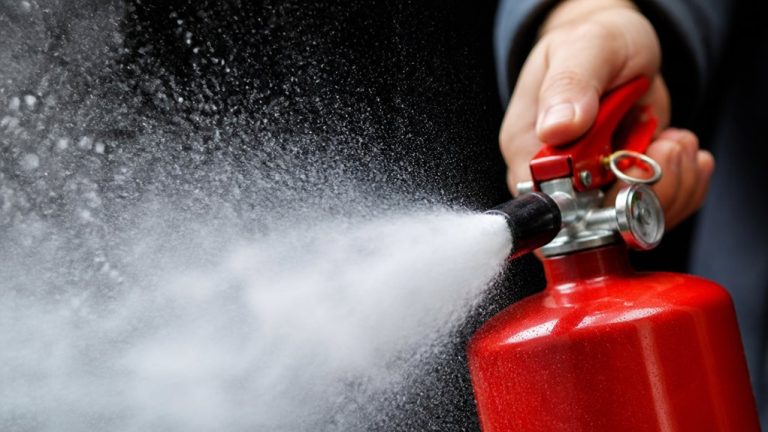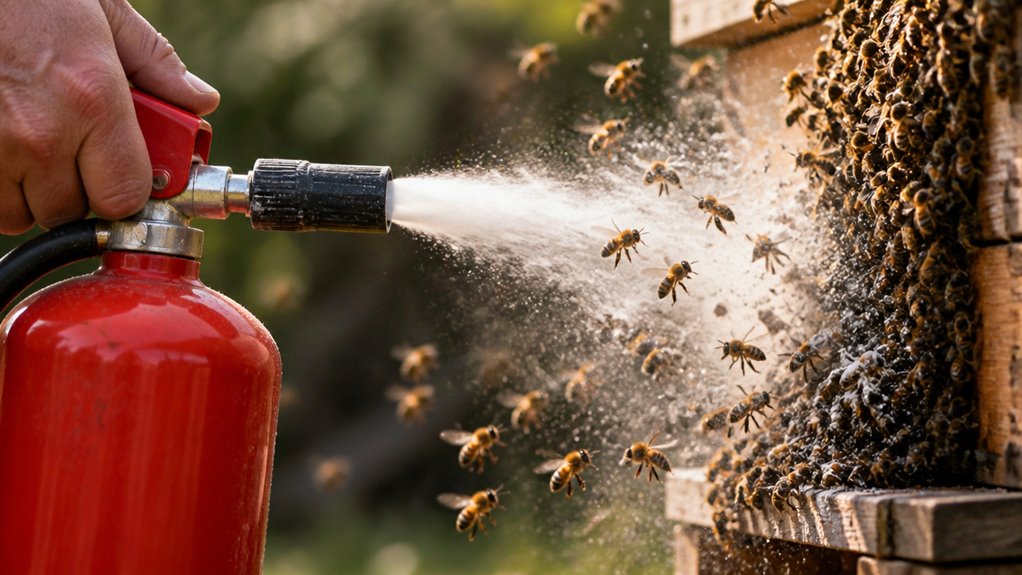

Using a fire extinguisher may stun or kill some bees temporarily by displacing oxygen, chilling, or causing mechanical injury. However, it won’t eliminate an entire swarm or colony.
The chemical agents lack residual effects, allowing surviving bees to reestablish nests. You also risk agitating bees, increasing sting danger and contaminating the environment.
Fire extinguishers aren’t practical or effective for long-term control. Understanding safer, more targeted approaches becomes essential for managing bee issues responsibly.
Key Takeaways
- Fire extinguishers can temporarily stun or kill some bees on contact but are not effective for complete swarm eradication.
- CO2 extinguishers may suffocate bees with prolonged exposure but practical application limits reduce effectiveness.
- Foam or dry powder agents chemically harm bees but lack residual effects to prevent recolonization.
- Loud discharge and spray agitation increase bee defensiveness, raising sting risk during extinguisher use.
- Surviving bees often regroup if the queen or nest remains, making fire extinguishers ineffective for long-term control.
What Happens to Bees When You Use a Fire Extinguisher?
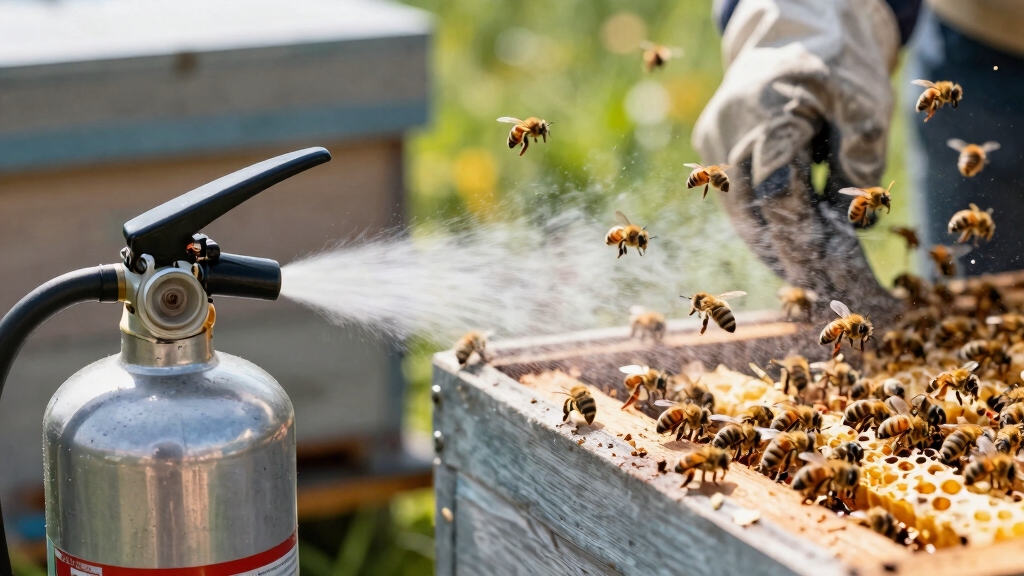
When you use a fire extinguisher on bees, the immediate effects vary depending on the extinguisher type and proximity.
If you spray a CO2 extinguisher close and continuously, you suffocate bees by displacing oxygen. The cold temperature stuns or slows them before death. The forceful discharge can physically injure bees through impact.
Close, continuous CO2 spray suffocates, stuns with cold, and physically injures bees through impact.
Foam or dry powder agents introduce chemicals that contaminate and harm bees chemically. Wetting agents, such as surfactants in low concentrations, cause rapid immobilization by disrupting the insect’s cuticle.
However, the extent of damage depends on exposure duration and distance.
Bees struck directly by the spray experience mechanical trauma, whereas those further away may only be temporarily displaced or stunned.
This immediate response is complex and varies with the extinguisher’s chemical and physical properties.
Similar to how smoke detectors signal danger through audible chirps when power is low, the effects on bees signal the severity of exposure to harmful agents.
Can Fire Extinguishers Kill Entire Bee Swarms?
Although fire extinguishers can temporarily disperse or kill some bees on contact, they cannot reliably eliminate entire swarms. The intensity and duration necessary to suffocate or stun bees exceed practical application limits. Resilient bees often survive initial exposure, and swarms may regroup if the nest remains intact.
Fire extinguishers lack the specificity and persistence needed to address swarm size or nesting complexity.
| Factor | Explanation |
|---|---|
| Physical impact | Can injure individual bees but not all swarm. |
| Chemical agents | May harm some bees but often insufficient. |
| Cold CO2 spray | Stuns or suffocates bees briefly. |
| Duration required | Prolonged exposure unrealistic for swarms. |
| Recolonization risk | High if nest or attractants remain. |
You’ll find extinguishers ineffective for total swarm eradication. Additionally, fire extinguishers feature pressure relief valves and controlled discharge mechanisms that prevent sudden or complete release of contents, limiting their effectiveness in widespread applications like swarm eradication.
What Are the Safety Risks of Using Fire Extinguishers on Bees?
Using a fire extinguisher near bees can be pretty risky. The loud sound and sudden spray really tend to agitate them, which makes them more defensive.
This means that anyone nearby could get stung multiple times, especially if they’re not wearing any protective gear.
Plus, when you discharge a fire extinguisher, the bees’ flight patterns become unpredictable. That makes it even harder to manage the situation safely.
Additionally, inhaling fire extinguisher powder can cause short-term respiratory irritation, so it’s important to avoid breathing in the discharged particles.
Agitation and Bee Aggression
Since fire extinguishers release sudden bursts of noise and forceful streams, using them near bees often provokes heightened aggression within the swarm.
This agitation stems from the bees’ natural defense mechanisms, as loud sounds and rapid air movement trigger alarm pheromone release. This signals danger to the colony.
When disturbed, bees adopt defensive postures and increase their readiness to sting. The unpredictable flight patterns caused by the extinguisher’s discharge further escalate their defensive behavior.
Consequently, the swarm becomes more reactive, posing challenges to anyone nearby. Understanding this biological response clarifies why fire extinguishers, though capable of causing physical harm, also intensify bee aggression.
This complicates safe removal efforts and increases the risk of defensive swarm behaviors in response to such disturbances.
Risk of Human Stings
The heightened aggression caused by fire extinguishers directly increases the risk of human stings during bee encounters. When you discharge an extinguisher near bees, the noise, sudden air blast, and chemical agents provoke defensive behavior, making bees more likely to sting.
You also risk multiple stings as agitated bees become highly defensive and swarm around perceived threats. Additionally, spraying a fire extinguisher can cause physical harm to bees, triggering erratic flight paths that further endanger you. Without adequate protective gear, your exposed skin and face remain vulnerable.
Using fire extinguishers in these situations doesn’t neutralize the threat safely; it escalates aggressive responses and increases the likelihood of painful, potentially dangerous stings. Consequently, you should consider alternative, less provocative removal methods to minimize personal injury risk. Furthermore, the chemical powder’s smothering and coating action is designed to suppress fires, not control insects, making it ineffective for bee removal.
Unpredictable Bee Flight
Spraying a fire extinguisher near bees often triggers erratic and unpredictable flight patterns that complicate safe removal efforts.
When you discharge the extinguisher, bees become agitated, increasing their defensive behavior. This unpredictability raises markedly safety risks for anyone nearby.
Specifically, you should consider these factors:
- Sudden bursts and loud noise from the extinguisher provoke bees to fly erratically, making them harder to avoid.
- The force of the spray may physically injure some bees, scattering them unpredictably and increasing swarm agitation.
- Agitated bees show heightened aggression, substantially raising the risk of multiple stings to unprotected individuals.
Given these risks, using a fire extinguisher near bees can escalate danger rather than control the swarm effectively.
Additionally, the powder discharge can cause respiratory irritation to humans nearby, increasing health risks during such attempts.
Why Experts Warn Against Using Fire Extinguishers on Bees?
You know, it’s actually not a great idea to use a fire extinguisher on bees.
First off, it often makes them more aggressive, which means you could end up with multiple stings. That’s definitely not fun!
Plus, using a fire extinguisher doesn’t really solve the problem in the long run.
The bees that survive can easily bounce back and reestablish their colonies if you don’t remove the nests completely. So, it’s kind of a temporary fix at best.
And let’s not forget about the environmental impact.
The chemicals in those extinguishing agents can contaminate the soil and water, not to mention harm other non-target organisms. So, it’s best to steer clear of that approach.
Additionally, improper use or storage of fire extinguishers can lead to pressure hazards that pose safety risks beyond just ineffective pest control.
Increased Bee Aggression
When you discharge a fire extinguisher near a bee swarm, you risk provoking increased aggression among the insects. The sudden noise, chemical exposure, and physical force activate defensive behaviors in bees, causing them to become more hostile. This heightened aggression increases the likelihood of multiple stings to anyone nearby, posing significant safety concerns.
Specifically, you should consider these effects:
- Loud discharge noise triggers alarm pheromone release, signaling danger to the colony.
- Chemical agents irritate bees, disrupting normal behavior and heightening defensiveness.
- Physical impact from spray causes unpredictable flight patterns, escalating swarm agitation.
Because of these factors, experts strongly advise against using fire extinguishers for bee control. The induced aggression creates a hazardous environment rather than effectively neutralizing the threat. Additionally, environmental conditions such as wind and debris can worsen the situation by spreading irritants and destabilizing the area, similar to how wind-induced shaking affects security camera stability.
Ineffective Long-Term Control
Although fire extinguishers can temporarily disperse bee swarms, they fail to provide effective long-term control because they don’t address the root causes of infestation, such as the presence of a nest or attractants.
When you use a fire extinguisher, you may stun or kill some bees, but resilient individuals often survive and can reestablish the colony.
The original nesting site remains intact, allowing bees to return or attract new swarms.
Additionally, extinguishing agents lack residual effects to prevent recolonization, making repeated treatments necessary.
Without eliminating the queen or removing attractants, the infestation persists.
Experts caution that relying on fire extinguishers offers only short-term relief.
Integrated pest management approaches targeting nests and environmental factors provide more sustainable, effective control.
Moreover, understanding that fires require heat, oxygen, and fuel to sustain themselves highlights why fire extinguishers are designed for combustion control, not pest elimination.
Environmental Contamination Risks
Environmental contamination poses significant concerns when using fire extinguishers on bees. Experts strongly advise against this practice. The chemicals in foam or dry powder extinguishers can contaminate soil and water, posing risks to non-target plants and insects.
Additionally, residues may persist, disrupting local ecological balance. When you use extinguishers, consider these risks:
- Toxic substances may enter the food chain via contaminated bee populations.
- Surfactants in aqueous film-foams can harm aquatic life if runoff reaches water bodies.
- Pollutants accumulate in habitats, affecting biodiversity and ecosystem health.
Given these environmental hazards, you should avoid fire extinguishers for bee control. Opt for safer, specialized removal methods that minimize ecological impact and protect surrounding flora and fauna. It is also important to consider the persistence of PFAS compounds in some firefighting foams, which can lead to long-term environmental buildup.
Humane Alternatives to Fire Extinguishers for Bees
Since fire extinguishers can harm bees and disrupt ecosystems, you should consider humane alternatives that prioritize both safety and effectiveness.
One method involves contacting local beekeepers who use specialized equipment to safely relocate honeybee colonies without destruction.
You can also employ bee vacuums designed to capture bees gently for later release in suitable habitats.
Natural deterrents like peppermint oil and citrus sprays discourage bees from nesting in unwanted areas without causing harm.
Sealing entry points prevents future infestations by blocking access to indoor spaces.
Additionally, professionals sometimes apply warm water mixed with detergent via pressure sprayers to immobilize bees temporarily, facilitating removal while minimizing injury.
These approaches offer targeted, non-lethal control, maintaining ecological balance and protecting pollinator populations effectively.
For monitoring and ensuring safety around areas where bees are present, employing motion detection technology with AI human recognition can help distinguish between humans and animals, reducing unnecessary disturbances.
How Do Fire Extinguisher Chemicals Impact the Environment?
When you use fire extinguishers near bee infestations, the chemicals released can contaminate soil and water sources. This poses risks to local ecosystems.
The chemical residues, particularly from foam and dry powder agents, may persist in the environment and disrupt ecological balance. These substances can affect native plants and non-target insects, altering biodiversity.
Additionally, aquatic life is vulnerable if runoff containing surfactants reaches water bodies.
You should consider these environmental impacts:
- Chemical contamination can enter the food chain, affecting multiple species.
- Foam residues degrade slowly, causing prolonged ecological disturbance.
- Toxic substances may inhibit plant growth and harm beneficial insects.
Understanding these consequences highlights the importance of using fire extinguishers cautiously and exploring less harmful alternatives for bee control.
How to Protect Yourself Safely When Dealing With Aggressive Bees?
Using fire extinguishers near bee infestations can provoke the swarm, increasing the risk of aggressive behavior.
Using fire extinguishers near bees may provoke them, escalating aggressive behavior and endangering safety.
To protect yourself, wear protective clothing that covers your entire body, including gloves and a veil or hat with a mesh face shield.
Avoid sudden movements and maintain calm, slow motions to reduce agitation.
Identify and keep a safe distance from the nest, as proximity escalates defensive responses.
If stung, immediately move away from the area and seek shelter to prevent multiple stings.
Avoid attempting to spray or physically disturb bees without professional training, as this can worsen aggression and risk injury.
Instead, contact licensed pest control or beekeepers equipped to manage swarms safely and humanely, minimizing harm to both you and the bees.
Frequently Asked Questions
Can Fire Extinguishers Be Used on Wasps or Hornets Too?
Yes, you can use fire extinguishers on wasps or hornets, but they’re not designed for this purpose.
The CO2 or foam can physically injure or chemically harm insects, potentially killing or dispersing them temporarily.
However, the spray might agitate the swarm, increasing aggression and risk of stings.
It’s safer and more effective to use specialized removal methods or call professionals who can target nests without provoking these stinging pests.
How Long Does It Take for Bees to Recover After Exposure?
You might expect bees to bounce back quickly after exposure, but recovery can vary markedly.
If bees face brief contact with CO2 or mild chemicals, they may recover within minutes to hours.
However, extended exposure often causes lasting harm or death, preventing recovery altogether.
Physical injury or chemical contamination from extinguishers typically disrupts their normal function.
This means many won’t fully regain strength or resume normal activity after such treatment.
Are Certain Fire Extinguisher Types Less Harmful to Bees?
Yes, certain fire extinguisher types are less harmful to bees.
CO2 extinguishers stun bees with cold gas and suffocation but cause less chemical contamination.
Wetting agents with mild detergents immobilize bees more humanely without lasting environmental damage.
Foam and dry powder types introduce toxic chemicals that contaminate habitats and harm bees chemically.
If you must intervene, choose wetting agents over foams or powders for reduced ecological impact and bee harm.
Do Fire Extinguisher Sprays Affect Honey Quality?
Fire extinguisher sprays can contaminate honey by introducing chemicals like foams, powders, or CO2 residues.
These substances may alter honey’s taste, composition, and safety, making it unsuitable for consumption.
If bees are sprayed directly, their stored honey could absorb toxic agents.
To maintain honey quality, avoid using extinguishers near hives and opt for specialized bee removal methods.
Contamination risks compromise the purity and marketability of honey products.
Can Fire Extinguishers Damage Bee Hives Structurally?
Imagine using a fire extinguisher like a sudden hailstorm battering a fragile greenhouse.
Yes, the strong blast can physically damage bee hives, breaking comb structures and dislodging brood.
The force disrupts the hive’s delicate architecture, risking colony health.
Studies show that foam and powder sprays can weaken hive integrity, causing comb collapse.
Final Answer: Will a Fire Extinguisher Kill Bees Safely?
When wanting to ward off wild, warring wasps or bees, wielding a fire extinguisher might seem swift but spells serious safety and environmental setbacks.
Chemicals can cause collateral contamination and cruel consequences for colonies.
Instead, seek safer, scientifically sound solutions to safeguard yourself and sustain bee swarms.
By balancing boldness with benevolence, you’ll protect both people and pollinators, proving that practical, peaceful practices prevail in pest prevention and preservation.