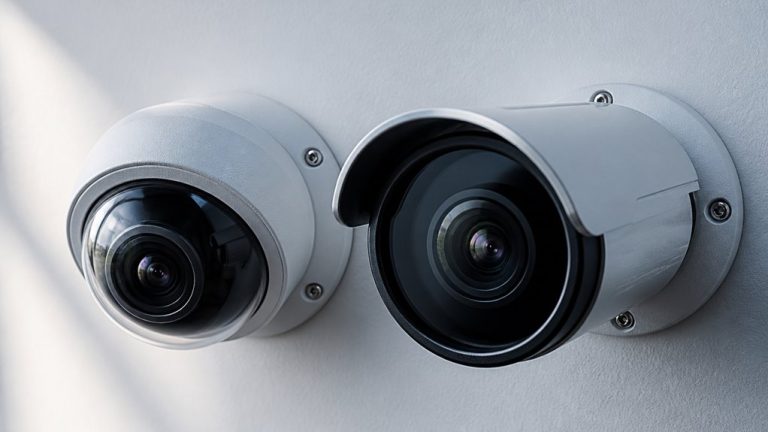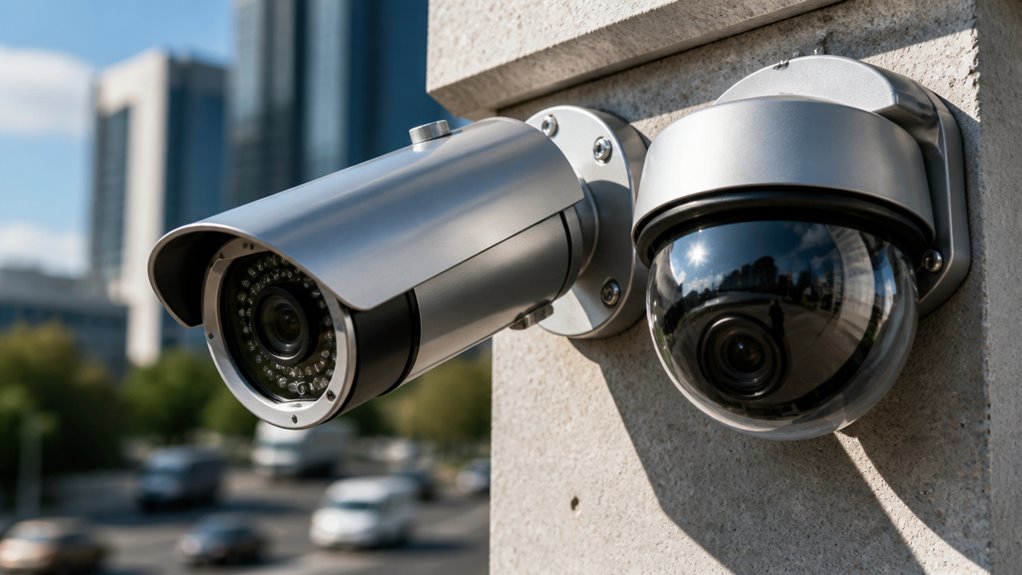

When choosing between bullet and dome cameras, consider your needs. Bullet cameras offer narrower fields of view, superior optical zoom, and better long-range night clarity. They are ideal for outdoor use with visible deterrence and adjustable mounts.
Dome cameras provide wider coverage with discreet, vandal-resistant designs, perfect for indoor ceiling installations. Both have weatherproof options but differ in maintenance demands and installation complexity.
If you want to optimize placement, durability, and image quality for specific environments, understanding these factors will help guide your decision.
Key Takeaways
- Dome cameras offer wider field of view and discreet indoor monitoring, while bullet cameras provide narrower FOV with superior long-range zoom and clarity.
- Dome cameras require recessed ceiling mounting with limited adjustability; bullet cameras mount on walls with adjustable brackets for easy repositioning.
- Dome cameras have vandal-resistant, enclosed housing ideal for covert surveillance; bullet cameras are highly visible deterrents but more vulnerable to tampering.
- Bullet cameras perform better in low-light and night conditions with minimal IR glare, whereas dome cameras may suffer from IR halo and limited zoom in darkness.
- Dome cameras need regular cleaning to prevent glare and condensation; bullet cameras require frequent lens maintenance to remove debris like spider webs.
Bullet Security Camera vs Dome: Feature Comparison
| Comparison Factor | Bullet Security Camera | Dome Security Camera |
|---|---|---|
| Physical design | Long, cylindrical housing with a clearly visible lens | Compact, rounded housing that conceals the lens direction |
| Visibility | Highly visible and provides a strong visual deterrent | Offers a discreet, low-profile appearance |
| Field of view | Usually provides a narrower, more focused viewing angle | Commonly provides wider area coverage |
| Monitoring distance | Better suited to long-range surveillance and targeted details | Better suited to broad monitoring over shorter distances |
| Zoom capability | Often supports stronger optical zoom for faces, entrances, or number plates | Usually prioritises wide coverage rather than distant detail |
| Night performance | Exposed lens design can reduce infrared reflection and improve distant night clarity | Dome cover may create IR glare or halo effects when dirty |
| Installation position | Commonly installed on walls, posts, building corners, and exterior surfaces | Commonly mounted on ceilings, soffits, and indoor overhead surfaces |
| Angle adjustment | Adjustable bracket makes repositioning relatively straightforward | Usually less convenient to adjust after installation |
| Vandal resistance | Protruding body and bracket may be easier to reach or redirect | Enclosed housing provides better tamper resistance |
| Weather protection | Well suited to outdoor use when properly weather-rated | Available in weatherproof models, although sealing and condensation require attention |
| Maintenance needs | Lens and housing may collect dirt, insects, and spider webs | Dome cover requires cleaning to prevent blur, reflections, and infrared glare |
| Ideal applications | Driveways, perimeters, gates, car parks, and long corridors | Offices, shops, reception areas, lobbies, and vandal-prone locations |
| Primary advantage | Focused detail, long-range viewing, and visible deterrence | Wide coverage, discreet monitoring, and protected housing |
Choosing Between Dome and Bullet Cameras: A Quick Guide
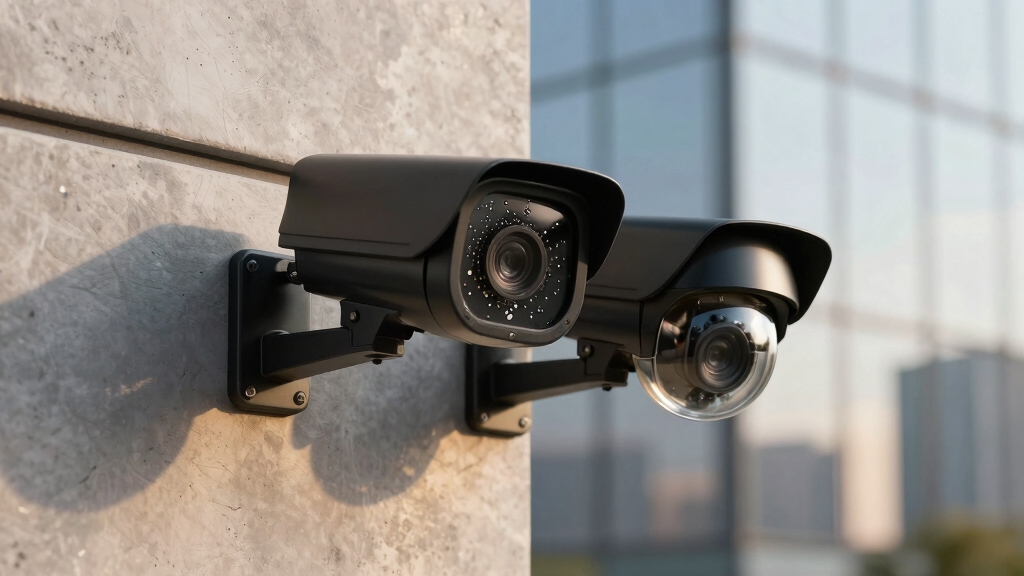
When deciding between dome and bullet security cameras, what factors should you prioritize to match your surveillance needs? Start by evaluating the field of view and range capabilities.
Dome cameras offer a wider field of view, typically between 80° and 145°. They’re ideal for monitoring expansive indoor areas but lack strong zoom capabilities. Bullet cameras provide a narrower view, around 80° to 105%. They’re optimized for focused zones and excel in long-range detail capture, such as license plates.
Consider installation methods: dome cameras mount on ceilings with limited adjustability, suited for fixed positions. Bullet cameras use wall-mounted adjustable brackets, enabling flexible repositioning.
You should also weigh environmental durability. Domes resist vandalism effectively due to their enclosed design. Bullets require maintenance to prevent lens obstructions.
Additionally, bullet cameras generally provide superior night vision and optical zoom, making them better suited for detailed outdoor surveillance in low-light conditions with minimal IR glare and reflections, thanks to their exposed lens design.
Differences in Appearance and Visibility
Although both dome and bullet cameras serve the same fundamental purpose, their physical designs create distinct differences in appearance and visibility that directly impact their effectiveness as surveillance tools.
Dome cameras feature a low-profile, spherical housing that mounts flush to ceilings, making them discreet and less conspicuous. Their enclosed design obscures the lens direction, preventing observers from easily identifying their viewing angle.
Dome cameras blend seamlessly into ceilings, concealing their viewing angle for discreet surveillance.
In contrast, bullet cameras have a cylindrical, elongated shape that’s immediately recognizable as a surveillance device. This high visibility acts as a strong deterrent, signaling active monitoring.
However, bullet cameras’ obvious presence can be intrusive, while dome cameras offer more covert surveillance. Your choice depends on whether you prioritize subtlety or overt deterrence in your security setup.
For optimal performance, consider mounting cameras at 8–10 feet high with a slight downward angle to maximize field of view and reduce vandalism risk.
Field of View and Range: Dome vs Bullet Cameras
When you’re looking at dome and bullet cameras, there are some notable differences to consider. Dome cameras usually offer wider viewing angles, ranging from 80° to 145°. This makes them perfect for covering large areas, like parking lots or open spaces.
On the other hand, bullet cameras have a narrower field of view, typically between 80° and 105°. But don’t let that fool you! They excel when it comes to zoom capabilities and capturing clear details over longer distances. Additionally, many IP bullet cameras enhance image quality and distance coverage through larger sensors and advanced compression, providing better clarity even in low-light conditions.
Viewing Angles Comparison
Security cameras differ markedly in their viewing angles, impacting their suitability for various surveillance needs.
Dome cameras typically offer a wider field of view, ranging from 80° to 145°, allowing you to monitor expansive areas efficiently.
This makes them ideal for general surveillance in open spaces.
In contrast, bullet cameras provide a narrower viewing angle, usually between 80° and 105°, focusing on targeted zones with greater detail.
Their design supports long-range monitoring where you need clarity for specific subjects like faces or license plates.
You should consider that dome cameras’ wide angle can limit zoom precision, while bullet cameras’ restricted field enhances focused observation.
Ultimately, your choice depends on whether broad coverage or concentrated monitoring takes priority in your security setup.
Additionally, bullet cameras often support local recording options such as microSD storage, enabling continuous operation without relying on Wi‑Fi.
Zoom And Distance
How far and how clearly a camera can see often determines its effectiveness in surveillance tasks. When comparing dome and bullet cameras, understanding their zoom and distance capabilities is pivotal for choosing the right device for your needs.
- Dome cameras offer wider fields of view, typically 80° to 145°. They’re ideal for broad area coverage but have limited optical zoom.
- Bullet cameras provide narrower views, around 80° to 105%. They’re optimized for targeted surveillance zones.
- Bullet models excel in long-range clarity, capturing detailed images like license plates and faces at greater distances.
- Dome cameras face challenges in low-light zoom performance due to IR halo effects. Bullet cameras have superior zoom and range.
You’ll find bullet cameras more effective where zoom and distance detail are priorities. Wired cameras generally provide more consistent video quality and reliability at longer distances compared to wireless models due to their stable connection stability.
Installation Methods for Dome and Bullet Cameras
Although dome and bullet cameras serve similar surveillance purposes, their installation methods differ markedly due to their design and intended use.
You’ll mount dome cameras primarily on ceilings or eaves, which limits adjustability post-installation. Bullet cameras, however, attach to walls via adjustable brackets, allowing easier angle modifications.
Dome installations suit permanent, discreet setups. Bullet cameras offer flexibility for targeted coverage and repositioning.
Mount brackets and cameras accurately by using a camera template to mark and drill precise mounting holes for secure installation.
| Feature | Dome Cameras | Bullet Cameras |
|---|---|---|
| Mounting Location | Ceilings, eaves | Walls |
| Adjustability | Limited after installation | Highly adjustable |
| Installation Complexity | Higher (recessed mounting often) | Lower (surface mounting) |
| Use Case | Fixed, indoor surveillance | Flexible, outdoor surveillance |
| Visual Profile | Low-profile, discreet | Prominent, acts as deterrent |
Durability: Vandal Resistance and Weatherproofing
When you’re considering security cameras, it’s important to think about how well they can handle physical attacks and tough weather conditions. You want something that’s going to perform reliably, right?
Dome cameras usually shine in the vandal resistance department. They come in these enclosed, impact-resistant housings that make them pretty tough to mess with.
On the other hand, bullet cameras have their strengths too, especially with their sturdy weatherproof casings and adjustable mounts. But here’s the catch: those mounts can be a bit more vulnerable to tampering.
Don’t forget about regular maintenance! It’s crucial for both types of cameras.
Dome lenses can get dirty, which might lead to glare issues. And bullet lenses? They can easily collect debris like spider webs, which can obstruct the view. So, a little upkeep goes a long way in keeping your cameras in top shape!
It’s also important to place cameras at an optimal height of 8–10 feet to maximize tamper resistance and visibility.
Vandal Resistance Features
Vandal-resistant housing plays a crucial role in securing surveillance cameras against tampering and physical damage.
When choosing between bullet and dome cameras, you must evaluate their ability to withstand intentional abuse.
Dome cameras excel here due to their enclosed, low-profile design, which protects the lens and sensitive components from impact and vandalism.
Bullet cameras, while robust, have exposed lenses and adjustable brackets that can be targeted more easily.
Consider these key vandal resistance features:
- Dome cameras’ polycarbonate or metal housing resists impacts better than bullet casings.
- Fixed mounting of dome cameras reduces vulnerability to repositioning or theft.
- Bullet cameras’ protruding form factor increases exposure to physical damage.
- Protective dome covers obscure lens direction, deterring tampering attempts.
Your choice depends on prioritizing discreet durability versus visible deterrence.
Mounting dome cameras under eaves or overhangs can further enhance their weatherproofing and durability to protect against environmental damage.
Weatherproofing Capabilities
Beyond protecting cameras from physical damage, making certain they withstand harsh weather conditions markedly impacts their reliability and lifespan.
You’ll find that both bullet and dome cameras offer weatherproof casings rated typically at IP65 or higher, effectively shielding internal components from rain, dust, and debris.
Bullet cameras, with their elongated housings, often feature robust seals and sunshields, optimized for prolonged outdoor exposure.
Dome cameras provide a compact, enclosed design that reduces ingress points, enhancing moisture resistance.
However, dome cameras require careful sealing to prevent condensation buildup inside the dome.
When selecting your system, prioritize cameras with proven temperature tolerance and corrosion-resistant materials to guarantee continuous operation in extreme environments.
Proper weatherproofing ensures your surveillance remains uninterrupted, maintaining image quality and functionality despite adverse weather conditions.
Many models also feature wired power options that contribute to consistent operation in challenging environmental conditions.
Maintenance and Upkeep
Maintenance and upkeep frequently determine the long-term performance and reliability of security cameras in demanding environments.
You need to take into account vandal resistance and weatherproofing when choosing between bullet and dome cameras. Dome cameras offer superior impact protection due to their enclosed design, reducing vandalism risk.
Bullet cameras, while weather-resistant, have exposed brackets prone to tampering and lenses vulnerable to debris buildup.
Key maintenance points to take into account:
- Regularly inspect dome housings for dirt that may cause IR glare or halo effects.
- Clean bullet camera lenses frequently to remove spider webs and dirt.
- Secure bullet camera brackets to prevent vandal tampering.
- Confirm weather seals on both types remain intact to prevent moisture ingress.
Proper upkeep ensures durability and consistent performance under harsh conditions. Additionally, regular inspections help identify issues like loose connections or corrosion that can compromise device reliability.
Maintenance Challenges for Dome and Bullet Cameras
Regularly cleaning dome camera casings is essential to prevent IR glare and halo effects caused by dirt buildup. This can markedly degrade image quality in low-light conditions.
Use non-abrasive cleaning solutions and microfiber cloths to avoid scratching the dome’s protective cover. Dome cameras’ fixed mounting also makes repositioning difficult, so ensure peak alignment during installation to minimize future adjustments.
Bullet cameras, however, present maintenance challenges of their own. Their exposed lenses attract spider webs and debris, requiring frequent cleaning to maintain clarity.
Their adjustable brackets simplify angle changes but are more vulnerable to vandalism and weather-related wear. Both camera types demand routine inspection and cleaning tailored to their physical designs, safeguarding sustained performance and preventing costly image quality degradation.
Indoor Use Cases for Dome Cameras
Dome cameras frequently serve as the preferred choice for indoor environments due to their discreet design and wide coverage capabilities. Their low-profile, ceiling-mounted installation blends seamlessly, making them less intrusive and more vandal-resistant.
You’ll find dome cameras excel in areas requiring broad surveillance and covert monitoring.
Consider these key indoor use cases for dome cameras:
- Office spaces for thorough coverage without disrupting aesthetics.
- Retail floors to monitor wide customer areas discreetly.
- Lobbies and reception areas where subtle security presence is essential.
- Vandal-prone environments, as their enclosed design protects against tampering.
Outdoor Advantages of Bullet Cameras
Bullet cameras often outperform other designs in outdoor settings thanks to their highly visible, elongated form and adjustable mounting brackets. You’ll benefit from their strong visual deterrence and precise targeting capabilities, especially on perimeters, driveways, and parking lots.
Their narrower field of view enhances long-range detail capture, such as license plates. Adjustable mounts let you easily reposition for prime coverage. These cameras withstand environmental challenges with weather-resistant casings but require routine cleaning to prevent lens obstruction by debris.
| Feature | Benefit |
|---|---|
| High Visibility | Acts as a strong deterrent |
| Adjustable Brackets | Enables precise angle adjustments |
| Long-Range Optics | Captures detailed images at greater distances |
Cost and Installation: What You Should Know
While bullet cameras offer advantages in outdoor visibility and adjustability, you should also consider cost and installation factors before choosing your surveillance system.
Consider both the benefits and installation costs of bullet cameras before selecting your surveillance system.
Both dome and bullet cameras have comparable equipment prices, but installation complexity varies markedly. Dome cameras often require recessed ceiling mounting, increasing labor and material expenses.
Conversely, bullet cameras mount easily on walls with adjustable brackets, reducing installation time and cost.
Key considerations include:
- Installation complexity: Dome cameras need precise ceiling mounting; bullet cameras use simpler wall mounts.
- Adjustability: Bullet cameras allow easy repositioning post-installation; dome cameras are typically fixed.
- Labor costs: Dome installations often demand more skilled labor, raising expenses.
- Longevity: Dome cameras’ fixed mounts reduce maintenance; bullet cameras’ brackets may require occasional adjustments.
Weigh these factors carefully to optimize budget and functionality.
Frequently Asked Questions
Can Dome and Bullet Cameras Be Integrated Into the Same Security System?
Yes, you can integrate dome and bullet cameras into the same security system seamlessly.
Modern systems support multiple camera types, allowing you to leverage dome cameras for wide, discreet indoor coverage and bullet cameras for focused, long-range outdoor monitoring.
Make sure your system’s video recorder and software handle diverse inputs.
Configure each camera’s settings individually to optimize performance based on their installation environments and functional strengths.
Do Dome Cameras Offer Better Night Vision Than Bullet Cameras?
You won’t see night vision as clear as a diamond’s sparkle from dome cameras.
Dome cameras typically suffer from IR halo or bounceback, which reduces their low-light effectiveness.
Bullet cameras, with their focused IR LEDs and better lens placement, tend to deliver superior night vision.
They capture sharper details even in near darkness.
Which Camera Type Is More Energy Efficient?
You’ll find dome cameras generally more energy efficient due to their enclosed design, which optimizes infrared LED placement and reduces IR halo effects. This design helps lower power consumption during night operation.
Bullet cameras, with their higher-powered IR LEDs for long-range illumination, often draw more energy. However, the actual difference is modest and depends on specific models and usage.
Choose based on your power availability and night vision needs to balance efficiency and performance.
Are There Significant Differences in Video Quality Between Dome and Bullet Cameras?
Imagine you’re monitoring a parking lot at night.
You’ll notice bullet cameras often deliver sharper details at long distances, ideal for reading license plates.
Dome cameras provide a wider field of view but usually at lower zoom quality.
So, yes, significant differences exist: bullet cameras excel in long-range clarity, while dome cameras prioritize broad coverage with less detail at a distance.
Choose based on your specific surveillance needs.
Can Bullet Cameras Be Used Effectively Indoors?
Yes, you can use bullet cameras indoors effectively, especially when you need adjustable angles or longer-range zoom capabilities.
Their wall-mounted design lets you reposition them easily, making them suitable for monitoring specific zones within large indoor spaces.
However, bullet cameras are more conspicuous and may not blend as seamlessly into indoor environments as dome cameras.
Dome cameras offer a discreet, low-profile appearance better suited for covert observation.
Make the Right Camera Choice for Your Property
Choosing between dome and bullet cameras is like picking the right tool for a job.
Imagine securing a museum. You’d want dome cameras for discreet, wide coverage indoors. Bullet cameras stand guard like sentinels outside, visible and deterrent.
Studies show bullet cameras often cover longer distances, but dome cameras resist tampering better.
By understanding their strengths and installation needs, you’ll make certain your security system is both effective and tailored perfectly to your environment.