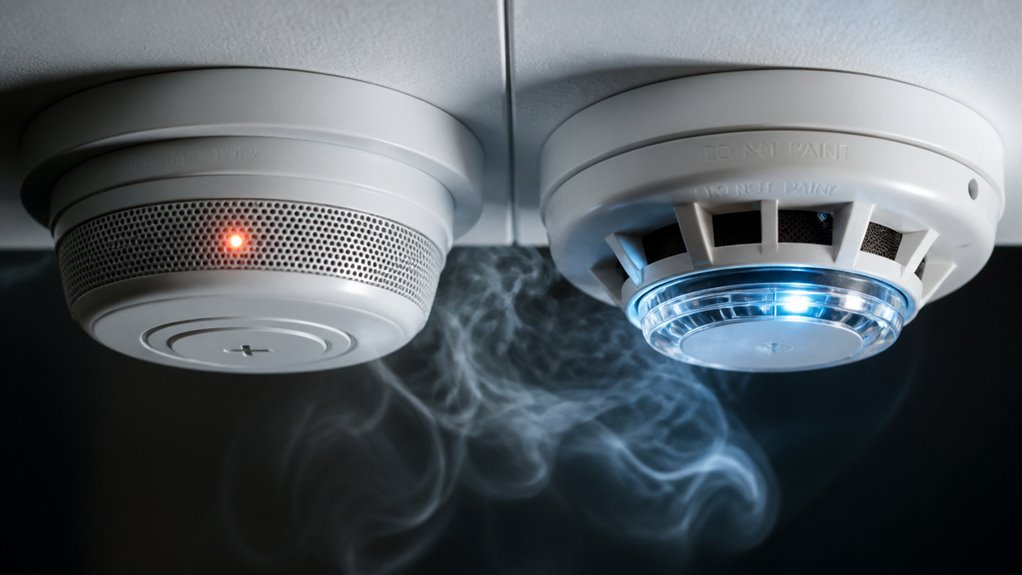

You’ll want ionisation detectors for faster alerts on flaming fires since they sense tiny smoke particles swiftly.
Photoelectric detectors excel at spotting smouldering fires by detecting larger smoke particles earlier.
Each uses distinct detection methods: ionisation relies on ionised air currents, while photoelectric uses light scattering.
Choosing the right type depends on your fire risk profile and installation area, balancing cost and performance.
Exploring dual-sensor options reveals how combining both technologies enhances overall safety.
Key Takeaways
- Ionisation detectors use radioactive americium-241 to sense small smoke particles, reacting faster to flaming fires with tiny particle smoke.
- Photoelectric detectors use light scattering to detect larger smoke particles, responding quicker to smouldering fires producing dense, heavy smoke.
- Ionisation alarms generally alert earlier during fast-flaming fires, while photoelectric alarms can warn up to 50 minutes sooner for smouldering fires.
- Dual-sensor detectors combine both technologies, improving overall detection speed and reducing false alarms across diverse fire scenarios.
- Detector choice should match expected fire types and placement, with photoelectric preferred for living areas and ionisation for fast-flaming fire-prone zones.
Ionisation vs Photoelectric Smoke Detectors: Quick Comparison Guide
| Feature | Ionisation Detector | Photoelectric Detector |
|---|---|---|
| Detection Method | Ionised air current | Light scattering |
| Smoke Particle Sensitivity | Smaller particles | Larger smoke particles |
| Best Fire Type | Fast-flaming fires | Smouldering fires |
| Flaming Fire Response | Faster | Generally slower |
| Smouldering Fire Response | Slower | Faster |
| Early Warning Advantage | Rapid warning for flaming fires | Can detect smouldering fires 15–50 minutes sooner |
| Sensing Technology | Ionisation chamber | Light source and optical sensor |
| Radioactive Source | Uses americium-241 | No radioactive component stated |
| False Alarms | More prone to cooking-smoke alarms | Generally fewer false alarms |
| Typical Placement | Storage rooms, electrical areas, warehouses | Living spaces, corridors, offices |
| Initial Cost | Lower | Higher |
| Main Strength | Fast flaming-fire detection | Early smouldering-fire detection |
| Main Limitation | Slower with dense smouldering smoke | Less optimized for fast-flaming fires |
| Maintenance | Regular cleaning/testing required | Regular cleaning/testing; optical components may need gentle cleaning |
| Typical Lifespan | About 8–10 years | About 8–10 years |
| Best Budget Choice | Budget-sensitive applications | Higher upfront cost for enhanced smouldering detection |
| Overall Coverage | Strong for flaming-fire scenarios | Strong for smouldering-fire scenarios |
| Alternative Option | Dual-sensor for broader coverage | Dual-sensor for broader coverage |
How Ionisation and Photoelectric Smoke Detectors Actually Work?
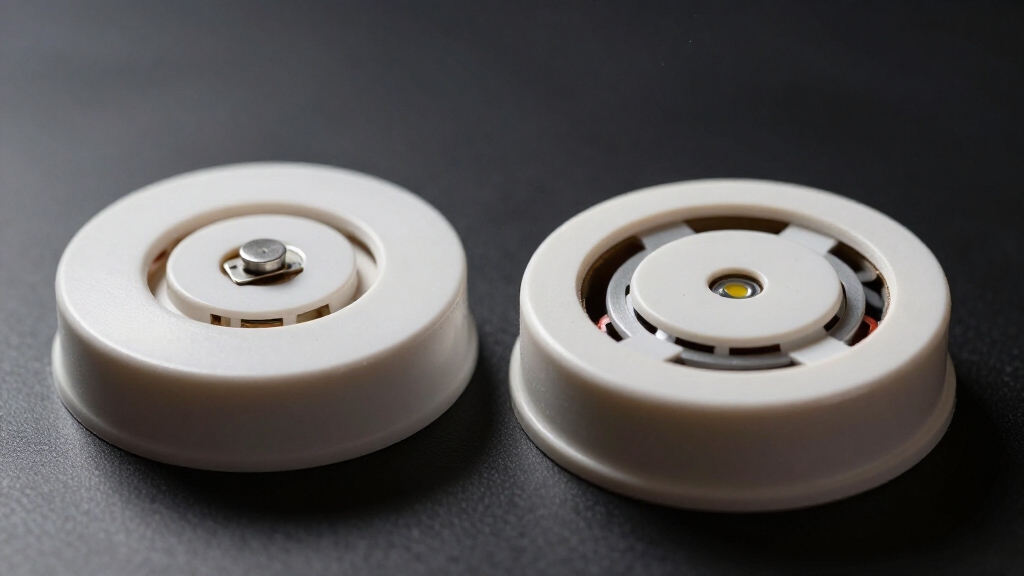
Although both ionisation and photoelectric smoke detectors serve the same purpose, they operate using fundamentally different principles to detect smoke.
Ionisation detectors use a small radioactive source to ionise air within a sensing chamber. This creates a steady electrical current. When smoke particles enter, they disrupt this current, triggering the alarm.
Ionisation detectors use ionised air to create a current that smoke particles interrupt, setting off the alarm.
In contrast, photoelectric detectors employ a light source and sensor positioned so that smoke scatters light onto the sensor. This activates the alarm.
You’ll notice ionisation relies on changes in electrical conductivity caused by tiny particles. Photoelectric depends on optical light scattering by larger particles.
Understanding these core mechanisms is essential because they affect how each detector responds to different fire conditions. This influences their effectiveness in various environments and fire scenarios.
Photoelectric detectors are especially sensitive to smoldering fires that emit large, dense smoke particles, providing early warnings with fewer false alarms.
Which Smoke Detector Responds Faster to Flaming and Smouldering Fires?
When it comes to smoke detectors, ionisation detectors are your go-to for flaming fires. Why? It’s all about their sensitivity to those tiny smoke particles that come with fast-burning flames. So, if you’re worried about a fire breaking out quickly, these detectors are the ones you want.
On the flip side, if you’re dealing with smouldering fires, photoelectric detectors shine. They’re great at picking up on the larger smoke particles that are typical in those situations. So, if you’re focused on catching those sneaky, slow-burning fires, photoelectric detectors are definitely the way to go.
In short, knowing how each type of detector performs based on the fire’s nature can really help you choose the best protection for your space. It’s all about matching the right detector to your needs! Additionally, ionisation detectors use a small amount of americium-241 to ionize air and detect smoke particles, making them highly sensitive to fast flaming fires.
Flaming Fire Detection Speed
Understanding which smoke detector responds faster to flaming fires is crucial for optimizing fire safety strategies.
Ionisation smoke detectors excel here because they use a radioactive source to ionise air, creating a current disrupted by the smaller smoke particles typical of flaming fires.
This disruption triggers the alarm rapidly, often before photoelectric detectors respond.
In contrast, photoelectric models rely on light scattering from larger smoke particles, common in smouldering fires, making them slower to detect fast-flaming events.
Research from NIST confirms ionisation alarms generally provide earlier warnings during flaming fires, enhancing escape time.
However, it is important to consider that smoldering fires produce hot embers which can retain heat and pose a risk of reignition if not detected early.
Smouldering Fire Response Time
While ionisation detectors respond quickly to flaming fires, photoelectric smoke detectors excel when it comes to detecting smouldering fires.
This advantage stems from their reliance on light scattering, which is highly sensitive to the larger smoke particles generated during smouldering combustion.
You’ll find that photoelectric detectors can trigger alarms markedly earlier, sometimes by 15 to 50 minutes, compared to ionisation detectors in these scenarios.
This early response is critical since smouldering fires produce heavy smoke before flames appear, increasing escape time.
Ionisation detectors’ ionisation chamber, optimized for smaller particles, reacts slower to dense, larger-particle smoke typical of smouldering fires.
Hence, if your priority is swift detection of smouldering fire conditions, photoelectric technology provides a more reliable early warning, enhancing occupant safety in environments prone to slow, smoky fires.
However, dual-technology detectors combine both ionisation and photoelectric methods to improve accuracy and reduce false alarms by detecting a wider range of fire types.
Fire Scenario Performance
Because fire conditions vary widely, the speed at which smoke detectors respond depends heavily on the fire’s characteristics.
Ionisation detectors excel at detecting fast-flaming fires, which produce smaller combustion particles that disrupt the ionisation chamber’s current rapidly.
Conversely, photoelectric detectors respond faster to smouldering fires, where larger smoke particles scatter light onto the sensor more effectively.
Studies, including NIST research, confirm ionisation alarms typically provide earlier alerts during flaming fires.
Photoelectric alarms detect smouldering fires up to 15 to 50 minutes sooner.
Your detector choice should consider these performance distinctions relative to expected fire scenarios.
Employing dual-sensor units or mixed coverage can optimize detection across both flaming and smouldering conditions.
This enhances overall safety by compensating for individual sensor limitations.
For optimal safety, it is important to understand that core safety functions remain operational throughout and after device resets.
Why Quick Smoke Detection Can Save Your Life?
When smoke enters your home, detecting it quickly can mean the difference between a safe escape and a life-threatening situation.
Rapid smoke detection provides critical early warning, allowing you to evacuate before toxic gases or flames reach dangerous levels.
The speed at which your detector responds depends on fire type and detection technology, impacting your reaction window.
| Fire Type | Smoke Particle Size | Detector Type | Response Speed | Escape Value |
|---|---|---|---|---|
| Flaming Fire | Small | Ionisation | Faster detection | Early flame awareness |
| Smouldering Fire | Large | Photoelectric | Faster detection | Early smoke and toxic gas warning |
Choosing the right detector improves your chances for timely escape in diverse fire scenarios.
First Alert smoke detectors focus exclusively on fire safety and do not include built-in camera features.
Cost and Practical Trade-Offs of Ionisation vs Photoelectric Detectors
Ionisation detectors usually come at a lower price point than photoelectric models, which makes them pretty attractive if you’re working with a tight budget.
But here’s the thing: photoelectric units, while pricier, often justify that cost by detecting smouldering fires earlier. This can be a big plus for safety in certain environments.
It’s also important to note that ionization detectors respond faster to flaming fires, while photoelectric detectors are better suited for smoldering fires, making dual-sensor alarms a versatile option.
Price Comparison Overview
How do cost considerations influence your choice between ionisation and photoelectric smoke detectors?
Ionisation detectors generally come at a lower price point due to simpler sensing mechanisms and widespread manufacturing.
Photoelectric detectors, incorporating optical components, typically cost more upfront but offer enhanced detection of smouldering fires.
When balancing expense against performance, you should weigh the detector’s sensitivity to your specific fire risk profile rather than just sticker price.
Ionisation alarms may suit budget-sensitive applications prioritizing rapid flaming-fire detection.
Photoelectric units justify their higher cost by delivering earlier warnings for smouldering fires that produce dense smoke.
Ultimately, your selection hinges on practical trade-offs: lower initial investment versus improved detection fidelity.
Understanding these cost-performance dynamics helps optimize fire safety without overspending on unnecessary features.
Kidde’s photoelectric alarms feature precision three times greater than standard alarms, which can help reduce false alarms and improve early warnings.
Budget Versus Protection
Although ionisation smoke detectors typically cost less, selecting the right alarm involves balancing initial budget constraints against the specific fire detection benefits each technology offers.
Ionisation detectors provide quicker alerts for fast-flaming fires by detecting smaller smoke particles. This makes them a cost-effective choice where flaming-fire risk dominates.
Conversely, photoelectric detectors, though pricier, excel in identifying smouldering fires early by sensing larger smoke particles. This enhances protection in environments prone to slow, smoky fire development.
Your decision should consider which fire scenario poses the greatest threat, as reliance on cost alone may compromise detection effectiveness.
Understanding these trade-offs enables you to optimize safety within financial limits, avoiding underprotection or unnecessary expenses.
Budgeting smartly means aligning detector selection with the dominant fire risk profile rather than defaulting to the lowest price.
Regular maintenance and proper placement can also significantly reduce false alarms and improve detector reliability.
Cost-Effective Coverage Strategies
Balancing cost and protection requires more than choosing between ionisation and photoelectric detectors based solely on price or fire type sensitivity.
You need to weigh the initial investment against the specific fire risks and coverage goals.
Ionisation detectors tend to be less expensive and excel in detecting fast-flaming fires.
Photoelectric units cost more but offer superior detection for smouldering fires.
A mixed or dual-sensor approach often yields the best compromise for all-encompassing coverage.
| Detector Type | Cost Range |
|---|---|
| Ionisation | Lower ($) |
| Photoelectric | Higher ($$) |
| Dual-Sensor | Highest ($$$) |
Choosing cost-effective coverage means prioritizing your environment’s fire profile while balancing upfront costs and detection effectiveness. Hardwired smoke detectors still require battery backups to ensure continuous protection even during power outages.
Where to Install Ionisation and Photoelectric Smoke Alarms?
When deciding where to install ionisation and photoelectric smoke alarms, consider the distinct fire risks and smoke characteristics in each area.
Place photoelectric alarms in living spaces, corridors, and offices where smouldering fires, characterized by larger smoke particles, are more likely to develop.
These detectors respond faster to slow, smoky fires, providing critical early warnings.
Conversely, install ionisation alarms in storage rooms, electrical areas, and warehouses prone to fast-flaming fires that produce smaller particles.
Ionisation detectors excel in detecting these rapidly spreading flames.
By strategically positioning each detector type according to fire behavior, you optimize early detection.
Avoid random placement; instead, assess the environment’s fire profile to ensure the detector’s sensing principle aligns with the expected fire type, maximizing safety and response time.
How Dual-Sensor Smoke Detectors Combine the Best of Both?
Selecting ionisation or photoelectric smoke detectors based on their individual strengths can improve fire detection.
However, combining both technologies in a single unit offers a more all-encompassing solution.
Dual-sensor detectors integrate ionisation’s rapid response to flaming fires with photoelectric’s sensitivity to smouldering fires.
This broadens detection coverage and reduces false alarms.
| Feature | Dual-Sensor Advantage |
|---|---|
| Flaming Fire Detection | Ionisation sensor triggers alarm fast |
| Smouldering Fire Detection | Photoelectric sensor detects heavy smoke early |
| Cost & Practicality | Higher initial cost, but improved safety |
Frequently Asked Questions
Are Ionisation Smoke Detectors Safe to Use Around Children and Pets?
Yes, ionisation smoke detectors are safe to use around children and pets. The radioactive material inside is sealed and emits minimal radiation, posing no health risk under normal use.
However, you should install them properly and avoid tampering with the device.
For enhanced safety, especially in homes with children or pets, you might consider photoelectric or dual-sensor alarms. These options offer broad detection without radioactive components.
How Long Do Ionisation and Photoelectric Smoke Detectors Typically Last?
You can expect both ionisation and photoelectric smoke detectors to last about 8 to 10 years.
After this period, their sensors degrade, reducing reliability.
Manufacturers recommend replacing units within this timeframe to maintain peak performance.
Battery-operated models require regular battery changes, but sensor lifespan is the limiting factor.
Keep in mind that environmental conditions can affect longevity, so periodic testing is essential to guarantee your detector functions correctly throughout its service life.
Can Ionisation Detectors Cause False Alarms From Cooking Smoke?
Yes, ionisation detectors can cause false alarms from cooking smoke. Their sensing chamber detects small particles typical of flaming fires, but lightweight cooking smoke particles can disrupt the ionised air, triggering alarms.
You’ll find them more sensitive to these fine particles than photoelectric detectors. To reduce false alarms, consider placing ionisation detectors away from kitchens or using photoelectric or dual-sensor alarms that are better suited for cooking environments.
Do Photoelectric Detectors Require More Maintenance Than Ionisation Types?
No, photoelectric detectors don’t require more maintenance than ionisation types. Both need regular cleaning to prevent dust buildup, which can impair sensitivity.
You should test either detector monthly and replace batteries yearly. Photoelectric units might accumulate visible dust on optical components, so occasional gentle cleaning helps maintain accuracy.
Are There Legal Regulations Favoring One Smoke Detector Type Over Another?
You won’t find universal legal regulations favoring one smoke detector type over another; codes often mandate smoke alarms without specifying ionisation or photoelectric technology.
However, some jurisdictions recommend or require photoelectric alarms in certain areas due to their superior response to smouldering fires.
You should check local fire safety codes and standards, as they may influence your choice.
Using dual-sensor alarms often satisfies regulatory and safety best practices thoroughly.
Ionisation or Photoelectric? Choosing the Right Smoke Detector
Just like a skilled detective uses multiple clues to solve a case, you need both ionisation and photoelectric smoke detectors to catch fires early.
Ionisation alarms are fast on flaming fires, while photoelectric ones spot smouldering dangers.
By understanding their strengths and installing them wisely or choosing dual-sensor models, you enhance your safety with precision.
Don’t rely on a single method; combine technology smartly to protect your home and loved ones effectively.