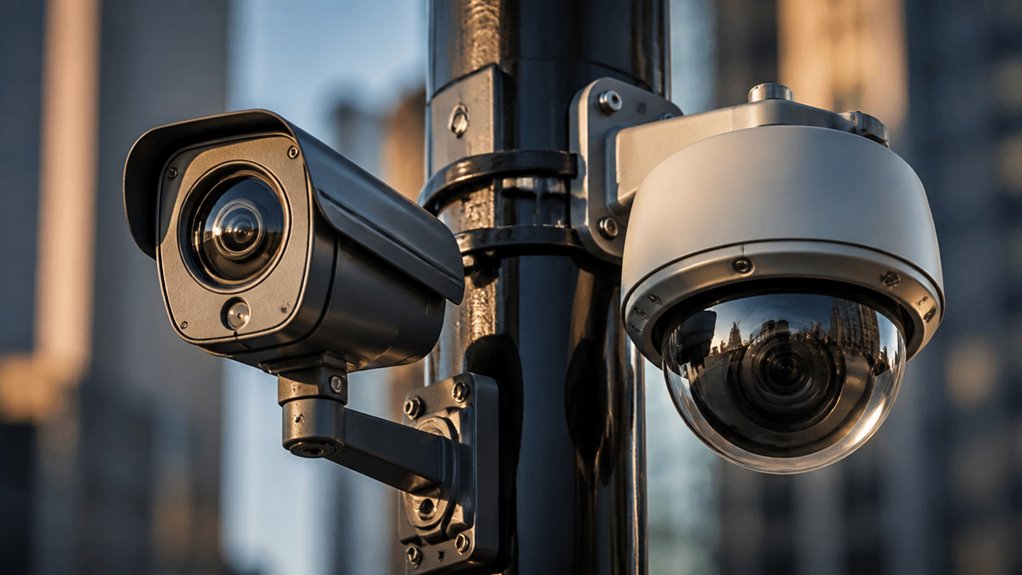

When choosing between turret and dome cameras, consider that turret cameras offer superior night vision, flexible lens adjustment, and better outdoor durability due to their weatherproof, exposed design.
Dome cameras excel indoors with sleek, vandal-resistant housings and concealed lens angles for stealth.
Turrets handle environmental challenges and zoom needs well, while domes blend unobtrusively and resist tampering.
Your ideal setup may combine both for precise coverage and robustness. Exploring their distinct advantages will clarify the best application for your system.
Key Takeaways
- Dome cameras offer a sleek, vandal-resistant design with concealed lens direction ideal for indoor stealth surveillance.
- Turret cameras provide superior night vision and zoom capabilities with minimal IR glare, better for outdoor and detailed monitoring.
- Turret cameras allow easy post-installation angle adjustments without disassembly, enhancing flexibility for dynamic environments.
- Dome cameras have enclosed housing that reduces tampering risk, making them preferred in vandal-prone indoor areas.
- Turret cameras feature weatherproof casings and better outdoor adaptability, while domes perform best indoors with wide coverage.
Turret vs Dome Camera Comparison: Design, Night Vision, Durability & Best Use
| Comparison Factor | Turret Camera | Dome Camera | Best Choice |
|---|---|---|---|
| Design Style | Has an exposed ball-and-socket design for easy aiming | Uses a covered dome-shaped housing for a sleek look | Dome for discreet appearance |
| Night Vision | Delivers clearer night footage with less IR glare | May experience IR reflection or haze from the dome cover | Turret for low-light clarity |
| Lens Adjustment | Easy to adjust after installation without opening the housing | Often requires opening the dome to reposition the lens | Turret for flexible aiming |
| Vandal Resistance | More exposed, so it offers moderate tamper protection | Enclosed housing provides stronger vandal resistance | Dome for tamper-prone areas |
| Outdoor Performance | Handles outdoor use well with weatherproof builds and strong IR | Works outdoors, but glare and reflections can affect clarity | Turret for outdoor monitoring |
| Indoor Use | Good for targeted indoor areas where camera direction can be visible | Excellent for stealthy indoor surveillance and wide coverage | Dome for offices and interiors |
| Image Detail | Better for capturing faces, entrances, and license plates | Better for broad area monitoring with a less obvious lens direction | Turret for detail, dome for coverage |
| Best Application | Ideal for driveways, entrances, yards, and parking areas | Ideal for hallways, shops, offices, and vandal-prone spaces | Use both for balanced security |
Design Differences of Turret vs Dome Cameras
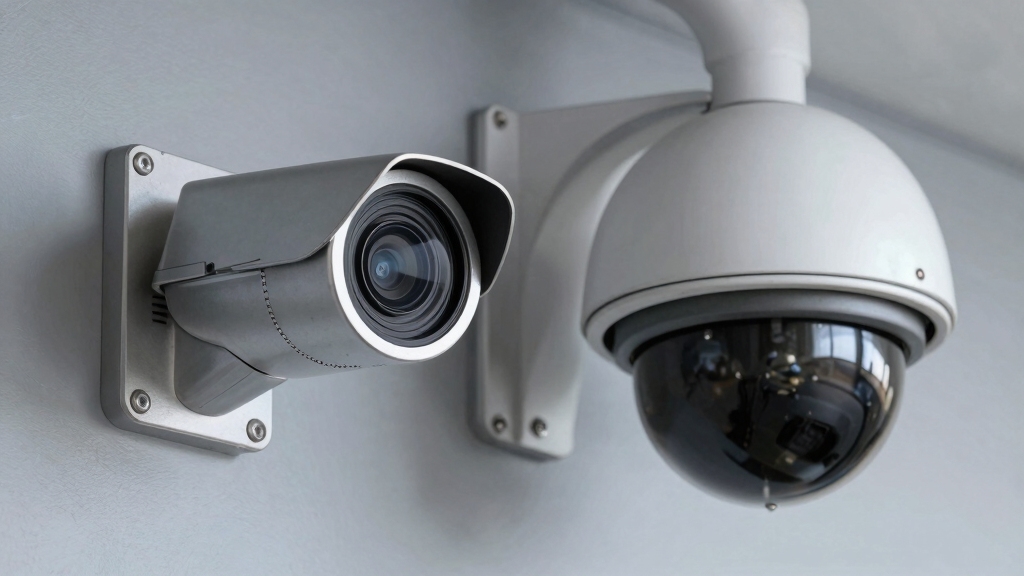
While both turret and dome cameras serve surveillance purposes, their design fundamentally differs to accommodate distinct functional and aesthetic needs.
Dome cameras feature a protective, dome-shaped housing that offers a sleek, unobtrusive appearance, making them ideal for low-profile indoor use. This enclosed structure enhances vandal resistance by shielding internal components.
In contrast, turret cameras utilize a ball-and-socket design without a dome, allowing flexible lens positioning and easier post-installation adjustments. Turret designs are more conspicuous, resembling eyeballs, which helps identify camera direction quickly.
However, they lack the dome’s protective shell, making them less resistant to tampering. Dome housings blend seamlessly into environments, while turrets prioritize functional flexibility and visibility.
Understanding these structural distinctions helps you select the appropriate model based on installation context and durability needs. For optimal effectiveness, consider the mounting heights and angles to reduce blind spots and enhance coverage when installing either camera type.
Image Quality: Night Vision and Zoom
Beyond structural differences, image quality plays a significant role in choosing between turret and dome cameras, especially under challenging lighting conditions.
Image quality is crucial when selecting between turret and dome cameras in low-light settings.
Turret cameras excel in night vision, delivering crisper images with minimal infrared (IR) reflections and glare. Their ball-and-socket design prevents IR bounceback, which often compromises dome cameras due to their protective glass domes.
This results in sharper, haze-free footage critical for identifying faces or license plates at night. Additionally, turrets support optical zoom, enabling clear close-up and distant detail capture, enhancing surveillance precision.
In contrast, dome cameras offer a near-panoramic wide-angle view but sacrifice distant clarity and zoom capability. Dome housings introduce IR ghosting effects, reducing nighttime image fidelity.
Therefore, if night vision quality and zoom are priorities, turret cameras provide superior performance for detailed, low-light surveillance. Positioning cameras at a 45-degree angle to glass surfaces further reduces IR reflection and glare, improving night vision clarity.
Installation Flexibility of Turret and Dome Cameras
When installing surveillance cameras, the ability to adjust angles quickly and accurately is crucial for prime coverage. Turret cameras excel here with their ball-and-socket design, allowing you to reposition the lens post-installation without disassembly.
Their built-in brackets facilitate precise aiming on walls or ceilings, enhancing flexibility for both indoor and outdoor setups. Conversely, dome cameras require you to open the casing to re-angle the lens after mounting, adding time and complexity.
While domes typically mount easily on ceilings indoors, their installation carries a higher chance of angle misalignment. If you need adaptability and straightforward adjustments during or after installation, turret cameras offer a more efficient solution.
Dome cameras prioritize a low-profile appearance but sacrifice ease of angle modification, impacting fine-tuning capabilities. Additionally, the turret’s three-axis ball mount allows for precise angle adjustment without removing the camera from its mount, optimizing placement efficiency.
Vandalism and Durability: Turret vs Dome Cameras?
Because vandal resistance directly impacts camera longevity and reliability, choosing the right design is critical. Dome cameras excel here with their enclosed, compact housing, reducing tampering risks.
Turret cameras, lacking a protective dome, remain more exposed and vulnerable to physical interference. Their ball-and-socket design offers flexibility but sacrifices vandal durability.
| Feature | Dome Cameras | Turret Cameras |
|---|---|---|
| Protective Housing | Enclosed dome, robust | Exposed lens, less shielded |
| Tampering Resistance | High | Moderate |
| Durability in Vandal-prone Areas | Preferred | Less suitable |
Protective housings made from impact-resistant materials and reinforced steel frames provide enhanced vandal and physical-shock protection to extend camera lifespan in challenging environments.
Your choice should consider these factors to maximize camera lifespan in hostile environments without compromising performance.
Environmental Suitability: Indoor and Outdoor Performance
Dome cameras are fantastic for indoor use, thanks to their low-profile design and wide coverage. They really minimize glare and blend right in with controlled lighting environments. It’s like they’re made for the job!
Now, when we look at outdoor settings, turret cameras really shine. They do a great job of reducing infrared reflections and keeping image clarity, even when the weather gets tricky or the light starts to fade.
So, when you’re figuring out where to place your cameras and which type to choose, it’s super important to think about how weather and lighting will affect their performance. That way, you’ll get the best surveillance setup for your needs! Additionally, considering the sensor size and dynamic range can greatly improve image quality in varying light conditions.
Indoor Camera Advantages
Indoor cameras frequently excel in environments where aesthetics and broad coverage are priorities.
Dome cameras, with their sleek, low-profile design, seamlessly blend into indoor ceilings, minimizing visual disruption.
Their near-panoramic field of view guarantees all-encompassing room coverage, reducing the number of cameras needed.
You’ll appreciate dome cameras’ enclosed housing, which provides enhanced vandal resistance and prevents lens obstruction from dust or insects indoors.
Conversely, turret cameras offer flexible lens positioning and easier angle adjustment post-installation, beneficial for targeted surveillance in dynamic spaces.
However, their more conspicuous design can detract from aesthetic considerations inside.
While turrets deliver sharper image detail, domes excel in delivering wide, unobtrusive surveillance ideal for indoor environments where design integration and coverage breadth matter most.
Additionally, just as Kidde alarms use advanced sensors to enhance safety and reliability, indoor cameras benefit from sophisticated sensor technology to improve image quality and detection capabilities.
Outdoor Camera Performance
Although both turret and dome cameras handle weather exposure, turret cameras outperform domes in outdoor environments. This is due to their reduced glare and stronger infrared (IR) emitters.
This design minimizes IR reflection and enhances night vision clarity, which is vital for low-light outdoor surveillance. Turrets’ ball-and-socket build allows precise aiming post-installation, unlike domes whose lenses require reopening the casing.
Domes excel indoors with broad coverage and vandal resistance but suffer from IR bounceback outdoors. When choosing for outdoor use, consider the following factors:
| Feature | Turret Camera | Dome Camera |
|---|---|---|
| IR Performance | Strong emitters, less glare | Weaker IR, prone to bounce |
| Lens Adjustment | Easy, post-installation | Difficult, requires casing |
| Vandal Resistance | Moderate | High |
| Outdoor Suitability | Excellent | Limited |
| Night Surveillance | Superior image clarity | Lower clarity |
Additionally, cameras with an IP66 weatherproof rating ensure reliable operation in challenging outdoor conditions, making turret cameras especially suited for long-term outdoor use.
Weather and Lighting Impact
When weather conditions and lighting vary, turret and dome cameras respond differently due to their design and technology.
Turret cameras excel outdoors, minimizing IR glare and reflections thanks to their exposed lenses. They provide sharp, detailed images even in low light. Their strong IR emitters enhance night surveillance, maintaining clarity despite weather changes.
Dome cameras, enclosed in protective glass, often suffer from IR bounceback and haze, reducing image quality outdoors. Indoors, dome cameras perform well with wide-angle views and aesthetic blending, handling stable lighting effectively.
However, their glass housing can cause IR reflection issues under variable lighting. Both camera types offer weatherproof models, yet turrets generally provide superior adaptability to fluctuating environmental conditions.
This makes them the preferred choice for outdoor surveillance where weather and lighting unpredictability impact performance. Additionally, turret cameras typically feature sealed weatherproof casings that help them withstand adverse weather better than dome cameras.
When to Choose Turret Cameras?
Several scenarios call for turret cameras due to their superior flexibility and outdoor performance.
When you need sharp night vision with minimal IR glare, turret cameras excel by reducing reflection issues common in domes.
Their ball-and-socket design allows quick, precise angle adjustments after installation, ideal for dynamic environments requiring frequent repositioning.
If you require optical zoom to capture detailed faces or license plates, turrets deliver higher image clarity and zoom capability.
Outdoors, their robust IR emitters and weatherproof builds outperform domes, especially in low-light conditions.
Choose turret cameras when you prioritize image quality, flexible mounting (wall or ceiling), and easy maintenance.
However, consider their lower vandal resistance compared to domes, making turrets best suited for less tamper-prone outdoor locations demanding high-resolution surveillance.
Proper installation and regular checks for power supply integrity help prevent unexpected video loss in turret cameras.
Why Dome Cameras Are Best for Indoor Stealth?
Why should you choose dome cameras for indoor stealth surveillance? Their dome-shaped housing offers a sleek, unobtrusive profile that blends seamlessly into indoor environments, reducing visual disruption.
Dome cameras provide a sleek, unobtrusive design that seamlessly blends into indoor settings, minimizing visual disruption.
This design conceals the lens direction, making it difficult for observers to detect where the camera is pointing, enhancing stealth. The enclosed structure also provides superior vandal resistance, protecting the device from tampering.
Dome cameras capture near-panoramic wide-angle footage, covering broad areas with fewer blind spots, which is ideal indoors. Although adjusting the lens angle post-installation requires opening the casing, their ceiling-mounted setup guarantees discreet placement.
In contrast, turret cameras’ visible ball-and-socket design draws attention and reveals viewing direction, making domes the best choice when stealth and environmental integration are priorities indoors.
For optimal coverage, it is important to fine-tune camera angles after installation to eliminate blind spots and achieve full indoor coverage.
How to Mix Turret and Dome Cameras for Best Coverage?
To achieve thorough surveillance coverage, integrating turret and dome cameras leverages the unique strengths of each design.
Use dome cameras indoors where stealth and wide-angle views matter. They benefit from vandal resistance and near-panoramic coverage.
Deploy turret cameras outdoors or in areas requiring crisp night vision and flexible zoom capabilities. Their ball-and-socket design allows precise angle adjustments without disassembly.
Combining both guarantees broad field coverage with detailed close-ups, minimizing blind spots. Position domes on ceilings for unobtrusive monitoring, and turrets on walls to capture license plates or faces with clarity.
Camera Placement and Maintenance Tips
When positioning your cameras, elevate them to minimize blind spots. Overlapping their fields of view ensures all-encompassing coverage.
Turret cameras’ adjustable mounts let you fine-tune angles post-installation. In contrast, dome cameras require casing removal for lens repositioning.
Regular maintenance, including lens cleaning and firmware updates, guarantees peak image quality. This also prolongs device life.
| Task | Dome Camera Tips | Turret Camera Tips |
|---|---|---|
| Placement | Ceiling-mount for wide coverage | Wall or ceiling with angle adjust |
| Cleaning | Use soft cloth, avoid moisture | Clean lens more frequently due to exposure |
| Adjustment | Remove dome to re-angle | Adjust easily without disassembly |
Strategic placement and maintenance maximize your surveillance system’s reliability and effectiveness.
Frequently Asked Questions
What Is the Average Lifespan of Turret Vs Dome Cameras?
You can generally expect both turret and dome cameras to last around 5 to 7 years under normal operating conditions.
Their lifespan depends largely on environmental factors like weather exposure and maintenance frequency.
Dome cameras, with their enclosed housing, often resist vandalism better, potentially extending durability.
Turrets, while slightly more exposed, offer rugged builds suitable for outdoor use.
Regular cleaning and timely repairs will help you maximize the functional life of either camera type.
How Do Turret and Dome Cameras Compare in Power Consumption?
You’ll find that turret and dome cameras consume similar amounts of power, as both typically use comparable infrared LEDs and image sensors.
However, turret cameras often have slightly higher consumption due to stronger IR emitters for enhanced night vision.
Dome cameras’ enclosed design can cause minor efficiency loss from heat buildup, but it’s generally negligible.
Are There Significant Price Differences Between Turret and Dome Cameras?
You won’t find major price gaps between turret and dome cameras; both fall within similar budget ranges based on resolution and features.
However, dome cameras often cost slightly more due to vandal-resistant housing and sleek design.
Turret models might be marginally cheaper, offering flexible installation and superior night vision without expensive glass domes.
Ultimately, your choice depends on specific needs rather than significant price differences.
Can Turret or Dome Cameras Integrate Better With Smart Home Systems?
When weaving your smart home’s digital tapestry, both turret and dome cameras integrate smoothly with popular systems like Alexa or Google Home. Their IP-based connectivity acts like a bridge, enabling real-time alerts and remote viewing.
However, turret cameras often edge ahead, thanks to superior image clarity and flexible positioning, enhancing motion detection accuracy. You’ll find neither inherently limits compatibility; your choice hinges more on installation needs and image quality priorities than integration capabilities.
Final Verdict: Turret vs Dome Camera
When choosing between turret and dome cameras, you’ll find each offers unique strengths suited for specific environments and needs.
Turret cameras bring adaptability and resilience, while dome cameras excel in discreet indoor monitoring.
By thoughtfully combining both, you create a balanced security system that covers blind spots and maximizes image clarity.
Remember, strategic placement and regular upkeep will gently enhance your system’s longevity and performance, ensuring your surveillance investment quietly delivers peak results.