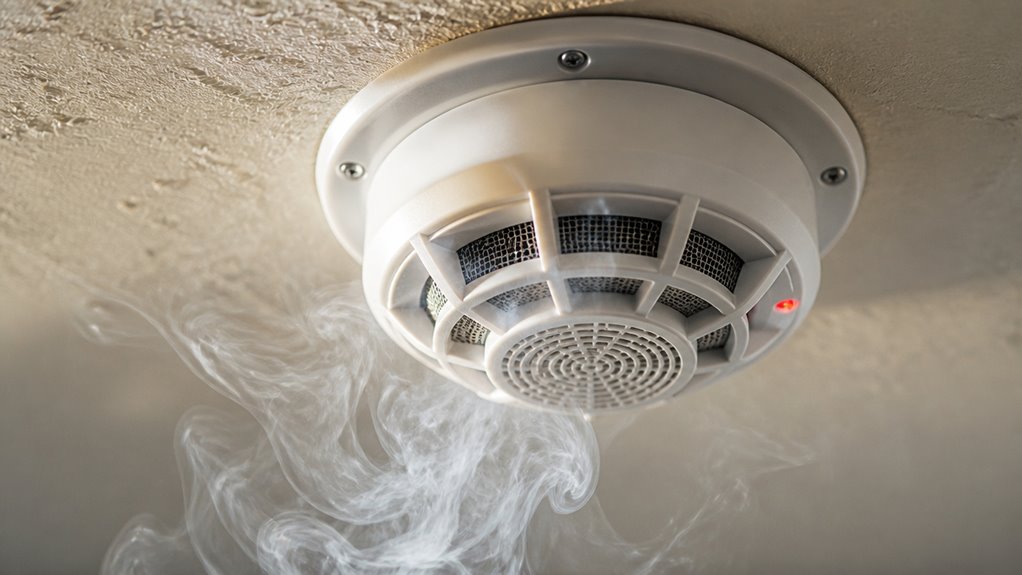

Your smoke detector senses fire by detecting smoke particles using ionization or photoelectric technology.
Ionization detectors use americium-241 to ionize air, measuring changes in electrical current as smoke neutralizes ions.
Photoelectric detectors rely on light scattering caused by larger smoke particles, triggering alarms when light intensity changes.
Some alarms combine both methods for faster, accurate fire detection.
These systems continuously monitor thresholds to avoid false alerts.
Explore further to understand their components, power sources, and advanced features.
Key Takeaways
- Ionization smoke detectors use americium-241 to ionize air, detecting smoke by measuring drops in electrical current caused by smoke particles.
- Photoelectric smoke detectors detect smoke by sensing light scattered by larger smoke particles inside a sensing chamber.
- Ionization detectors excel at detecting fast-burning fires, while photoelectric detectors are more sensitive to smoldering fires.
- Dual-technology detectors combine ionization and photoelectric methods to improve detection accuracy and reduce false alarms.
- Alarm circuitry continuously monitors sensor signals and triggers loud alerts when smoke levels exceed preset thresholds.
How Smoke Detectors Detect Smoke?
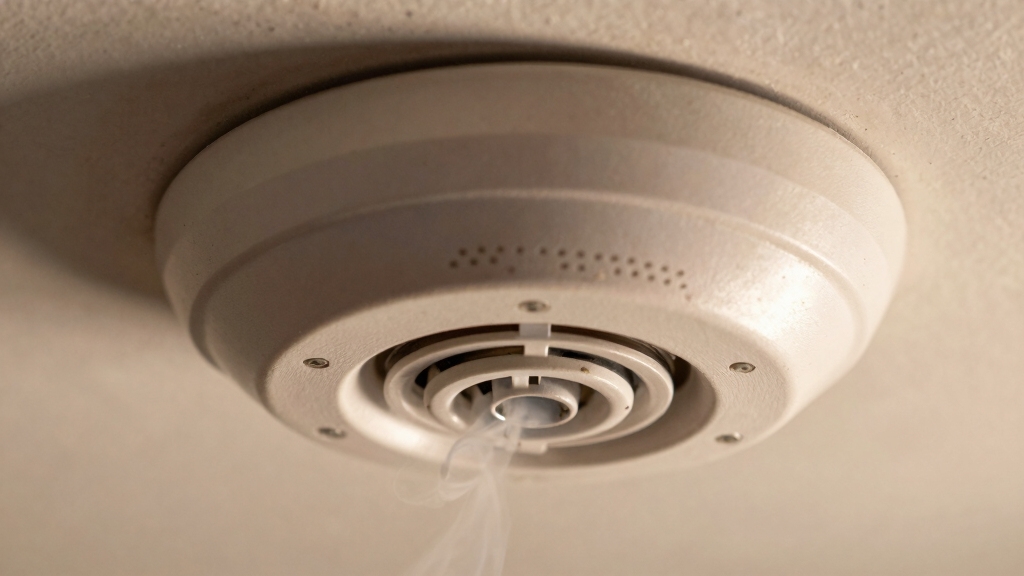
Smoke detectors identify smoke by sensing changes in the air caused by airborne particles. When smoke enters the detector’s chamber, it alters either the electrical current or the light intensity within the sensor.
Depending on the technology, the device measures these changes precisely. Ionization detectors use a radioactive source to ionize air molecules, creating charged ions that form a steady current. Smoke particles disrupt this current by attaching to ions and reducing flow.
Conversely, photoelectric detectors employ a light source and sensor positioned at right angles inside the chamber. Smoke particles scatter the light onto the sensor, increasing detected light intensity.
Once the measured current drops or light intensity rises beyond a preset threshold, the detector triggers an alarm to alert you. Photoelectric smoke detectors are especially sensitive to large smoke particles from smoldering fires, providing early warnings with fewer false alarms through their light scattering detection.
What Makes Ionization Smoke Detectors Work?
So, here’s how ionization smoke detectors work. They actually use a tiny radioactive source to ionize air molecules. What does that mean? Well, it creates charged ions between two plates, and this sets up a steady current.
Now, when smoke particles come into the chamber, they attach themselves to those ions. This is where things get interesting! By doing that, they disrupt the current because they’re carrying charges away. So, when there’s a drop in the current, that’s the detector’s way of saying, “Hey, there’s smoke here!” And that’s what triggers the alarm. Pretty clever, right?
Radioactive Ionization Process
Although the radioactive ionization process operates quietly inside the detector, it plays an essential role in identifying smoke particles. You rely on this process to maintain a constant flow of ions, enabling the detector to sense changes in air quality.
Here’s how it works:
- A small amount of americium-241 emits alpha particles, ionizing air molecules between two charged plates.
- This ionization generates positive and negative ions that create a steady electric current.
- When smoke enters, it attaches to ions, reducing the current as fewer ions reach the plates.
This reduction signals the presence of smoke, triggering the alarm. The controlled radioactive source guarantees consistent ion production, providing reliable detection of fast-burning fires with fine combustion particles. The americium-241 source is securely enclosed in foil and ceramic to prevent any radiation exposure during normal use.
Ion Movement and Current
Ions continuously travel between two charged plates inside an ionization smoke detector, creating a steady electrical current that serves as the baseline for detecting smoke.
The detector uses americium-241 to ionize air molecules, producing positive and negative ions that move toward oppositely charged electrodes.
This ion flow generates a measurable current, typically in the microampere range.
When smoke enters the chamber, particles attach to ions, neutralizing them and reducing ion mobility.
This decrease disrupts the current between the plates.
The detector’s circuitry continuously monitors this current, triggering an alarm once it falls below a defined threshold.
The americium-241 foil is securely sealed inside the detector to ensure radiation safety during normal use.
Smoke Particle Interaction
When smoke particles enter the ionization chamber, they interact directly with the charged ions. This disrupts their movement between the electrodes and reduces the steady electric current the detector monitors. Here’s how this happens in detail:
- Smoke particles attach to positive and negative ions, neutralizing their charge.
- Neutralized ions can no longer complete the circuit between the plates.
- The drop in ion current triggers the detector’s alarm circuit.
You’ll see that the detector relies on this precise ion disruption to identify smoke presence rapidly.
The efficiency of this method stems from the predictable behavior of ions and their charge neutralization by smoke particles.
This makes ionization detectors particularly sensitive to small combustion particles typical of flaming fires.
For continuous operation, ionization detectors often require a battery backup to maintain functionality during power outages.
How Photoelectric Smoke Detectors Detect Smoke?
You know those photoelectric smoke detectors? They’re pretty cool because they detect smoke by using light scattering in their sensing chamber. So, when smoke particles drift in, they start to scatter the light beam. This scattering directs some of that light toward a sensor that’s positioned at a 90-degree angle.
As the smoke particles do their thing, the sensor picks up an increase in light intensity. Once that reading goes beyond a certain threshold, the alarm gets triggered. It’s a smart way to keep us safe, don’t you think? However, the presence of spider webs or insect debris inside the detection chamber can cause optical interference, which may lead to false alarms.
Light Scattering Principle
Light scattering forms the core principle behind photoelectric smoke detectors’ ability to identify smoke particles. Inside the sensing chamber, a light source projects a beam at a 90-degree angle to a photodetector.
When smoke particles enter, they scatter the light, redirecting some of it toward the sensor. This increase in detected light intensity signals the presence of smoke.
You should know these key points about the light scattering principle:
- The sensor remains inactive without smoke because the light beam misses the photodector.
- Smoke particles cause a measurable rise in scattered light intensity, triggering detection.
- The system quantifies scattered light to determine if smoke concentration exceeds the alarm threshold.
This method excels at detecting larger particles from smoldering fires with high sensitivity and reliability. Photoelectric sensors often include a right-angle light path design that enhances smoke detection accuracy while reducing false alarms.
Sensor Activation Process
Understanding how photoelectric smoke detectors identify smoke requires examining the sensor activation process triggered by scattered light.
Inside the sensing chamber, a light source projects a beam away from the photocell sensor, positioned at a 90-degree angle.
In clear air, this beam bypasses the sensor, registering minimal light intensity.
When smoke particles enter, they scatter the beam toward the photocell, causing a measurable increase in detected light intensity.
The detector’s circuit board continuously monitors this intensity.
Once the scattered light surpasses a predefined threshold, it activates the alarm.
This activation relies on precise calibration to distinguish between ambient light fluctuations and genuine smoke presence.
This ensures timely and accurate alerts, particularly for smoldering fires generating larger particles that efficiently scatter light within the chamber.
However, dense steam particles can also scatter light in a similar way, sometimes causing false alarms in photoelectric detectors.
Why Some Smoke Detectors Use Two Technologies?
Because different fire types produce distinct smoke characteristics, some smoke detectors incorporate both ionization and photoelectric technologies to enhance detection accuracy.
By combining these methods, you improve early fire detection across varying combustion conditions. This reduces false alarms and increases safety.
Combining detection methods enhances early fire alerts, minimizes false alarms, and boosts overall safety.
Here’s why dual-technology detectors benefit you:
- Ionization sensors rapidly detect flaming fires producing small, fast-moving particles.
- Photoelectric sensors excel at sensing smoldering fires with larger, slower particles.
- The combined system covers a wider range of smoke particle sizes and densities, ensuring prompt alarms for diverse fire scenarios.
Using both technologies lets you rely on a single device for thorough detection. This overcomes the limitations each technology has individually.
This integration optimizes your home or workplace fire safety strategy effectively. Additionally, photoelectric sensors provide detection speed more than 25% faster than average alarms, improving early warnings in smoldering fire situations.
Key Components Inside a Smoke Detector
Inside every smoke detector, several essential components work together to rapidly identify smoke and alert occupants. The core element is the sensor, which employs either ionization or photoelectric technology to detect smoke particles.
A circuit board continuously monitors changes in electrical current or light intensity within the sensing chamber. When smoke alters these parameters beyond preset thresholds, the circuit triggers the alarm.
The power source, either a battery or household electrical wiring, guarantees continuous operation, often supported by a backup battery.
Finally, the loud electronic horn provides the audible alert needed to wake and inform occupants.
Each component integrates precisely to maintain sensitivity, reliability, and quick response. This forms a cohesive system designed to detect fires early and prompt timely evacuation.
Many detectors use a dual-source design combining mains power and backup batteries to ensure continuous operation during power outages.
How Smoke Detectors Sound the Alarm?
Once the sensor detects smoke particles and the circuit board confirms a threshold change in current or light intensity, the detector activates its alarm system.
When smoke particles trigger the sensor and circuit board detects a threshold change, the alarm system activates immediately.
This process involves several coordinated steps that guarantee timely alerting:
- The circuit board processes sensor signals, verifying that smoke levels exceed preset thresholds to avoid false alarms.
- Upon confirmation, the board supplies power to the piezoelectric horn or electronic buzzer, generating a loud, pulsating sound.
- This alarm sound is designed to be audible throughout the protected area, waking occupants and prompting evacuation.
You rely on this rapid, automated sequence to provide critical early warnings. It leverages sensor data and electrical control to convert invisible smoke detection into an unmistakable audible alert.
Regular testing and maintenance of fire alarms ensures the system remains reliable and reduces false alerts.
Fire Types Best Detected by Smoke Detectors
Typically, smoke detectors excel at identifying specific fire types based on their sensing technology.
Ionization detectors quickly detect flaming fires that emit smaller combustion particles by registering a drop in ion current.
In contrast, photoelectric detectors are more sensitive to smoldering fires producing larger, light-scattering smoke particles, triggering an increase in detected light intensity.
When you combine both methods, you optimize detection across diverse fire scenarios, covering both fast-flaming and slow-smoldering fires effectively.
While ionization units respond rapidly to fast flames, photoelectric sensors provide earlier warning for smoldering fires, which often precede intense flames.
Understanding these distinctions helps you select appropriate detectors to maximize safety.
This ensures early detection tailored to the fire’s combustion characteristics and particle size distribution.
Safety Features and Modern Upgrades in Smoke Detectors
Although smoke detectors rely on sensitive detection technologies, their safety is enhanced by shielding the radioactive materials in ionization models. This ensures minimal risk during everyday use.
Shielding radioactive materials in ionization smoke detectors greatly reduces everyday safety risks.
You benefit from these safety features that prevent radiation exposure while maintaining detection accuracy. Modern upgrades improve functionality and reliability, so you stay better protected.
Key enhancements include:
- Integration with smart home systems, allowing alerts directly to your phone or monitoring services.
- Backup battery systems in hardwired units, ensuring continuous operation during power outages.
- Automated self-testing and diagnostics that notify you of sensor malfunctions or low battery levels.
How Power Sources Keep Smoke Detectors Running?
Because smoke detectors must operate continuously to guarantee safety, their power sources play a critical role in maintaining reliable performance.
You’ll find two main options: batteries and household electrical wiring. Battery-powered units rely on replaceable or sealed lithium batteries, which offer consistent voltage and long operational life.
However, these require periodic replacement to prevent failure. Hardwired detectors connect directly to your home’s electrical system, ensuring uninterrupted power. They also incorporate a backup battery to maintain function during outages.
The smoke detector’s circuit board manages power distribution to sensors and the alarm horn. This optimizes energy use and monitors voltage levels to detect power anomalies.
This dual-source design maximizes reliability, ensuring the detector remains active at all times. It promptly alerts you to smoke hazards, regardless of power interruptions.
Frequently Asked Questions
How Often Should Smoke Detector Batteries Be Replaced?
You should replace smoke detector batteries at least once a year to guarantee reliable operation.
Many units emit a low-battery warning chirp when power weakens, signaling immediate replacement is necessary.
If your detector uses a sealed lithium battery, it may last up to 10 years, but regular testing remains essential.
Maintaining fresh batteries prevents alarm failure during emergencies, preserving the sensor’s ability to detect smoke and trigger timely alerts effectively.
Can Smoke Detectors Detect Carbon Monoxide?
Imagine a faint, invisible gas creeping through your home: carbon monoxide. Standard smoke detectors don’t detect it, but some specialized units include carbon monoxide sensors that analyze air chemistry for this odorless threat.
These combined detectors use electrochemical cells to identify CO presence, triggering alarms before levels become dangerous. To guarantee your safety, consider installing these dual-function detectors, especially near sleeping areas, for all-encompassing fire and gas hazard detection.
What Is the Lifespan of a Typical Smoke Detector?
You should expect a typical smoke detector to last about 8 to 10 years.
Over time, sensor sensitivity degrades due to dust accumulation and component wear, reducing reliability.
Manufacturers recommend replacing the entire unit within this period to maintain peak detection performance.
Some models include a built-in end-of-life signal to alert you.
Regular testing and battery replacement won’t extend the sensor’s lifespan, so timely replacement is essential for safety.
How Do Smoke Detectors Perform in High Humidity or Dust?
Imagine your smoke detector as a vigilant sentinel. High humidity or dust can cloud its judgment.
Moisture can cause false alarms in photoelectric sensors by scattering light unpredictably.
Dust buildup may block sensor chambers or mimic smoke particles, triggering false alerts or reducing sensitivity.
Regular cleaning and proper placement shield your detector’s precision.
This ensures it distinguishes real threats from environmental noise without compromise.
Are Smoke Detectors Required by Law in All Homes?
Yes, you’re generally required by law to have smoke detectors in all homes, though specifics vary by location.
Building codes mandate their installation to guarantee occupant safety, often specifying placement in bedrooms, hallways, and living areas.
You’ll find stricter regulations for new construction versus existing homes.
It’s essential to check your local and state laws to stay compliant and safeguard your household effectively.
Choose the Right Smoke Detector Technology
Now that you understand how smoke detectors quietly stand guard, detecting even the faintest signs of trouble, you can appreciate their subtle vigilance.
These devices blend ionization and photoelectric technologies, acting as your home’s discreet sentinels.
They alert you before situations escalate.
By relying on precise sensors and reliable power sources, they offer a sophisticated safety net.
This ensures you’re always one step ahead of potential hazards with minimal fuss.