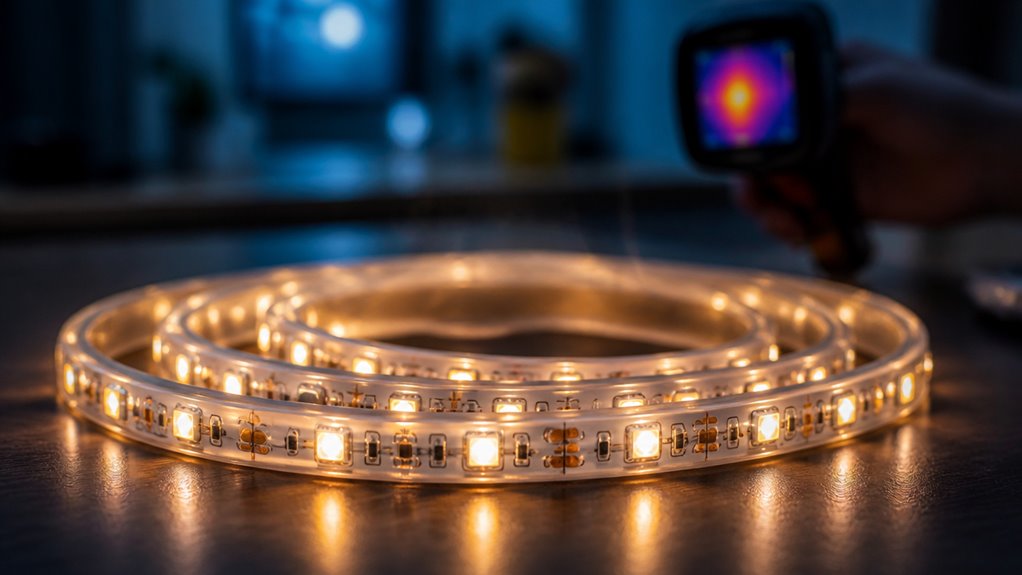

Yes, LED light strips do get hot due to energy conversion inefficiencies. Only 30%–50% of power converts to light while the rest becomes heat.
Heat levels depend on wattage, LED density, electrical current, and mounting materials. Aluminum backing and proper ventilation reduce operating temperatures.
However, high power density or poor installation can cause hotspots and reduced lifespan. Understanding these factors helps you manage heat effectively and maintain safe, peak performance.
Key Takeaways
- LED light strips generate heat as a byproduct of energy conversion inefficiency, with 50%–70% of input power dissipated as thermal energy.
- Typical LED strip surface temperatures can reach around 140°F (60°C), especially in high-power or densely packed designs.
- Heat buildup increases with higher wattage, concentrated current, and closely spaced LEDs, causing hotspots and reducing lifespan.
- Proper mounting on aluminum profiles and good ventilation significantly reduce operating temperatures and improve heat dissipation.
- Using correct voltage, quality power supplies, and maintaining thermal management prevents excessive heat and prolongs LED strip life.
Why LED Light Strips Produce Heat?
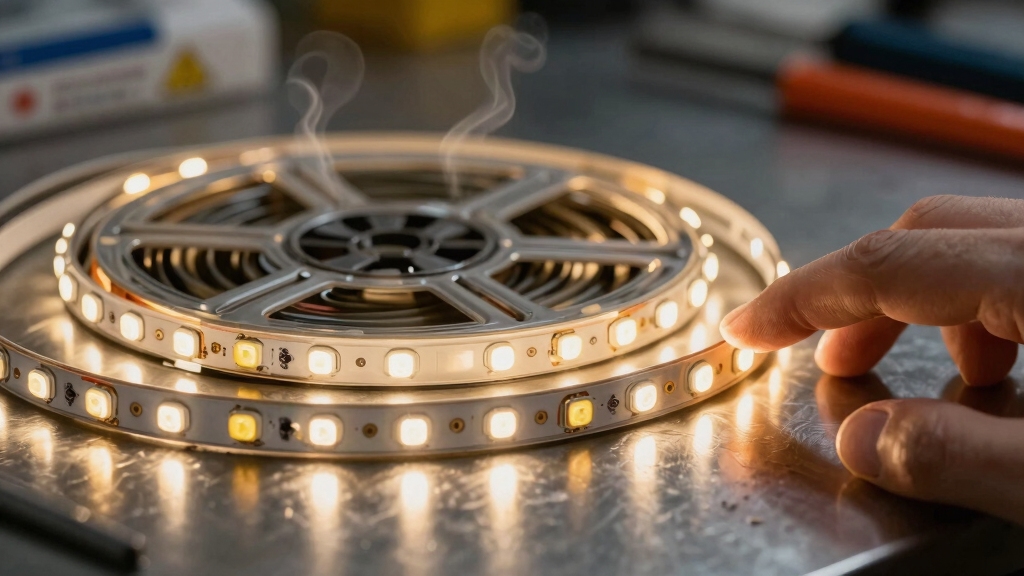
LED light strips produce heat primarily due to energy conversion losses inherent in their operation.
When you power an LED strip, only about 30% to 50% of the electrical energy converts into visible light; the remainder dissipates as thermal energy.
This inefficiency is intrinsic to semiconductor physics and electrical resistance within the components.
As you increase the strip’s wattage, the total heat output rises proportionally.
Additionally, if you supply voltage beyond recommended levels or use incompatible drivers, the heat generation escalates sharply.
The heat you observe results from these conversion losses combined with internal resistive elements.
Understanding this helps you anticipate the thermal behavior of LED strips.
It also guides you in selecting proper power supplies and ensuring adequate heat dissipation to maintain performance and longevity.
Excessive heat can overheat internal components, shortening lifespan and causing failure, so proper heat management is crucial for reliable operation and durability in varying environments, similar to how extreme temperatures impact security cameras.
How Hot Do LED Strips Get?
LED strips are pretty cool, but they do get warm! Typically, you can expect their temperatures to rise about 30°F (17°C) above the surrounding air. In some cases, they can even reach up to 140°F (60°C), depending on how much power they’re using and their overall design.
There are a few things that can really affect how hot these strips get. For instance, power density, ventilation, and the surfaces they’re mounted on all play a big role in heat levels. So, if you’re planning to use them, keep these factors in mind!
To keep things safe and efficient, it’s important to manage that heat. Using the right drivers is key, and don’t forget about ensuring good airflow. You might also want to look into thermal dissipating materials to help keep everything cool. It’s all about finding that balance!
Proper heat management, such as installing aluminum heat sinks, helps prevent overheating and extends the lifespan of LED strips by maintaining lower junction temperatures and preserving luminous efficacy, making it essential for safe continuous operation and thermal management.
Typical Temperature Ranges
Although heat generation varies by design and power density, typical LED light strips generally experience a temperature rise of around 30°C (54°F) above ambient conditions during normal operation.
For example, in a room at 24°C (75°F), you can expect the strip surface temperature to reach approximately 54°C (129°F).
Maximum operating temperatures often hover near 60°C to 65°C (140°F to 149°F), depending on the strip’s power rating and thermal management features.
Lower-power strips run cooler, while high-power variants generate more heat.
The temperature range you observe will directly impact the strip’s longevity and performance.
Knowing these typical values helps you assess whether your setup maintains safe, efficient conditions without risking overheating or degradation.
Proper installation and ventilation are essential to prevent heat buildup that can shorten LED strip lifespan and pose fire risks.
Factors Influencing Heat
Because heat generation depends on several design and environmental variables, understanding these factors is essential for managing strip temperature effectively.
The primary influences include strip design and power density; higher wattage strips produce more heat due to increased energy conversion losses.
Ambient temperature also plays a critical role. Warmer surroundings elevate operating temperatures.
Additionally, installation quality impacts heat dissipation. Poor ventilation or mounting on non-thermal surfaces traps heat, causing temperature buildup.
Overdriving the strip with incompatible power supplies further escalates heat output. You should note that LED efficiency, often between 30% and 50%, determines how much input power converts to heat.
These variables interact dynamically, making precise temperature prediction challenging without considering all factors simultaneously. Understanding them helps you anticipate thermal behavior and optimize LED strip performance safely.
Proper installation and compliance with local fire codes can also prevent hazards related to overheating.
Heat Reduction Methods
When managing LED strip temperatures, employing effective heat reduction methods is essential to maintaining performance and longevity. You can markedly lower operating temperatures by following specific strategies that optimize heat dissipation and prevent excessive thermal buildup.
Consider these key approaches:
Use the recommended voltage and avoid overdriving the strip to minimize unnecessary heat generation.
Leave about a 20% capacity margin in your power supply or driver to prevent overload and excess heat.
Install LED strips with proper ventilation, allowing airflow to carry heat away efficiently.
Mount strips onto aluminum profiles or extrusions that act as heatsinks, improving thermal conduction and reducing surface temperature.
Selecting components with high endurance and proper thermal ratings can also help extend the lifespan of LED strips by preventing premature failure due to heat stress, as emphasized in endurance ratings for continuous use.
How LED Strip Design Affects Heat?
Power density is a big deal when it comes to how much heat your LED strip generates. Basically, the higher the power density, the more thermal energy you’re looking at. It’s kind of like cooking; if you turn the heat up too high, things can get pretty toasty!
Now, let’s talk about design. Those thermal management features? They’re super important. Things like integrated heatsinks or aluminum backing help dissipate heat really well. Think of them as the strip’s cooling system, making sure it doesn’t overheat.
And don’t forget about the materials and overall construction. They really matter too! The way the strip is built determines how well it can handle and transfer heat during operation. So, if you want your LED strip to shine bright without losing its cool, pay attention to these factors!
Effective temperature regulation via heat sinks or small fans is essential to stabilize internal electronics and prevent overheating.
Power Density Impact
Many LED strip designs incorporate varying power densities, which directly influence the amount of heat generated during operation.
Power density refers to the wattage per unit length. Higher values mean more electrical energy converts to heat along the strip.
When you select a strip, consider these factors:
Higher power density strips produce more heat per inch, raising operating temperature.
Closely spaced LEDs increase heat concentration and reduce heat dissipation efficiency.
Narrower strip substrates limit heat spreading, causing localized hot spots.
Increased current draw in high-density strips accelerates thermal buildup without adequate cooling.
Understanding power density helps you predict heat levels and choose strips that fit your thermal constraints.
Proper installation and cooling methods, such as using heat sinks or adequate ventilation, are essential to managing thermal buildup effectively.
Thermal Management Features
Optimizing thermal management features in LED strip design plays a critical role in controlling heat buildup and ensuring performance stability.
Effective thermal management involves integrating heat sinks, optimizing circuit layout, and managing power distribution to minimize hotspots.
For example, the spacing of LEDs directly impacts heat dispersion, as closer spacing intensifies localized heat.
Additionally, incorporating thermal vias or metal-core printed circuit boards (MCPCBs) helps transfer heat away from the diodes efficiently.
You should also consider the role of current regulation in thermal control; stable current prevents excessive heat generation from overdriving.
By engineering these elements precisely, manufacturers can maintain LED junction temperatures within safe limits.
This enhances lifespan and reduces performance degradation.
Proper thermal design mitigates overheating risks and guarantees consistent light output.
Choosing cables with appropriate insulation ratings also helps maintain safe operating temperatures and prevents heat-related damage in LED installations.
Material and Construction
Although LED strips generate less heat than traditional lighting, their material composition and construction markedly influence how efficiently that heat dissipates.
When you evaluate LED strips, consider how substrates, adhesives, and circuit layers affect thermal conductivity. Poor materials trap heat, reducing lifespan and performance.
Key construction factors include:
Base material: Aluminum-backed strips conduct heat away better than flexible PCB alone.
Encapsulation type: Silicone or epoxy coatings impact heat retention and protection.
LED placement density: Higher density increases local heat concentration.
Thermal interface: Adequate thermal paste or adhesive improves heat transfer to mounting surfaces.
Proper thermal management is essential to prevent overheating and ensure the longevity and safety of LED light strips.
How Power Density Affects LED Strip Heat?
When you increase the power density of an LED strip, the amount of heat generated per unit length rises proportionally. Higher power density means more electrical current flowing through a concentrated area, which leads to increased energy conversion losses as thermal output.
This heat accumulation can elevate the strip’s operating temperature, potentially impacting LED efficiency and lifespan. You must consider that densely packed LEDs, while brighter, create thermal hotspots that challenge heat dissipation.
Without adequate thermal management, such as aluminum mounting surfaces or spacing, excessive heat buildup will degrade performance and reliability. Consequently, understanding and controlling power density is critical to maintaining safe operating temperatures and ensuring the strip’s durability in your application. Proper environmental factors such as heat and dust management play a crucial role in preserving device performance and longevity.
How Ambient Temperature Affects LED Strip Heat?
Because ambient temperature directly influences the rate at which heat dissipates from LED strips, higher surrounding temperatures cause the strip’s operating temperature to rise correspondingly.
When the environment is warmer, the thermal gradient between the strip and its surroundings decreases, reducing heat transfer efficiency. This leads to increased operating temperatures, which can affect performance and longevity.
Elevated ambient temps limit cooling, causing higher steady-state strip temperatures.
In cooler environments, LED strips maintain lower operating temperatures, improving efficiency.
Extreme ambient heat may push strips near or beyond maximum rated temperatures. Consistent high ambient temperature raises thermal stress on LED components, potentially shortening lifespan.
Understanding ambient temperature’s role helps you anticipate heat behavior and manage LED strip thermal conditions effectively.
How Proper Installation Controls LED Strip Heat?
Managing the heat generated by LED strips involves more than just considering ambient temperature; how you install the strips plays a significant role in controlling their operating temperature.
You need to make certain the strips are mounted on surfaces that allow effective heat transfer away from the LEDs. Avoid insulating or enclosing strips in tight, non-ventilated spaces, as trapped heat markedly raises operating temperatures.
Maintain appropriate spacing between strip segments and nearby materials to promote airflow. Also, use the correct power supply to prevent overdriving, which increases heat output.
Proper wiring and secure connections reduce resistance-related heat buildup. By controlling these installation parameters, you minimize thermal stress on the LED components. This improves performance, reliability, and lifespan while reducing the risk of overheating-related failures.
Materials That Help Dissipate LED Strip Heat
Although LED strips inherently produce heat during operation, selecting appropriate materials can markedly enhance heat dissipation and maintain peak performance.
You want to focus on materials that offer high thermal conductivity and surface area to efficiently transfer heat away from the LED components.
Using proper substrates and mounting surfaces directly impacts the strip’s operating temperature and longevity.
Key materials worth evaluating include:
Aluminum profiles or extrusions: Act as heatsinks by conducting heat away efficiently.
Thermally conductive adhesive tapes: Improve contact between the strip and metal surfaces.
Ceramic substrates: Provide excellent thermal stability and conductivity.
Thermal interface materials (TIMs): Fill microscopic gaps between surfaces to optimize heat transfer.
Choosing these materials helps you maintain safer operating temperatures and prevents thermal degradation of LEDs.
When LED Strip Heat Is a Safety Risk?
When LED strip heat exceeds design limits, it can pose significant safety risks, especially if you overlook installation guidelines or use incompatible components.
Excessive heat may cause the strip or surrounding materials to reach temperatures that degrade insulation, warp substrates, or ignite flammable objects nearby.
You risk accelerated aging, circuitry damage, or fire hazards when using low-quality strips or mismatched power supplies that push current beyond specifications.
Poor ventilation and improper mounting further trap heat, intensifying thermal stress.
Signs like hot-to-touch surfaces, flickering, or discoloration indicate unsafe operating conditions.
Because LED strips convert much of the input energy into heat, monitoring maximum operating temperature and adhering to manufacturer ratings is critical.
Ignoring these limits compromises both safety and strip performance, increasing the likelihood of hazardous failures.
How to Prevent LED Strip Overheating?
To keep your LED strips from overheating, it’s super important to start with a power supply that’s rated correctly. You want to avoid overdriving those LEDs, so aim for a power supply that has about a 20% capacity margin. This little buffer can make a big difference!
Plus, let’s talk about heat dissipation. It’s really effective to mount your LED strips on aluminum profiles or other surfaces that conduct heat well. This way, any extra heat can escape more easily!
Oh, and don’t forget about ventilation! Making sure there’s good airflow around your strips is crucial for keeping temperatures in check. With these simple steps, you can enjoy your LED lighting without worrying about overheating!
Proper Power Supply
Selecting and using the proper power supply plays a critical role in preventing your LED strip from overheating. An incompatible or undersized power supply can push excess current, increasing heat output and reducing strip lifespan.
To optimize performance and safety, consider the following:
Choose a power supply with at least 20% capacity margin above your strip’s wattage to avoid overloading.
Match the voltage precisely to the LED strip’s specifications to prevent overdriving.
Use high-quality, certified power supplies to guarantee stable current delivery and reduce electrical losses.
Avoid cheap or uncertified adapters that may cause voltage fluctuations, leading to heat spikes.
Effective Heat Dissipation
Managing heat effectively is essential to maintaining LED strip performance and longevity.
You should mount your LED strips on aluminum profiles or extrusions, which act as heatsinks and significantly reduce operating temperatures.
Make sure adequate ventilation surrounds the strips to allow thermal energy to dissipate naturally.
Avoid enclosing strips in tight, non-ventilated spaces that trap heat, increasing the risk of thermal buildup.
Using a power supply with about 20% capacity margin prevents overdriving, which contributes to excess heat generation.
Always choose high-quality, certified LED strips designed to tolerate expected thermal loads.
By combining proper mounting, ventilation, and power management, you’ll minimize heat accumulation, prevent premature degradation, and maintain stable luminous efficiency throughout the strip’s lifespan.
Effective heat dissipation is your best defense against LED strip overheating.
Why Certified LED Strips Reduce Heat Risks?
Although uncertified LED strips might seem more affordable, certified LED strips offer critical advantages that materially reduce heat-related risks.
Certified LED strips significantly enhance safety by effectively reducing heat-related hazards compared to uncertified options.
They undergo rigorous testing to guarantee thermal performance and safety compliance, which minimizes overheating hazards.
When you choose certified products, you benefit from:
Verified component ratings that tolerate higher temperatures without degradation.
Controlled manufacturing processes that prevent defects causing heat buildup.
Compliance with safety standards such as UL or CE, guaranteeing fire resistance.
Optimized thermal designs that improve heat dissipation and maintain operating temperatures.
Frequently Asked Questions
Can LED Strip Heat Damage Nearby Electronics?
Yes, LED strip heat can damage nearby electronics if it’s excessive and persistent.
You should avoid placing strips too close to sensitive components, especially if ventilation is poor or the strip runs at high power.
Heat buildup may degrade electronic parts, causing performance issues or shortened lifespan.
To prevent this, mount strips on heat-dissipating surfaces and ensure proper airflow.
Using certified, quality strips also helps minimize harmful thermal effects on adjacent devices.
Do Color Temperatures Affect LED Strip Heat Output?
Oh sure, your LED strip’s color temperature is secretly plotting to crank up the heat like a tiny sun.
In reality, though, color temperature itself barely affects heat output.
It’s mostly about the power consumption and efficiency of the LEDs, not whether they’re warm white or cool white.
So, you don’t have to worry that picking a “warmer” tone means turning your strip into a mini heater.
Focus on wattage and quality instead.
How Does Dimming Impact LED Strip Temperature?
Dimming LED strips lowers their current draw, so you’ll see a reduction in heat output proportional to the power decrease.
However, certain dimming methods like PWM (pulse-width modulation) can introduce slight additional heat due to switching losses in the driver circuitry.
Overall, dimming generally reduces the strip temperature, but the impact depends on the dimmer type and quality.
Proper dimmer compatibility helps maintain peak thermal performance and longevity.
Are Waterproof LED Strips More Prone to Overheating?
Yes, waterproof LED strips can be more prone to overheating because their protective coatings and enclosures restrict heat dissipation.
The added waterproof layer acts as insulation, trapping more thermal energy.
To manage this, install them with proper ventilation and use aluminum profiles or heatsinks to improve heat transfer.
Choosing high-quality, certified waterproof strips also helps minimize overheating risks despite their inherently reduced cooling efficiency.
Can LED Strip Heat Affect Adhesive Backing Longevity?
Think of your LED strip’s adhesive like a cozy blanket. It can lose its warmth and grip when exposed to constant heat.
Yes, the heat from LED strips can degrade the adhesive backing over time, reducing its stickiness and causing detachment risks. This happens because elevated temperatures accelerate adhesive breakdown, especially on lower-quality tapes.
To maintain longevity, ensure proper heat dissipation and choose high-temperature-rated adhesives designed for LED applications.
Know When LED Strip Heat Becomes a Problem
Now that you understand why LED light strips produce heat and how factors like design, power density, and ambient temperature influence their temperature, you can better manage their safety and performance.
Don’t you want your LED strips to last longer and stay cool?
By using proper materials, ensuring good ventilation, and choosing certified products, you’ll effectively prevent overheating and reduce risks. This makes your lighting both efficient and reliable.