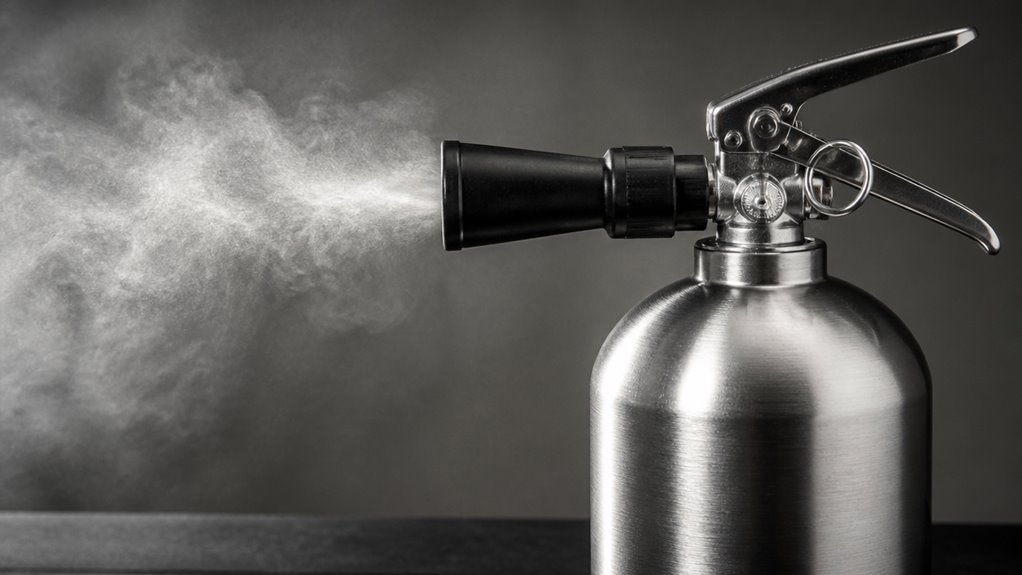

A clean agent fire extinguisher uses electrically non-conductive gases or volatile agents that rapidly suppress fires without leaving residue.
You’ll find these systems stored as gases or liquids that vaporize quickly to interrupt combustion by displacing oxygen, absorbing heat, or breaking chemical reactions.
They’re ideal for protecting sensitive electronics and occupied spaces due to their non-toxic and environmentally friendly nature.
If you want to understand their types, uses, and how they outperform traditional systems, keep exploring this technology.
Key Takeaways
- A clean agent fire extinguisher uses electrically non-conductive gases to suppress fires without leaving residue.
- It rapidly interrupts fire by displacing oxygen, absorbing heat, or disrupting chemical reactions.
- Common agents include inert gas mixtures, FM-200, Novec 1230, and FK-5-1-12.
- Suitable for protecting sensitive electronics and occupied spaces due to non-toxicity and residue-free properties.
- Environmentally friendly with zero ozone depletion and low global warming potential.
What Is a Clean Agent Fire Extinguisher?
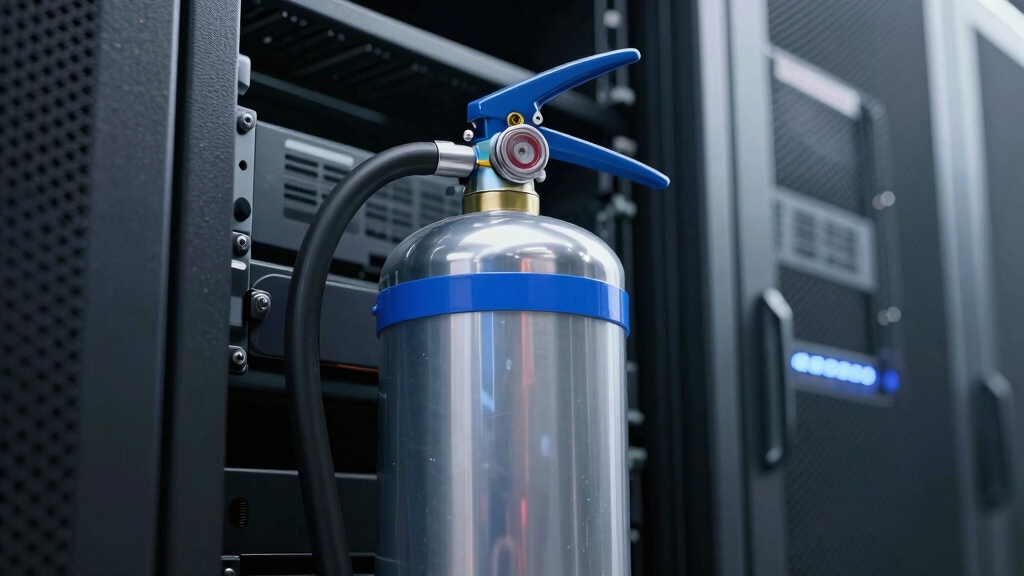
When you need a fire extinguisher that leaves no mess behind, a clean agent fire extinguisher fits the bill perfectly.
You’re dealing with an electrically non-conductive, volatile or gaseous agent that evaporates without residue, as defined by NFPA 2001.
Stored as a gas or liquid, it converts to gas upon discharge, enabling rapid suppression.
The extinguishing mechanism involves displacing oxygen, absorbing heat, or interrupting the chemical chain reaction, essentially disrupting the fire tetrahedron.
You can rely on it for safe use around humans and sensitive equipment because it’s ozone-friendly and non-toxic at operational levels.
Its ability to reach extinguishing concentrations in under 10 seconds means you suppress fires at the incipient stage, minimizing damage and downtime effectively.
Typical spray durations for clean agent extinguishers vary but generally fall within the 8–30 seconds range, depending on model and agent type.
Common Types of Clean Agent Fire Extinguishers
Explore the variety of clean agent fire extinguishers designed to address specific fire hazards and environments.
You’ll encounter inert gas systems that use nitrogen, argon, and carbon dioxide mixtures to reduce oxygen levels rapidly.
Hydrofluorocarbon-based FM-200 is popular for its rapid heat absorption and chemical interruption capabilities.
Novec 1230, a fluorinated ketone, extinguishes fires by absorbing heat and evaporates without residue.
FS 49 C2 combines tetrafluoroethane, pentafluoroethane, and CO2, offering balanced suppression characteristics.
FK-5-1-12, another fluorinated ketone, targets specialized hazards with minimal environmental impact.
Each agent stores as liquid or compressed gas and discharges as gas, ensuring quick action within 10 seconds.
Your choice depends on fire class compatibility, environmental compliance, and asset sensitivity.
This enables precise, residue-free fire suppression tailored to your operational needs.
Unlike dry chemical agents such as Purple K fire extinguishers, which leave powder residue, clean agents provide residue-free suppression ideal for sensitive equipment.
Applications of Clean Agent Fire Extinguishers
In environments housing sensitive electronics or valuable assets, clean agent fire extinguishers provide targeted fire suppression without causing damage.
You’ll find these systems essential in data centers, server rooms, museums, and telecommunications facilities, where traditional extinguishing agents could harm equipment or artifacts.
Their non-conductive, residue-free nature guarantees fires involving electrical equipment and flammable liquids (Class B and C) are swiftly extinguished with minimal downtime.
By rapidly disrupting the fire tetrahedron through oxygen displacement, heat absorption, or chemical chain interruption, these agents suppress fires within seconds, limiting spread and damage.
You can also deploy them in occupied spaces due to their human-safe concentrations.
Their precise application protects critical infrastructure while maintaining operational continuity, making them indispensable for high-risk environments that demand both fire suppression efficiency and asset integrity.
To ensure continued reliability, clean agent extinguishers require regular inspection and servicing by licensed fire protection services in compliance with NFPA standards.
How Clean Agent Fire Extinguishers Protect People and the Environment?
The commitment to safety and environmental responsibility drives the design of clean agent fire extinguishers. They effectively protect both people and ecosystems.
Designed with safety and environmental care, clean agent extinguishers safeguard people and the planet.
These extinguishers utilize agents that are electrically non-conductive and non-toxic at extinguishing concentrations. This makes them safe for occupied spaces.
They rapidly suppress fires by disrupting the fire tetrahedron by reducing oxygen, absorbing heat, or interrupting chemical reactions without compromising human safety.
Environmentally, clean agents have zero ozone depletion potential and low global warming potential, aligning with NFPA 2001 standards.
Upon discharge, they evaporate completely, leaving no residue and minimizing environmental contamination and cleanup.
This design minimizes harm to sensitive electronics and valuable assets while ensuring occupant safety and environmental preservation.
It fulfills both fire protection and sustainability goals.
Additionally, clean agent extinguishers often contain specialized surfactants that help form protective films, enhancing their fire suppression efficiency.
Comparing Clean Agent Fire Extinguishers to Other Fire Suppression Systems
When evaluating fire suppression options, you’ll find clean agent extinguishers excel by delivering rapid, residue-free extinguishing without damaging sensitive equipment.
Unlike water-based sprinklers, they cause no collateral water damage, making them ideal for electronics and valuable assets.
Compared to CO2 systems, clean agents maintain human safety at effective concentrations, reducing risk during discharge.
They also replace Halon systems, providing ozone-safe alternatives with low global warming potential.
Moreover, clean agents suppress fires in three dimensions, unlike two-dimensional sprinkler coverage, enhancing effectiveness.
While Element systems offer broader class coverage and longer discharge times, clean agents provide faster suppression, limiting fire growth.
Ultimately, your choice depends on asset sensitivity, occupancy, and environmental impact, with clean agent extinguishers offering a precise balance of speed, safety, and minimal cleanup.
It is essential to have clean agent extinguishers regularly inspected and serviced by certified technicians to ensure optimal performance and safety.
Frequently Asked Questions
How Often Should Clean Agent Fire Extinguishers Be Inspected and Maintained?
You should inspect clean agent fire extinguishers monthly to make certain pressure, seals, and no physical damage.
Perform a thorough maintenance check annually, including verifying agent weight, checking for leaks, and testing system components.
Additionally, conduct hydrostatic testing every 12 years or as manufacturer guidelines specify.
Following NFPA 2001 and manufacturer recommendations guarantees your extinguisher remains reliable, fully charged, and ready to protect sensitive equipment and environments effectively.
Can Clean Agent Extinguishers Be Refilled After Use?
Yes, you can refill clean agent extinguishers after use, but it requires certified technicians who follow strict procedures.
The system must be evacuated, inspected for damage, and recharged with the exact agent type and pressure.
Improper refilling risks system failure or damage to sensitive equipment.
Always ensure recharging complies with NFPA 2001 standards and manufacturer guidelines to maintain the extinguisher’s effectiveness and safety for future emergencies.
What Are the Installation Requirements for Clean Agent Systems?
You need to install clean agent systems in airtight or well-sealed spaces to maintain agent concentration during discharge.
Assure proper piping and nozzle placement for uniform distribution, avoiding obstructions.
Comply with NFPA 2001 standards, including adequate detection and alarm integration.
Provide ventilation controls to prevent agent loss and assure occupant safety.
Verify structural integrity to handle pressure during release.
Allow for routine maintenance access to preserve system reliability and performance.
Are Clean Agent Fire Extinguishers Effective on Class a Fires?
Clean agent fire extinguishers aren’t typically effective on Class A fires alone because they primarily target flammable liquids and electrical fires by displacing oxygen or interrupting chemical reactions.
While they can suppress incipient Class A fires briefly, they don’t cool embers or prevent re-ignition like water-based systems do.
For thorough Class A protection, combining clean agents with water or foam-based suppression is advisable to guarantee complete fire extinguishment and prevent reignition.
How Do Clean Agent Extinguishers Perform in Extreme Temperatures?
Clean agent extinguishers perform reliably across a broad temperature range, typically from -20°C to 50°C.
You’ll find their chemical stability maintains extinguishing effectiveness even in extreme cold or heat.
However, extremely low temperatures can affect pressure in stored cylinders, potentially reducing discharge velocity.
Proper system design and maintenance guarantee consistent performance.
You can trust them in diverse environments without compromising rapid fire suppression or safety.
Take the Next Step Toward Safer Fire Protection
Now that you understand clean agent fire extinguishers, it’s worth noting they can suppress fires up to 50% faster than traditional systems.
This efficiency minimizes damage and reduces downtime in critical environments.
By choosing clean agent extinguishers, you’re ensuring rapid fire suppression that’s safe for people and the environment.
Their advanced technology makes them a superior option for protecting sensitive equipment without leaving harmful residues.