
You should start by planning your fire alarm wiring layout to ensure full building coverage with detectors and alarm devices.
Choose fire-rated cables and components matching your system type, whether addressable or conventional, and comply with local codes.
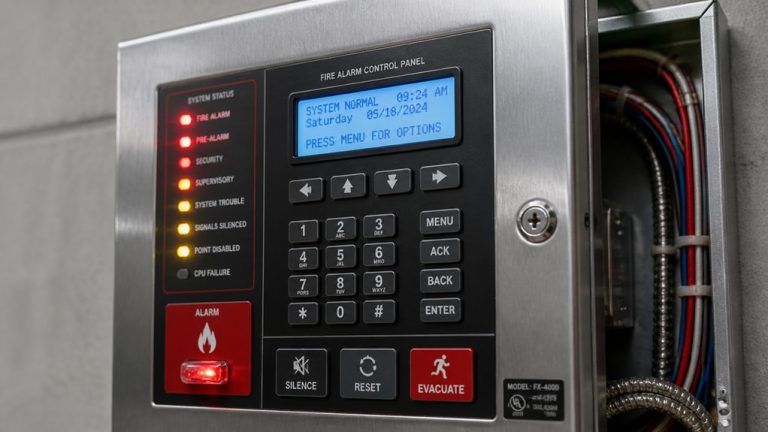
Install the control panel centrally near a stable power source, using secure wiring methods and proper power backups.
Wire devices following polarity and circuit requirements, then perform thorough testing for continuity and faults.
Keep your installation compliant and reliable. The next steps cover detailed procedures to optimize your system setup.
Key Takeaways
- Plan detector, manual call point, and alarm device placement for full building coverage and centralized, accessible control panel location.
- Use fire-rated cables per manufacturer specs, with shielded or twisted-pair types in interference-prone areas to ensure signal integrity.
- Install control panel near a reliable power source with dedicated 230V AC supply and battery backup for uninterrupted operation.
- Wire addressable systems as single loops with correct polarity and unique device addresses; conventional systems require zoned circuits.
- Test wiring for continuity, secure terminations, and correct polarity; protect cables with conduits and maintain regular inspections per standards.
Plan Your Fire Alarm Wiring Layout for Full Coverage
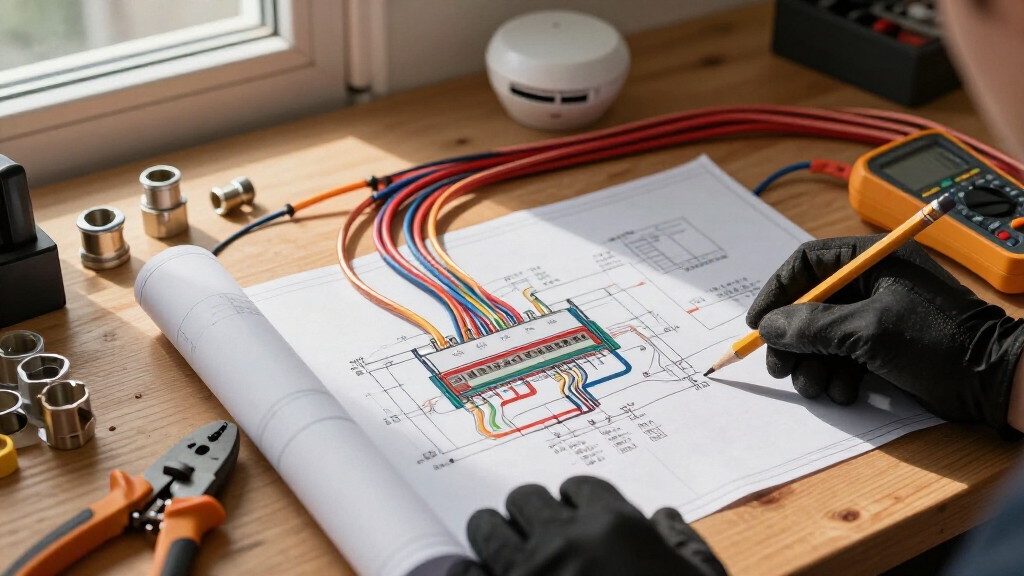
When planning your fire alarm wiring layout, start with a reviewed floor plan that clearly marks all detectors, manual call points, and alarm devices to guarantee all-encompassing coverage and minimize installation errors.
Position the control panel centrally, making certain it’s secure, accessible, and near a reliable power source for maintenance.
Carefully map your wiring routes in advance to maintain organized circuits and ensure compliance with relevant codes.
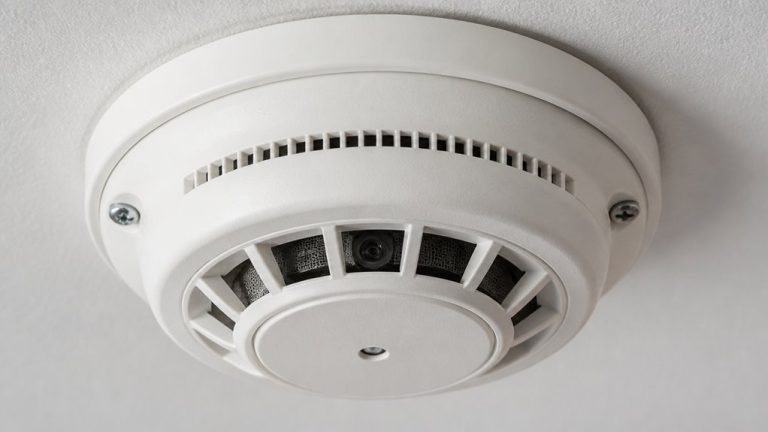
Account for the full building’s coverage by placing smoke detectors, heat detectors, manual call points, sirens, and strobes strategically.
Tailor your layout to the system type, whether conventional or addressable, since each requires different circuit topologies.
This methodical approach prevents wiring mistakes and supports efficient installation, operation, and future servicing of your fire alarm system.
Regular inspection schedules should be integrated into the maintenance plan to ensure ongoing system reliability and compliance.
Choose the Right Fire Alarm Cable and Components
After establishing a detailed layout for your fire alarm system, selecting appropriate cables and components guarantees reliable performance and compliance.
Careful selection of cables and components ensures your fire alarm system performs reliably and meets all compliance standards.
Choose fire-rated cables, typically 16- or 18-gauge, per your panel manufacturer’s specifications and local codes.
Use shielded or twisted-pair cables in areas with electromagnetic interference to maintain signal integrity.
Confirm cable conductor counts match your system type. Addressable loops require specific wiring, while mains interlinked alarms need Live, Neutral, Earth, plus interconnect conductors.
Components must meet recognized standards and support your circuit topology.
Make certain cable jackets and insulation withstand fire and mechanical stresses.
Maintain separation from high-voltage wiring to avoid interference and hazards.
Secure cables with clamps and allow slack to prevent tension damage.
Following these precise selections reduces faults, eases installation, and supports long-term system reliability.
Always turn off the breaker and verify power absence with a voltage detector before working on fire alarm wiring to ensure safety.
Install the Fire Alarm Control Panel and Power Supply Safely
Position the fire alarm control panel in a central, secure location close to a reliable power source to facilitate maintenance and guarantee uninterrupted operation. Connect the panel to a dedicated, permanent 230V AC supply. Ensure the circuit is isolated before installation to eliminate electrical hazards.
Install a battery backup within the control panel to maintain system functionality during power outages. Use fire-rated cable compliant with manufacturer specifications and local codes for all power connections. Route wiring through conduit or cable trays to protect against physical damage.
Avoid proximity to high-voltage lines to prevent interference. Secure cables with appropriate clamps, leaving slack to prevent strain or overheating. Finally, verify supply stability and perform continuity checks before finalizing connections to guarantee safe and reliable panel operation. Always verify stable AC and battery voltage to ensure proper power supply before proceeding with installation.
Wire Addressable and Conventional Fire Alarm Systems Correctly
Understand that wiring addressable and conventional fire alarm systems requires distinct approaches due to their differing circuit topologies. Addressable systems use a single loop carrying both power and data, connecting each device sequentially.
Conventional systems employ separate circuits, often wired in series or parallel, organizing devices by zones.
When wiring these systems correctly, follow these steps:
- For addressable loops, maintain correct polarity and continuity. Guarantee each device’s address is unique and readable by the control panel.
- In conventional setups, segregate zones and verify each circuit’s integrity. Avoid cross-connections between devices.
- Use manufacturer-specified cable types and secure wiring to prevent interference or damage. Adhere strictly to labeling and terminal instructions.
This methodical approach guarantees system reliability and compliance with safety standards. Addressable systems use digital binary communication over loop wiring to provide real-time device status and diagnostics.
Test and Protect Your Fire Alarm Wiring Installation
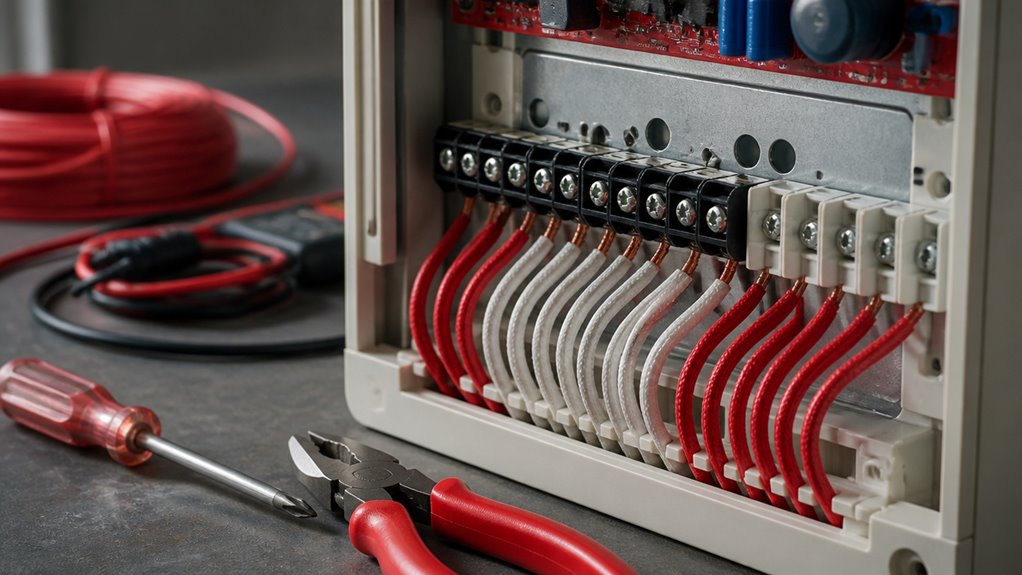
Making certain the integrity of your fire alarm wiring installation starts with thorough testing and protective measures. You need to verify secure terminations, correct polarity, and absence of loose connections.
Use continuity testers and measure voltage drop to confirm circuit integrity. Protect wiring by routing through conduits or trays and maintain separation from high-voltage cables to reduce interference and damage risk.
| Test Element | Method | Purpose |
|---|---|---|
| Continuity | Multimeter continuity test | Detect open or short circuits |
| Voltage Drop | Voltage measurement | Ensure power delivery to devices |
| Control Panel Faults | Panel diagnostics | Identify wiring or device errors |
Regular inspection and compliance with standards like NFPA 72 ensure your system functions reliably under all conditions. It is also essential to follow manufacturer wiring instructions carefully to maintain safety and functionality throughout the installation.
Frequently Asked Questions
How Often Should Fire Alarm Wiring Be Inspected After Installation?
You should inspect fire alarm wiring at least annuallylyto ensure system integrity and compliance with standards.
After installation, perform thorough testing and visual checks for loose connections, damage, or corrosion.
Regular inspections help identify faults like voltage drops or interference early.
In high-risk or code-mandated environments, more frequent inspections might be necessary.
Always follow local regulations and manufacturer recommendations to maintain reliable operation and safety.
Can Fire Alarm Wiring Be Extended Beyond the Recommended Maximum Circuit Length?
You shouldn’t extend fire alarm wiring beyond the recommended maximum circuit length of 6,000 feet, as Honeywell’s guidance specifies to avoid voltage drops exceeding 6.0 V.
Extending beyond this limit risks signal degradation and unreliable device operation.
If you need longer runs, consider using additional power supplies, loop extenders, or separate circuits to maintain system integrity, comply with standards, and ensure prompt, accurate alarm responses throughout the building.
What Are the Common Signs of Fire Alarm Wiring Faults to Watch For?
You’ll notice common signs of fire alarm wiring faults like intermittent or no response from devices, frequent false alarms, and fault indicator lights on the control panel.
Also watch for inconsistent signal strength, damaged or loose wiring connections, and unexpected voltage drops.
If detectors or call points fail to register or alarms don’t sound uniformly, it often signals wiring issues needing immediate inspection and correction to maintain system reliability.
Is It Necessary to Use Shielded Cable in Residential Fire Alarm Systems?
You don’t always need shielded cable in residential fire alarm systems, but it can be essential if you face significant electromagnetic interference (EMI).
While unshielded cables often suffice in typical homes, shielded or twisted-pair cables protect signal integrity in environments with high EMI, like near heavy machinery or complex wiring.
Always check your panel manufacturer’s instructions and local codes to decide.
Using the right cable guarantees reliable alarm performance and compliance.
How Do Environmental Conditions Affect Fire Alarm Cable Lifespan?
Environmental conditions, like temperature extremes, moisture, and exposure to chemicals, directly shorten your fire alarm cable lifespan.
High heat can degrade insulation, while moisture leads to corrosion and electrical faults.
UV exposure breaks down cable jackets outdoors.
You must select cables rated for specific conditions: fire-rated, moisture-resistant, or UV-protected.
Install them with proper shielding or conduit.
Regular inspection guarantees early detection of environmental damage to maintain system reliability.
Use Proper Cables, Circuits, and Backup Power
By following this guide, you’ll have your fire alarm wiring planned and installed with precision, leaving no stone unturned.
Choosing the right cables and components secures reliability, while correct wiring of control panels, whether addressable or conventional, guarantees system integrity.
Always test thoroughly and protect your installation from damage.
Taking these steps methodically will keep your system running smoothly, giving you peace of mind that your safety measures are rock solid.