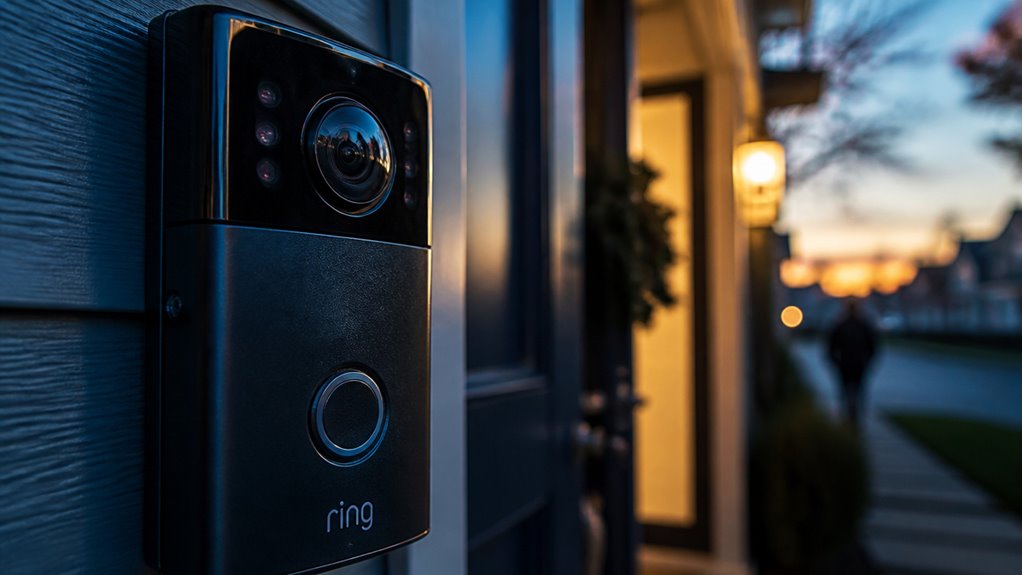

You benefit from Ring cameras’ layered security, including device-side end-to-end encryption on select models and Transport Layer Security for data in transit.
Mandatory two-factor authentication and Captcha safeguards protect your account from unauthorized access. Regular firmware updates enhance detection algorithms and patch vulnerabilities.
Subscription plans extend cloud storage and enable advanced AI features while privacy controls limit data exposure. However, battery-powered models lack full encryption, and legacy devices pose some risks.
Exploring these details reveals how Ring balances functionality with security.
Key Takeaways
- Ring cameras use end-to-end encryption on certain hard-wired models, but battery-powered devices lack this feature, affecting security levels.
- Data in transit is protected by Transport Layer Security (TLS), ensuring encrypted communication between devices and cloud storage.
- Two-factor authentication (2FA) and CAPTCHA challenges prevent unauthorized account access and reduce automated attack risks.
- Regular firmware updates improve security by patching vulnerabilities and enhancing motion detection accuracy.
- Privacy controls and adjustable video retention limits help users manage data exposure and sharing with law enforcement or neighbors.
What You Get With Ring Protect Subscription Plans?
When you sign up for a Ring Protect subscription, you gain access to cloud video storage that keeps your footage for up to 180 days. This allows you to review incidents long after they occur.
With a Ring Protect subscription, your footage is securely stored in the cloud for up to 180 days, enabling thorough incident review.
Without a subscription, live view and real-time alerts are available, but recorded footage isn’t saved, limiting post-event analysis.
The Home Basic plan costs $4.99 monthly and enables cloud recording for one camera. The Standard plan at $9.99 monthly covers unlimited devices at one location, providing extensive coverage.
Additionally, photo snapshots extend beyond the default 7-day retention when subscribed. These subscription tiers offer scalable solutions tailored to your monitoring needs.
This ensures you retain vital video evidence with precise retention periods and flexible device support.
For enhanced protection, higher-tier subscriptions also include cellular backup to maintain connectivity during internet outages.
How Ring Cameras Protect Your Video Data With Encryption?
Beyond subscription benefits that extend your video retention, Ring employs robust encryption methods to secure your video data.
Most Ring cameras support end-to-end encryption (E2EE), ensuring that video streams are encrypted on your device before transmission and remain encrypted until you decrypt them.
This means neither Ring, Amazon, nor potential hackers can access your footage without physical access to your camera and your encryption keys.
However, E2EE is limited to certain hard-wired models, excluding older and battery-powered devices.
In transit, Ring uses Transport Layer Security (TLS) protocols to safeguard data from interception.
This layered encryption approach protects your videos both at rest in the cloud and during transmission.
It reduces the risk of unauthorized access and helps maintain your privacy and data integrity.
Regular firmware updates and strong access controls are essential to mitigate vulnerabilities and enhance overall security with Ring cameras, following best patch management practices.
How Two-Factor Authentication and Captcha Strengthen Your Account?
Although robust encryption safeguards your video data, your Ring account remains vulnerable without additional layers of protection.
Two-factor authentication (2FA) adds a critical security barrier, requiring you to enter a time-sensitive code sent via text or generated by an authenticator app after submitting your password.
Two-factor authentication strengthens security by requiring a time-sensitive code after your password entry.
This process markedly reduces the risk of unauthorized access, even if your password is compromised.
Additionally, Ring employs Captcha challenges in both its app and Neighbors platform to differentiate human users from automated bots attempting credential stuffing or brute-force attacks.
By combining 2FA and Captcha, Ring enforces multi-dimensional defenses that address both credential theft and automated intrusion attempts.
These mechanisms are mandatory and seamlessly integrated within the Control Center for user convenience.
For comprehensive home security, consider that video monitoring requires separate cameras since devices like First Alert smoke detectors do not include built-in cameras.
Common Ring Camera Security Flaws and Amazon’s Fixes
You might’ve heard about some risks with earlier Ring models, especially when it comes to account takeovers and insecure data transmission. It’s definitely concerning!
But the good news is that Amazon has stepped up their game. They’ve introduced mandatory two-factor authentication, which adds an extra layer of security, and they’ve also put a stop to sharing data with third parties. Additionally, Ring’s system benefits from dual-path communication via Wi‑Fi and cellular to maintain reliable operation even during outages.
Account Takeover Vulnerabilities
When attackers exploit Ring’s account takeover vulnerabilities, they gain unauthorized access to your camera feeds and personal data, posing serious security risks.
These vulnerabilities often stem from weak password policies, phishing, or insufficient multi-factor authentication enforcement in earlier versions.
Amazon has mandated two-factor authentication (2FA) for all users, markedly reducing risk by requiring a secondary verification step via SMS or authenticator apps.
Additionally, introducing CAPTCHA mechanisms in login attempts blocks automated bot attacks targeting your credentials.
Despite these safeguards, legacy accounts without updated security settings remain susceptible.
Amazon continues to patch identified flaws and improve encryption protocols, but you must actively enable 2FA and monitor login activity to prevent unauthorized access.
Staying vigilant and maintaining strong, unique credentials remains essential to securing your Ring account from takeover attempts.
Implementing account security best practices, including strong passwords and two-factor authentication, is critical to reducing the risk of unauthorized access.
Data Transmission Concerns
Beyond account takeover vulnerabilities, data transmission practices have raised significant security and privacy concerns for Ring users.
You should know that Ring’s Android app once transmitted personal data to third-party services, including Facebook. Amazon halted this data sharing after disclosures, but the incident highlighted gaps in secure data handling.
When your camera streams video, it relies on encrypted channels. Yet some older models lacked end-to-end encryption, exposing data in transit to interception risks.
| Transmission Aspect | Risk Level | Amazon’s Response |
|---|---|---|
| Third-party data | High | Suspended sharing |
| Encryption standard | Moderate | Rolling out end-to-end encryption |
| Legacy device support | Moderate to High | Phasing out unsupported models |
You must stay updated on firmware to benefit from ongoing fixes. Additionally, ensuring your system operates on a secure Wi‑Fi network is critical to prevent interception and unauthorized access during data transmission.
Security Protocol Enhancements
Although Ring cameras initially faced significant security flaws, Amazon has actively implemented protocol enhancements to mitigate these vulnerabilities.
You now benefit from mandatory two-factor authentication (2FA), which significantly reduces account takeover risks.
End-to-end encryption, available on most devices, guarantees video data remains inaccessible to unauthorized parties, including Amazon itself.
Additionally, Captcha integration blocks automated bot attacks on login interfaces.
Amazon also addressed third-party data sharing concerns by suspending such practices, enhancing user privacy.
Privacy controls now let you define exclusion zones, reducing unnecessary data exposure.
Furthermore, video retention policies are configurable, enabling you to limit stored footage duration.
These targeted protocol upgrades demonstrate Amazon’s commitment to reinforcing Ring camera security, although some legacy devices still lack full protection and require cautious use.
It is important to note that Ring cameras require WiFi for remote viewing and cloud storage features, meaning offline operation limits some smart functionalities.
Ring Privacy Controls and Police Video Requests
Since law enforcement agencies may request access to your Ring video footage without a warrant depending on local laws, you need to manage these requests carefully through the Ring app settings.
You can control which footage is shared and limit access duration, reducing your privacy risks. Privacy zones let you exclude sensitive areas from recording. You can also shorten video storage from 180 to 1 day to minimize data exposure.
Cameras often use custom detection zones to focus monitoring on critical areas, which can help reduce unnecessary recording and sharing of irrelevant footage.
| Feature | Description |
|---|---|
| Law Enforcement Access | Controlled via app; varies by jurisdiction |
| Privacy Zones | Customizable exclusion areas to protect sensitive spots |
| Video Storage Duration | Adjustable from 1 to 180 days |
| Search Party Sharing | Opt-in/out sharing with neighbors |
You must proactively configure these controls to balance security with privacy.
False Alarms and Their Impact on Ring Camera Security
You know, false alarms can be quite a hassle. They often come from everyday things like passing cars or animals. This makes it tricky to figure out what’s a real threat and what’s just background noise.
When you get these alerts all the time, it can start to desensitize you. Before you know it, you’re just ignoring the notifications, which really cuts down on the effectiveness of your Ring camera security.
To keep things reliable, it’s important to fine-tune your motion settings. And if you have a Ring Protect plan, don’t forget to make use of those AI features. They can really help reduce those unnecessary notifications and keep you focused on what matters.
Adjusting your Motion Zones and sensitivity regularly helps optimize detection accuracy and minimize false alerts.
Causes Of False Alarms
When your Ring camera sends frequent motion alerts, false alarms often cause this issue by detecting non-threatening events such as passing cars, animals, or environmental factors.
These false positives arise from the camera’s sensitivity settings and the limitations of its motion detection algorithms. You must understand these triggers to fine-tune your system effectively.
Common causes include:
Movement of small animals like squirrels or birds
Passing vehicles triggering motion zones near streets
Shadows or light reflections caused by trees or clouds
Environmental changes such as wind-blown foliage
Inadequate adjustment of motion sensitivity and detection zones
Advanced AI smart detection technology, like that used in some security cameras, can help reduce false alarms by distinguishing between humans, pets, and vehicles using local AI processing.
Effects On Security
Frequent false alarms directly undermine the reliability of your Ring camera system by desensitizing your response to alerts.
When you receive numerous non-threatening notifications, you’re more likely to ignore or delay response to genuine security breaches.
This reduces the overall effectiveness of your surveillance and increases vulnerability.
The table below highlights the core impacts of false alarms on your system’s security:
| Impact Area | Effect Description |
|---|---|
| Alert Fatigue | Leads to ignoring or dismissing alerts |
| Resource Drain | Wastes time verifying benign events |
| Security Gaps | Genuine threats may be overlooked |
Understanding these effects is essential to maintain the practical security value of your Ring cameras despite inherent motion detection limitations.
Reducing False Alerts
Although false alerts pose a significant challenge, you can implement specific strategies to reduce their frequency and improve your Ring camera’s reliability. False alarms degrade system trust and may cause you to miss genuine security events.
To enhance accuracy, consider these technical adjustments:
Customize motion zones to exclude high-traffic non-threat areas.
Adjust motion sensitivity to balance detection and false positives.
Use the Ring Protect plan to enable AI features like Familiar Faces.
Schedule motion detection during critical hours to limit unnecessary alerts.
Regularly update firmware for improved detection algorithms.
Security Feature Differences Among Ring Camera Models
Since Ring offers a range of camera models, understanding their security feature differences is essential for selecting the right device for your needs.
Most hard-wired Ring cameras support end-to-end encryption, ensuring video data remains inaccessible without physical device access. However, battery-powered models lack this encryption, which may affect your security posture.
All cameras provide 1080p HD video, color night vision, and two-way audio, but models like the Ring Indoor Cam Plus deliver superior 2K resolution.
Subscription plans enable advanced AI features and extended cloud storage, which you’ll need to evaluate for thorough security.
The Floodlight Cam Pro (2nd Gen) offers robust area coverage with enhanced hardware.
Evaluating these differences helps you balance security capabilities with your deployment environment and threat model.
Frequently Asked Questions
How Long Do Ring Cameras Store Video Footage Without a Subscription?
Without a subscription, Ring cameras don’t store video footage at all.
You’ll only get live view and real-time alerts.
Photo snapshots, however, are saved for up to 7 days without a subscription.
To access recorded video footage, you need a Ring Protect plan that enables cloud storage for up to 180 days.
If you want to review past events, subscribing is essential since non-subscribers lose recorded video access entirely.
Can I Customize Motion Detection Zones on My Ring Camera?
You can paint your camera’s view with precision by customizing motion detection zones. This lets you exclude areas where motion is irrelevant, like busy streets or swaying trees, turning your Ring camera into a vigilant sentinel focused on what truly matters.
Using the app, you draw exclusion zones, optimizing sensitivity and reducing false alarms. This technical control sharpens your system’s accuracy, ensuring alerts trigger only on meaningful activity within your defined boundaries.
Which Ring Camera Models Offer the Highest Video Resolution?
You’ll find the highest video resolution in the Ring Indoor Cam Plus, which delivers Retinal 2K resolution, offering superior indoor monitoring clarity.
For outdoor use, the Ring Outdoor Cam Plus provides excellent 1080p HD resolution with color night vision, but it’s not quite as sharp as the Indoor Cam Plus.
All other Ring cameras generally offer at least 1080p HD, but none match the Indoor Cam Plus’s advanced 2K imaging quality.
Are Battery-Powered Ring Cameras Compatible With End-To-End Encryption?
You won’t find end-to-end encryption wrapped around battery-powered Ring cameras like a fortress. This advanced security layer is reserved for hard-wired models, leaving your wireless devices without that airtight protection.
While your battery-powered camera delivers crisp 1080p HD video and smart alerts, it lacks the encryption that prevents unauthorized access to footage.
What Are the Monthly Costs for Different Ring Protect Plans?
You’ll pay $4.99 per month for the Ring Home Basic plan, which covers cloud recording for one camera.
If you want to protect multiple devices at one location, the Ring Protect Standard plan costs $9.99 monthly and offers unlimited device coverage with extended cloud video storage.
Both plans enable recorded footage saving, while live view and alerts remain accessible without a subscription.
Choose based on the number of cameras you manage.
Final Thoughts: Are Ring Cameras Secure Today?
When you choose a Ring camera, you’re stepping into a network where encryption, two-factor authentication, and privacy controls intersect like tightly woven threads.
While occasional flaws and false alarms appear, Amazon’s ongoing fixes and subscription plans strengthen your defenses.
Just as overlapping security layers create a robust shield, your vigilance combined with Ring’s evolving technology forms a dynamic barrier.
This keeps your video data secure and your peace of mind intact.