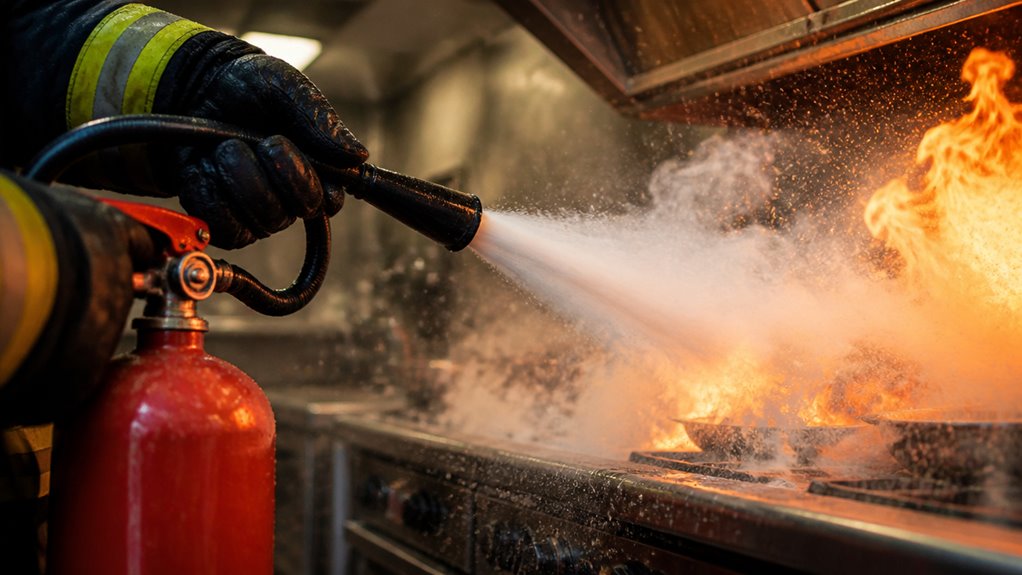

You extinguish the majority of fires by using water cooling, which effectively removes heat by absorbing thermal energy and vaporizing.
This method targets the fire’s heat element, lowering temperature below ignition points. It is ideal for ordinary combustibles like wood and paper.
Water is abundant, non-toxic, and offers sustained cooling to prevent re-ignition.
While smothering and chemical inhibitors are vital for specific fires, mastering water cooling gives you a solid foundation for safe, efficient fire suppression.
Key Takeaways
- Most fires are extinguished by removing heat through water cooling, effectively lowering temperature below ignition points.
- Smothering fires by cutting off oxygen supply with foam, CO2, or wet chemicals is a common and effective method.
- Portable fire extinguishers using the P.A.S.S. technique successfully control small fires by targeting fire’s base and breaking combustion.
- Fuel removal or isolation is crucial to starve and prevent fire spread, often combined with thorough extinguishment to avoid re-ignition.
- Multi-purpose dry chemical extinguishers interrupt chemical reactions, making them widely used for rapid suppression in various fire classes.
How to Choose the Right Fire Extinguishing Method?
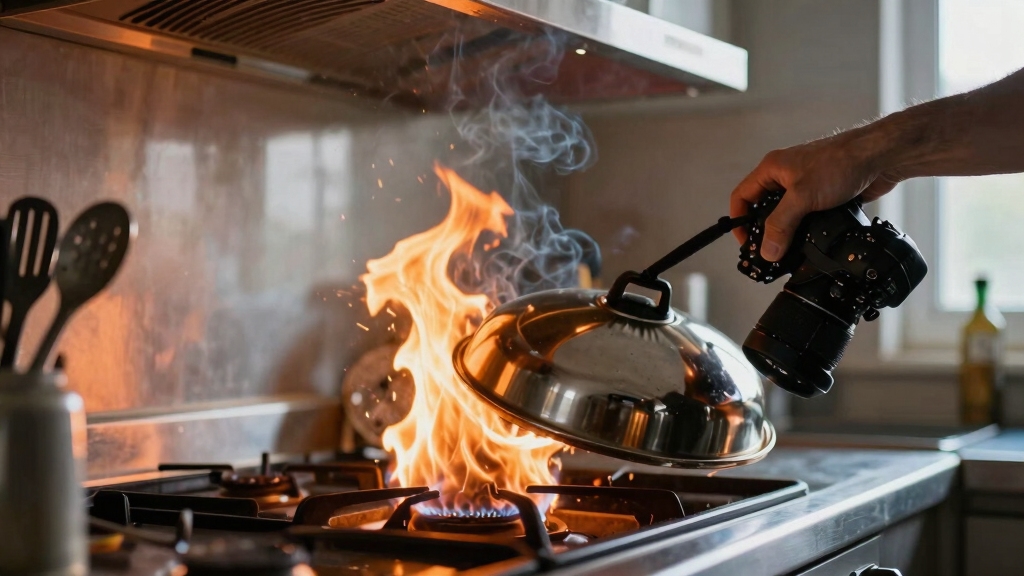
When selecting the right fire extinguishing method, you must first identify the fire’s class and fuel source. This determines the most effective suppression approach.
Class A fires involve ordinary combustibles like wood and paper. These are best extinguished by cooling with water to remove heat.
For flammable liquids (Class B), smothering with foam or CO2 to cut off oxygen is essential. Electrical fires (Class C) require non-conductive agents such as CO2 or dry chemical to prevent shock hazards while interrupting combustion.
Combustible metals (Class D) need specialized dry powders that inhibit chemical reactions. Matching the extinguishing agent to the fire type guarantees safe, efficient suppression and prevents escalation.
You must also consider environmental and safety factors when choosing your method. Using the PASS technique correctly enhances extinguisher effectiveness and user safety.
Why Water Cooling Is the Most Effective Fire Suppression Method?
After determining the appropriate extinguishing method based on fire class, it’s important to recognize why water cooling remains the dominant choice for most fires.
Water’s unparalleled heat absorption capacity allows it to remove the thermal energy sustaining combustion rapidly. As water vaporizes upon contact, it absorbs significant heat—up to 2,260 kJ/kg—effectively lowering temperatures below ignition points.
This phase change also expands water into steam, displacing oxygen locally and further inhibiting fire propagation. Particularly for Class A fires involving wood or paper, water’s cooling mechanism directly addresses the core combustion requirement: heat.
Its abundance, affordability, and non-toxic nature make it universally applicable and efficient. By targeting the heat element in the fire tetrahedron, water cooling guarantees rapid suppression, preventing re-ignition and minimizing fire damage with proven reliability across diverse fire scenarios.
Additionally, water’s high specific heat capacity enables efficient heat removal from fuel, ensuring sustained cooling throughout the extinguishing process and enhancing its overall effectiveness in fire suppression. high specific heat capacity
How Smothering Cuts Off Oxygen to Stop Fires?
By isolating the fire from its oxygen supply, smothering rapidly halts combustion. When you apply smothering, you effectively interrupt the fire triangle’s oxygen leg, preventing the chemical reactions sustaining the flame.
You can achieve this by covering the fire with materials such as foam, wet blankets, or a lid, which create an airtight barrier. Carbon dioxide extinguishers work similarly, displacing oxygen with inert gas to suffocate flames without residue. This makes them ideal for electrical fires.
Aqueous film-forming foam forms a sealing blanket, excluding oxygen and suppressing vapor release. In kitchens, smothering is the primary method because it quickly cuts off oxygen without spreading flames.
How Removing Fuel Helps Stop Fires?
Removing fuel effectively starves a fire, cutting off the essential material it needs to sustain combustion.
You stop the fire’s progress by eliminating or isolating combustible materials, halting the chemical reaction at its source.
This method is vital in wildfires, structural fires, and controlled burns.
For example, fire lines remove vegetation, preventing flames from advancing.
Fires can still reignite if residual heat and smoldering embers remain after fuel removal, so thorough extinguishment is crucial.
| Method | Description |
|---|---|
| Fuel Removal | Physically taking away solid or liquid fuel |
| Fuel Isolation | Creating barriers to separate fuel from fire |
| Fuel Supply Shutdown | Stopping flow of gaseous or liquid fuels |
How Chemical Inhibitors Interrupt Fire Reactions?
You can actually stop fires at the molecular level by interrupting the combustion chain reaction. Pretty interesting, right? Chemical inhibitors come into play here; they specifically target free radicals. These are those highly reactive atoms that keep flames going strong. By neutralizing them, the inhibitors effectively halt the fire’s propagation.
Understanding how this mechanism works is crucial. It gives you insight into why certain agents, like dry chemicals and halons, are so effective at extinguishing fires. Halon extinguishers work by chemically disrupting free radicals, which is why they are especially effective on electrical fires and in sensitive environments due to their clean-agent properties. So, the next time you think about fire safety, remember that it all starts at that tiny molecular level!
Breaking Combustion Chain
Although extinguishing fires often relies on cooling or smothering, chemical inhibitors play an essential role by interrupting the combustion chain reaction.
You use dry chemical agents and halogenated compounds to disrupt the propagation of free radicals, halting flaming combustion rapidly. These inhibitors chemically bond with reactive species, effectively breaking the reaction cycle.
For example, wet chemical extinguishers saponify burning oils, creating a foam that excludes oxygen and cools simultaneously. Understanding each agent’s mechanism optimizes fire suppression strategies.
Chemical inhibitors are particularly valuable when removing heat or oxygen is not feasible, allowing for rapid and effective fire suppression by interrupting the chemical chain reaction.
| Inhibitor Type | Mechanism of Action |
|---|---|
| Dry Chemical | Interrupts free radical propagation |
| Halogenated Agents | Bonds with reactive radicals |
| Wet Chemical | Saponification and foam formation |
| Class D Dry Powder | Forms crust to block oxygen |
| Sound Waves (Low Hz) | Displaces oxygen physically |
Role of Free Radicals
Free radicals drive the rapid chain reactions sustaining combustion by continuously generating new reactive species.
When you apply chemical inhibitors, such as dry chemicals or halogenated agents, they target these free radicals directly.
These inhibitors either suspend or bond with free radicals, disrupting the propagation phase of the combustion reaction.
This interruption prevents the formation of additional radicals, effectively halting the self-sustaining reaction.
For instance, halons chemically neutralize radicals like H· and OH·, which are essential for flame propagation.
Similarly, Class D dry powders form a crust that isolates fuel and chemically interferes with reactions.
By breaking this chain at the molecular level, chemical inhibitors extinguish flames without relying on cooling or oxygen deprivation.
This makes them highly effective in specialized fire scenarios.
Dry chemical powders, such as monoammonium phosphate, are especially effective because they scavenge free radicals to weaken flame propagation.
How to Use Portable Fire Extinguishers for Best Results?
To effectively use a portable fire extinguisher, you’ll want to remember the P.A.S.S. technique.
First, pull the pin. This is a crucial step, as it allows you to use the extinguisher.
Next, aim at the base of the fire. This part is really important because you need to target the source of the flames to put them out.
Once you’ve aimed, squeeze the handle. This action releases the extinguishing agent, which starts to do its job.
Finally, make sure to sweep side-to-side. This sweeping motion helps ensure that you cover the entire area and prevents the fire from reigniting.
Always position yourself with a clear exit behind you to ensure a quick escape if necessary.
Proper P.A.S.S. Technique
Mastering the P.A.S.S. technique guarantees you use a portable fire extinguisher effectively and safely. Follow its four steps precisely to maximize your success rate in extinguishing fires.
First, pull the pin to release the extinguisher. Next, aim at the fire’s base to target the fuel source. Then, squeeze the handle firmly to discharge the agent. Finally, sweep the nozzle side-to-side, covering the fire area evenly until it’s fully extinguished.
| Step | Action Description |
|---|---|
| Pull | Remove safety pin |
| Aim | Point at fire base |
| Squeeze | Press handle to release agent |
| Sweep | Move nozzle side-to-side |
| Repeat | Continue until fire is out |
Executing P.A.S.S. precisely guarantees rapid, controlled fire suppression. Always ensure you position yourself with a clear exit behind you for safe escape while using the extinguisher.
Target Fire Base
Aim your extinguisher directly at the fire’s base, the source of the flames, since targeting this area interrupts the combustion process most effectively.
The base contains the fuel, heat, and oxygen interacting to sustain the fire.
By directing the extinguishing agent here, you disrupt this interaction, cooling the fuel, smothering oxygen, or breaking the chemical reaction depending on the extinguisher type.
Avoid spraying above the flames, which wastes agent and reduces effectiveness.
Maintain a steady, controlled stream, ensuring the extinguishing material fully penetrates the fuel source.
Position yourself at a safe distance, adjusting as the fire diminishes to maintain contact with the base.
Correct targeting maximizes agent efficiency, increases extinguishment speed, and reduces fire spread.
This ensures you use portable extinguishers to their full potential.
ABC fire extinguishers utilize a multi-purpose dry chemical that coats and interrupts the fire’s chemical reactions effectively.
Sweep Side-To-Side
Sweep the extinguisher’s nozzle side-to-side across the fire’s base to cover the entire fuel source evenly. This motion guarantees the agent suppresses all flames and prevents reignition.
Maintain a steady, controlled sweep, moving slowly to maximize coverage while avoiding gaps. Position yourself upwind and keep a safe distance, adjusting as the fire diminishes.
| Step | Description |
|---|---|
| Aim | Direct nozzle at fire base |
| Sweep Motion | Side-to-side, full coverage |
| Distance | Maintain 6-8 feet initially |
| Control Speed | Slow, deliberate sweeps |
Mastering this technique optimizes extinguisher efficiency. It increases the 93% success rate of portable extinguishers in controlling small fires swiftly and safely. Effective use targets a critical fire-triangle point, breaking the combustion cycle early.
Frequently Asked Questions
What Percentage of Fires Require Professional Firefighting Intervention?
Only about 7% of fires require professional firefighting intervention.
You’ll find that 93% of fires are successfully extinguished using portable fire extinguishers before they escalate.
This high success rate reflects improved extinguisher technology and user training.
When you respond quickly and use the proper technique, you often prevent the fire from spreading, reducing the need for firefighters to get involved.
Always act fast and follow safety protocols to control fires early.
How Often Should Fire Extinguishers Be Inspected and Maintained?
You must inspect fire extinguishers monthly to make certain they’re fully charged, accessible, and undamaged.
Additionally, schedule a thorough maintenance check by a professional annually, including internal examination, pressure testing, and refilling if needed.
Neglecting these intervals risks malfunction during emergencies.
Remember, proper upkeep makes certain your extinguisher performs reliably when seconds count.
Keep records of all inspections and maintenance to comply with safety standards and regulations.
Can Fire Suppression Methods Damage Electronics or Sensitive Equipment?
Yes, fire suppression methods can damage electronics or sensitive equipment.
Water-based suppression risks short-circuiting and corrosion.
Dry chemical agents leave residues that may harm components and require thorough cleanup.
CO2 extinguishers are safer for electronics, as they displace oxygen without residue, minimizing damage.
For sensitive environments, clean agent systems like halon alternatives or inert gases provide effective fire suppression while protecting equipment integrity.
Always choose suppression based on the specific risks involved.
What Are the Environmental Impacts of Various Fire Extinguishing Agents?
Like Prometheus taming fire, you must wield extinguishing agents wisely.
Water, though abundant and non-toxic, can cause runoff pollution and soil erosion.
Chemical powders may leave harmful residues, impacting ecosystems and requiring careful disposal.
Halogenated agents, once popular, deplete ozone and contribute to greenhouse gases.
Foam agents risk contaminating waterways with fluorinated compounds.
You should balance extinguishing effectiveness with environmental stewardship, choosing agents that minimize lasting ecological harm.
Are There Fire Extinguishing Methods Suitable for Wildland or Forest Fires?
Yes, you can use fire extinguishing methods designed specifically for wildland or forest fires.
You’ll rely mainly on fuel removal techniques like creating fire lines by raking or digging to separate combustible material from the fire path.
Moistening fuels and backburning are common direct attack strategies.
Chemical inhibitors and water-based methods have limited use due to scale, so controlling fuel and oxygen remains your most effective approach in these environments.
Final Answer: The Majority of Fires Are Extinguished by Which Method
When fighting fires, remember that water cooling is your Excalibur, cutting heat swiftly and effectively.
Smothering and fuel removal work like a well-coordinated chess game, depriving fire of its lifelines.
Chemical inhibitors act as precise disruptors in the fire’s chain reaction.
By understanding these methods and using portable extinguishers correctly, you’ll wield control over flames with confidence and authority.
This ensures safety and minimizes damage every time you act.