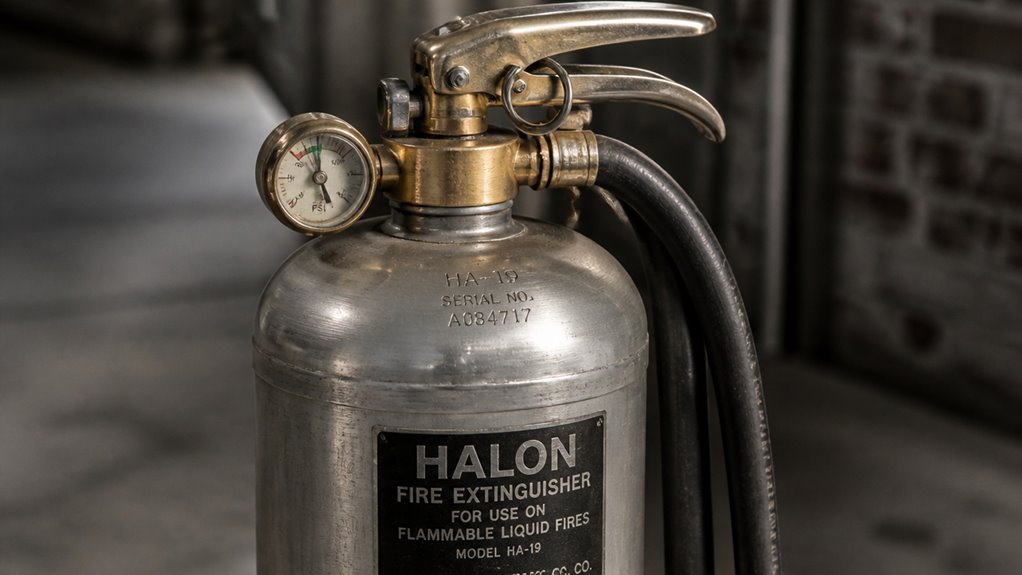

A Halon fire extinguisher uses halogenated compounds to quickly stop fires by chemically interrupting combustion rather than smothering or cooling flames.
You can rely on it especially for electrical fires, as it’s non-conductive and leaves no residue, protecting sensitive equipment.
Halon 1211 suits handheld use for direct flame attack, while Halon 1301 works in fixed systems for total flooding in enclosed spaces.
Understanding their benefits, differences, and environmental impacts is essential for effective and safe application.
Key Takeaways
- A Halon fire extinguisher uses halogenated compounds to chemically interrupt the combustion chain reaction and suppress fires rapidly.
- Halon 1211 is a portable streaming agent designed for direct flame attack, while Halon 1301 is used in fixed total-flooding systems.
- These extinguishers are effective on electrical and flammable liquid fires without leaving residue or damaging sensitive equipment.
- Halon agents are nonconductive, safe on energized electrical equipment, and evaporate quickly after discharge.
- Due to ozone depletion concerns, Halon production is banned, and its use is limited to emergencies with strict recovery and recycling requirements.
Halon Fire Extinguishers: Definition and How They Work
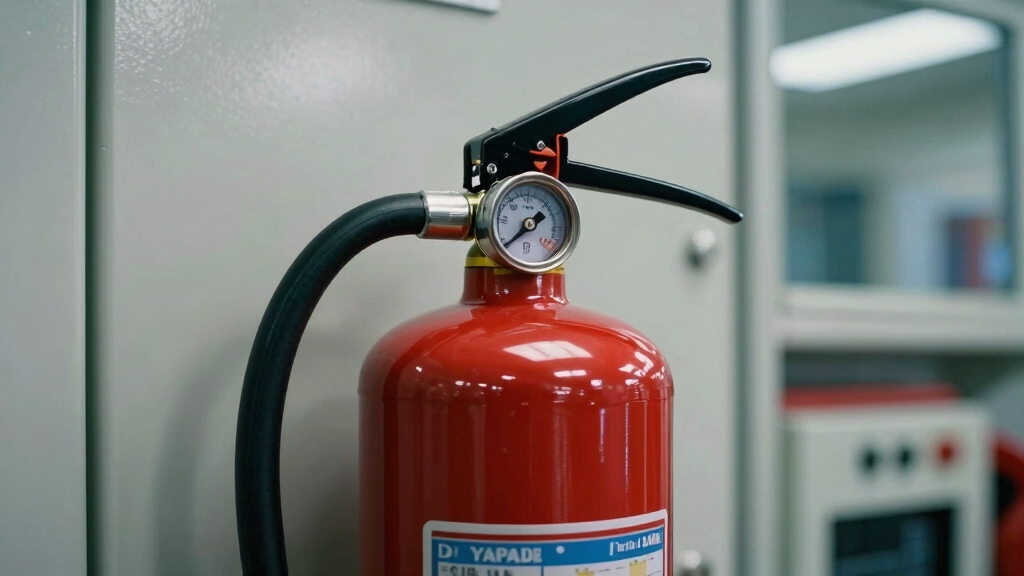
Halon fire extinguishers use halogenated clean-agent compounds designed to suppress fires by interrupting the chemical chain reaction that sustains combustion.
When you activate a halon extinguisher, the agent disperses as a gas, chemically disrupting the free radicals essential for fire propagation.
Unlike other suppressants that cool or smother flames, halon attacks the molecular process of combustion directly.
Halon 1211 typically appears in portable units you handle, while Halon 1301 suits fixed systems for rapid, total flooding in enclosed areas.
You’ll find bromine and chlorine atoms in halon agents, which inhibit combustion effectively at specific concentrations.
To use halon efficiently, you must make certain the agent reaches the fire’s base, maintaining a concentration that halts the chain reaction without relying on oxygen displacement.
Halon systems operate similarly to dry chemical extinguishers by rapidly dispersing agents to interrupt fire chemistry and control flames, providing a powerful edge against fire spread.
Why Halon Fire Extinguishers Are Ideal for Electrical Fires?
When it comes to tackling electrical fires, halon fire extinguishers really shine. Why? Well, first off, their nonconductive agents mean you don’t have to worry about electrical shock hazards while you’re putting out the fire. That’s a huge relief!
Plus, these extinguishers leave no residue behind. So, if you’re dealing with sensitive equipment, you can rest easy knowing it won’t get damaged and there won’t be a huge cleanup afterwards. Isn’t that great?
And let’s not forget about how quickly halon works. Its rapid chemical interruption of combustion helps control electrical fires fast, which means less damage and less downtime for you.
All in all, halon fire extinguishers are a smart choice for anyone looking to protect their electrical systems. They are also ozone-friendly and non-toxic at operational levels, making them safe for both people and the environment.
Nonconductive Fire Suppression
Frequently, electrical fires demand extinguishing agents that won’t conduct electricity or leave harmful residues that could damage sensitive equipment.
Halon fire extinguishers meet these requirements by using halogenated compounds that are electrically nonconductive, ensuring safe application on energized electrical sources.
When you use a halon extinguisher, you interrupt the fire’s chemical chain reaction without relying on oxygen displacement, minimizing the risk of electrical shock or equipment damage.
The agent’s gaseous form disperses rapidly, preventing conductive pathways while leaving no residue that could short-circuit components.
This makes halon ideal for protecting sensitive electronics, computer rooms, and aircraft cockpits.
In environments where maintaining electrical integrity is critical, halon’s nonconductive suppression offers a precise, reliable solution that balances fire control with equipment preservation.
However, it is important to note that halon extinguishers are less effective for fires involving lithium batteries due to thermal runaway reactions that require specialized suppression agents.
Residue-Free Cleanup Advantage
In environments where electrical integrity matters, minimizing cleanup time after fire suppression can save significant downtime and costs. Halon fire extinguishers offer a residue-free cleanup advantage, making them ideal for electrical fires.
Since halon agents evaporate rapidly and leave no solid or liquid residue, you avoid potential damage to sensitive components and extensive cleanup processes.
Key benefits include:
No corrosive or conductive deposits left behind.
Maintains operational readiness of electrical equipment.
Eliminates need for post-fire cleaning or component replacement.
Prevents contamination that could cause malfunctions.
Reduces labor and downtime costs associated with cleanup.
This residue-free characteristic guarantees that once the fire is suppressed, your equipment stays functional and ready for immediate use.
Additionally, halon agents work by chemically interrupting the combustion chain reaction, similar to Purple K’s chemical inhibition method, allowing for rapid fire suppression without relying on cooling.
Rapid Electrical Fire Control
Halon fire extinguishers deliver rapid suppression of electrical fires by chemically interrupting the combustion process without relying on oxygen displacement.
When you face energized electrical equipment fires, halon agents disrupt the fire’s chemical chain reaction, halting flame propagation swiftly.
This mechanism prevents damage to sensitive electronics by avoiding conductive or corrosive residues, making halon ideal for areas with critical electrical assets.
Unlike water or foam, halon’s gaseous form penetrates confined spaces evenly, ensuring thorough suppression.
You’ll appreciate that halon extinguishers leave no residue, evaporate quickly, and maintain electrical non-conductivity, minimizing downtime and cleanup.
However, you must aim accurately at the fire base for peak effectiveness.
Halon’s unique chemical action and clean-agent properties make it a precise, reliable choice for rapid electrical fire control in sensitive environments.
For ongoing readiness, proper inspection and maintenance of halon extinguishers is essential to ensure reliable performance when needed.
Common Uses of Halon Fire Extinguishers in Aircraft and Industry
Although many fire suppression agents exist, halon fire extinguishers remain integral in aircraft and industry due to their rapid, residue-free suppression capabilities. You rely on halon especially where sensitive electronics and confined spaces demand quick fire interruption without damage or cleanup.
In aviation, halon extinguishers protect critical zones, ensuring operational safety and minimizing downtime.
Typical uses include:
- Portable extinguishers in cockpits and cabin areas
- Fixed systems in cargo holds and engine compartments
- Protection of electrical and electronic control rooms
- Safeguarding data centers with residue-free suppression
- Emergency equipment on vessels and industrial plants
Their ability to disrupt the chemical chain reaction makes them highly effective for rapid fire suppression in sensitive environments requiring minimal residue and damage, similar to the benefits seen with water mist fire extinguishers.
Halon 1211 vs. Halon 1301: Key Differences
You’ll mainly find Halon 1211 in portable extinguishers, which makes it super convenient for quick response situations.
On the other hand, Halon 1301 is typically used in fixed systems, designed for more permanent setups.
These two chemicals do have slightly different compositions, and that affects how they behave when discharged.
It’s interesting to note how these differences can influence their application in various environments.
Refilling and servicing Halon extinguishers should always be done by licensed fire protection services to ensure safety and compliance with standards.
Portable Versus Fixed Use
When selecting a fire suppression agent for specific applications, understanding the distinct roles of Halon 1211 and Halon 1301 is essential.
Halon 1211 is designed for portable use, giving you direct, handheld control. Halon 1301 suits fixed systems, flooding enclosed spaces automatically.
You’ll find key operational differences critical to your choice:
Halon 1211 offers a limited discharge range (~4-6 feet) for targeted fire attack.
Halon 1301 rapidly fills enclosed volumes for total flooding suppression.
Portable units require manual aiming at the fire base; fixed systems activate via detection.
Halon 1211 suits vehicle, boat, and equipment protection where mobility matters.
Halon 1301 excels in cargo holds, engine compartments, and sealed hazard zones.
Choosing between them depends on your spatial constraints and suppression strategy.
Both types must be used with proper knowledge of fire classes to ensure effectiveness and safety.
Chemical Composition Differences
Because Halon 1211 and Halon 1301 serve distinct fire suppression roles, their chemical compositions differ fundamentally to optimize performance.
Halon 1211, chemically bromochlorodifluoromethane (CBrClF2), is designed for portable extinguishers. It balances volatility and discharge range to interrupt combustion quickly at the fire’s base.
In contrast, Halon 1301, bromotrifluoromethane (CBrF3), is optimized for fixed total flooding systems. Its higher vapor pressure enables rapid room-filling concentrations.
This composition difference impacts their physical behavior. Halon 1211 discharges as a streaming agent, while Halon 1301 diffuses uniformly as a gaseous blanket.
You’ll find Halon 1211 more effective for direct flame attack. Halon 1301 excels in enclosed spaces needing rapid, even suppression.
Understanding these chemical distinctions helps you select the right agent for specific fire protection applications.
Unlike water, which primarily suppresses fire through steam production and oxygen displacement, Halon agents interrupt combustion chemically rather than thermally.
Key Performance Benefits of Halon Fire Extinguishers
Experience the efficiency of halon fire extinguishers, which deliver rapid flame suppression by chemically disrupting the combustion process rather than relying on oxygen displacement or cooling.
You’ll appreciate that halon agents act quickly, targeting the fire’s chemical chain reaction. This enables fast control of flammable liquid and electrical fires.
Their clean-agent nature means no residue, minimizing cleanup and equipment damage.
Key performance benefits include:
- Electrically non-conductive, safe on energized equipment
- Leaves no residue, preserving sensitive electronics
- Rapid evaporation post-discharge, avoiding lingering effects
- Effective at low concentrations, ensuring minimal agent use
- Suitable for enclosed spaces where concentrations can be maintained
These characteristics provide you with a precise, reliable firefighting tool tailored for critical, sensitive environments. Additionally, like other fire suppression systems, halon extinguishers are designed with pressure relief valves to ensure safe discharge and prevent explosive failures.
Limitations of Halon Fire Extinguishers and Safety Tips for Use
Although halon fire extinguishers offer rapid and clean fire suppression, you should be aware of their operational limitations to use them effectively and safely. Their discharge range is typically limited to 4 to 6 feet, so you must aim accurately at the fire’s base to interrupt the chemical chain reaction.
Keep in mind that halon’s effectiveness decreases in open or poorly enclosed areas where maintaining concentration is difficult. You should also be cautious of potential re-ignition if the fuel source isn’t fully neutralized.
For safety, avoid direct inhalation during discharge and make certain proper ventilation afterward. Regular maintenance and servicing with recapture systems are essential to preserve extinguisher integrity and comply with handling protocols, assuring both operational reliability and user safety.
What You Need to Know About Halon’s Environmental Impact and Regulations?
Understanding the operational limitations of halon fire extinguishers also requires recognizing their environmental consequences and regulatory constraints. Halon compounds contribute notably to ozone layer depletion, prompting stringent international controls. You must comply with regulations that restrict halon production, mandate recovery during servicing, and limit discharge to approved scenarios only. Awareness of these factors is critical for legal and environmental responsibility.
Key points you should know include:
Halon production is largely banned under the Montreal Protocol.
Recovery and recycling during maintenance are mandatory.
Discharge is prohibited except for emergencies or testing under regulation.
Older systems need special servicing equipment for halon capture.
Many industries have shifted to alternative clean agents due to halon’s environmental impact.
Adhering to these guarantees compliance and mitigates ecological damage.
Frequently Asked Questions
How Do I Properly Dispose of a Halon Fire Extinguisher?
You need to contact a certified halon recovery specialist or hazardous waste facility to properly dispose of your halon fire extinguisher.
Don’t release halon gas into the atmosphere, as it’s strictly regulated due to environmental harm. A professional will safely recover and recycle the halon.
Make certain your extinguisher’s servicing features allow for halon recapture during maintenance.
Following legal protocols prevents atmospheric damage and complies with environmental regulations.
Can Halon Extinguishers Be Refilled or Recharged?
Just like a vintage car needs expert care, you can have halon extinguishers professionally refilled or recharged, but only by certified technicians.
Given halon’s environmental sensitivity and regulatory controls, improper handling risks legal issues and damage.
You must guarantee recovery and recycling protocols are followed during servicing.
This precision maintains system integrity and complies with strict emissions regulations, keeping your extinguisher ready without harming the atmosphere or violating laws.
Are Halon Fire Extinguishers Safe for Use Around Food?
Yes, you can safely use halon fire extinguishers around food because they leave no residue and evaporate quickly, minimizing contamination risk.
Their chemical action interrupts combustion without producing harmful byproducts, so they won’t taint food products or surfaces.
However, make sure proper ventilation after discharge to avoid inhalation exposure.
Despite these safety features, always check regulatory guidelines and consider alternative agents specifically approved for food environments when possible.
What Training Is Required to Operate a Halon Extinguisher?
You need specific training to operate a halon extinguisher safely and effectively.
This training covers recognizing fire types, proper aiming at the fire base, and controlling discharge within confined spaces to maintain agent concentration.
You’ll learn about halon’s electrical nonconductivity and residue-free properties, plus environmental regulations requiring careful handling and recapture.
Practical drills guarantee you can quickly suppress fires without re-ignition risks or environmental harm during use and servicing.
How Long Is the Typical Lifespan of a Halon Extinguisher?
You’ll find that a typical halon extinguisher lasts about 10 to 15 years with proper maintenance.
This lifespan depends on regular inspections, pressure checks, and servicing to prevent leaks or degradation.
Since halon is sensitive to environmental factors and strict regulations govern its use, you must ensure compliance with recovery and recycling protocols.
Neglecting maintenance can shorten its effective service life, compromising fire suppression reliability when you need it most.
Explore Modern Alternatives to Halon Fire Extinguishers
While you might worry about halon’s environmental impact, its unmatched efficiency in quickly suppressing electrical and sensitive fires often outweighs this concern in critical settings.
Picture a cockpit fire swiftly contained without damage to essential instruments. Halon’s rapid, residue-free action guarantees safety and operational continuity.
Understanding its proper use and adherence to regulations lets you leverage halon extinguishers’ superior performance responsibly. They are indispensable in high-risk environments where precision matters most.