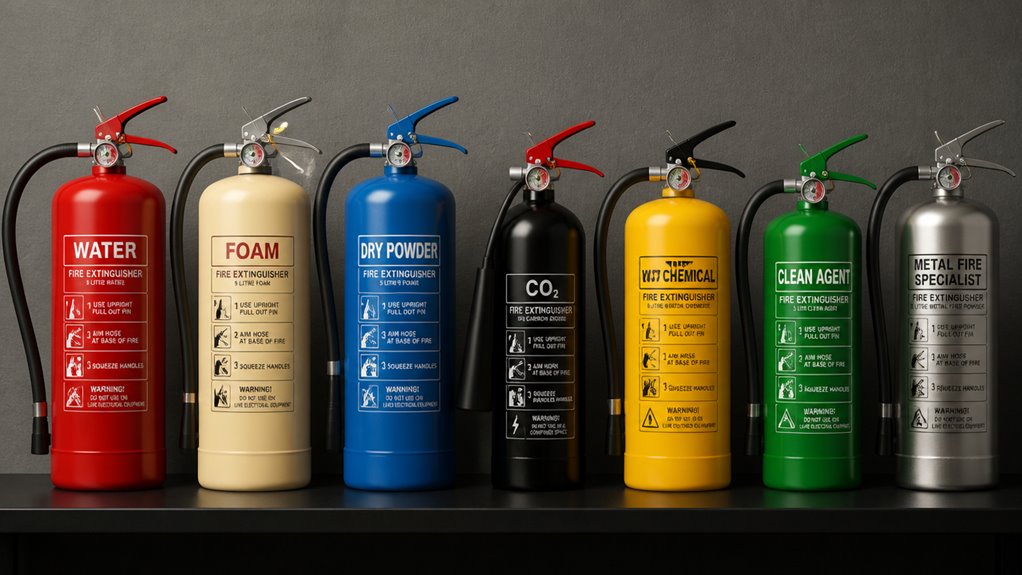

You’ll find several main types of fire extinguishers designed for specific fire classes: water (for Class A), foam (Class A and B), dry powder (Class B and C), carbon dioxide (Class B and C), and wet chemical (Class K).
Additionally, multipurpose ABC extinguishers cover multiple classes, while specialized versions handle metals or sensitive electronics. Each type uses agents matched to fire hazards for safety and effectiveness.
Understanding these distinctions guarantees you select the right extinguisher for every situation. More detailed insights follow.
Key Takeaways
- There are five main types of fire extinguishers: water, foam, dry powder, carbon dioxide (CO2), and wet chemical.
- Water extinguishers are effective only for Class A fires involving ordinary combustibles like wood and paper.
- Foam extinguishers handle Class A and B fires by creating a barrier on flammable liquids.
- Dry powder extinguishers cover Class B and C fires and some multipurpose ABC models also exist.
- CO2 extinguishers are ideal for Class B and C fires, while wet chemical extinguishers specifically target Class K kitchen fires.
What Are the Main Types of Fire Extinguishers?
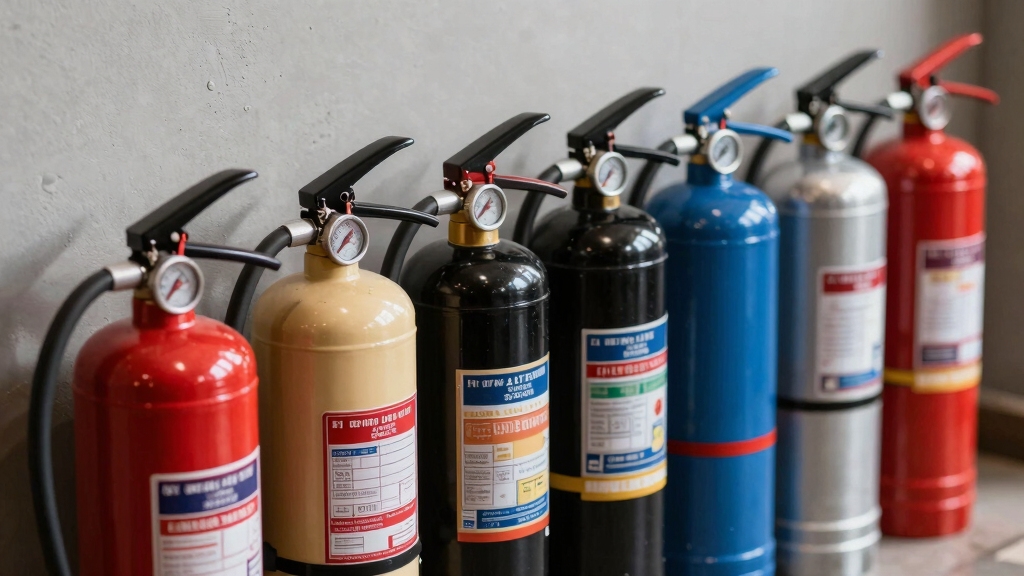
While selecting the right fire extinguisher depends on the fire class you’ll face, you should know the main types available: water, foam, dry powder, carbon dioxide (CO2), and wet chemical extinguishers.
Water extinguishers are effective for Class A fires involving ordinary combustibles like wood and paper.
Foam extinguishers, employing aqueous film-forming foam, handle Class A and B fires involving flammable liquids.
Dry powder extinguishers use sodium or potassium bicarbonate agents, suitable for Class B and C fires, including electrical hazards.
CO2 extinguishers discharge non-conductive gas, making them ideal for electrical and flammable liquid fires.
Wet chemical extinguishers contain potassium-based solutions tailored for Class K fires, common in commercial kitchens.
For versatile protection against Class A, B, and C fires, ABC fire extinguishers use a monoammonium phosphate-based dry chemical agent.
How Fire Classes Determine Fire Extinguisher Types?
To effectively combat fires, it’s essential to match fire extinguishers to the specific fire classes they’re designed for. Each class—A through K—represents different fuel sources, and knowing which extinguisher works for which class can make all the difference.
For example, Class A fires involve ordinary combustibles like wood or paper, while Class B fires are fueled by flammable liquids. Class C fires are associated with electrical equipment, and Class D deals with combustible metals. Lastly, Class K is specific to cooking oils and fats.
Selecting the appropriate extinguisher size, such as the commonly recommended 5 lb ABC unit, ensures effective and manageable fire suppression for most residential hazards, highlighting the importance of UL ratings and certifications in choosing the right extinguisher.
Fire Classes Overview
Because different materials ignite and burn in distinct ways, fire classes categorize fires based on their fuel sources to guide you in selecting the appropriate extinguisher type.
Class A fires involve ordinary combustibles like wood and paper, requiring water or foam extinguishers.
Class B covers flammable liquids such as gasoline, necessitating foam, dry powder, or CO2 agents.
Class C pertains to energized electrical equipment, so you must use non-conductive extinguishers like CO2 or dry chemical.
Class D involves combustible metals, demanding specialized dry powder agents tailored to specific metals.
Finally, Class K fires occur in commercial kitchens with cooking oils and fats, best suppressed by wet chemical extinguishers.
Understanding these classifications makes certain you choose the extinguisher that effectively interrupts the fire’s chemical reaction without causing additional hazards. Identifying the fire class first prevents adding fuel to the fire and guides correct extinguisher selection with safe fire suppression.
Extinguisher Compatibility Guide
How do fire classes directly influence the selection of fire extinguishers? Fire classes categorize fires by fuel type, guiding you to select extinguishers with appropriate agents to assure effective suppression and safety. Mismatched extinguishers may worsen fires or pose hazards.
Consider these compatibility points:
- Class A fires require water or foam extinguishers to cool and soak combustible solids.
- Class B fires demand foam, dry powder, or CO2 extinguishers that interrupt flammable liquid flames.
- Class C fires need non-conductive agents like CO2 or dry powder to avoid electrical shock.
- Class K fires call for wet chemical extinguishers that saponify cooking oils and fats.
You must match extinguisher types precisely to fire classes to optimize performance and minimize risk. Dry chemical extinguishers, particularly those with monoammonium phosphate, provide broad-spectrum protection against Classes A, B, and C fires.
Which Fire Extinguishers Work on Multiple Fire Classes?
You know, when it comes to fire extinguishers, multipurpose ABC extinguishers are pretty handy. They can tackle ordinary combustibles, flammable liquids, and even electrical fires. That makes them a versatile choice for a wide range of situations.
On the flip side, we’ve BC dry chemical agents. These are great for dealing with flammable liquids and electrical fires, but they don’t handle ordinary combustibles. So, if you’re dealing with something like wood or paper, you might want to reach for an ABC extinguisher instead.
And let’s not forget about halogenated clean agents. These are really effective for both ABC and BC classes, especially in environments with sensitive electronics. They suppress fires without leaving a mess, which is a big plus. So, depending on your needs, there are definitely options out there!
Always verify the extinguisher’s label to confirm it is rated for Class C electrical fires to ensure safe and effective use on energized equipment.
Multipurpose ABC Extinguishers
Multipurpose ABC extinguishers frequently serve as the most versatile option for fire protection, effectively addressing Class A, B, and C fires.
You’ll find these extinguishers contain dry chemical agents, typically monoammonium phosphate, that interrupt combustion across common fire types.
When selecting one, consider these key factors:
- They suppress ordinary combustibles (Class A) such as wood and paper by coating and cooling.
- They effectively interrupt flammable liquid (Class B) fires by smothering vapors.
- Their non-conductive powder safely manages energized electrical equipment fires (Class C).
- Their broad rating makes them ideal for homes, offices, and mixed-use environments requiring thorough fire defense.
Using a multipurpose ABC extinguisher guarantees you’re prepared for diverse fire hazards without needing multiple devices.
For ongoing safety, it is important to have your extinguisher inspected and serviced regularly by a certified technician.
BC Dry Chemical Agents
BC dry chemical extinguishers utilize sodium bicarbonate or potassium bicarbonate agents designed specifically for Class B and C fires. They target flammable liquids and energized electrical equipment.
These extinguishers interrupt the chemical reaction of the fire, effectively suppressing flames without conducting electricity. This makes them safe for electrical hazards.
You should note they are not suitable for Class A or K fires.
| Fire Class | Agent Type |
|---|---|
| Class B | Sodium/Potassium Bicarbonate |
| Class C | Non-conductive Dry Chemical |
| Class A | Not Recommended |
| Class K | Not Applicable |
When selecting a BC extinguisher, ensure it matches the fire risks present. This is especially important in environments with flammable liquids or electrical equipment.
Proper usage follows the PASS method for maximum effectiveness.
They also leave minimal residue and are safer to use around sensitive electrical components compared to some other agents.
Halogenated Clean Agents
While BC dry chemical agents effectively tackle flammable liquids and electrical fires, they don’t cover all fire classes.
Halogenated clean agents provide a versatile solution, working efficiently on multiple fire types without leaving residue. You’ll find these extinguishers ideal for sensitive environments like data centers or laboratories.
Key features include:
- Effective on Class A, B, and C fires, addressing ordinary combustibles, flammable liquids, and energized electrical equipment.
- Non-conductive and non-corrosive agents that protect delicate electronics.
- Rapid extinguishing action through chemical interruption of combustion.
- Minimal cleanup due to their gaseous or vapor-phase agents.
These agents achieve extinguishing concentrations in under 10 seconds, enabling rapid fire suppression that minimizes damage and downtime.
Why Water Extinguishers Should Only Be Used on Class A Fires?
Because water extinguishers rely on water’s cooling and penetrating properties, you should use them exclusively on Class A fires involving ordinary combustibles like wood, paper, and cloth.
Water effectively reduces heat and saturates materials, preventing re-ignition. Using water on other fire classes can be dangerous or ineffective.
| Fire Class | Why Water Is Suitable? |
|---|---|
| Class A | Cools and penetrates solid combustibles |
| Class B | Not suitable; spreads flammable liquids |
| Class C | Unsafe; conducts electricity, risk of shock |
You must never apply water extinguishers on Class B or Class C fires. Water can spread flammable liquids or cause electrical shock.
Stick to Class A fires for safe, effective suppression. The high specific heat capacity of water allows it to absorb large amounts of heat, making it especially effective at cooling and stopping combustion.
When to Use Foam and Dry Powder Fire Extinguishers?
When tackling fires fueled by flammable liquids or energized electrical equipment, you should rely on foam and dry powder extinguishers for effective suppression.
Foam extinguishers are ideal for Class A and B fires, creating a barrier to prevent re-ignition on flammable liquids.
Dry powder extinguishers excel on Class B and C fires, disrupting the chemical reaction and providing non-conductive suppression for electrical hazards.
Use foam and dry powder extinguishers when:
- You face fires involving gasoline, oil, or solvents (Class B).
- Electrical equipment is energized and poses a fire risk (Class C).
- You need to prevent fire re-ignition on liquid surfaces.
- Water-based agents are unsafe due to electrical conductivity.
Selecting the correct extinguisher guarantees both safety and fire control efficacy. Each type works by targeting specific elements of the fire triangle to effectively halt combustion.
How Carbon Dioxide Extinguishers Handle Electrical Fires?
You know, when it comes to electrical fires, carbon dioxide extinguishers are a go-to choice. Why? Well, they release a non-conductive gas that cuts off the oxygen supply, which means you’re not at risk of getting shocked. Pretty handy, right?
Now, when you grab one of these extinguishers, remember to hold the nozzle away from your hand. This simple step helps prevent frostbite—trust me, you don’t want that! And make sure to aim the gas right at the base of the fire. This technique really boosts both safety and effectiveness, especially when dealing with energized equipment. It’s all about staying safe while tackling those tough fires!
Non-Conductive Gas Benefits
Utilizing carbon dioxide as a non-conductive gas, CO2 extinguishers efficiently suppress electrical fires without risking electrical shock. When you deploy CO2, you interrupt combustion by displacing oxygen and cooling the fire area, all while maintaining electrical isolation. This makes CO2 ideal for energized equipment.
Key benefits include:
- Non-conductivity: CO2 doesn’t carry electrical current, ensuring user safety near live circuits.
- Rapid cooling: The gas cools surfaces instantly, reducing fire reignition risks.
- Residue-free: CO2 leaves no abrasive residue, protecting sensitive electronics.
- Versatility: Effective on Class B liquid fires as well as electrical Class C fires.
Safe Usage Techniques
Although carbon dioxide extinguishers provide effective suppression for electrical fires, proper handling is critical to guarantee safety and maximize efficiency.
When using a CO2 extinguisher, always hold it by the insulated horn to prevent frostbite from the cold discharge. Never touch the metal discharge horn during operation.
Aim the nozzle at the fire’s base, then squeeze the lever firmly to release the gas in a controlled sweep. Maintain a safe distance, as CO2 displaces oxygen but doesn’t cool surfaces notably, so reignition is possible.
Avoid using CO2 extinguishers in confined spaces without ventilation due to asphyxiation risk. Also, make certain the extinguisher is suitable for Class C fires, as CO2’s non-conductive nature prevents electrical current transmission, protecting you from shock hazards during firefighting.
What Makes Wet Chemical Extinguishers Unique for Kitchens?
Because kitchen fires often involve combustible oils and fats that burn at high temperatures, wet chemical extinguishers are uniquely formulated to tackle these hazards effectively.
You’ll find these extinguishers use potassium acetate or citrate solutions designed to saponify fats, creating a soapy layer that cools and seals the fire source. This chemical reaction prevents re-ignition, which is critical in kitchen environments.
Here’s what sets wet chemical extinguishers apart:
- They target Class K fires specifically, involving cooking oils and fats.
- Their agent cools the fire rapidly, reducing heat below ignition points.
- They form a barrier that prevents oxygen from fueling the flames.
- They comply with strict commercial kitchen safety standards like NFPA 10.
Using them guarantees efficient, safe suppression of high-temperature grease fires.
How Regional Fire Extinguisher Standards Differ?
Understanding the unique formulations and applications of wet chemical extinguishers in kitchens highlights the importance of recognizing how fire extinguisher standards vary across regions.
Recognizing wet chemical extinguisher uses underscores the need to understand regional fire safety standards.
In the US, classifications include Class K for kitchen fires, while Europe uses Class F to denote similar hazards involving cooking oils.
The UK focuses on extinguisher types: water, foam, dry powder, CO2, and wet chemical, rather than specific fire classes.
You’ll notice that multipurpose ABC extinguishers are common in the US, covering ordinary combustibles, flammable liquids, and electrical fires.
In contrast, Europe and the UK emphasize agent-specific ratings.
These regional differences affect extinguisher selection, labeling, and regulation compliance.
When choosing extinguishers, you must consider these standards to ensure proper fire protection tailored to local requirements and fire risk profiles.
Specialized Extinguishers for Metals and Electronics
When dealing with fires involving combustible metals or sensitive electronic equipment, you need extinguishers specifically designed for these purposes.
Standard extinguishers won’t suffice, as metals and electronics require unique agents to avoid exacerbating the fire or causing damage.
Specialized extinguishers include:
- Class D Dry Powder Extinguishers: Use tailored powders for combustible metals like magnesium and titanium, preventing violent reactions.
- CO2 Extinguishers: Discharge non-conductive gas ideal for electrical fires without residue or damage.
- Halogenated Clean Agent Extinguishers: Provide effective suppression on electronics while leaving no residue.
- Specialist Metal-Specific Powders: Formulated for particular metals in industrial or laboratory contexts, guaranteeing precise compatibility.
Choosing the right extinguisher guarantees safety and efficiency in these high-risk fire scenarios.
Choosing the Right Fire Extinguisher for Your Needs
Selecting the appropriate fire extinguisher depends on the specific hazards present in your environment and the types of fires most likely to occur.
First, identify the fire classes relevant to your space: Class A for combustibles, Class B for flammable liquids, Class C for electrical equipment, Class D for metals, and Class K for cooking oils.
Next, match extinguisher agents accordingly: water or foam for Class A, dry powder or CO2 for Class B and C, specialized powders for Class D, and wet chemical for Class K.
Avoid using water-based extinguishers on electrical or grease fires due to safety risks.
Consider multipurpose ABC extinguishers for general coverage but supplement with specialized types where hazards demand.
Proper selection guarantees effective suppression and minimizes damage or injury during fire emergencies.
Frequently Asked Questions
How Often Should Fire Extinguishers Be Professionally Inspected?
You should have your fire extinguishers professionally inspected at least once a year to guarantee they function properly during an emergency.
Monthly visual checks are also essential, but a certified technician must perform the thorough annual inspection.
This includes verifying pressure, mechanical parts, and agent condition.
Neglecting inspections risks extinguisher failure, compromising safety and code compliance.
Always follow local regulations and manufacturer guidelines for inspection frequency and maintenance.
What Is the Average Lifespan of a Fire Extinguisher?
Imagine gripping a fire extinguisher, knowing it’s your last line of defense.
The average lifespan of a fire extinguisher is typically 5 to 15 years, depending on type and maintenance.
You must check for corrosion, pressure loss, and damage regularly.
Proper inspections, servicing, and adherence to manufacturer guidelines guarantee it functions reliably when you need it most.
Don’t leave your safety to chance. Replace or service extinguishers as recommended.
Can Fire Extinguishers Be Refilled After Use?
Yes, you can refill many types of fire extinguishers after use, but it depends on the extinguisher type and damage extent.
Dry chemical, CO2, and wet chemical extinguishers are commonly serviceable and refillable by certified professionals.
However, some disposable models must be replaced entirely.
Always have a qualified technician inspect, recharge, and perform maintenance according to NFPA 10 standards to ensure your extinguisher remains fully operational and compliant.
How Should Fire Extinguishers Be Stored for Safety?
Don’t let fire extinguishers gather dust. Store them in accessible, visible locations free from obstructions.
Keep them mounted on brackets about 3-5 feet off the ground to prevent damage and guarantee quick access.
Avoid extreme temperatures or humidity that can compromise functionality.
Regularly inspect for pressure, corrosion, or damage.
Proper storage is key to readiness, so make certain they’re always within arm’s reach and ready to spring into action when needed.
Are There Fire Extinguishers Safe for Use on Pets?
Yes, some fire extinguishers are safer around pets, particularly those using clean agents like halogenated or CO2 types.
These extinguishers minimize residue and toxicity, reducing harm if your pet is nearby during discharge.
Avoid dry chemical or foam extinguishers around animals, as their agents can irritate or be toxic.
Always prioritize your pet’s safety by evacuating them first.
Use suitable extinguishers only when necessary and with caution.
Use the Right Extinguisher for Safer Protection
You can’t afford to guess which fire extinguisher to grab when seconds count. It’s literally a life-or-death decision.
With multiple types designed for specific fire classes, using the wrong one could make matters explode out of control.
Knowing the exact extinguisher for your environment isn’t just smart; it’s essential. Mastering this knowledge guarantees you’re always ready, turning potential disaster into manageable safety with precision and authority.
Don’t leave fire safety to chance.