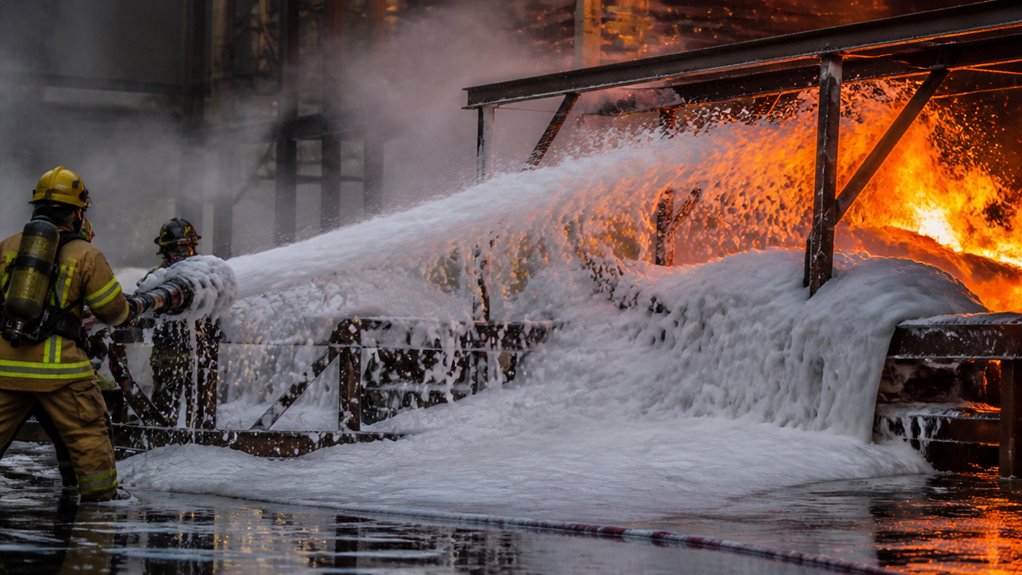

You can rely on foam retardants to quickly suppress active fires by forming a low-viscosity blanket that cools the fuel surface, cuts off oxygen, and suppresses flammable vapors. This combined effect smothers flames, minimizes reignition risk, and often achieves knockdown within seconds.
Different foams are optimized for varying fire classes, but their effectiveness depends on proper application and water content. Understanding these mechanisms and limitations will clarify how foam best supports firefighting efforts.
Key Takeaways
- Foam retardants form a low-viscosity blanket that cools fuel, blocks oxygen, and smothers flames to extinguish active fires.
- Aqueous Film-Forming Foam (AFFF) rapidly spreads a thin film that suppresses flammable vapors and achieves fire knockdown in under 30 seconds.
- Foam blankets isolate fuel from oxygen, interrupting combustion and preventing flame propagation and reignition.
- Cooling effects from water content reduce vapor release and flame spread, enhancing fire suppression effectiveness.
- Proper foam proportioning and application optimize film formation, vapor suppression, and cooling for rapid fire extinguishment.
How Firefighting Foam Suppresses Flammable Liquid Fires?
When you apply firefighting foam to a flammable liquid fire, it rapidly forms a low-viscosity blanket that cools the fuel surface and blocks oxygen access.
Firefighting foam quickly creates a cooling, oxygen-blocking blanket over flammable liquid fires.
This foam consists of water, air, and fluorosurfactants, which lower surface tension. This enables a thin aqueous film to spread swiftly across the burning liquid.
The foam blanket suppresses flammable vapors by isolating the fuel from oxygen, effectively interrupting combustion. Simultaneously, the water content in the foam absorbs heat, cooling the fuel and surrounding materials.
This reduces vapor release and flame propagation. The combined effects of vapor suppression, fuel separation, and cooling create an impenetrable barrier, smothering flames and preventing flame travel back to the fuel.
This mechanism guarantees rapid knockdown and burnback resistance in Class B fires involving hydrocarbons and polar solvents.
Foam extinguishers are ideal for Class A and B fires because they provide both cooling and a barrier, making them highly effective for suppressing flammable liquids.
Types of Firefighting Foam and Their Best Uses
When it comes to firefighting foam, you’ll find a variety of types, each designed for specific fire classes and situations.
For instance, Aqueous Film-Forming Foam, or AFFF for short, is fantastic for tackling flammable liquid fires.
On the other hand, if you’re dealing with wildland fires or ordinary combustibles, Class A foam is your go-to choice.
Getting to know these differences is really important. It ensures that you’re using the right foam for the job, which maximizes both effectiveness and safety.
In addition, understanding the compatibility of extinguishing agents with different fire classes, such as the use of Class A and B certifications, is essential for safe and effective fire suppression.
Foam Types Overview
Although firefighting foams share the common goal of extinguishing fires, their formulations and applications vary markedly based on the fire class and environment.
You’ll mainly encounter Aqueous Film-Forming Foam (AFFF) for flammable liquid fires (Class B) and Class A foam for wildland and structural fires. Each foam type performs uniquely by targeting specific fuel sources and fire dynamics.
| Foam Type | Best Use Case |
|---|---|
| AFFF | Flammable liquid fires |
| Class A | Wildland and structural |
| Fluorine-free | Environmental sensitive sites |
Understanding these distinctions lets you select the foam that optimizes suppression efficiency, minimizes environmental impact, and guarantees safety during active firefighting and mop-up operations. Unlike foams, ABC fire extinguishers use a monoammonium phosphate-based dry chemical that coats and smothers flames across multiple fire classes.
Optimal Application Scenarios
Selecting the right firefighting foam hinges on understanding the specific fire scenario and fuel involved. For Class B fires fueled by hydrocarbons, such as gasoline, diesel, and jet fuel, you’ll want Aqueous Film-Forming Foam (AFFF).
It rapidly forms an aqueous film that suppresses vapors and cools the fuel surface. This enables swift extinguishment and burnback resistance. Conversely, for wildland or Class A fires involving wood, brush, or paper, Class A foam enhances water’s penetration and retention.
This improves knockdown and mop-up efficiency. You should avoid using AFFF on Class A fires due to cost and environmental concerns. In spill prevention or early-stage fuel leaks, applying foam can inhibit ignition risk.
Proper foam proportioning and application methods are critical across scenarios. This optimizes film formation, vapor suppression, and cooling, ensuring maximum fire suppression efficacy. Foam works primarily by smothering fires, effectively isolating the fire from oxygen to interrupt combustion.
Why AFFF Is Preferred for Flammable Liquid Fires?
AFFF really shines when it comes to tackling flammable liquid fires. Why? Well, it suppresses flames quickly and does a great job of blocking those pesky flammable vapors from reigniting.
The secret lies in its formulation. AFFF creates a thin aqueous film that spreads rapidly, effectively isolating the fuel from oxygen in just seconds.
This kind of efficiency isn’t just impressive; it meets some pretty strict military-grade performance standards. That’s why AFFF is often the go-to choice for handling high-risk flammable liquid fires.
Unlike AFFF, Purple K extinguishers work by disrupting the fire tetrahedron’s chemical chain reaction, providing rapid suppression without relying on cooling.
Rapid Fire Suppression
AFFF rapidly suppresses flammable liquid fires by forming an aqueous film that quickly spreads over the fuel surface, cutting off oxygen and reducing vapor release.
You’ll find that this film’s low surface tension, enabled by fluorosurfactants, allows it to spread uniformly and fast, creating an immediate barrier between the fuel and air.
Meanwhile, the foam’s water content cools the fuel and adjacent hot surfaces, lowering combustion temperature.
This combined action smothers flames and prevents flame propagation back to the fuel source.
When you deploy AFFF, you achieve fire knockdown in markedly less time than with conventional foams, often under 30 seconds in controlled tests.
This rapid suppression minimizes fire growth and damage while enhancing firefighter safety and operational efficiency.
Additionally, chemical flame inhibition within the foam disrupts the chain-branching radicals that sustain combustion, further accelerating fire extinguishment.
Effective Vapor Suppression
Beyond rapid flame knockdown, controlling vapor release plays a pivotal role in extinguishing flammable liquid fires effectively. AFFF excels here by forming an aqueous film that rapidly spreads across the fuel surface, suppressing vapor generation and interrupting the fuel-oxygen interface.
This vapor suppression minimizes reignition risk and enhances fire knockdown speed.
| Feature | Benefit |
|---|---|
| Aqueous Film Formation | Rapid vapor barrier creation |
| Fluorosurfactants | Lower surface tension for spread |
| Water Content | Cooling & sustained suppression |
For environments at risk of covert hazards, combining visual inspection with infrared detection can enhance safety by identifying hidden threats early.
Military-Grade Performance
When tackling high-risk flammable liquid fires, military-grade firefighting foams deliver unmatched performance by rapidly extinguishing flames and preventing reignition.
AFFF achieves this through its unique aqueous film-forming properties, which spread a thin, continuous film over hydrocarbon fuels. This effectively separates fuel from oxygen.
The foam’s fluorosurfactants reduce surface tension, enabling rapid coverage and vapor suppression.
You’ll find AFFF meets rigorous military standards, often extinguishing fires in under 30 seconds with burnback resistance that prevents fire resurgence.
Its water content cools the fuel surface, while the foam blanket smothers flames and inhibits vapor release.
This combination makes AFFF superior to fluorine-free alternatives, especially in dynamic, high-hazard environments where rapid knockdown and sustained suppression are critical for safety and operational success.
Additionally, proper inspection and maintenance are crucial to ensure the effectiveness of firefighting agents and equipment, as regular hydrostatic testing guarantees operational reliability.
Using Firefighting Foam for Wildland and Industrial Fires
Although firefighting foam is often associated with flammable liquid fires, it also plays a critical role in controlling wildland and industrial fires.
Firefighting foam is essential beyond flammable liquids, aiding control of wildland and industrial fires alike.
In wildland scenarios, Class A foam enhances water’s wetting ability, allowing you to penetrate dense vegetation and reduce ignition potential efficiently. This foam supports direct attack and mop-up by improving water retention on fuels, minimizing flare-ups.
For industrial fires, particularly those involving hydrocarbons or mixed materials, foam application stabilizes burning surfaces and suppresses vapors. This improves containment and reduces fire spread.
You need to apply foam with proper proportioning equipment to guarantee the correct mixture and maximize effectiveness. While foam doesn’t replace traditional suppression methods, its ability to extend water’s reach and create barriers is indispensable for managing complex industrial and wildland fire environments. Additionally, foam-enhanced water benefits from improved fuel wetting, which increases suppression efficiency and fire control.
Cooling and Smothering: How Firefighting Foam Stops Flames
Building on foam’s role in wildland and industrial fire management, understanding how it actively stops flames reveals why it’s so effective.
When you apply firefighting foam, it forms a low-viscosity blanket of water, air, and fluorosurfactants that rapidly spreads over the fuel surface.
This film cools the burning material by transferring heat away, while the foam blanket smothers flames by cutting off oxygen supply.
Additionally, the aqueous film suppresses flammable vapors, reducing vapor release that fuels combustion.
By separating fuel from oxygen and lowering surface tension, the foam halts flame propagation and prevents reignition.
Its cooling effect extends to adjacent hot surfaces, slowing fire spread.
This combination of cooling and smothering mechanisms makes firefighting foam a precise and efficient agent in extinguishing active fires.
Similar to how laminated glass holds shards together to reduce injury severity, firefighting foam creates a protective barrier that limits fire damage.
Limits and Environmental Risks of Firefighting Foam
Despite their effectiveness, firefighting foams come with inherent limitations and environmental concerns you need to take into account. Their efficacy depends on water content; once water evaporates, the foam’s ability to suppress fire diminishes rapidly.
Firefighting foams rely on water content, losing effectiveness quickly as water evaporates.
Additionally, firefighting foams are tailored for specific fire classes, primarily Class B, and aren’t universal extinguishing agents. From an environmental standpoint, you must recognize that many traditional AFFF formulations contain PFAS compounds, which persist in ecosystems and pose health risks.
Although fluorine-free foams reduce this hazard, they sometimes underperform in critical fire suppression tests. Proper proportioning and application are essential; misuse or overuse can exacerbate environmental contamination without improving fire control.
Balancing operational effectiveness with environmental responsibility requires careful product selection, precise deployment, and consideration of long-term ecological impacts.
Frequently Asked Questions
How Long Does Firefighting Foam Remain Effective After Application?
Firefighting foam remains effective as long as its water content persists, typically minutes to an hour depending on environmental conditions.
You’ll find that heat, wind, and surface exposure accelerate water evaporation, reducing foam longevity and effectiveness.
Once dry, the foam loses its cooling and vapor suppression properties.
To maintain protection, you must reapply foam or use sufficient initial volume, especially in high-temperature or windy scenarios.
This ensures sustained fire suppression and burnback resistance.
Can Firefighting Foam Be Used on Electrical Fires?
Of course, you wouldn’t want to douse electrical fires with foam unless you like short circuits and sparks flying.
Firefighting foam, especially AFFF, isn’t designed for energized electrical fires because it’s conductive and water-based.
Instead, you should use Class C-rated extinguishers like CO2 or dry chemical agents that don’t conduct electricity.
Applying foam on live electrical equipment risks shock hazards and equipment damage.
Always make certain power is off before foam use.
What Equipment Is Needed to Properly Apply Firefighting Foam?
You need a foam proportioner to mix foam concentrate with water at the correct ratio, ensuring effective suppression.
Use a compatible foam delivery system, like a nozzle or monitor, designed to generate the proper foam expansion and spread.
Air aspirating nozzles improve foam quality by mixing air.
Additionally, maintain compatible hoses and pumps rated for foam use.
Proper calibration and regular equipment checks are essential for consistent foam application performance.
Are There Health Risks for Firefighters Using AFFF Regularly?
Yes, you face health risks using AFFF regularly because many formulations contain PFAS chemicals linked to cancer, liver damage, and immune issues.
Exposure can occur through skin contact, inhalation, or ingestion during firefighting.
You must use proper protective gear, follow safety protocols, and consider fluorine-free alternatives to reduce risks.
Regular medical monitoring and minimizing unnecessary exposure are vital for your long-term health when working with AFFF.
How Is Firefighting Foam Stored and Transported Safely?
You should store firefighting foam in cool, dry, and well-ventilated areas, maintaining temperatures between 40°F and 110°F to preserve its effectiveness.
During transport, secure containers upright to prevent leaks and comply with DOT regulations. Over 60% of foam incidents stem from improper handling.
Use corrosion-resistant containers and label them clearly. Always avoid exposure to direct sunlight and extreme temperatures, which can degrade foam quality and compromise firefighting performance.
Use the Right Foam Retardant for the Fire Type
You might think firefighting foam only prevents fires from spreading, but it actually extinguishes active flames by cooling and smothering them. This makes it indispensable for flammable liquid fires.
While environmental concerns exist, advancements in biodegradable foam formulations are addressing these risks without compromising effectiveness.
Understanding foam types and their applications guarantees you can deploy the right solution swiftly, optimizing fire suppression and safety in both industrial and wildland settings.