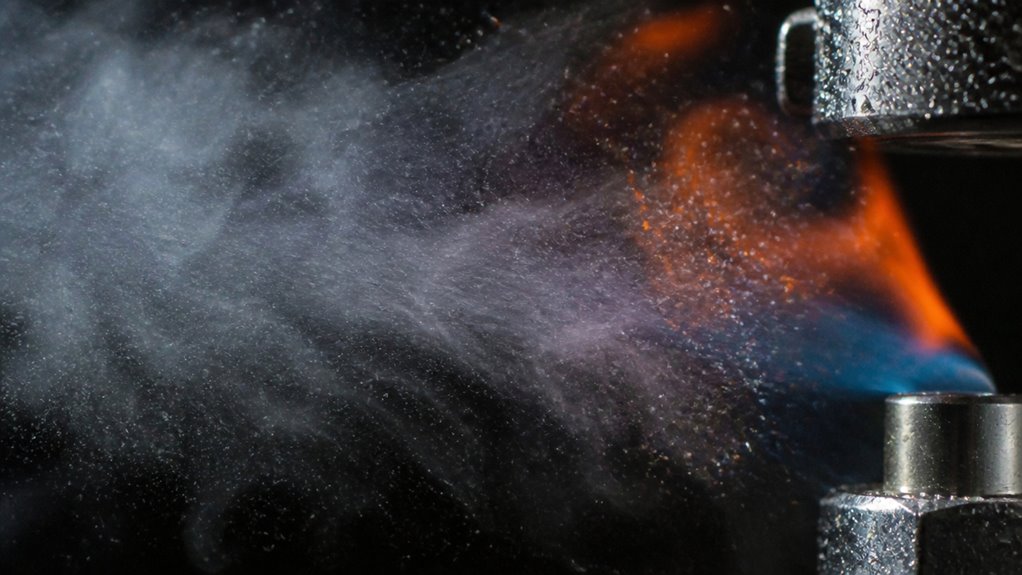

You extinguish fire by chemically disrupting the critical radical chain-branching reactions that sustain combustion.
Chemical flame inhibitors target radicals like H, O, and OH in the flame zone, converting them into stable species and slowing reaction rates.
This occurs without relying on heat absorption or dilution.
Catalytic cycles regenerate inhibitors, enabling ongoing radical scavenging that weakens flame propagation and increases reaction zone thickness.
These precise kinetic effects differ fundamentally from physical dilution.
Understanding these mechanisms reveals why chemical inhibition is highly effective in fire suppression.
Key Takeaways
- Chemical flame inhibition disrupts combustion by targeting and reducing flame-propagating radicals like H, O, and OH in the reaction zone.
- Inhibitors chemically alter reaction pathways, slowing chain-branching reactions and reducing flame speed without significant heat removal.
- Radical scavenging converts reactive radicals into stable species, lowering radical concentration and weakening flame propagation.
- Catalytic cycles regenerate inhibitor species, enabling continuous radical removal and sustained flame suppression.
- Unlike physical dilution, chemical inhibition achieves flame weakening mainly through kinetic effects rather than thermal or concentration changes.
What Is Chemical Flame Inhibition?
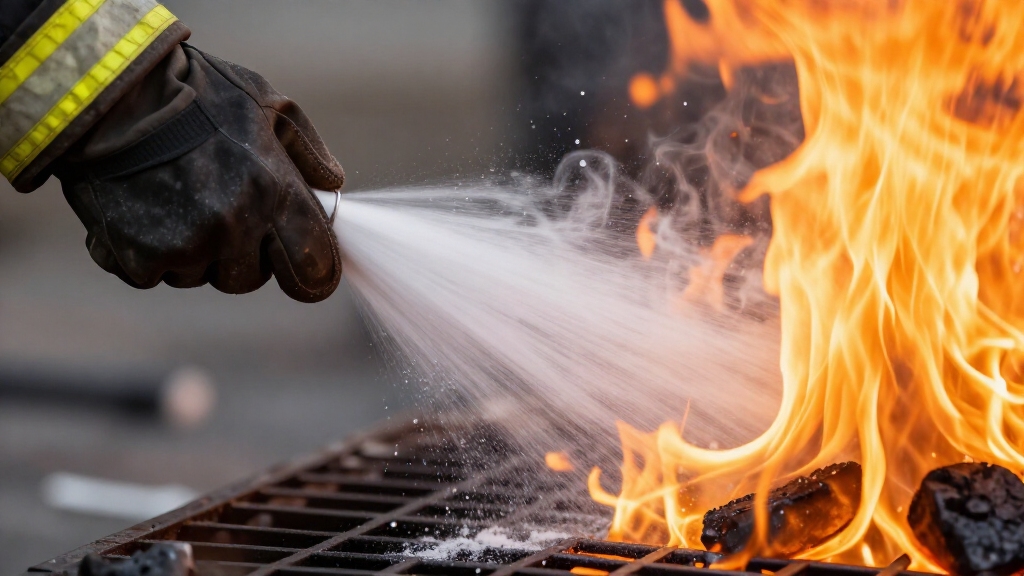
While you might think flame suppression primarily involves cooling or diluting the fuel, chemical flame inhibition works differently by targeting the fundamental reaction pathways.
Flame suppression isn’t just about cooling or dilution; chemical inhibition targets the core reaction mechanisms.
You reduce the concentration of key flame-propagating radicals like H, O, and OH in the flame zone. This slows the overall exothermic reaction rate.
This effect is kinetic rather than thermodynamic, altering reaction pathways to weaken chain-branching chemistry instead of simply reducing heat release.
Chemical inhibitors often act catalytically, regenerating active species that continuously scavenge radicals.
By interrupting radical propagation and recombination, you slow flame speed and broaden the reaction zone.
This precise control over flame chemistry allows chemical inhibition to suppress fires effectively, often beyond what physical cooling or dilution alone can achieve.
Clean agent fire extinguishers utilize chemical flame inhibition through agents like FM-200 and Novec 1230 that rapidly interrupt fire by chemical chain interruption, providing fast and residue-free suppression.
How Flame-Propagating Radicals Keep Fires Burning?
Understanding the persistence of fire hinges on the critical role played by flame-propagating radicals.
These highly reactive species like H, O, and OH drive chain-branching reactions within the combustion zone.
These radicals sustain the combustion process by continuously generating new radicals through rapid, exothermic reactions.
You can think of them as the primary agents that propagate the flame front, maintaining high reaction rates essential for flame stability.
Their abundance influences flame speed and temperature, directly impacting fire intensity.
Without sufficient radicals, chain branching diminishes, slowing combustion kinetics and destabilizing the flame.
This radical-driven mechanism operates mainly in the preflame and reaction zones, where radical generation and recombination determine the flame’s self-sustaining nature.
Consequently, controlling these radicals is key to understanding and eventually disrupting the fire’s chemical feedback loop.
Chemical inhibitors work by targeting these free radicals to halt the combustion chain reactions at the molecular level.
How Chemical Flame Inhibitors Remove Radical Species?
Flame-propagating radicals like H, O, and OH sustain combustion by driving chain-branching reactions.
Chemical flame inhibitors disrupt this process by actively removing these radicals from the reaction zone.
Chemical flame inhibitors work by actively eliminating radicals within the combustion zone to halt flame propagation.
Inhibitors typically engage in radical trapping, where species such as halogens rapidly react with H atoms, forming stable intermediates like HX.
This reaction reduces radical concentrations, slowing the overall reaction rate.
Many inhibitors operate catalytically, regenerating active species to sustain radical scavenging cycles.
For example, halogen cycles convert reactive radicals into less reactive molecules, repeatedly depleting the radical pool.
Additionally, some inhibitors generate reactive fragments via electron attachment, further enhancing radical removal.
By controlling radical availability precisely, chemical flame inhibitors weaken flame propagation.
This makes the combustion zone less reactive and more susceptible to extinguishment.
Proper placement and maintenance of detection systems can enhance safety by alerting occupants to fire hazards early, allowing for timely evacuation during such fire events, as indicated by patterns like three rapid beeps.
Why Chemical Flame Inhibition Slows Chain Reactions?
You can slow down chain reactions by chemically scavenging crucial radicals like H, O, and OH. This process directly interrupts flame propagation, which is pretty important.
Now, here’s where it gets interesting: catalytic radical cycles come into play. They actually regenerate the inhibitor species, allowing them to keep removing radicals without getting used up themselves.
This continuous trapping really makes a difference. It reduces the overall concentration of radicals, which in turn effectively decelerates the chain-branching chemistry that’s essential for flame growth. So, it’s a smart strategy to manage flames!
Similar to how continuous operation of an air purifier steadily removes airborne contaminants, maintaining inhibitor species through catalytic cycles ensures ongoing flame suppression by consistently reducing radical concentrations, a concept akin to continuous operation benefits in air purification.
Radical Scavenging Mechanism
Chemical flame inhibitors frequently slow chain reactions by targeting and removing key radicals such as H, O, and OH from the flame zone.
By scavenging these radicals, inhibitors reduce the concentration of chain carriers essential for flame propagation. This lowers the overall reaction rate and flame speed.
You’ll find that halogen-based inhibitors often react first with H atoms, forming stable intermediates that further deactivate radicals.
This radical trapping alters the kinetic pathways, thickening the reaction zone and weakening the flame.
Key aspects include:
- Selective reaction with H, O, and OH radicals
- Formation of stable species that don’t propagate chains
- Reduction of radical concentration, slowing chain branching
- Catalytic regeneration of inhibitor species allowing continuous radical removal
This mechanism fundamentally disrupts flame chemistry by controlling radical populations. Additionally, specialized agents like F-500 and Lith-Ex enhance suppression by interrupting thermal runaway reactions, providing effective flame inhibition beyond traditional chemicals.
Catalytic Radical Cycles
Understanding how catalytic radical cycles operate is key to grasping why flame inhibition effectively slows chain reactions. You’ll find that inhibitors, particularly halogens, engage in cycles where reactive radicals like H are converted into less reactive species, such as HX.
This intermediate then reacts further to regenerate the original inhibitor, X, allowing continuous radical scavenging without depleting the inhibitor. For example, the cycle H + X → HX followed by HX + radical → X sustains radical removal efficiently.
Metal-based inhibitors also catalyze similar gas-phase cycles involving metal oxides. These catalytic pathways disrupt chain-branching by rapidly recombining radicals, lowering radical concentrations and hence slowing the overall reaction kinetics.
The key to effectiveness lies in the inhibitor’s presence at the right flame zone, ensuring persistent catalytic intervention in flame chemistry. This process is fundamental to how dry chemical extinguishers interrupt fire chemistry by scavenging free radicals that sustain combustion.
How Catalytic Cycles Enhance Flame Inhibition?
Catalytic cycles play a fascinating role in flame inhibition. They work by continuously converting reactive radicals into less reactive species, which helps keep those pesky radicals in check. This process effectively sustains radical depletion, making it harder for flames to sustain themselves.
Now, here’s where it gets interesting: these cycles depend on the regeneration of inhibitor molecules. This means that the inhibitors can keep coming back to do their job over and over again, participating in radical scavenging time and time again.
But it’s not just about having these inhibitors around. Their effectiveness really hinges on getting them to the flame zone at just the right moment and in the right chemical form. That’s when radical recombination becomes most impactful, and that timing is crucial for effective flame suppression.
Additionally, ensuring proper storage and handling within the manufacturer’s specified temperature range is vital to maintain the chemical integrity of flame inhibitors and their effectiveness.
Radical Conversion Processes
Although radical scavenging reduces flame-propagating species, catalytic cycles amplify this effect by continuously converting reactive radicals into less reactive forms.
You’ll find these cycles essential because they regenerate inhibitor species, sustaining radical removal without depleting the inhibitor. This process leads to prolonged suppression of chain-branching reactions, effectively weakening the flame.
Key aspects of radical conversion processes include:
- Rapid reaction of radicals (H, O, OH) with inhibitor species forming stable intermediates.
- Subsequent reactions that regenerate the original inhibitor, enabling repeated cycling.
- Metal-based catalytic cycles involving oxides that facilitate radical recombination.
- Timing and chemical form of inhibitor delivery to the flame zone for maximum efficiency.
Effective fire suppression often requires matching the method to the specific battery chemistry to prevent violent reactions and ensure safety.
Regeneration of Inhibitors
Catalytic cycles maintain flame inhibition by regenerating inhibitor species, allowing them to repeatedly neutralize reactive radicals without being consumed.
You’ll find that halogen inhibitors, for example, convert hydrogen atoms (H) to halogen acids (HX), which then react with other radicals to regenerate the original halogen atom (X).
This cycle sustains radical scavenging, continuously reducing concentrations of key chain carriers like H, O, and OH.
You rely on this regeneration to slow chain branching effectively, as each inhibitor molecule participates in multiple radical removal events.
Metal-based inhibitors follow a similar principle, cycling through oxidation states to disrupt flame chemistry.
Understanding these catalytic loops clarifies why inhibitors dramatically lower flame propagation rates despite their minimal thermal contribution, emphasizing kinetic control over combustion mechanisms.
Dry chemical agents like Purple K enhance flame inhibition by chemically interrupting the fire tetrahedron’s chain reaction, rapidly halting combustion without relying on cooling.
Timing and Location Effects
When inhibitor species reach the flame zone at the most favorable moment and chemical form, they maximize their impact on radical concentrations and chain-branching reactions.
You need to make certain the inhibitor’s catalytic cycles engage precisely where radical recombination is most active, typically in the preflame region, to disrupt flame propagation effectively.
Timing and location influence how efficiently inhibitors convert reactive radicals into less reactive species, sustaining suppression.
Key factors include:
- Arrival of inhibitor species synchronized with peak radical concentration zones.
- Chemical form stability to persist through transport without premature reaction.
- Positioning within the flame structure to intercept chain-branching radicals.
- Rapid regeneration of active inhibitor species to maintain catalytic cycles.
Optimizing these parameters enhances flame inhibition by prolonging radical scavenging and reducing overall reaction rates. This mechanism is conceptually similar to how surfactants reduce surface tension in fire extinguisher foams, enabling effective isolation of fuel from oxygen.
How Halogen Inhibitors Suppress Flames?
Because halogen inhibitors directly target flame-propagating radicals, they effectively disrupt the chain-branching reactions essential for flame sustenance.
You’ll find that halogen species, such as atomic chlorine or bromine, rapidly react with hydrogen atoms (H), forming stable halogen acids (HX).
These acids then engage in catalytic cycles that convert reactive radicals into less reactive species, continuously regenerating the halogen radicals.
This radical scavenging lowers the concentration of key radicals like H, O, and OH, directly reducing the overall reaction rate.
As a result, the flame speed decreases, and the reaction zone thickens.
This kinetic interference slows chain-branching chemistry, weakening the flame’s energy feedback loop.
The Role of Electron Attachment in Flame Inhibition
Halogen inhibitors don’t just neutralize radicals through straightforward chemical reactions. They can also engage in electron attachment processes that generate reactive fragments critical to flame inhibition.
When an inhibitor molecule captures an electron, it undergoes dissociative electron attachment, producing highly reactive negative ions and radicals. These fragments then interact with flame radicals, accelerating their removal from the reaction zone.
Key aspects include:
- Electron attachment initiates fragmentation, forming species like Br and CF(_3).
- Reactive fragments rapidly scavenge key radicals (H, O, OH).
- Fragment chemistry complements catalytic cycles, enhancing inhibition efficiency.
- This mechanism enables inhibitors to disrupt chain branching beyond direct molecule-radical reactions.
How Chemical Flame Inhibitors Differ From Physical Diluents?
Chemical flame inhibitors work a bit differently than you might expect. They actually change the concentrations of radicals and the reaction rates within the flame zone. This disruption of chain-branching processes is what makes them effective.
On the other hand, physical diluents take a different approach. They mainly suppress flames by lowering the concentration of reactants or absorbing heat. This means they focus more on the thermodynamics of the flame rather than its chemistry.
Chemical Inhibition Mechanisms
Chemical flame inhibitors operate through specific chemical interactions that disrupt the flame’s radical-driven chain reactions. They do this rather than simply diluting reactants or absorbing heat like physical diluents.
Chemical inhibition primarily reduces the concentration of key radicals—H, O, and OH. This reduction slows the overall reaction rate. The effect is kinetic, altering the reaction pathways more than the total heat release.
Catalytic cycles regenerate inhibitor species, enabling continuous radical scavenging. When you use chemical inhibitors, expect:
- Radical trapping that removes chain carriers from combustion.
- Catalytic regeneration of inhibiting species sustaining suppression.
- Disruption of chain-branching chemistry, especially preflame.
- A thickened, slower reaction zone leading to flame weakening.
These mechanisms make chemical inhibition uniquely effective in fire suppression.
Physical Diluents Effects
When examining flame suppression, it’s important to distinguish physical diluents from chemical inhibitors.
Physical diluents primarily lower flame temperature or reduce reactant concentration by absorbing heat or diluting fuel and oxidizer streams. This effect suppresses combustion thermodynamically, slowing reaction rates by limiting available energy or reactants.
In contrast, chemical inhibitors operate kinetically, targeting radical species within the flame zone to disrupt chain-branching reactions.
Unlike physical diluents, chemical inhibitors engage in catalytic cycles that actively scavenge radicals such as H, O, and OH, altering flame chemistry at a molecular level.
While physical dilution can complement suppression, it generally requires larger quantities and produces a proportional thermal effect.
Chemical inhibition achieves significant flame weakening even with minimal thermal impact, making it a more efficient and direct approach to extinguishing fire.
How Chemical Flame Inhibition Changes Flame Structure?
Although flame inhibition targets microscopic radical populations, it markedly alters the macroscopic flame structure by reducing radical concentration and slowing chain-branching reactions.
When you introduce chemical inhibitors, you disrupt the delicate balance of reactive intermediates, leading to a measurable change in flame morphology.
You’ll observe the following effects:
- Decreased radical density lowers the flame propagation speed, directly affecting flame stability.
- Chain-branching reactions slow down, thickening the reaction zone and extending the preflame region.
- Radical recombination intensifies, causing a redistribution of heat release within the flame.
- The flame’s thermal profile changes, but the dominant effect remains kinetic, not thermodynamic.
What Chemical Flame Inhibition Means for Fire Suppression?
Since effective fire suppression hinges on disrupting the flame’s radical pool, you need to focus on how inhibition lowers key chain carriers like H, O, and OH to weaken combustion.
By reducing these radicals, chemical inhibitors slow chain-branching reactions, decreasing flame speed and increasing reaction zone thickness. This kinetic interference weakens the flame without relying heavily on thermal effects.
You’ll find that halogenated and metal-based inhibitors act catalytically, regenerating active species that continuously trap radicals and suppress the exothermic reaction rate. However, successful fire suppression depends on delivering inhibitors at the right conditions to guarantee radical recombination dominates.
Ultimately, chemical flame inhibition means you can disrupt combustion chemistry directly, making the flame less intense, less stable, and easier to extinguish even under challenging flow dynamics.
Frequently Asked Questions
What Safety Precautions Are Needed When Using Chemical Flame Inhibitors?
You need to wear appropriate personal protective equipment, including gloves, goggles, and respiratory protection, to avoid inhaling toxic fumes or skin contact.
Make sure proper ventilation in the area to prevent accumulation of harmful gases.
Handle chemical inhibitors carefully, following material safety data sheets and storage guidelines.
Avoid mixing incompatible substances and use containment measures to prevent environmental release.
Always have emergency protocols ready for spills or exposure incidents to maintain safety.
How Do Environmental Regulations Affect the Use of Flame Inhibitors?
Environmental regulations rigorously restrict risky reagents, requiring you to reconsider chemical flame inhibitors carefully.
You must comply with limits on halogenated compounds due to their potential persistence and toxicity.
These policies pressure you to prioritize safer, sustainable substitutes or minimize usage.
Regulatory reviews often mandate thorough testing, documentation, and reporting, influencing your choices.
Consequently, your fire suppression strategies must balance effectiveness with environmental impact, adhering strictly to evolving legal frameworks.
Can Chemical Flame Inhibitors Damage Materials or Electronics?
Yes, chemical flame inhibitors can damage materials or electronics, especially halogenated types that release corrosive byproducts like halogen acids during combustion.
You’ll find these acids can corrode metal contacts and degrade sensitive components.
Additionally, some inhibitors may leave residues that affect insulation or cause surface deterioration.
To prevent damage, you must carefully select inhibitors compatible with the protected materials and consider post-suppression cleaning protocols to remove harmful residues.
What Are the Common Commercial Products Containing Chemical Flame Inhibitors?
You’ll find chemical flame inhibitors in products like halogenated fire extinguishing agents (e.g., Halon alternatives such as FM-200 and FE-36), brominated flame retardants used in electronics and textiles, and metal-based inhibitors in specialized fire suppressants.
These commercial products rely on compounds like HBr, brominated hydrocarbons, and metal oxides to disrupt flame chemistry effectively.
This ensures rapid suppression in applications ranging from data centers to aircraft and household materials.
How Does Temperature Affect the Efficiency of Chemical Flame Inhibitors?
Think of temperature as the conductor of a chemical orchestra; it sets the pace for flame inhibition reactions.
You’ll find that higher temperatures generally enhance inhibitor efficiency by accelerating radical scavenging and catalytic cycles.
However, if it’s too hot, inhibitors might decompose prematurely, reducing effectiveness.
Conversely, lower temperatures slow reaction rates, weakening inhibition.
Final Take on Chemical Flame Inhibition
You can think of chemical flame inhibition as a precise strike against the fire’s sustaining elements, like removing key players from a relay race.
By targeting and neutralizing flame-propagating radicals, you disrupt the chain reactions that fuel combustion.
This selective interference slows the fire’s growth more effectively than physical dilution alone, altering flame structure and enhancing suppression.
Understanding these mechanisms empowers you to optimize fire control strategies with scientific accuracy and efficiency.