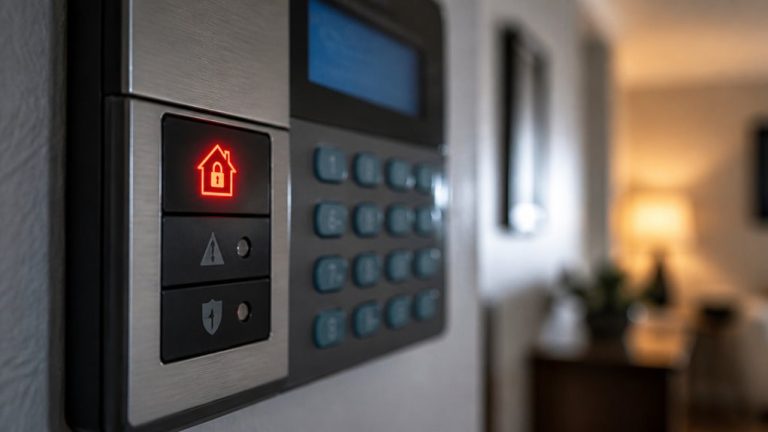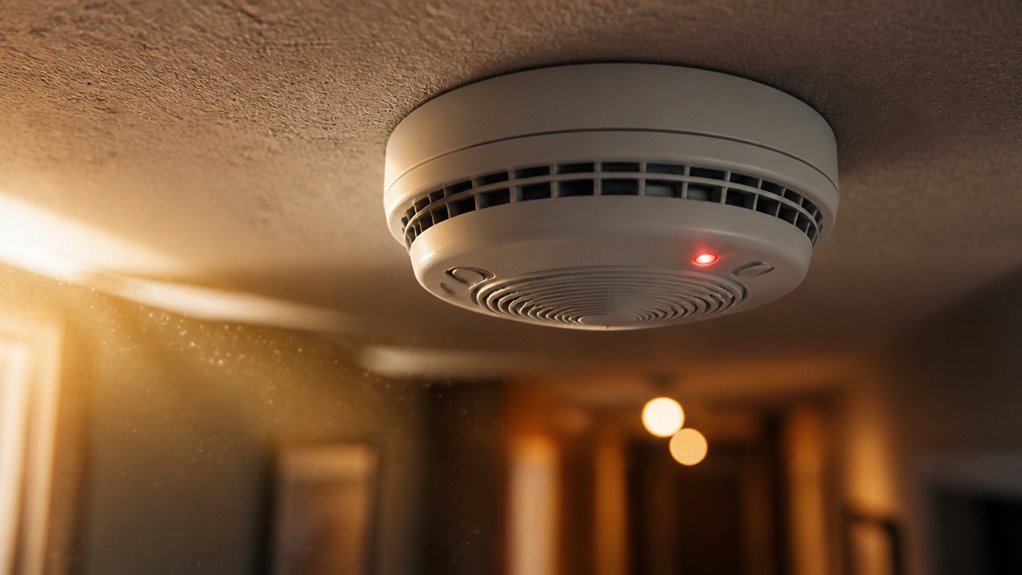

A fire alarm sounds as a loud, high-pitched beep, typically between 500 and 3,000 Hz. This is designed to penetrate walls and cut through ambient noise.
You’ll hear repetitive, urgent patterns like the Temporal-Three (T-3), which signals immediate danger and the need to evacuate. These sounds are engineered to wake you quickly and trigger instant response.
Understanding these alerts and distinguishing them from low-battery chirps can markedly improve your safety. There’s more to know about how these alarms work and save lives.
Key Takeaways
- Fire alarms emit loud, high-pitched tones typically between 70 and 100 decibels to ensure they wake sleeping occupants.
- The common fire alarm pattern is the Temporal-Three (T-3), consisting of three short beeps followed by a pause.
- Fire alarm sounds are repetitive and urgent to penetrate ambient noise and prompt immediate evacuation.
- Low-battery warnings differ, producing single, brief chirps every 30 to 60 seconds, distinct from fire alarm beeps.
- Interconnected alarms sound simultaneously throughout a home for rapid, whole-house alert and faster occupant response.
What Do Fire Alarm Sounds Actually Sound Like?
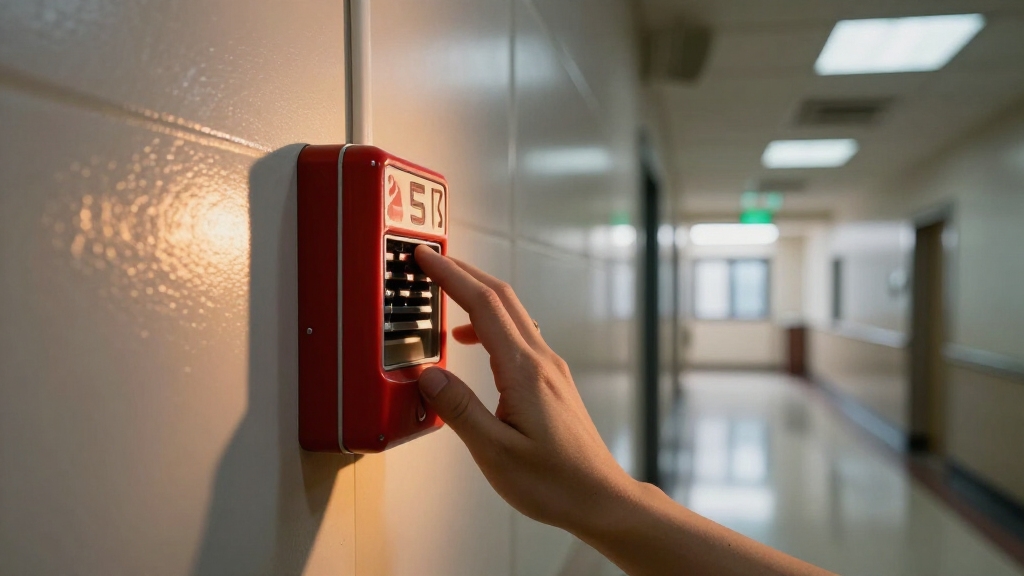
Although you might think fire alarm sounds are just loud beeps, they actually follow specific patterns and tones designed for immediate recognition and urgency.
These alarms emit harsh, high-pitched tones typically ranging from 500 to 3,000 Hz, chosen to penetrate ambient noise and alert occupants swiftly. Their volume usually measures between 70 and 100 decibels, loud enough to wake sleeping individuals and be heard through closed doors.
The sound is intentionally repetitive and urgent, engineered to be difficult to ignore. Residential alarms rely on simple, distinctive beeping, while commercial systems may incorporate complex tones or voice messages.
Every element—from pitch to volume and repetition—is precisely calibrated to maximize effectiveness in emergencies, ensuring you can quickly identify and respond to fire hazards. Proper testing procedures are essential to verify that these alarms function correctly and reliably when needed.
What Fire Alarm Beeps Mean: The Common Patterns?
When you hear a fire alarm, the beeping patterns convey essential information about the situation. The most common pattern is the Temporal-Three (T-3) signal: three short beeps followed by a pause, repeating continuously. This pattern specifically indicates a fire emergency, distinguishing it from other alerts.
You’ll find that the alarm’s high-pitched, loud tone commands immediate attention, ensuring you recognize the danger quickly. Understanding these patterns can aid your response during an emergency.
| Pattern | Meaning |
|---|---|
| Three short beeps | Fire or smoke detected |
| Continuous beep | Fire emergency ongoing |
| Intermittent beep | Alert or warning state |
| Pause after beeps | Pattern repetition |
| Repeating cycle | Active alarm notification |
Recognizing Low Battery and Power Warning Sounds
You’ll frequently notice a single chirp every 30 to 60 seconds signaling a low battery in your fire alarm.
This distinct, brief chirp differs sharply from the loud, repeating fire emergency beeps. It alerts you to replace the battery promptly to maintain proper function.
Continuous short chirps may also indicate power-source issues, such as loose electrical connections or failing backup batteries.
If the chirping persists after battery replacement, the device might be nearing the end of its operational life and require full replacement.
These maintenance alerts are intentionally less intense to prevent confusion with emergency signals, ensuring you can differentiate between routine warnings and urgent fire alarms.
Recognizing these sounds helps you maintain alarm readiness and enhances overall safety.
Removing the battery will not reliably stop the chirping due to the detector’s internal power reserve, so replacing the battery and resetting the unit is recommended.
Why Fire Alarm Sounds Are Loud and Harsh?
Because fire alarms must cut through ambient noise and reach occupants even when they’re asleep, their sounds are deliberately loud and harsh.
The sound intensity typically ranges between 70 and 100 decibels, ensuring it overpowers common background noises like conversations, appliances, or traffic.
This loudness is critical to awaken sleeping individuals and alert those in adjoining rooms.
The harsh, urgent tone is engineered to be difficult to ignore, triggering an immediate response.
By delivering a repetitive, piercing sound pattern, fire alarms maximize recognition and reduce reaction time during emergencies.
You rely on these design choices to guarantee that the alarm penetrates barriers, captures attention rapidly, and supports your safety through unmistakable, highly effective audible warnings.
For enhanced reliability, many outdoor fire alarms incorporate solar-powered alarms to ensure continuous operation even in remote locations.
What Pitch and Frequency Make Fire Alarm Sounds Effective?
Although loudness grabs your attention, the pitch and frequency of fire alarm sounds play a crucial role in guaranteeing they’re immediately recognizable and hard to ignore.
Pitch and frequency ensure fire alarms are instantly recognizable and impossible to overlook.
Fire alarms typically emit high-pitched tones between 500 and 3,000 Hz, with many modern devices utilizing frequencies near 520 Hz.
These frequencies maximize sound transmission through walls and furniture while standing out from ambient noise. The shrill, piercing quality guarantees rapid auditory recognition, even when occupants are asleep or in noisy environments.
Additionally, the tonal characteristics, whether continuous, intermittent, or sweeping, are engineered to maintain urgency without causing desensitization.
Modern fire alarm systems often integrate these sounds with data transmitted over the Signaling Line Circuit to ensure immediate and precise alerts.
How Residential and Commercial Fire Alarms Differ?
When comparing fire alarms in residential and commercial settings, you’ll notice distinct differences in complexity and functionality designed to meet the specific needs of each environment.
Residential fire alarms typically emit a straightforward, repetitive beeping pattern, often the Temporal-Three (T-3) signal, optimized for rapid recognition and simplicity.
In contrast, commercial systems integrate more sophisticated audible signals, including varied tone patterns and voice evacuation messages that provide clear instructions, such as “evacuate” or “do not use elevators.”
Commercial alarms often incorporate synchronized strobe lights to enhance visibility and accessibility.
These systems are engineered to cover larger, more complex spaces and accommodate diverse occupant populations, ensuring effective alerting even in noisy or partitioned environments.
Understanding these distinctions helps you appreciate how fire alarm design aligns with safety requirements tailored to each setting.
Proper operation and maintenance by authorized personnel ensure these systems function effectively and comply with safety codes.
How Fire Alarm Sounds Get You Awake and Alert?
Fire alarm sounds penetrate deep into your awareness by combining high volume, distinctive pitch, and a repetitive pattern designed to break through sleep and background noise.
Fire alarm sounds cut through noise and sleep with loud, sharp, and repetitive signals that demand immediate attention.
These alarms typically emit 80 to 100 decibels, a harsh intensity that overrides ambient sounds and triggers your brain’s arousal mechanisms.
The Temporal-Three (T-3) pattern, three short beeps repeated with pauses, signals urgency, ensuring you recognize a fire emergency rather than a maintenance alert.
High-frequency tones between 500 and 3,000 Hz further enhance detectability, as your auditory system is most sensitive in this range.
This deliberate design activates neural pathways that shift your brain from sleep to alertness rapidly, compelling you to respond.
Consequently, fire alarm sounds serve as an immediate, unmistakable stimulus engineered to wake and alert occupants efficiently.
However, it is important to remember that the alarm sound alone does not automatically contact emergency services unless connected to a monitored system.
How Knowing Fire Alarm Sounds Can Save Your Life?
Understanding the specific sounds of fire alarms empowers you to respond quickly and appropriately during emergencies.
When you recognize the Temporal-Three (T-3) pattern, three short beeps repeated, you’ll know it signals smoke or fire, prompting immediate evacuation.
Differentiating this from low-battery chirps, which are single, less intense chirps every 30 or 60 seconds, prevents confusion and guarantees timely action.
Familiarity with the loud, high-pitched tones designed to penetrate walls and wake sleeping occupants enhances your situational awareness.
By knowing these distinct sounds, you reduce reaction time, avoid hesitation, and increase your chances of escaping safely.
Regular training and testing solidify this recognition, making your response instinctive rather than uncertain during critical moments.
Your knowledge directly contributes to saving lives in fire emergencies.
Interconnected alarms provide whole-house alerts by sounding simultaneously, ensuring faster awareness throughout your home.
Frequently Asked Questions
How Often Should I Test My Fire Alarm for Proper Sound Function?
You should test your fire alarm at least once a month to ensure its sound function works properly. Press and hold the test button until you hear the loud, distinctive alarm tone, confirming the speaker and battery are operational.
Regular testing helps catch issues early, guaranteeing the alarm remains effective in emergencies. Replace batteries annually or as needed, and replace the entire alarm unit every 10 years to maintain peak performance.
Can Pets Hear Fire Alarm Sounds Differently Than Humans?
Yes, pets hear fire alarm sounds differently than you do. Their hearing range extends beyond human limits, detecting higher frequencies up to around 65,000 Hz, while humans hear up to 20,000 Hz.
Since fire alarms emit tones between 500 and 3,000 Hz, pets perceive these sounds as sharper and more intense. This heightened sensitivity can cause distress or anxiety.
You should monitor your pets during alarms and consider calming strategies.
Are There Fire Alarms Designed Specifically for Hearing-Impaired Individuals?
Did you know fire alarms for hearing-impaired individuals exist? Yes, you can use alarms that combine visual alerts like strobe lights with tactile devices such as vibrating pads.
These systems guarantee you receive immediate warnings without relying on sound. They meet safety codes and provide effective evacuation cues in noisy or silent environments.
If you or someone you know has hearing challenges, these specialized alarms are essential for timely fire emergency awareness.
What Maintenance Extends the Lifespan of a Fire Alarm’s Sound System?
To extend your fire alarm’s sound system lifespan, regularly test the alarm to verify proper function. Replace batteries annually or when low-battery chirps occur, and clean the device to prevent dust buildup interfering with sensors and sound output.
Avoid painting the alarm or obstructing its openings. If persistent issues arise after maintenance, replace the entire unit, as aging components degrade sound reliability and volume over time.
How Do Fire Alarm Sounds Vary Internationally or by Country Standards?
You’ll notice fire alarm sounds vary internationally, with some countries requiring alarms at 85 dB, while others specify ranges up to 100 dB for effective alerting.
Different standards dictate tone patterns too. For example, the U.S. uses Temporal-Three (T-3) beeps, whereas parts of Europe may adopt continuous or sweeping tones.
These variations guarantee alarms meet local acoustic environments and regulatory requirements, maximizing recognition and occupant safety worldwide.
Final Answer: What Does a Fire Alarm Sound Like?
Now that you know the distinctive decibels and deliberate designs behind fire alarm sounds, you’re better equipped to recognize risks rapidly.
These loud, looping, and piercing patterns prompt prompt protection, pushing you to prioritize safety without pause.
Understanding the urgent undertones and unique uses of alarms in homes and hubs helps heighten hazard awareness.
Staying sharp and sound-savvy can save your life, so stay alert and act immediately when alarms activate.