
If you want ultra-clear 4K video with advanced smart detection, Arlo’s your pick, though its notifications are slightly slower.
Ring focuses on faster alerts, broader sensor integration, and better budget-friendly plans. It excels in whole-home security beyond cameras.
Arlo shines with premium video features and multi-purpose sensors. Ring’s extensive ecosystem supports intrusion and hazard detection with easy setup.
You can weigh these trade-offs carefully to choose which system suits your security priorities best.
Key Takeaways
- Arlo offers superior video quality with up to 4K resolution, while Ring maxes out at 1080p HD.
- Ring provides faster notifications (~3 seconds) compared to Arlo’s slightly slower but more detailed alerts (~6 seconds).
- Arlo supports advanced smart detection like facial recognition; Ring focuses on broader sensor coverage including environmental hazard detectors.
- Ring has more budget-friendly subscription plans and core features that work without a plan, whereas Arlo plans are pricier but more feature-rich.
- Ring integrates deeply with Amazon Alexa and sensors for comprehensive home security; Arlo emphasizes camera versatility and multi-functional sensors.
Arlo vs Ring Security Camera Comparison: Video, Alerts, and Smart Security
| Comparison Point | Arlo Security Camera | Ring Security Camera | Best Choice |
|---|---|---|---|
| Video Quality | Offers up to 4K resolution for sharper detail | Maxes out around 1080p HD | Arlo for clearer footage |
| Alert Speed | Sends detailed alerts, but usually slower | Delivers faster notifications for quick response | Ring for speed |
| Smart Detection | Detects people, animals, cars, and objects with more detail | Uses motion and radar-based detection | Arlo for AI detection |
| Notification Detail | Can show thumbnail previews for better context | Sends simpler, faster alerts | Arlo for alert clarity |
| Security Ecosystem | Focuses mainly on premium cameras and video doorbells | Adds sensors, alarms, and hazard detectors | Ring for whole-home security |
| Smart Home Fit | Works across more platforms, including Alexa, Google, Apple, and SmartThings | Strongest inside the Amazon Alexa ecosystem | Arlo for multi-platform homes |
| Subscription Value | Higher-cost plans with more advanced camera features | More budget-friendly plans for basic protection | Ring for lower ongoing cost |
| Hardware Focus | Better for users wanting premium camera technology | Better for users wanting cameras plus entry sensors | Depends on system goals |
| Best Use Case | High-detail monitoring, AI alerts, and camera-first setups | Full home protection with alarms, sensors, and fast alerts | Match to security priority |
Comparing Arlo and Ring Camera Quality and Features
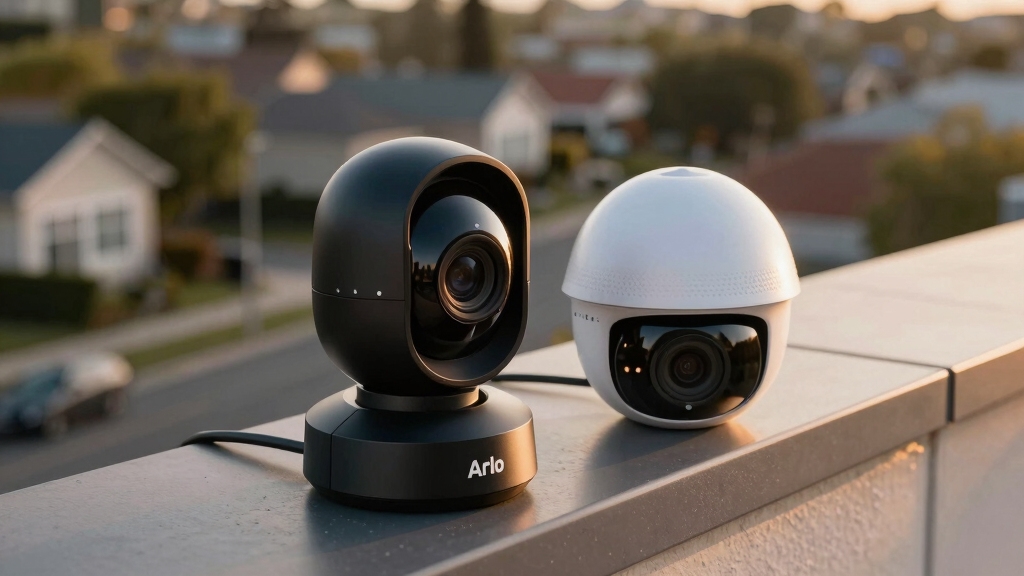
While both Arlo and Ring offer reliable security cameras, their quality and feature sets cater to different priorities.
You’ll notice Arlo supports up to 4K resolution, delivering much sharper video detail than Ring’s 1080p HD maximum. If clarity is your priority, Arlo’s advanced facial recognition and person detection features enhance your monitoring experience.
On the other hand, Ring relies on 3D or radar-based motion detection, which is less precise but still effective. Ring also provides better spotlight options and a wider variety of camera models, giving you more versatility in coverage.
Choosing between them depends on whether you value superior video quality and AI features from Arlo or prefer versatile hardware options with solid motion detection from Ring. Both have strengths but serve different user needs.
Additionally, Arlo’s cameras benefit from dual-band Wi‑Fi connectivity, supporting both 2.4 GHz and 5 GHz bands to ensure stable streaming and prompt alerts.
Arlo vs Ring: Notification Speed and Smart Detection
Often, the speed and accuracy of notifications can make a critical difference in home security.
Ring delivers alerts within 3 seconds, giving you faster reaction times.
Arlo’s notifications lag slightly at around 6 seconds but offer smarter detection, identifying animals, cars, and people with thumbnail previews.
You get more precise info with Arlo, though Ring wins in consistent delivery speed.
Additionally, Arlo allows you to disable notifications while recording, a feature Ring lacks.
Both brands recommend using modern protections such as WPA3 encryption to enhance network and device security.
| Feature | Arlo | Ring |
|---|---|---|
| Notification Speed | ~6 seconds | ~3 seconds |
| Detection Types | People, animals, cars | Person-focused, radar-based |
| Notification Detail | Highlighted thumbnails | Basic alerts |
| Notification Control | Disable notifications mode | No such mode |
| Stability | Slightly less consistent | More stable |
Arlo and Ring Subscription Plans Compared
When you’re comparing Arlo and Ring subscription plans, it’s pretty clear that there are some key differences in pricing and features. This can really influence your decision on which one to go with.
Arlo’s plans tend to start at a higher price point, but they pack in some advanced features. We’re talking about things like person detection and customizable motion zones, which can make a big difference in how you monitor your home.
On the flip side, Ring offers more budget-friendly tiers that come with essential functions right off the bat. So, if you’re looking for basic security without breaking the bank, Ring might be more your speed.
It’s worth noting that many advanced detection features, such as person detection, often require a subscription to unlock their full potential.
Subscription Pricing Overview
Because subscription plans markedly influence the overall value of security cameras, understanding how Arlo and Ring structure their pricing is essential.
Arlo’s plans start at $7.99 per month for a single camera, scaling up to $17.99 for unlimited cameras. Ring offers lower entry costs and more affordable tiers, making it budget-friendly if you have multiple devices.
Both require subscriptions for cloud recording, but Arlo locks certain advanced features like motion zones and person detection behind its plans.
Professional monitoring also differs: Arlo charges $25 monthly, while Ring is slightly cheaper at $20.
Your choice depends on how many cameras you use and which features matter most. Arlo’s higher cost aligns with more advanced detection capabilities, whereas Ring emphasizes affordability and ease of access.
Unlike these subscription-based services, some brands like Eufy prioritize local storage to avoid ongoing cloud fees and enhance privacy.
Feature Access Comparison
Although both Arlo and Ring offer subscription plans to enhance their security camera capabilities, the specific features you gain access to vary markedly between the two.
With Arlo, subscriptions enable advanced smart detection like facial recognition, person detection, and object identification (animals, cars), alongside motion zones. However, these features require a paid plan.
Ring’s subscription focuses on enabling cloud recording, as most core features work without a plan, but it lacks Arlo’s AI-driven detection.
Ring’s plans are more affordable, and their notifications are faster and more consistent.
You’ll also notice Arlo’s subscription costs rise with unlimited cameras, while Ring offers tiered pricing.
Ultimately, Arlo targets users wanting enhanced AI features, while Ring appeals to those prioritizing affordability and faster alerts.
Both platforms rely on cloud storage for enhanced features, which increases exposure despite encryption, making cloud storage risks an important consideration for users.
Arlo vs Ring: Smart Home Integration
Since smart home integration plays a pivotal role in how seamlessly your security system fits into your daily routine, it’s important to compare Arlo and Ring on this front.
Arlo offers broader compatibility, supporting Amazon Alexa, Google Home, Samsung SmartThings, Apple Home, and Siri. This makes it ideal if you use multiple ecosystems or prefer Google Home’s full announcement capabilities.
Ring, on the other hand, focuses primarily on Amazon Alexa and incorporates Z-Wave for its own devices. This limits third-party integration but strengthens its Amazon ecosystem presence.
If you want doorbell alerts on Google Home or Sonos devices, Arlo delivers that capability. In contrast, Ring’s integrations remain more Amazon-centric.
Your choice depends on which smart home ecosystem you prioritize and how much cross-platform functionality matters to you.
Additionally, both systems benefit from real-time notifications to ensure you receive instant alerts for any detected motion or events.
Expanding Security: Ring’s Sensor Ecosystem vs Arlo’s Camera Focus
You’ll see that Ring takes a different approach by creating a more comprehensive security system. They integrate sensors like door and window contacts, plus environmental detectors, alongside their cameras. This way, you get a more rounded protection setup.
On the flip side, Arlo sticks mainly to high-quality cameras and video doorbells. They don’t rely as much on traditional sensors, which makes their focus pretty clear. This difference really affects how each brand supports your overall home security and how you might think about expanding your setup in the future.
Ring also offers 24/7 professional monitoring that can reduce burglary risk by 60%, adding another layer of security beyond just hardware.
Ring’s Sensor-Based Security
When expanding your home security beyond cameras, Ring offers a more all-encompassing sensor ecosystem compared to Arlo’s primarily camera-focused approach.
Ring’s system includes intrusion sensors, door and window contacts, and environmental hazard detectors, providing multiple layers of protection.
You can integrate these sensors seamlessly with Ring Alarm Kits, creating a unified security network that monitors both entry points and environmental risks.
This broad sensor coverage allows for real-time alerts on various threats, not just motion or video events.
In contrast, Arlo concentrates on camera and video doorbell technology, using multi-functional all-in-one sensors rather than traditional entryway sensors.
If you want a system that combines conventional security sensors with cameras, Ring’s sensor-based security delivers a more robust, integrated solution for all-inclusive home protection.
Additionally, Ring’s system supports personalized access codes for multiple users, enhancing secure and convenient control over your alarm system.
Arlo’s Camera-Centric Approach
Arlo’s security strategy centers on delivering advanced camera technology and smart video features rather than a broad sensor network.
You’ll notice Arlo cameras support up to 4K resolution, offering clearer video detail than Ring’s 1080p HD. Their smart detection excels, highlighting persons, animals, or vehicles in notifications, which can display thumbnails for instant context.
While Ring focuses on a wider sensor ecosystem, Arlo prioritizes camera versatility and intelligence. You also get the flexibility to disable notifications while keeping recordings active, a feature Ring lacks.
However, Arlo’s notification speed lags slightly behind Ring’s faster alerts. Ultimately, if you want top-tier video clarity and smart AI capabilities for monitoring, Arlo’s camera-centric approach suits you.
But it limits traditional sensor expansion seen in Ring’s ecosystem.
Unlike Arlo, some competitors emphasize local storage options to reduce ongoing costs and enhance data privacy.
Integrated Home Protection Options
In comparing integrated home protection, Ring extends beyond cameras by incorporating a comprehensive sensor ecosystem that includes intrusion sensors, door/window contacts, and environmental hazard detectors.
This broader approach lets you build a thorough security setup that covers more than just video surveillance.
In contrast, Arlo focuses heavily on camera technology, offering multi-functional all-in-one sensors but lacking traditional entryway sensor coverage.
You’ll want to weigh whether you prefer Ring’s extensive sensor network or Arlo’s advanced camera features.
Key points to consider:
Ring Alarm Kits combine sensors and cameras for full home protection.
Arlo prioritizes high-resolution cameras with limited sensor options.
Ring supports environmental hazard detection (e.g., smoke, CO).
Arlo uses multi-purpose sensors without traditional intrusion detection.
Both offer strong protection, but your choice depends on your security priorities.
Additionally, Ring’s system features DIY installation with a quick 10–30 minute setup, making it accessible for most homeowners.
Arlo vs Ring Pricing and Hardware Value
Value plays a vital role when choosing between Arlo and Ring security systems, especially as you weigh upfront costs against long-term benefits.
Ring’s products generally come at lower prices, offering all-encompassing home protection kits between $130 and $500, which include cameras and sensors.
In contrast, Arlo’s cameras start at a lower $39.99, but its Premier line is particularly pricier, especially for single units.
When evaluating hardware value, consider that Arlo’s wired doorbells feature battery backup for tampering detection, a benefit Ring lacks.
Ring shines with its Pro 2 doorbell quality, while Arlo excels in high-end camera resolution and features.
Ultimately, your choice depends on whether you prioritize a broader, affordable security system or premium camera technology.
Frequently Asked Questions
Can Arlo and Ring Cameras Be Used Together on the Same Network?
Yes, you can use Arlo and Ring cameras together on the same network since both connect via Wi-Fi independently.
However, they operate on separate apps and ecosystems, so you’ll manage them individually rather than through a unified interface.
This means you’ll need to switch between Arlo’s and Ring’s apps for live views, notifications, and settings.
Having both brands on one network won’t cause connectivity issues or interference.
What Is the Typical Lifespan of Arlo and Ring Camera Batteries?
Think of your camera battery like a smartphone battery, lasting longer with moderate use.
Typically, Arlo’s batteries last around 3 to 6 months depending on activity and settings.
Ring’s batteries often last 6 to 12 months under similar conditions.
You’ll want to monitor usage and weather since colder temperatures can reduce lifespan.
Both brands require recharging or replacement sooner if you use features like continuous recording or frequent motion alerts.
How Do Arlo and Ring Handle Privacy and Data Security?
You’ll find both Arlo and Ring take privacy seriously, encrypting video data during transmission and storage.
Arlo offers end-to-end encryption for added security, while Ring encrypts data but doesn’t provide end-to-end encryption by default.
Both require subscriptions for cloud storage, raising some privacy concerns. You should review their privacy policies since Ring’s history includes scrutiny over data sharing.
In contrast, Arlo emphasizes user control and transparency.
Are There Any Weather Resistance Differences Between Arlo and Ring Cameras?
Like soldiers braving the storm, both Arlo and Ring cameras stand resilient.
You’ll find Arlo’s cameras generally offer IP65 to IP67 ratings, handling water jets and dust with ease.
Ring cameras often come with an IP54 rating, protecting against splashes but less dust-resistant.
So, if you expect harsher weather, Arlo’s robust sealing might suit you better.
Ring’s protection works fine for mild conditions and covered spots.
Can I Use Arlo or Ring Cameras Without a Wi-Fi Connection?
You can’t fully use Arlo or Ring cameras without a Wi-Fi connection because both rely on Wi-Fi to stream live video and send notifications.
However, they’ll still record locally if you have a compatible storage option, like a microSD card or base station with local storage.
But remote access and smart features won’t work. So, without Wi-Fi, your cameras’ functionality is limited mostly to on-site recording and playback.
Secure Your Home With the Right Camera Ecosystem
When choosing between Arlo and Ring, you’re weighing precision against ecosystem depth.
Arlo offers superior video quality and sharp smart detection, while Ring shines with faster notifications and a broader sensor network.
Subscription plans and pricing vary, so consider what fits your budget and needs.
Like two sides of the same coin, each excels differently. Your decision hinges on whether you prioritize camera excellence or integrated home security.
Either way, you’re securing peace of mind.