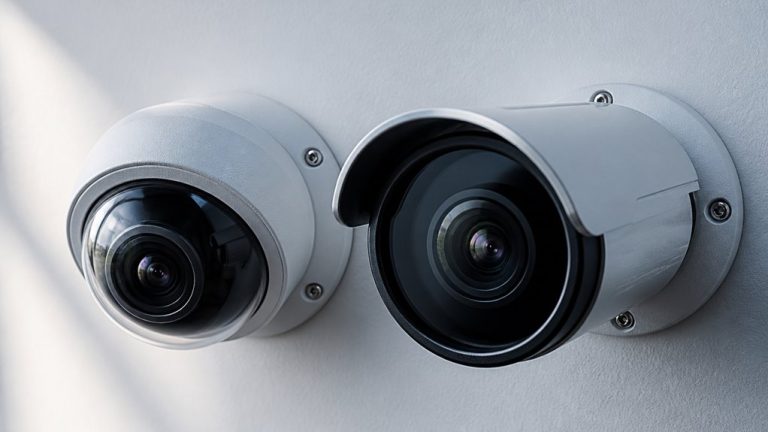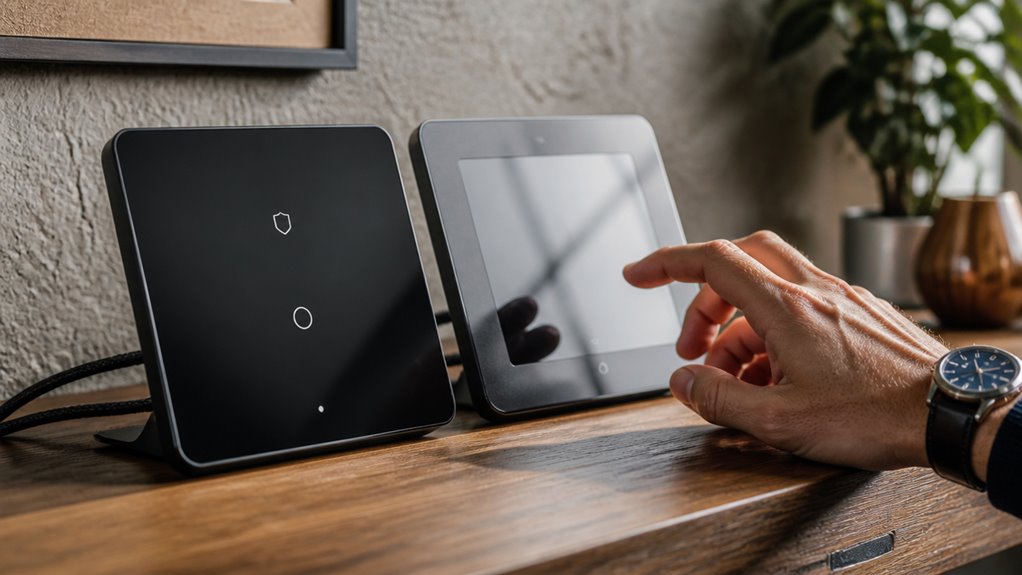

When choosing between Alarm.com and ADT, consider your priorities: Alarm.com offers flexible, platform-driven service with broad smart home compatibility and customizable hardware via authorized providers.
In contrast, ADT delivers a standardized, full-service approach with proprietary equipment, nationwide professional support, and predictable pricing under long-term contracts.
Alarm.com’s contract terms vary, providing more flexibility but less predictability. Your ideal choice hinges on whether you value customization and automation or uniformity and all-encompassing service.
Further insights clarify these distinctions.

- Full HD 2MP HDR video for clear day/night footage. 165° horizontal / 145° vertical field of view…
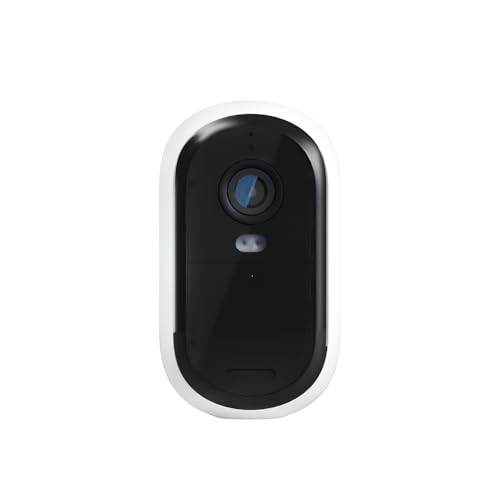
- New customers: get 30 Days Free Monitoring with required paid subscription (Video Connect or add to…
- Wireless 2K security camera outdoor with rechargeable battery: install anywhere outside your home…
- Integrated spotlight and 20-foot night vision: deter intruders with the built-in spotlight and…
Key Takeaways
- Alarm.com offers flexible equipment choices and customizable smart home automation through authorized dealers with varying pricing and contract terms.
- ADT provides a full-service, centralized security solution with standardized installation, nationwide monitoring, and predictable bundled pricing.
- ADT requires long-term contracts with upfront fees and early termination penalties, while Alarm.com contracts vary widely and often allow shorter terms.
- Alarm.com supports broader device integration and unified app control, while ADT’s smart home features may require multiple apps or higher-tier plans.
- Choosing depends on priorities: ADT for brand consistency and full-service reliability; Alarm.com for equipment flexibility, automation, and contract flexibility.
Alarm.com vs ADT: Key Differences in Features, Monitoring, and Smart Home Security
| Comparison Factors | Alarm.com | ADT |
|---|---|---|
| Service Model | Cloud-based security platform offered through authorized providers | Full-service home security company |
| Security Monitoring | Professional monitoring through participating service providers | Professional monitoring through ADT services |
| Equipment Options | Broad hardware selection through compatible security systems | Integrated equipment packages with supported devices |
| Installation | Provider-dependent installation and equipment configuration | Professional installation, with options varying by package |
| Smart Home Integration | Extensive automation for locks, lights, cameras, and thermostats | Smart home integration, including supported Google Nest devices |
| Mobile App Control | Unified Alarm.com app for compatible security and automation devices | ADT app ecosystem for supported monitoring and smart devices |
| Automation Features | Custom scenes, schedules, and connected-device control | Automation and connected-device features, depending on system |
| Contract Flexibility | Varies by authorized provider, with different agreement options | Depends on service package and installation arrangement |
| Equipment Compatibility | Multiple compatible security panels, including supported IQ and 2GIG systems | ADT-supported equipment and selected third-party integrations |
| Cellular Connectivity | Cellular communication and supported backup connectivity | Cellular communication and supported backup connectivity |
| Customer Support | Provided through individual authorized service providers | Centralized customer support through ADT |
| System Customization | Highly customizable, depending on provider and equipment | Structured security packages with available customization |
| Best For | Smart home enthusiasts and users seeking equipment flexibility | Homeowners seeking integrated monitoring and professional support |
| Overall Recommendation | Best for flexible security configurations and automation | Best for a coordinated, full-service security experience |
Alarm.com vs ADT: Key Differences in Company and Services
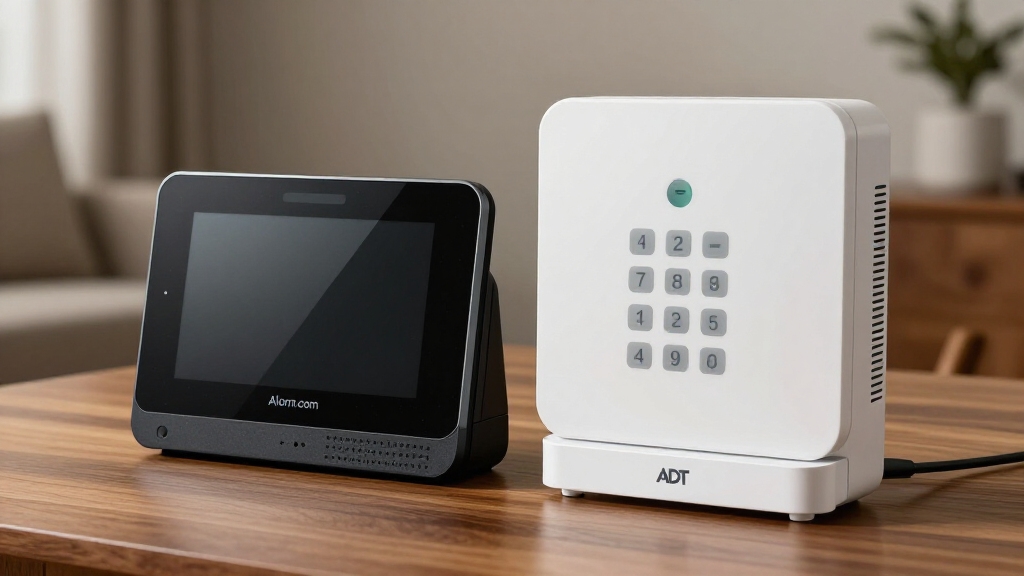
While both Alarm.com and ADT operate within the home security sector, they serve fundamentally different roles. Alarm.com functions as a cloud-based platform powering various authorized providers’ services.
ADT operates as a full-service security company with centralized installation, monitoring, and customer support. When you choose ADT, you engage a recognized brand offering bundled security solutions backed by nationwide professional teams and standardized packages.
In contrast, Alarm.com provides the technological infrastructure behind multiple dealers, granting you flexibility in equipment and service options. Alarm.com’s platform supports diverse smart home devices and integrates with multiple hardware brands.
ADT typically uses proprietary equipment with less device compatibility. Therefore, your decision hinges on whether you prefer a unified service experience or a customizable, platform-driven approach. Ring Alarm, for example, offers a DIY system with professional monitoring options that reduce burglary risk by 60%.
Alarm.com vs ADT Pricing Compared
Because Alarm.com pricing varies by authorized service provider, it can be less predictable than ADT’s standardized plans.
ADT offers clear-tiered monthly fees: $29 for Traditional, $37 for Control, and $53 for Video plans, with installation typically at $125 upfront.
ADT provides straightforward monthly plans starting at $29, with a typical $125 installation fee.
These set prices simplify budgeting but may include additional fees for higher-end features.
In contrast, Alarm.com’s cost depends on the reseller’s pricing model and selected equipment.
Some plans start as low as $7.95 monthly when billed annually.
This variability means you might find lower entry costs or tailored packages but less pricing transparency.
ADT’s uniform pricing supports straightforward comparisons, while Alarm.com’s dealer-dependent fees offer flexibility that can yield cost savings or higher expenses, depending on your chosen provider and system configuration.
Additionally, unlike ADT, Alarm.com often emphasizes integration with a broader range of smart home devices, but may not provide the same level of professional monitoring options available with ADT.
Alarm.com vs ADT Contract Terms and Flexibility
When it comes to contract terms, ADT usually has a pretty standard setup. They typically require a 36-month commitment, and if you decide to cancel early, be prepared for some hefty fees—often around 75% of what you still owe. Ouch, right?
On the flip side, Alarm.com offers a bit more wiggle room. Their contract terms can vary depending on the authorized provider, which means you might find options that suit your needs better. That flexibility can really come in handy if you need to adjust or even discontinue your service without facing those steep penalties. So, if you value that freedom, Alarm.com might be the way to go!
In comparison, Xfinity Alarm System provides contract-free plans that allow customers to avoid long-term commitments altogether.
Contract Length Comparison
When comparing contract lengths, ADT typically requires you to commit to a 36-month agreement for most of its professionally installed packages.
These often come with early termination fees that can amount to 75% of the remaining balance. Alarm.com, however, operates through various authorized providers, meaning contract terms vary markedly depending on the dealer or service provider.
Key differences include:
ADT contracts are standardized and generally inflexible.
Alarm.com contracts vary widely by provider.
Alarm.com often offers shorter or month-to-month options.
ADT’s fixed 3-year term limits contract flexibility.
Alarm.com’s model supports easier switching between providers.
This variability means you must carefully review Alarm.com provider terms, while ADT offers predictability but less contract flexibility.
Additionally, many Alarm.com providers offer month-to-month monitoring plans, providing a flexible alternative to ADT’s long-term contracts.
Early Termination Policies
Understanding the implications of early termination fees is key to evaluating contract flexibility between Alarm.com and ADT.
ADT typically requires a 36-month contract with early termination fees amounting to about 75% of the remaining balance. This can markedly impact your cost if you cancel prematurely.
In contrast, Alarm.com’s early termination policies vary since they depend on the dealer or provider you choose.
This variability means you might find more lenient or even no early termination penalties, offering you potentially greater flexibility. However, you must review each provider’s specific terms carefully.
Unlike ADT, many systems with professional monitoring, such as Cove Alarm System, offer month-to-month monitoring plans without long-term contracts, which can enhance contract flexibility.
Service Flexibility Options
Although ADT enforces a standardized contract model with typical three-year commitments and substantial early termination fees, Alarm.com offers markedly more variability in contract terms due to its reliance on independent dealers and service providers.
When you consider service flexibility, Alarm.com allows you to choose contract lengths based on provider offerings, from month-to-month to multi-year.
You can avoid or reduce early termination penalties depending on the dealer.
Additionally, you can customize hardware and service bundles tailored to your needs.
Switching providers is easier without being locked into proprietary equipment.
You also have access to diverse pricing structures reflecting different service models.
In contrast, ADT’s fixed contracts provide less adaptability but deliver a consistent, nationwide service experience.
Your choice depends on whether you prioritize flexibility or standardized terms.
ADT’s offerings include premium features such as dual-path LTE cellular communication that may influence your decision depending on your need for reliability and advanced protection.
Equipment and Installation: What Each Platform Offers
Steering the equipment and installation options between Alarm.com and ADT reveals distinct approaches tailored to different user needs.
With ADT, you get proprietary equipment typically bundled in a professional installation service. This often requires a long-term contract and can limit portability if you switch providers.
ADT provides proprietary equipment with professional installation, often tied to long-term contracts that limit system portability.
ADT’s installation is standardized and supported by a large nationwide network, ensuring consistency and centralized support.
In contrast, Alarm.com offers broader hardware compatibility, working with authorized providers using various panels like IQ and 2GIG. Its installation model is more flexible, allowing you to choose from multiple dealers and equipment configurations.
Alarm.com supports diverse smart home devices, giving you greater customization potential. However, installation quality and terms depend on the selected provider.
This makes Alarm.com more adaptable but less standardized than ADT’s turnkey approach. Monitronics, rebranded under Brinks Home Security, also provides certified professional monitoring centers with advanced verification protocols that enhance emergency response reliability.
Home Security Smart Features: Alarm.com vs ADT
When it comes to home security, you’ll find that Alarm.com really shines with its automation and control. They’ve got a single app that brings everything together, supporting a whole range of devices like cameras, locks, and thermostats. Plus, their scene-based automation makes it super easy to customize your home’s security and convenience.
Now, ADT offers smart home features too, but it can be a bit more complicated. You often need higher-tier plans or additional apps to get everything working seamlessly. They do have a partnership with Google Nest, which adds some smart device compatibility, but it doesn’t quite match the integration you get with Alarm.com. Unlike Spectrum’s discontinued system that was locked to proprietary hardware, both Alarm.com and ADT support open platforms that allow integration with a wide variety of devices and services.
Automation And Control
Both Alarm.com and ADT offer robust automation and control features, but they differ markedly in integration and user experience.
Alarm.com delivers unified control for security devices, cameras, locks, thermostats, and garage doors through a single app, emphasizing scene-based automation.
ADT provides automation too but may require multiple apps or higher-tier plans for full functionality.
You’ll find Alarm.com’s dual-path communication (Wi-Fi plus cellular) offers enhanced reliability, whereas ADT leverages partnerships with companies like Google Nest to expand smart device options.
Key considerations include:
- Single-app management with Alarm.com versus potential multi-app use with ADT
- Scene-based automation support on Alarm.com
- Crash and Smash Protection exclusive to Alarm.com
- ADT’s tiered automation feature access
- Cellular backup standard on Alarm.com for consistent control
This impacts how easily you manage devices and respond to alerts.
Additionally, verifying platform protocol support ensures seamless integration and ongoing firmware updates to maintain system security and functionality.
Integration And Compatibility
When evaluating integration and compatibility, Alarm.com stands out for its broad support of various smart home devices and security panels. This enables seamless interoperability across multiple brands and technologies.
You’ll find Alarm.com works with numerous authorized providers and supports popular panels like IQ and 2GIG. This enhances flexibility in device selection and upgrades.
In contrast, ADT primarily uses proprietary equipment in its traditional model, which can limit compatibility and portability if you switch providers.
While ADT supports smart home features and offers integrations like Google Nest, its ecosystem tends to be less unified and more restrictive than Alarm.com’s.
If you value broad device compatibility and flexible integration with diverse smart home technologies, Alarm.com’s platform provides a more adaptable solution than ADT’s bundled, brand-specific approach.
Additionally, many platforms like Ring focus primarily on Amazon Alexa integration, which highlights how ecosystem alignment can impact smart home compatibility.
Device Compatibility: Which Works Better With Smart Home Gadgets?
How well a security system integrates with smart home gadgets can materially impact your overall user experience and system flexibility. Alarm.com excels in device compatibility by supporting a broad range of third-party smart home devices across multiple authorized providers.
ADT, while offering smart home capabilities, tends to rely on proprietary equipment and may require separate apps for full functionality.
Consider these compatibility factors:
Alarm.com supports multiple panels like IQ and 2GIG, enhancing hardware flexibility.
ADT’s ecosystem is more proprietary, limiting cross-vendor device use.
Alarm.com offers unified app control for locks, cameras, lights, thermostats, and garage doors.
ADT’s smart home features may require higher-tier plans or additional apps.
Alarm.com’s platform better accommodates diverse smart home ecosystems, increasing device integration options for you.
Nationwide Support and Brand Recognition: ADT’s Strengths
Although Alarm.com offers flexibility through various providers, ADT’s nationwide support network and strong brand recognition provide distinct advantages for customers seeking reliability and consistent service.
With over 6 million customers and a physical presence in more than 200 locations staffed by 17,000 professionals, ADT guarantees rapid response times and standardized installation and monitoring processes.
This centralized infrastructure reduces variability in service quality, which can be a concern with Alarm.com’s decentralized dealer model.
ADT’s brand recognition also fosters trust and confidence, particularly for users who prioritize a well-established security provider.
If you value a cohesive support system and uniform service delivery across regions, ADT’s structure offers tangible operational benefits compared to relying on the diverse and varied network of Alarm.com authorized providers.
Choosing the Right Home Security Platform for Your Needs
Picking the right home security platform boils down to evaluating your priorities around brand consistency, equipment flexibility, pricing structure, and contract terms.
You need to weigh how each platform aligns with your technical and budgetary needs.
Consider these factors:
- Brand consistency: ADT offers a unified, nationally recognized service. Alarm.com provides a technology platform used by various providers.
- Equipment compatibility: Alarm.com supports broader hardware options. ADT relies more on proprietary devices.
- Pricing structure: ADT has standardized packages and upfront fees. Alarm.com pricing varies by dealer, sometimes offering lower entry costs.
- Contract flexibility: ADT requires long-term contracts with termination fees. Alarm.com terms depend on the provider and tend to be more flexible.
- Smart home integration: Alarm.com delivers extensive automation under one app. ADT’s smart features may require multiple apps or higher-tier plans.
Focus on what best matches your technical requirements and service expectations.
Pros and Cons of Alarm.com and ADT for Homeowners
Understanding the advantages and drawbacks of Alarm.com and ADT helps you make an informed decision tailored to your home’s security needs.
Alarm.com offers flexible service terms, broad device compatibility, and strong smart home automation through a single app. However, pricing and contracts vary by provider.
ADT delivers standardized bundled plans, centralized nationwide support, and a recognized brand with proprietary equipment. It often requires longer contracts and may limit device portability.
Alarm.com’s cloud-based platform supports diverse hardware and customizable setups. Meanwhile, ADT emphasizes integrated, professionally installed systems with fixed pricing.
You’ll weigh Alarm.com’s flexibility and wider smart home scope against ADT’s predictability and full-service approach. Choosing will depend on your preferred contract terms, equipment compatibility, and desired level of automation integration.
Frequently Asked Questions
Can I Integrate Alarm.Com With Non-Security Smart Home Devices?
Yes, you can integrate Alarm.com with non-security smart home devices like lights, thermostats, locks, and garage doors.
The platform supports broad compatibility across various smart home brands and devices, enabling you to control multiple systems through a single app.
This integration allows for scene-based automation and remote access, enhancing convenience and security.
However, the exact compatibility depends on your authorized service provider and the specific devices you choose to connect.
What Happens to My ADT System if I Move to a New Home?
If you move to a new home, your ADT system may not be fully portable because it often uses proprietary equipment tied to the original installation.
You’ll need to coordinate with ADT to transfer or reinstall the system, which might involve additional fees and a professional technician.
Some components may require replacement, and the new location must support ADT’s monitoring and service infrastructure for continued functionality and contract compliance.
Are There Any Hidden Fees With Alarm.Com Service Providers?
You might encounter hidden fees with Alarm.com service providers since pricing and contract terms vary by dealer. Setup or installation fees, equipment costs, and early termination penalties depend on the specific provider you choose.
Because Alarm.com operates through authorized resellers, it’s vital to carefully review your contract and ask about any additional charges upfront to avoid surprises. Transparency differs, so thorough vetting is essential before committing.
How Do Alarm.Com and ADT Handle Emergency Response Times?
Wonder how emergency response times compare between services?
Both Alarm.com providers and ADT rely on professional monitoring centers that dispatch emergency responders after verifying alarms.
Response speed depends largely on the monitoring center’s protocols and local emergency services, not the platform itself.
ADT’s centralized, nationwide monitoring may offer more consistency, while Alarm.com’s response times vary by authorized provider.
You should evaluate each provider’s monitoring center reputation and local dispatch efficiency for accurate expectations.
Can I Self-Monitor My Alarm.Com System Without Professional Monitoring?
Yes, you can self-monitor your Alarm.com system without professional monitoring if your provider allows it.
Since Alarm.com operates through authorized dealers, contract terms vary. Some permit self-monitoring via the app.
This gives you real-time alerts and full remote control but requires you to respond to emergencies.
Make sure you verify with your specific provider because not all offer self-monitoring as an option. Some might require a monitoring plan.
Alarm Com vs ADT: Making the Right Choice
When choosing between Alarm.com and ADT, consider that ADT protects over 6 million customers nationwide, showcasing its extensive reach and reliability.
Alarm.com offers more flexible contracts and broader smart home compatibility, ideal if you want customization.
ADT’s brand recognition and thorough support appeal to those valuing stability.
Weigh their pricing, features, and contract terms carefully to match your specific security needs and tech preferences for the best fit.
- Full HD 2MP HDR video for clear day/night footage. 165° horizontal / 145° vertical field of view…
- New customers: get 30 Days Free Monitoring with required paid subscription (Video Connect or add to…
- Wireless 2K security camera outdoor with rechargeable battery: install anywhere outside your home…
- Integrated spotlight and 20-foot night vision: deter intruders with the built-in spotlight and…
Last update on 2026-10-17 / Affiliate links / Images from Amazon Product Advertising API