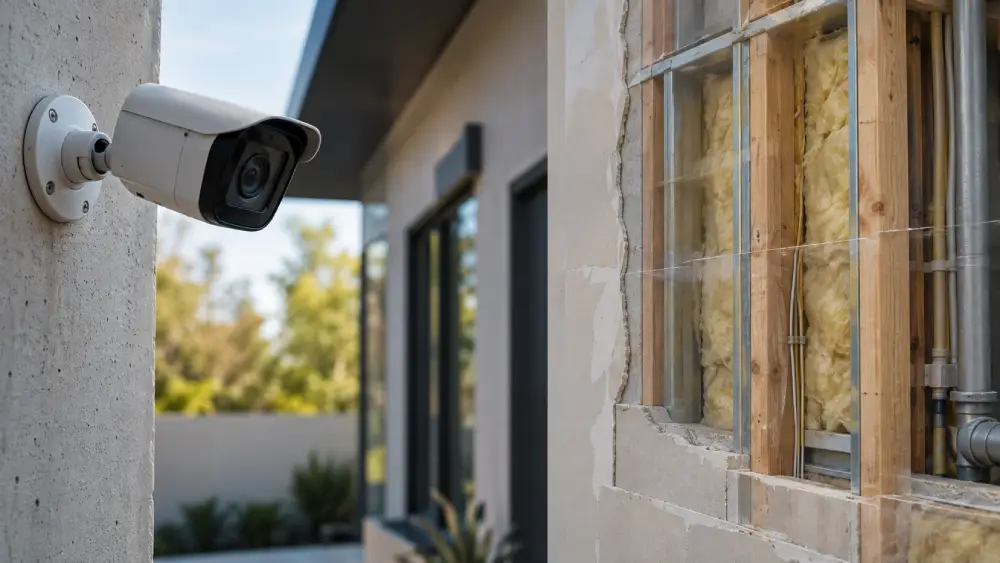

You can’t use regular cameras to see through walls because visible light doesn’t penetrate opaque materials like drywall or brick. Cameras rely on direct line-of-sight and detect only surface-reflected or emitted radiation, so they capture just what’s exposed.
Thermal cameras sense heat on surfaces but don’t image behind barriers. Specialized systems using radio waves or indirect light can infer hidden shapes, but with trade-offs in resolution and complexity. Exploring these methods reveals how wall composition and signal types impact imaging behind walls.
Key Takeaways
- Standard cameras cannot see through walls because they rely on visible light requiring direct line of sight to surfaces.
- Thermal cameras detect surface heat patterns but cannot produce direct images of objects behind walls.
- Radar and microwave systems can penetrate some wall materials, but only infer shapes and movement, not optical images.
- Wall thickness and material composition significantly limit any electromagnetic signal penetration, blocking direct imaging behind walls.
- No consumer camera or optical device can bypass opaque solid structures to capture hidden scenes.
Can Cameras See Through Walls? The Simple Answer
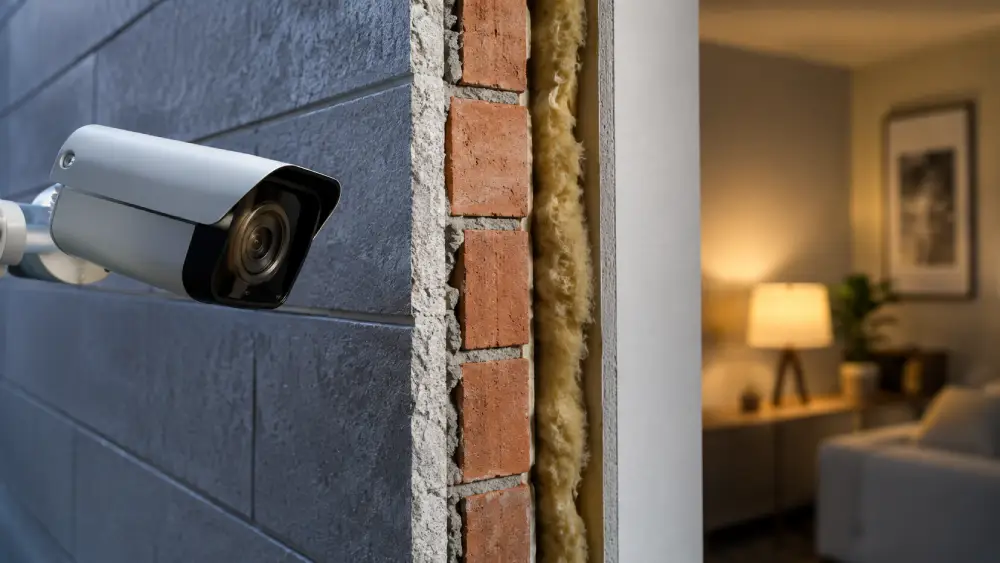
Although it might seem intuitive that cameras could capture images through walls, standard cameras can’t do this because visible light doesn’t penetrate opaque materials.
When you use a typical camera, it relies exclusively on visible light reflecting off surfaces directly within its line of sight.
Walls composed of materials like drywall, brick, or concrete block this light, preventing the camera from receiving any photons from behind the barrier.
Consequently, the camera sensor records only the wall’s surface, not hidden objects.
To image behind walls, you’d need sensors that operate on different electromagnetic spectrum bands or exploit indirect reflections.
Standard optical cameras lack this capability, making it impossible to form a direct image of anything obscured by solid, opaque walls under normal conditions.
However, technologies such as thermal imaging cameras can detect infrared radiation emitted as heat, providing a different method to perceive objects not visible to standard cameras.
Why Cameras Can’t See Through Walls: The Role of Visible Light
Understanding why standard cameras can’t see through walls requires examining the behavior of visible light, which these cameras depend on.
Visible light consists of electromagnetic waves with wavelengths that opaque materials like drywall, brick, and concrete absorb or reflect, preventing transmission.
Since standard cameras capture images by detecting visible light reflected off surfaces, any light from objects behind a wall never reaches the camera sensor.
This results in recording only the wall’s surface, making hidden objects invisible.
The physical principle of line-of-sight imaging strictly limits standard optical systems: without a direct light path, no image forms.
Hence, cameras relying solely on visible light can’t penetrate walls, as the wall’s material properties block or scatter all incident visible photons before they reach concealed scenes.
Additionally, the camera’s image sensor and lens system are designed to capture light only from direct lines of sight, emphasizing the importance of lens focus in image formation.
What Thermal Cameras Reveal About Walls
When you use a thermal camera on a wall, you’re detecting infrared radiation emitted from the wall’s surface rather than seeing through it.
Walls composed of brick, concrete, wood, or drywall absorb and block infrared wavelengths, preventing direct thermal imaging of objects behind them.
Instead, thermal cameras reveal temperature variations on the wall’s exterior, which can indirectly indicate hidden features.
For example, heat patterns may expose concealed pipes, moisture accumulation, or insulation inconsistencies due to differential heat conduction.
However, these indications depend on temperature gradients transferring through the wall material, not on direct visualization of concealed objects.
Consequently, thermal imaging offers only surface-level thermal signatures influenced by internal conditions, without providing a direct image of what lies behind the wall’s opaque layers.
For enhanced monitoring of such conditions on construction sites, integrating thermal cameras with smart motion detection systems can improve alert accuracy and operational efficiency.
Technologies That Detect Objects Behind Walls
You can’t really count on standard cameras to see behind walls, right? But there’s good news! Radar-based imaging systems come into play here. They use radio or microwave signals to detect shapes and movement through barriers. It’s pretty fascinating how these systems work! They do trade off a bit on resolution for more penetration depth, so instead of clear images, you get inferred outlines.
And then there are indirect light techniques, which are super interesting too. They actually exploit reflections around corners! By using laser pulses, they can reconstruct hidden scenes from scattered light. It’s amazing how technology can give us a peek at what’s behind those walls!
For remote imaging applications like these, choosing energy-efficient video compression can help manage limited power and storage resources effectively.
Radar-Based Imaging Systems
Although ordinary cameras can’t penetrate walls, radar-based imaging systems employ radio waves to detect objects behind barriers by analyzing signal reflections and transmissions.
These systems emit low-frequency radio waves that can penetrate materials like drywall and wood, bouncing back from hidden objects.
By processing the time delay and amplitude of reflected signals, they reconstruct spatial information about shapes or movements behind walls.
However, penetration depth and resolution depend heavily on wall material and wave frequency. Higher frequencies yield finer detail but reduced penetration.
These systems generate inferred images or motion maps rather than optical photographs.
To operate effectively, you need specialized hardware and advanced signal processing algorithms.
While they don’t offer direct visual imagery, radar-based imaging systems provide valuable situational awareness where line-of-sight cameras fail.
Similar to how fog machines emit particles that interfere with sensors, radar systems must account for signal interference caused by various materials to ensure accurate detection.
Indirect Light Techniques
By exploiting the behavior of light as it scatters and reflects off surrounding surfaces, indirect light techniques enable detection of objects hidden from direct view behind walls. You leverage time-resolved measurements of photons that bounce off visible surfaces, reconstructing hidden scenes through computational algorithms. This approach relies on analyzing subtle changes in indirect light paths caused by occluded objects.
| Method | Principle |
|---|---|
| Time-of-flight LIDAR | Measures photon travel times |
| Non-line-of-sight Imaging | Analyzes scattered light patterns |
| Computational Reconstruction | Uses inverse modeling to infer shapes |
| Laser Scatter Analysis | Detects minute variations in reflected light |
While indirect light methods don’t capture direct images, they provide spatial information about concealed objects. This extends vision beyond line-of-sight limitations with high temporal and spatial precision. Such advanced detection techniques can be integrated with devices identified by a unique UID to ensure secure and traceable remote access.
How Radio Waves and Microwaves See Through Walls
When radio waves and microwaves encounter walls, their longer wavelengths allow them to penetrate materials like drywall, wood, and some masonry that visible light can’t pass through.
You can leverage this property in specialized imaging systems that emit and receive these waves to infer shapes or movements behind walls.
Unlike visible light cameras, these systems don’t create direct optical images but generate radar-like maps based on reflected signals.
Lower-frequency radio waves penetrate deeper but yield lower resolution, while higher-frequency microwaves offer finer detail at reduced penetration.
You’ll need advanced signal processing to interpret the scattered waves and distinguish objects from background clutter.
Although these techniques reveal hidden elements, they depend heavily on wave-material interactions and don’t deliver conventional photographs of occluded scenes.
Similar to how motorized varifocal lenses adjust focus dynamically in license plate recognition cameras to optimize imaging across conditions, advanced systems adapt their signal parameters for clearer detection through walls.
Why Wall Material and Thickness Affect Imaging
You know, the wall material really plays a big role in how well we can capture images. When it comes to imaging, the composition of the wall affects how signals either penetrate or bounce back.
Now, think about thickness. As walls get thicker, the ability for signals to penetrate diminishes. This means that sensors can’t scan as deeply, which is definitely a limitation we’ve to consider.
And then there are denser materials like concrete or metal. They really complicate things because they tend to absorb or scatter the waves. This absorption and scattering can lead to less clear and lower resolution images. So, the material and thickness really do make a difference! Environmental factors such as light scattering caused by moisture or fog further reduce image clarity in challenging conditions.
Wall Composition Impact
Although some imaging technologies can penetrate walls, the composition and thickness of the wall markedly limit their effectiveness.
You need to take into account that materials like concrete, brick, metal, and dense masonry absorb or reflect electromagnetic waves differently. This impacts signal attenuation and scattering.
For example, metal reflects most radio and microwave signals, blocking penetration. Meanwhile, drywall and wood are more permissive but still reduce signal strength.
The wall’s density affects how much energy is lost as waves pass through, directly influencing image resolution and clarity. Denser materials cause greater signal degradation, forcing systems to balance between penetration depth and detail.
Understanding these material properties is essential when selecting or designing through-wall imaging systems. The wall acts as a complex filter altering the transmitted and received signals.
Infrared light, used in many security cameras, does not penetrate walls and is instead reflected or absorbed by surfaces, limiting through-wall imaging capabilities IR illumination limitations.
Thickness Versus Penetration
Understanding penetration challenges requires examining how wall thickness directly influences the ability of imaging signals to pass through materials.
As thickness increases, the signal, whether radio waves, microwaves, or millimeter waves, attenuates exponentially. This reduces the energy reaching the hidden object and the reflected signal reaching the sensor.
You’ll find that thicker walls impose greater signal loss, limiting penetration depth and degrading image quality.
This effect varies with frequency: lower frequencies penetrate thicker walls better but yield lower resolution. Higher frequencies provide finer detail but attenuate rapidly in thicker materials.
When you consider wall thickness, you must balance penetration depth against image fidelity.
Thicker walls demand more powerful transmitters or more sensitive receivers, increasing system complexity.
Hence, wall thickness is a fundamental constraint shaping through-wall imaging capabilities.
Similar to the importance of redundancy in fire alarm systems, having a redundant signal path enhances reliability in imaging technologies by mitigating signal loss due to obstacles.
Material Density Challenges
Because different wall materials vary widely in density and composition, they affect how imaging signals penetrate and reflect in distinct ways.
When you try to image through a wall, denser materials like concrete or metal absorb and scatter electromagnetic waves more. This reduces penetration depth and signal clarity.
Less dense materials such as drywall or wood allow greater signal transmission but still attenuate high-frequency waves essential for detailed imaging.
You must consider that as density increases, signal attenuation escalates exponentially. This forces a tradeoff between resolution and penetration.
Lower-frequency radar waves penetrate better but produce coarse images, while higher-frequency waves offer finer detail but fail to pass through thick, dense barriers.
Ultimately, your imaging system’s effectiveness depends on accurately accounting for these material density challenges to optimize signal selection and processing for through-wall detection.
Tradeoffs Between Image Resolution and Wall Penetration
When you attempt to image through walls, you’ll quickly find that increasing image resolution often reduces the system’s ability to penetrate dense materials. Higher resolution demands higher frequency signals, such as millimeter waves, which attenuate more rapidly through thick or metallic walls, limiting penetration depth.
Conversely, lower frequency waves, like radio waves, penetrate walls more effectively but offer coarse spatial resolution, resulting in blurred or indistinct images. This inverse relationship forces you to balance detail against depth depending on the application.
Additionally, wall composition affects this tradeoff; denser materials absorb or reflect high-frequency signals more, further degrading resolution at depth. Optimizing imaging performance consequently requires selecting appropriate frequency bands and sophisticated signal processing to extract meaningful data while managing limitations imposed by wall attenuation and resolution constraints.
What Special Sensors Reveal Behind Walls
Balancing resolution and penetration limits means relying on specialized sensors designed to detect signals beyond visible light.
These sensors don’t produce traditional images but infer hidden details by detecting electromagnetic waves or thermal variations.
They overcome walls’ opacity by exploiting different physical principles.
Here’s what special sensors can reveal behind walls:
Radar and microwave systems detect movement and structural layouts through walls, mapping shapes rather than capturing optical images.
Millimeter-wave sensors provide higher resolution but penetrate thinner materials.
Thermal sensors detect heat patterns on wall surfaces, hinting at hidden pipes or insulation anomalies.
Laser-based indirect imaging reconstructs objects by analyzing reflected light from surrounding surfaces, not direct line-of-sight.
Each technology balances penetration depth with detail, revealing concealed information under specific conditions and material constraints.
Why Consumer Cameras Can’t See Through Walls Like X-Rays
Although X-rays can penetrate solid objects to reveal internal structures, consumer cameras rely solely on visible light. Opaque walls block this light completely.
You depend on photons reflecting from surfaces into the lens. Walls absorb or scatter this light, preventing any direct imaging of hidden objects.
Unlike X-rays, visible light lacks the energy to traverse dense materials like drywall, brick, or concrete.
Thermal cameras detect infrared radiation but only from the wall’s surface, not beyond it.
Specialized sensors use radio or microwaves to infer shapes behind barriers, but these systems differ fundamentally from optical cameras and require complex processing.
Consequently, no consumer camera can produce images through walls. Their operation fundamentally requires line of sight, making them inherently incapable of seeing through opaque solid structures.
Frequently Asked Questions
Can Smartphone Cameras Be Modified to See Through Walls?
You can’t simply modify a smartphone camera to see through walls because it relies on visible light, which walls block completely.
To detect objects behind walls, you’d need sensors using radio waves, microwaves, or specialized radar technology, none of which standard phones have.
Even thermal cameras on phones only detect surface heat, not hidden objects.
Do Sound Waves Help Detect Objects Behind Walls?
You use sound waves to detect, to analyze, and to map objects behind walls. Sound waves, especially ultrasound or sonar pulses, reflect off hidden structures, allowing sensors to interpret echoes and infer shapes or movements.
While they don’t provide detailed images, they offer valuable spatial information where light can’t reach. However, wall thickness and material density affect accuracy, and signal processing complexity increases.
Are There Legal Restrictions on Using Through-Wall Imaging Devices?
Yes, you face strict legal restrictions when using through-wall imaging devices.
Many jurisdictions classify them as surveillance tools that invade privacy and require warrants or explicit consent.
Unauthorized use can lead to criminal charges or civil liabilities.
Laws vary widely, so you must understand local regulations before deploying such technology.
Always guarantee compliance with privacy laws, especially since these devices reveal concealed information without direct visual access.
How Do Dogs or Animals Sense Things Behind Walls?
Imagine a dog’s senses as a finely tuned radar, picking up signals invisible to you.
Dogs use acute hearing to detect faint sounds behind walls, like tapping or movement vibrations. Their sensitive noses pick up scent particles that seep through cracks, guiding them even without line of sight.
These biological sensors combine to create a mental map beyond physical barriers, allowing animals to sense presence or activity where your eyes hit a brick wall.
Can Moisture Sensors Detect Hidden Leaks Inside Walls?
Yes, moisture sensors can detect hidden leaks inside walls by measuring elevated moisture levels within building materials.
You’ll use sensors that detect changes in electrical resistance or capacitance caused by water presence.
Some advanced moisture meters penetrate drywall or plaster to assess internal dampness without demolition.
However, accuracy depends on sensor type, wall material, and leak size.
You may need complementary tools like thermal imaging to localize leaks precisely.
So, Can Cameras Really See Through Walls?
You can’t expect your regular camera to see through walls. Visible light just won’t penetrate solid materials.
Imagine emergency responders using thermal and microwave sensors to locate survivors behind rubble. These technologies reveal heat signatures or radio wave reflections invisible to your eyes.
While specialized sensors trade resolution for penetration, consumer cameras lack this capability. Understanding these limits helps you appreciate why imaging behind walls requires advanced tools beyond everyday optics.