
NAC stands for Notification Appliance Circuit, a key part of your fire alarm system that powers and controls devices like horns, strobes, bells, and speaker-strobes.
It delivers power and signals during alarms to alert occupants promptly and guarantees devices are supervised to detect faults early.
Proper NAC design and maintenance are critical for safety and code compliance. If you want to understand wiring types, device connections, and troubleshooting, there’s plenty more to explore.
Key Takeaways
- NAC stands for Notification Appliance Circuit in fire alarm systems.
- It provides power and control to notification devices like horns, strobes, bells, and speaker-strobes.
- NACs activate audible and visual alerts to warn occupants during fire emergencies.
- The fire alarm control panel energizes the NAC to trigger notification appliances during alarms.
- NAC circuits are supervised continuously to ensure proper operation and fault detection.
What Does NAC Stand For in Fire Alarm Systems?
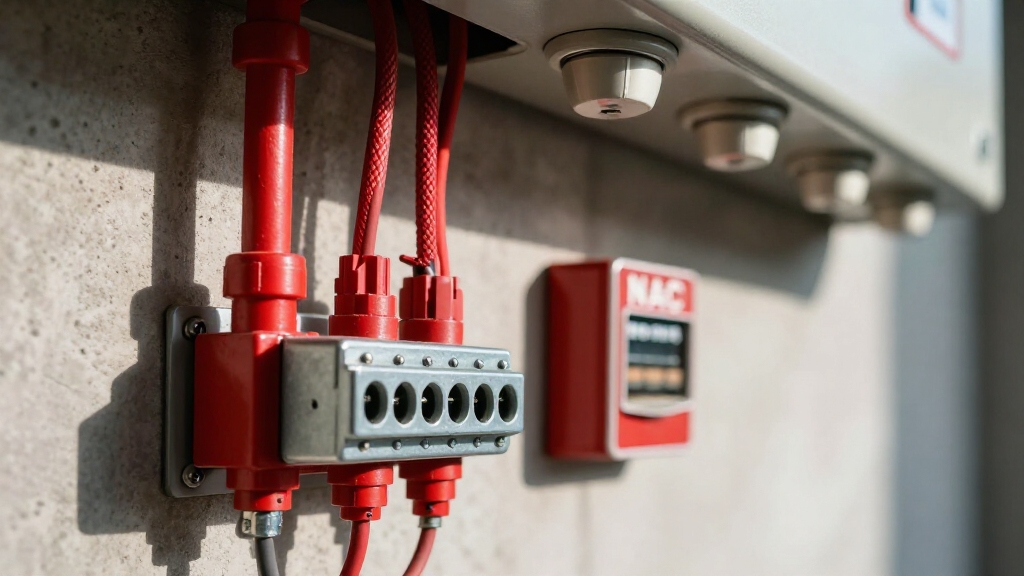
NAC stands for Notification Appliance Circuit, a critical component in fire alarm systems that powers and controls the devices alerting occupants during emergencies.
NAC, or Notification Appliance Circuit, powers and controls devices that alert occupants during fire emergencies.
When you work with fire alarm systems, you’ll find that the NAC connects the fire alarm control panel directly to notification appliances such as horns, strobes, bells, and speakers.
It functions as the alarm output circuit, ensuring that these devices receive the proper electrical signals to activate during an alarm condition.
Understanding NAC is essential because it forms the backbone of the notification output side, responsible for promptly warning building occupants.
The NAC is part of the panel’s output circuits, which activate notification appliances and contribute to coordinated emergency response.
How NACs Power Fire Alarm Devices?
The fire alarm control panel delivers electrical power through the notification appliance circuit to activate various alerting devices.
When the panel detects an alarm condition, it energizes the NAC, sending a controlled voltage to connected devices like horns, strobes, bells, and speaker-strobes. This power flow triggers audible and visual alerts designed to notify occupants promptly.
NACs use Class A or Class B wiring configurations to maintain circuit integrity and ensure dependable delivery of power. You’ll find that the panel continuously supervises the NAC for faults, but during normal operation, it simply supplies constant power to the devices.
Proper wiring practices, including the use of fire-rated cables and secure terminations, are essential to ensure system reliability and compliance with safety standards.
How Fire Alarm Panels Monitor NAC Circuits?
Fire alarm panels are pretty fascinating when you think about how they monitor NAC circuits. They’re always on the job, keeping an eye on circuit continuity and voltage levels to make sure everything’s running smoothly.
If something goes wrong—like an open wire, a short, or even a missing component—the system doesn’t go into alarm mode right away. Instead, it triggers a trouble signal.
It’s really important to grasp the difference between alarm and trouble states. Knowing this distinction helps with both system response and maintenance.
After all, you want to be sure that when there’s a real emergency, the system reacts appropriately!
Additionally, NAC circuits are part of the notification appliances that alert occupants effectively during an alarm event.
Continuous Circuit Supervision
Continuous circuit supervision plays a crucial role in guaranteeing fire alarm systems function reliably by constantly monitoring the integrity of Notification Appliance Circuits (NACs).
Your fire alarm control panel continuously checks NAC wiring for continuity, voltage levels, and proper resistance values. It uses end-of-line devices, such as resistors, to verify the circuit is complete and free of faults.
If a wire opens, shorts, or a device fails, the panel detects the anomaly immediately. This real-time supervision guarantees that the NAC can deliver power effectively to horns, strobes, or speaker-strobes during an alarm.
Regular weekly visual inspections and functional tests help ensure that NAC circuits and their connected devices remain operational and unobstructed.
Fault Detection Methods
Maintaining circuit integrity requires fire alarm panels to employ specific fault detection methods on Notification Appliance Circuits (NACs).
These methods ensure the system promptly identifies wiring issues or device failures, preserving reliable occupant notification. You rely on continuous monitoring techniques that check the NAC’s electrical parameters to detect abnormalities.
Key fault detection methods include:
- Supervisory Voltage Monitoring: The panel measures voltage levels to confirm circuit continuity and detect open or short circuits.
- End-of-Line Resistor Supervision: This resistor verifies proper circuit termination, alerting you to wiring breaks or device disconnections.
- Current Sensing: By monitoring current flow, the system detects faults caused by device failures or wiring shorts.
Additionally, Class B wiring requires an End of Line resistor to maintain supervision and detect faults in the linear circuit configuration.
These detection strategies allow the fire alarm panel to alert you to NAC troubles before they compromise emergency notification performance.
Alarm Versus Trouble States
Although fire alarm panels constantly monitor NAC circuits, they distinguish clearly between alarm and trouble states to guarantee accurate system responses.
When the panel energizes a NAC, it signals an alarm condition, activating notification appliances like horns and strobes to alert occupants immediately.
Conversely, a trouble state indicates a fault within the NAC circuit, such as an open wire, short, or missing end-of-line resistor, that compromises device operation.
The panel continuously supervises the NAC wiring for integrity, detecting faults that trigger trouble notifications without activating alarms.
This separation guarantees you’re alerted to system malfunctions requiring maintenance while preventing false alarms.
Understanding this distinction helps you diagnose system status effectively, ensuring notification appliances function reliably during actual emergencies.
Regular testing and maintenance are essential to maintain system reliability and prevent false alarms or failures in NAC circuits.
What’s the Difference Between Class A and Class B NAC Wiring?
When you design or troubleshoot a fire alarm system, understanding the difference between Class A and Class B NAC wiring is essential.
Class A wiring forms a continuous loop from the panel, through the notification appliances, and back to the panel. This loop allows the system to maintain circuit integrity if a wire is cut or damaged.
Class B wiring, however, is a single run from the panel to the devices, ending with an end-of-line resistor.
Here’s how they differ:
Class A: Provides circuit redundancy, enabling continued operation despite a single open fault.
Class B: Simpler wiring, but a single break interrupts the entire circuit.
Supervision: Both types are supervised for faults, but Class A offers higher reliability.
Choosing the right class impacts system resilience and troubleshooting complexity.
Additionally, integrating NAC wiring with addressable devices can enhance system monitoring and control capabilities.
Common Devices Connected to NACs
NACs usually power two main types of devices: audible and visual notification appliances.
Let’s start with the audible devices. These include horns, bells, and chimes that deliver clear sound signals during emergencies. They’re really important for alerting people when things go south.
Now, onto visual devices. This category features strobe lights and speaker-strobes, which provide essential visual alerts. This is especially crucial in noisy environments or places with lots of people.
In fire safety systems, it is important to ensure devices meet regulatory minimum standards to guarantee effective emergency notification.
Audible Notification Devices
Audible notification devices frequently connect to Notification Appliance Circuits (NACs) to deliver clear, immediate alerts during fire emergencies.
These devices generate sound signals that warn occupants to evacuate or take action.
When the fire alarm control panel energizes the NAC, it powers these devices, guaranteeing rapid and unmistakable notification.
You’ll commonly encounter these audible devices on NACs:
- Horns: Emit loud, distinct tones to capture attention.
- Bells: Produce continuous ringing sounds for traditional alerting.
- Chimes: Provide softer, patterned sounds for specific alert types.
Each device type serves a purpose depending on the environment, occupancy, and code requirements.
Their connection to the NAC guarantees uniform activation and monitoring, helping you maintain compliance and occupant safety.
Regular testing and maintenance of these devices are essential to ensure effective fire alarm operation and compliance with safety standards.
Visual Notification Devices
Alongside audible notification devices, visual notification devices connect to NACs to guarantee occupants receive clear alert signals, especially in noisy or hearing-impaired environments.
Common visual devices include strobes and beacon lights, which flash brightly to attract immediate attention during emergencies. You’ll often find these devices integrated into horn/strobe combinations or installed separately in strategic locations to secure visibility across a building.
Visual notification devices operate on the NAC circuit’s power and supervision, guaranteeing continuous monitoring and activation during alarms. Their design complies with code requirements for illumination intensity and flash patterns.
When you’re specifying or troubleshooting fire alarm systems, understanding how these visual devices interface with NACs is essential. Any circuit fault can compromise occupant safety by disabling or diminishing the visual alert function.
For optimal safety, it is important to ensure that visual notification devices are code-compliant and regularly tested alongside interconnected alarms.
What Triggers a NAC Trouble Condition?
NAC trouble conditions frequently arise when there’s a disruption in the notification appliance circuit‘s integrity. When the fire alarm control panel detects any irregularity in the NAC wiring, it triggers a trouble signal to alert you.
These faults compromise the circuit’s ability to power and control notification devices, potentially leaving occupants unalerted during emergencies.
You’ll typically see a NAC trouble condition caused by:
- An open circuit or broken wire interrupting continuity
- A short circuit causing excessive current flow
- A missing or incorrect end-of-line resistor disrupting supervision
Understanding these triggers helps you recognize when the NAC can’t reliably activate horns, strobes, or other devices. This prompts timely maintenance before an actual alarm situation occurs.
Troubleshooting Common NAC Circuit Problems
You can spot NAC trouble signals by keeping an eye out for specific notifications on the panel.
These alerts usually point to circuit faults.
Some common issues with the wiring include open wires, short circuits, and sometimes, missing end-of-line resistors.
It’s important to tackle device failures and any wiring faults quickly.
Identifying NAC Trouble Signals
Troubleshooting notification appliance circuits requires recognizing specific trouble signals that indicate faults in the system.
When you see a “NAC trouble” alert on the fire alarm control panel, it means the notification appliance circuit has detected an issue that could prevent proper device activation. Common trouble signals include abnormal voltage levels, loss of circuit continuity, or unexpected resistance values.
Identifying these signs quickly helps you address faults before they affect occupant notification.
Look for these typical NAC trouble indicators:
- Panel displays a trouble message specific to the NAC zone.
- Audible trouble signals (chimes or beeps) from the panel.
- Visual indicators such as LEDs flashing on the control panel or NAC modules.
These signals guide your diagnostic process to restore NAC functionality.
Common Wiring Faults
When the fire alarm control panel signals a NAC trouble, wiring faults often lie at the root of the problem.
You should first check for open circuits caused by broken or disconnected wires, which interrupt the signal path.
Next, inspect for short circuits where conductors touch, causing a fault condition.
Missing or incorrect end-of-line resistors can also trigger trouble signals by disrupting circuit supervision.
Additionally, verify that all connections are secure and free from corrosion, as poor contacts can mimic wiring faults.
Use a multimeter to measure circuit continuity and resistance values, confirming proper wiring integrity.
Resolving Device Failures
Identify device failures quickly by focusing on individual notification appliances connected to the NAC circuit. Start by isolating the faulty device to prevent unnecessary system-wide downtime.
Use a multimeter to verify voltage at each device terminal, checking for opens or shorts. Inspect wiring connections and guarantee the end-of-line resistor is present and properly installed. Replace any devices that show signs of malfunction or physical damage.
Key troubleshooting steps include:
Verify device voltage and continuity with a multimeter.
Inspect wiring for loose connections or shorts.
Confirm correct placement and value of end-of-line resistor.
NACs in Voice Evacuation: Supporting Emergency Communication
In voice evacuation systems, NACs play a crucial role by powering speaker-strobes that deliver clear audio instructions alongside visual alerts.
You rely on NAC circuits to supply supervised power from the fire alarm control panel to these devices, ensuring they activate immediately during emergencies.
By energizing speaker-strobes, NACs enable voice messages to guide occupants safely, supplementing traditional horn or strobe signals.
The fire alarm panel continuously monitors NAC wiring for faults, maintaining system integrity so communication isn’t compromised.
When an alarm triggers, NACs provide the necessary current to drive both the speakers and visual indicators simultaneously, supporting effective evacuation.
Understanding how NACs function in voice evacuation helps you appreciate their critical role in delivering coordinated emergency communication that enhances occupant safety.
Best Practices for Designing Effective NAC Circuits
Building on the role NAC circuits play in voice evacuation systems, you need to carefully plan their layout to guarantee reliable operation across all connected devices.
Start by selecting the appropriate wiring class, Class A or Class B, based on redundancy and fault tolerance requirements. Make sure you calculate the total load correctly to avoid overloading the circuit, considering voltage drop and device power ratings.
Always include end-of-line resistors for proper supervision and fault detection. Follow these best practices:
Use dedicated NAC circuits for different device types to simplify troubleshooting and maintenance.
Maintain consistent wiring standards and label circuits clearly for future reference.
Test NAC circuits regularly to verify supervision, continuity, and device activation under alarm conditions.
Implementing these practices helps maintain system integrity and occupant safety during emergencies.
Why Understanding NACs Matters for Fire Alarm Safety?
Understanding Notification Appliance Circuits (NACs) is essential because they directly control the devices that alert occupants during emergencies.
Notification Appliance Circuits are vital for activating emergency alert devices and ensuring occupant safety.
When you grasp how NACs function, you ensure that horns, strobes, and speaker-strobes activate promptly, delivering clear, immediate warnings.
This knowledge helps you design systems that meet safety codes and avoid false alarms or missed alerts.
You’ll also identify and troubleshoot NAC troubles like wiring faults or device failures that compromise notification effectiveness.
By understanding NAC supervision, power delivery, and wiring configurations, you safeguard the reliability of fire alarm systems.
Ultimately, your expertise in NACs enhances occupant safety by guaranteeing that notification appliances operate correctly when it matters most.
This provides critical seconds for evacuation and response.
Frequently Asked Questions
Can NAC Circuits Be Integrated With Building Automation Systems?
Yes, you can integrate NAC circuits with building automation systems.
By linking the fire alarm control panel’s NAC outputs to the automation system, you enable coordinated responses like releasing doors, activating HVAC shutdowns, or triggering elevators to return to the lobby during alarms.
This integration enhances safety and operational efficiency.
Just confirm compatibility between devices and follow proper wiring and programming standards to maintain reliable supervision and fault detection within the NAC circuits.
What Are the Typical Voltage Requirements for NAC Circuits?
Like a heartbeat driving life through veins, NAC circuits typically require 24 volts DC to power notification devices. This voltage level guarantees reliable activation of horns, strobes, and speakers during alarms.
You’ll find most fire alarm control panels supply a regulated 24 V DC output, often supervised and monitored for faults. Using this standard voltage helps maintain compatibility across devices and guarantees prompt occupant notification in emergencies.
How Long Can a NAC Circuit Power Devices During a Power Outage?
You can typically expect a NAC circuit to power devices for at least 24 hours during a power outage, followed by a minimum of 5 minutes of alarm operation, as required by NFPA 72.
The exact duration depends on the fire alarm control panel’s backup battery capacity and the connected load.
Make certain your system’s batteries are maintained and sized properly to meet these standards for reliable notification during emergencies.
Are Wireless Notification Appliances Compatible With NAC Circuits?
Wireless notification appliances aren’t directly compatible with traditional NAC circuits because NACs supply supervised, powered wiring designed for hardwired devices.
However, you can integrate wireless appliances via specialized wireless transceiver modules connected to the NAC.
These modules receive NAC signals, then communicate wirelessly to the devices.
You’ll need to ensure the wireless system meets supervision and power requirements to maintain code compliance and reliable notification during alarms.
What Maintenance Schedules Are Recommended for NAC Wiring Inspections?
You should inspect NAC wiring at least annually, following NFPA 72 guidelines. Check for continuity, shorts, and proper end-of-line resistors.
Perform visual inspections for physical damage or corrosion quarterly. After any system modifications, test NAC circuits immediately.
Document all inspections and tests meticulously. Maintaining this schedule guarantees reliable notification appliance operation and helps you quickly identify faults before they affect occupant alerting during emergencies.
Final Answer: What Does NAC Stand for in Fire Alarm?
So, now you know NAC stands for Notification Appliance Circuit because calling it “the thing that makes alarms scream” wasn’t technical enough.
Without NACs, your fire alarm system’s just a fancy paperweight. They power devices, monitor circuits, and keep you safe, even if you never want to hear that annoying beep again.
Understanding NACs isn’t just nerd stuff; it’s the difference between safety and chaos. So, don’t ignore them; your alarm’s life depends on it.