

When choosing between NVR and cloud video surveillance, you’ll weigh upfront costs and ongoing fees. NVR demands higher initial hardware investment with minimal continuous expenses. Cloud lowers initial costs but incurs ongoing subscriptions.
NVR offers local control and reliable recording during outages. Cloud excels in scalability, centralized multi-site management, and advanced AI features.
Security also differs, with cloud encrypting data off-site and NVR relying on local IT. Understanding these trade-offs will clarify which system fits your specific needs better.
Key Takeaways
- NVR requires significant upfront hardware investment but has minimal ongoing costs and full local control over footage.
- Cloud systems offer easy scalability, centralized multi-site management, and eliminate on-site hardware for flexible growth.
- NVR ensures continuous recording during internet outages with local storage, while cloud depends on stable connectivity and may have gaps.
- Cloud solutions incur ongoing monthly fees per camera, whereas NVR costs are primarily front-loaded with predictable long-term expenses.
- NVR provides absolute ownership and direct access to video files onsite, unlike cloud services managed by external providers.
NVR vs Cloud Comparison: Storage, Cost, and Security
| Comparison Point | NVR System | Cloud System | Best Choice |
|---|---|---|---|
| Storage Location | Stores footage locally on-site using recorders and hard drives | Stores footage remotely in cloud servers | NVR for local control |
| Upfront Cost | Requires higher initial hardware investment | Usually has lower setup cost with less equipment | Cloud for lower starting cost |
| Ongoing Fees | Minimal recurring fees after installation | Requires monthly or yearly subscriptions | NVR for long-term savings |
| Internet Dependence | Keeps recording during internet outages | Needs stable internet for continuous uploads | NVR for outage reliability |
| Scalability | Expansion depends on recorder channels and drive capacity | Easy to add cameras and sites through the platform | Cloud for flexible growth |
| Multi-Site Management | More complex because each site may need local hardware | Easier with centralized remote access | Cloud for multiple locations |
| Footage Ownership | Gives direct physical control over video files | Access depends on provider terms and active subscription | NVR for data ownership |
| Cybersecurity | Depends on local network security and IT management | Often includes encrypted off-site protection | Cloud for managed protection |
| Best Use Case | Best for fixed sites needing control and reliable local recording | Best for growing systems needing remote access and AI tools | Depends on security priorities |
Comparing Upfront and Ongoing Costs: NVR vs Cloud
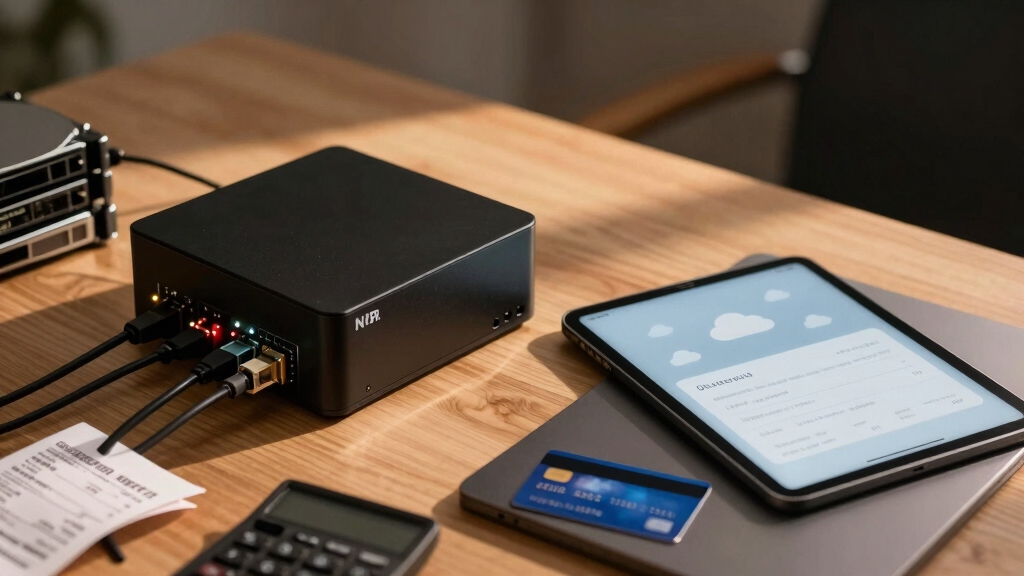
While NVR systems demand a significant upfront investment in dedicated recording hardware and storage drives, cloud solutions reduce your initial costs by eliminating physical equipment purchases.
NVR systems require hefty upfront hardware investment, whereas cloud solutions cut initial costs by removing equipment needs.
You’ll pay less initially with cloud storage, but ongoing monthly fees apply per camera, reflecting retention duration and data volume.
NVR’s capital expenditure is front-loaded; after installation, maintenance costs remain minimal without subscription fees.
Conversely, cloud’s operational expense model ties costs directly to retention flexibility and camera count, scaling expenses continuously.
If your priority is predictable total cost over extended retention, NVR offers financial stability.
However, if minimizing initial capital outlay is vital, cloud’s pay-as-you-grow pricing provides budgetary relief despite recurring charges.
Your choice hinges on balancing upfront investment against long-term operational expenditure and retention requirements.
Additionally, NVR systems benefit from scalable channel capacity, allowing easy expansion without major performance degradation.
Scalability Differences Between NVR and Cloud Systems
Because cloud systems rely on centralized infrastructure, they let you scale your camera network easily without adding physical hardware on-site. You can add cameras incrementally, and the cloud platform dynamically allocates storage and processing resources, avoiding physical limitations.
In contrast, NVR scalability depends on the capacity of local recorders and hard drives. Expanding an NVR system requires purchasing and installing additional hardware, increasing complexity and cost.
Furthermore, NVRs face finite drive capacities, limiting large deployments unless you invest in multiple recorders.
Cloud solutions also enable seamless scalability over time, ideal for growth plans spanning 24 months or more. Therefore, if you prioritize flexible, hassle-free expansion, cloud systems outperform NVRs, which are constrained by physical infrastructure and require proactive capacity planning for scalability.
Additionally, NVR systems primarily store and display video while relying on local storage, which contrasts with cloud storage’s scalability and flexibility, making NVR storage limitations a key factor in deployment decisions.
Managing Multiple Sites: NVR vs Cloud Solutions
Managing multiple sites becomes markedly more efficient when you use cloud solutions. They provide centralized remote access and eliminate the need for physical recorders at each location.
Centralized remote access with cloud solutions simplifies managing multiple sites without physical recorders.
With cloud platforms, you can monitor and manage all your sites through a single interface, simplifying configuration and maintenance.
Conversely, NVR systems require dedicated hardware at every site, increasing complexity and operational overhead. Each location demands local IT support for device upkeep and troubleshooting, complicating multi-site management.
Additionally, NVR scalability is constrained by physical storage limits, making expansion costly and logistically challenging. Cloud infrastructure scales seamlessly, allowing you to add cameras or sites without on-site hardware upgrades.
If you prioritize streamlined multi-site control with minimal physical infrastructure, cloud solutions offer a clear advantage over traditional NVR deployments.
However, it is important to consider that ongoing cloud storage costs may add $10–$100 monthly, impacting long-term expenses.
Reliability During Internet Outages: NVR vs Cloud
When it comes to reliability during internet outages, NVR systems really shine. They keep recording locally, so even if the internet goes down, you won’t lose any data on-site. That’s a huge plus, right?
On the other hand, cloud solutions rely on a stable internet connection. If there’s an outage, it can interrupt recording unless your cameras have some onboard buffering. So, while cloud options have their benefits, they can be a bit tricky in areas with spotty network access.
Getting to know these operational differences is super important. It helps you figure out which system will work best for your needs, especially if you’re in a place where the internet isn’t always reliable. Local storage often uses loop recording that continuously overwrites the oldest footage, ensuring ongoing recording without internet dependence.
Local Recording Continuity
Ensuring continuous local recording during internet outages is critical for maintaining reliable surveillance. With an NVR system, your footage is stored directly on-site, so recording persists uninterrupted regardless of internet availability.
This local storage architecture means you won’t lose critical data during connectivity lapses, supporting forensic integrity. In contrast, cloud solutions rely heavily on stable internet connections; if connectivity drops, recording usually halts unless your cameras feature onboard buffering.
However, buffering provides limited short-term coverage and depends on camera hardware capabilities. Consequently, if uninterrupted local recording continuity is a priority, NVRs offer a more robust and fail-safe solution.
Cloud systems require careful assessment of buffering capacity and network reliability to mitigate recording gaps during outages, but they inherently lack the guaranteed persistence that local NVR storage delivers.
Choosing the right system also involves considering DVR/NVR setup and testing to ensure seamless operation and recording reliability.
Cloud Dependency Challenges
Although cloud video surveillance offers many operational advantages, its reliance on a stable internet connection introduces significant challenges for maintaining uninterrupted recording. When your internet goes down, cloud cameras without onboard buffering stop recording immediately, creating critical gaps in footage.
In contrast, NVR systems record locally, ensuring continuous data capture regardless of network status. Cloud reliability demands consistent upload bandwidth, which you must verify before deployment to avoid service interruptions. If your site experiences frequent outages or bandwidth fluctuations, cloud dependency can compromise security monitoring.
While some cloud cameras include limited buffer storage, it often isn’t sufficient for extended offline periods. Thus, if uninterrupted recording during internet outages is essential, relying solely on cloud-based surveillance can expose you to operational risks that traditional NVRs inherently mitigate through local storage. Additionally, bandwidth requirements for cloud streaming can be substantial, especially at higher resolutions, making consistent connectivity even more critical.
Video Footage Ownership: NVR or Cloud?
When deciding between NVR and cloud storage, understanding footage ownership is essential. It directly affects your control over recorded data.
With an NVR system, you retain absolute ownership since video files reside on physical drives within your premises. This grants you full access and control. You can export footage anytime for legal or insurance purposes without relying on third parties.
In contrast, cloud storage ties ownership contractually to your active subscription. If your subscription lapses, access to archived footage ends immediately. The provider can alter terms or delete data without your consent.
This shifts physical control to the service provider, limiting your autonomy over footage retention. Therefore, NVR offers definitive ownership and control, while cloud solutions involve conditional access governed by provider policies.
Additionally, just as Kidde alarms provide UL and CSA certifications to ensure reliable performance and consumer confidence, choosing a storage solution with verified standards can enhance your data security and trustworthiness.
Cybersecurity and Data Protection: NVR vs Cloud
Since cybersecurity threats continue to evolve, choosing between NVR and cloud systems requires careful evaluation of their data protection capabilities.
Cloud platforms inherently offer off-site protection, encrypting data during transmission and storing footage in secure remote data centers. This reduces risks of physical tampering or damage.
They also eliminate bulky hardware vulnerabilities by removing on-site recorders. Conversely, NVR systems store footage locally, relying heavily on your IT team to enforce strict access controls and maintain server security.
NVRs have no inherent off-site backup unless you implement external strategies. While NVRs provide full control over hardware, they expose you to risks from physical breaches and hardware failure.
Ultimately, cloud solutions deliver stronger cybersecurity frameworks by design. You must weigh the trade-offs between physical control and advanced off-site data protection.
Additionally, employing encryption protocols during data transmission and storage is crucial to maintaining footage integrity and privacy in both NVR and cloud environments.
Feature Sets: Traditional NVR vs Advanced Cloud Capabilities
Beyond cybersecurity, evaluating the feature sets of NVR and cloud systems reveals distinct strengths aligned with different operational priorities.
Traditional NVRs excel in local, high-capacity storage, offering straightforward recording without reliance on internet connectivity. However, their feature sets remain limited to hardware capabilities. They lack integrated AI or real-time analytics unless paired with external platforms.
In contrast, cloud systems provide advanced, built-in functionalities such as AI-driven detection and continuous software updates. This enhances operational efficiency and threat responsiveness.
Cloud platforms also enable seamless scalability and centralized multi-site management, features that NVRs struggle to match due to hardware constraints.
If you prioritize cutting-edge analytics and flexible expansion, cloud capabilities outpace NVRs. However, if your focus is robust local storage without dependence on connectivity, NVRs still serve effectively.
Many modern NVR systems, like those from Reolink, support processing video at the camera for higher-resolution recording with less load on the recorder, bridging some gaps between traditional and cloud capabilities.
Future-Proofing Surveillance: Advantages of Cloud Systems
Although traditional NVR systems provide reliable local storage, cloud surveillance platforms offer superior future-proofing by continuously integrating advanced technologies like AI and machine learning.
You benefit from automatic software updates that enhance detection accuracy and operational efficiency without hardware upgrades.
Cloud platforms enable seamless scalability and centralized multi-site management, removing physical constraints.
Their encrypted transmission and off-site storage markedly improve cybersecurity and resilience against onsite damage.
Key advantages include:
- Continuous AI-driven feature enhancements via cloud updates
- Effortless scalability with no physical hardware limits
- Centralized management for multi-site deployments
- Robust cybersecurity with encrypted, off-site data protection
Additionally, cloud systems often employ encrypted transmission protocols such as AES-128 or AES-256 to ensure secure data transfer and storage.
How to Choose Between NVR and Cloud for Your Needs?
When deciding between NVR and cloud solutions, it’s important to think about the upfront costs versus ongoing fees, especially if you’re working with a tight budget. You’ll want to consider how your surveillance needs might grow if you plan to expand across multiple locations. Do you need centralized management, or is local control more important for you?
Also, don’t overlook the significance of data ownership and security. With NVR, you have physical control over your data, while cloud solutions offer off-site protection and robust cyber defenses. Take the time to weigh these factors carefully to find the best fit for your needs!
Cost And Budget Considerations
When deciding between NVR and cloud surveillance systems, understanding the cost structure is essential to aligning your budget with operational needs.
NVR demands higher upfront capital for hardware acquisition, including recorders and storage drives. In contrast, cloud solutions lower initial expenses but require ongoing monthly fees per camera. Your choice hinges on evaluating long-term versus immediate financial impact.
- NVR systems incur significant initial costs but minimal ongoing fees, ideal for extended retention needs.
- Cloud services offer flexible retention tied to subscription pricing, with predictable monthly charges.
- Maintenance costs for NVR remain low post-installation; cloud requires continuous payments.
- Budget constraints favor cloud if hardware investment is limited; NVR suits stable budgets seeking cost predictability.
Analyze these points to select the most advantageous system for your financial strategy.
Scalability And Site Management
Many organizations face challenges scaling surveillance systems and managing multiple sites efficiently. When you choose NVR, scalability is limited by physical storage. Expanding means installing more recorders at each site, increasing costs and local IT demands.
Multi-site oversight grows complex, requiring on-site management for every location. In contrast, cloud platforms offer near-limitless scalability. You can add cameras centrally without new hardware. Remote access lets you monitor all sites from one interface, simplifying administration and reducing IT overhead.
If you plan to expand your camera count over two years or manage numerous locations, cloud systems provide seamless scaling and centralized control. However, if your deployment is small or fixed, the complexity and cost of cloud management may outweigh benefits. Your choice hinges on how much you prioritize flexible growth and operational efficiency.
Data Control And Security
Data ownership and security remain critical factors in selecting between NVR and cloud-based surveillance systems. When you opt for an NVR, you retain absolute control since footage physically resides onsite.
This allows unrestricted export and evidence handling.
Cloud solutions, however, store data remotely. Your access is tied to subscription status and subject to provider policies.
Consider these points:
- NVR footage is fully controlled locally; cloud footage depends on active contracts.
- Cloud providers enforce encryption and off-site backups, enhancing cybersecurity.
- NVR systems require robust local IT security and lack inherent off-site protection.
- Cloud archives risk deletion or access loss if subscriptions lapse or terms change.
Your choice hinges on prioritizing physical control versus scalable, secure off-site storage and management.
Frequently Asked Questions
What Are the Typical Installation Times for NVR Versus Cloud Systems?
You’ll typically spend more time installing an NVR system because it involves setting up physical recorders, hard drives, and local networking.
Cloud setups are generally quicker since you mainly configure cameras and connect them to the internet, avoiding on-site hardware installation.
However, cloud systems require verifying upload bandwidth and potentially configuring remote management.
Can NVR and Cloud Systems Be Integrated for Hybrid Surveillance Solutions?
Yes, you can integrate NVR and cloud systems to create hybrid surveillance solutions.
This approach lets you leverage local recording reliability while benefiting from cloud scalability and off-site backup.
You’ll manage data locally for immediate access and use cloud platforms for centralized multi-site monitoring and AI analytics.
Hybrid setups require careful network configuration and compatibility checks but can optimize cost, redundancy, and feature flexibility across your surveillance infrastructure.
How Do Environmental Conditions Affect NVR and Cloud Camera Hardware?
Environmental conditions impact your camera hardware’s durability and performance markedly. Both NVR and cloud cameras must withstand temperature extremes, humidity, dust, and vandalism risks.
You’ll need weatherproof, IP-rated enclosures for outdoor installations to protect sensors and electronics. Harsh environments can shorten hardware lifespan or cause signal degradation.
Regular maintenance and choosing ruggedized models are vital to guarantee consistent video quality and system reliability regardless of environmental stressors.
What Are the Noise Levels of NVR Recording Appliances During Operation?
Picture a quiet hum that’s constant but unobtrusive. That’s the typical noise level of NVR recording appliances during operation.
You’ll hear the subtle whirring of hard drives and cooling fans, which generally produce noise around 30-40 decibels. This is comparable to a quiet office.
If you place the appliance in a dedicated equipment room, the noise won’t disturb you. However, in small or silent environments, the persistent sound could be noticeable and might require soundproofing measures.
Are There Specific Compliance Requirements Unique to NVR or Cloud Surveillance?
You’ll find that compliance requirements often depend on data control and retention policies.
With NVRs, you must make certain physical security and local data handling meet regulations, since footage stays on-site.
Cloud surveillance demands strict adherence to data privacy laws, encryption standards, and contractual obligations due to third-party storage.
You’ll also need to verify that cloud providers comply with industry-specific certifications, such as GDPR or HIPAA, to satisfy regulatory frameworks.
Secure Your Footage With the Right Choice
Choosing between NVR and cloud surveillance is like selecting between a sturdy, self-reliant lighthouse and a dynamic, far-reaching satellite network.
The lighthouse (NVR) offers control and reliability in isolation, while the satellite (cloud) provides expansive coverage and adaptability, dependent on connectivity.
Your decision hinges on balancing immediate control with scalable innovation.
By weighing costs, security, and future needs, you’ll navigate to the system that best secures your digital horizon.